Orhan Gazi Mosque: An Early Ottoman Religious Complex in Bursa


Site at a Glance
- Rating
- 4.8
- Popularity
- Medium
- Country
- Turkey
- Primary era
- Medieval
- Eras represented
- Medieval, Early Modern
- Civilizations
- Ottoman
- Site type
- Religious
- Remains
- Mosque
On this page11 sections
History
Orhan Gazi Mosque in Türkiye was founded and commissioned by the Ottoman ruler Orhan Gazi in Bursa in 1339–1340. Built as part of a larger religious and charitable complex, it is among the oldest surviving monuments commissioned by the Ottoman dynasty. The mosque originally served Sufi dervishes, combining a place of worship with accommodation, meeting areas, and spaces for religious ceremonies.
Foundation and Religious Use
The mosque belonged to an Ottoman külliye, a religious and charitable complex centered on a mosque and supported by institutions such as schools, baths, soup kitchens, and commercial buildings. A surviving Arabic inscription above the entrance gives the mosque’s date as 1339–1340. The oldest surviving waqf document associated with the building dates to 1360. A waqf was a charitable endowment that supported religious, educational, social, or commercial institutions.
An addition made around 1400 describes the mosque as a zaviye, a Sufi religious establishment that could provide lodging, gathering space, and facilities for devotional practice. This description reflects the building’s early role as more than a congregational mosque. It formed part of a setting where dervishes could live, meet, and conduct rituals.
Fire, Repair, and Later Restoration
During the siege of Bursa in 1413 by Mehmed II of Karaman, a fire damaged the mosque and destroyed its front facade and portico. Sultan Mehmed I ordered repairs in 1417 and entrusted the work to his grand vizier, Bayezid Pasha. The dome above the prayer niche may belong to this early fifteenth-century rebuilding phase.
A major earthquake struck Bursa in 1855 and damaged the mosque. Restoration followed in 1863–1864 under the French architect Léon Parvillée. The brightly painted decoration inside the prayer niche carries an inscription dated 1864. The minaret’s conical lead covering was renewed in 1899, and another restoration took place in 1904. Most of the walls are thought to be original, while the upper walls and much of the remaining roof are likely reconstructions. The extent to which other original material survived Parvillée’s restoration remains uncertain.
The Charitable Complex
Orhan Gazi Mosque formed part of a wider complex that included religious, educational, charitable, and commercial institutions. The mosque, Emir Han, and the hammam are the surviving structures associated with it. The mektep, or primary school, was destroyed in the 1855 earthquake. The madrasa once stood on the site later occupied by Bursa’s nineteenth-century town hall, while the imaret, or soup kitchen, remained nearby as late as 1907 before disappearing.
Emir Han was constructed to generate income for the charitable complex. Fires damaged it in 1544, 1788, and 1958. It was repaired in 1634, suffered earthquake damage in 1674 and 1855, and was restored in 1963. The hammam, originally a double bathhouse, was converted into a shopping complex after the 1958 bazaar fire and is now known as Aynalı Çarşı, or the Mirrored Bazaar.
Orhan Gazi Mosque is included within the UNESCO World Heritage site in Bursa, linking the surviving building and its associated structures to the wider historical landscape of the city.
Remains
The surviving complex combines an early Ottoman mosque with a revenue-producing caravanserai and a converted bathhouse in Bursa’s bazaar district. The mosque uses an inverted T-plan, while Emir Han and the hammam retain the basic forms of their original commercial and social functions, despite later repairs and alterations.
Orhan Gazi Mosque
Plan and Interior
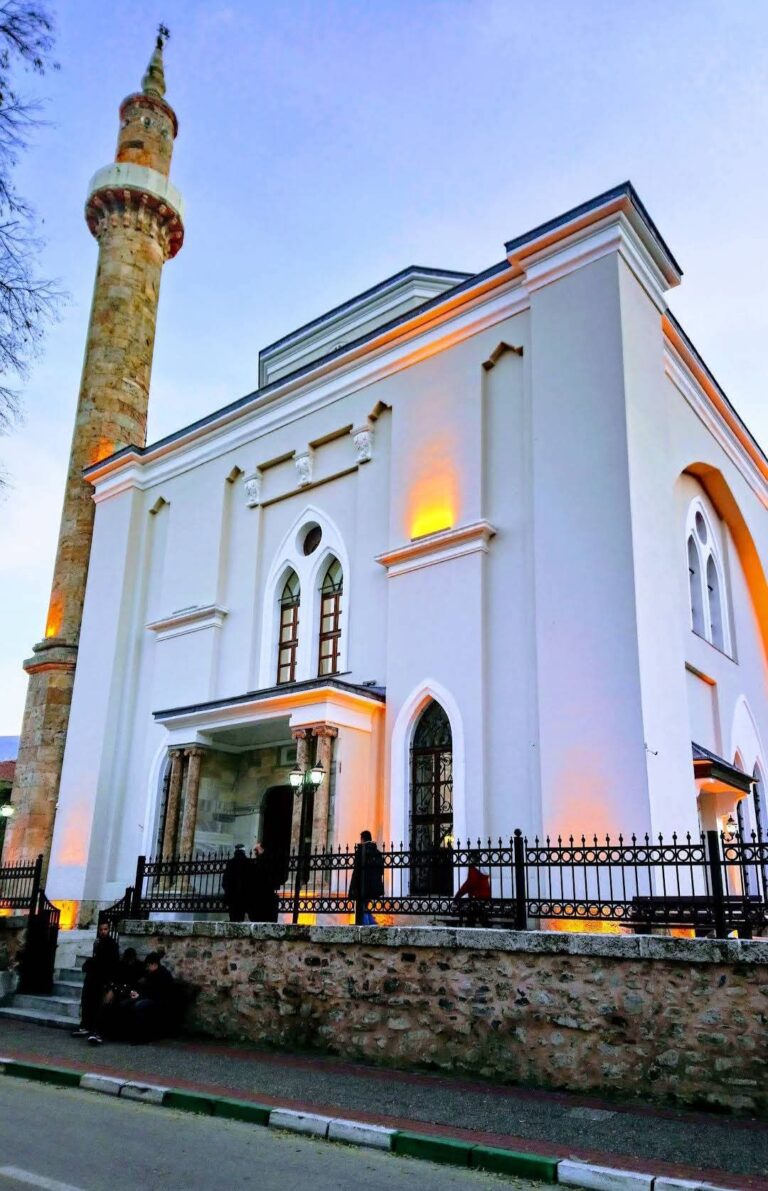
The mosque’s inverted T-plan is associated with early Ottoman religious complexes in Bursa and elsewhere. A square central court is covered by a dome and surrounded by three domed iwans, vaulted or domed halls open on one side. One iwan extends from each side except the north, where the entrance is located. The southern iwan is aligned with the qibla, the direction of prayer, and contains the mihrab, the prayer niche that marks this direction.
The mihrab has brightly colored painted decoration, with an inscription dating the present interior decoration to 1864. A domed portico stands before the entrance. The mosque is principally built of brick, with brick and tile among its recorded construction materials. A bifora, or two-light window divided by a central column, includes a Corinthian column whose ornate capital is traditionally decorated with acanthus leaves.
Minaret and Building Fabric
One minaret survives. It dates from the seventeenth century and was built over the base of an earlier minaret. Its conical lead covering was renewed in 1899. The mosque’s brick construction and some decorative details have been compared with Byzantine architecture rather than with the stone-built tradition associated with Anatolian Seljuk architecture. The possibility has been proposed that the same building groups constructed both Byzantine churches and Ottoman mosques in the region during Orhan Gazi’s period.
Associated Complex Buildings
Emir Han
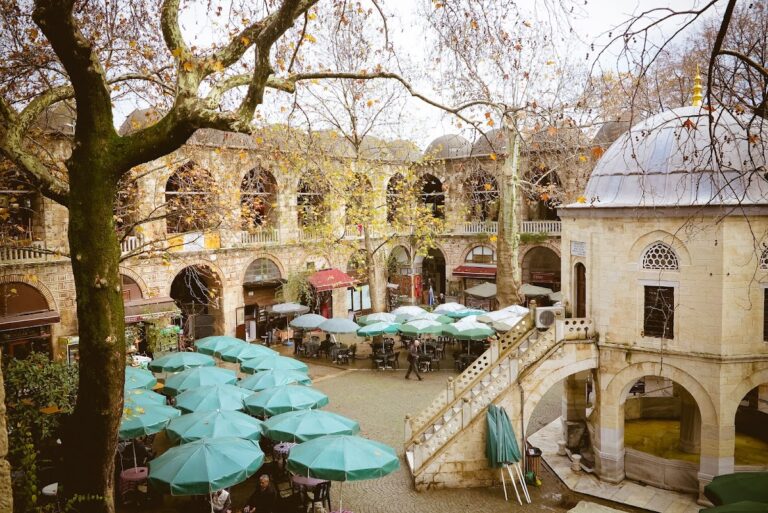
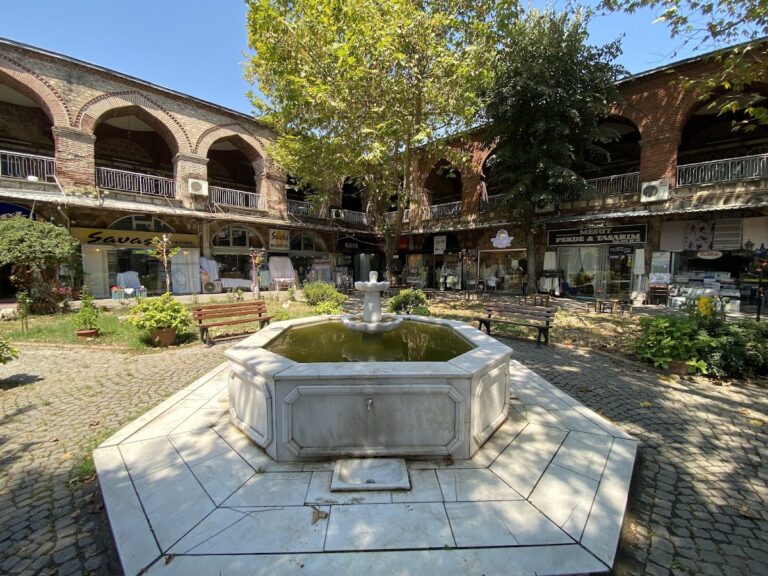
Emir Han remains within Bursa’s bazaar district. It follows a typical Ottoman caravanserai plan, with a large central courtyard surrounded by a two-story gallery. Rooms stand behind the gallery, and the complex is covered by barrel vaults. Its construction provided revenue for Orhan Gazi’s charitable foundation. Repeated fires, earthquakes, repairs, and the restoration of 1963 shaped the building that survives today.
Aynalı Çarşı
The former hammam was a double bathhouse with separate men’s and women’s sections arranged side by side. The men’s section contained a cold room, a warm room with attached latrines, a hot room with adjoining private rooms, and a furnace area. The women’s section followed the same sequence on a smaller scale. Conversion into Aynalı Çarşı added two entrances and removed original elements, including the furnace.
Nearby sites