Sitti Hatun Mosque: An Early Ottoman Place of Worship in Bursa


Site at a Glance
- Rating
- 4.8
- Popularity
- Very Low
- Country
- Turkey
- Primary era
- Medieval
- Eras represented
- Medieval
- Civilizations
- Ottoman
- Site type
- Religious
- Remains
- Mosque
On this page8 sections
History
Sitti Hatun Mosque, also known as Kamberler Mosque, is an early Ottoman place of worship built in Bursa, Türkiye, in 1459. It belongs to the formative period of the Ottoman state, when Bursa remained an important political and religious centre around the reign of Mehmed II, also known as Mehmed the Conqueror.
Foundation and Patronage
The mosque was commissioned by Sittî Nefise Hatun, daughter of Oruç Bey. He was a statesman and commander, the son of Kara Timurtaş Pasha, who is regarded as one of the Ottoman Empire’s first viziers. Sittî Hatun was also the wife of Zağanos Pasha, a senior statesman during Mehmed II’s reign.
The building’s date and patronage appear in the calligraphic inscription above the entrance. The same inscription records Sittî Hatun’s endowment of three underground water channels and three barrels or jars for the benefit of Muslims. The endowment specified that the containers were not to be filled and that the water was not to be used. Three channels found around the mosque during repairs in 1956 corresponded to this unusual provision.
Earthquake, Renaming, and Restoration
The mosque’s minaret was rebuilt after the Bursa earthquake of 1855. The Bursa Association of Friends of Ancient Monuments restored the building in 1956, and the General Directorate of Foundations carried out further repairs in 2008.
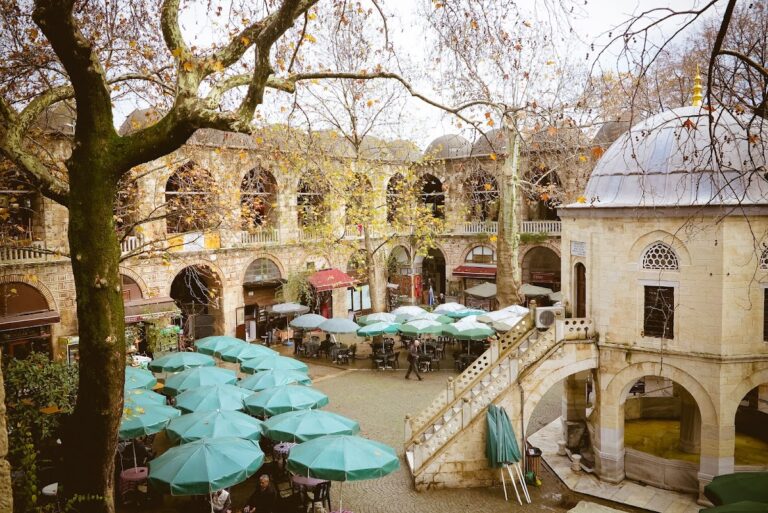
In 2012, the mosque was restored together with the fifteenth-century Hatice Sultan Prayer Hall after urban redevelopment converted the surrounding area into a park. The building remains associated with the Kamberler neighborhood, which was renamed Ebu Ishak in 2007. It stands in Kamberler Park, above the Panorama 1326 Bursa Conquest Museum and below Dayıoğlu Bath.
Remains
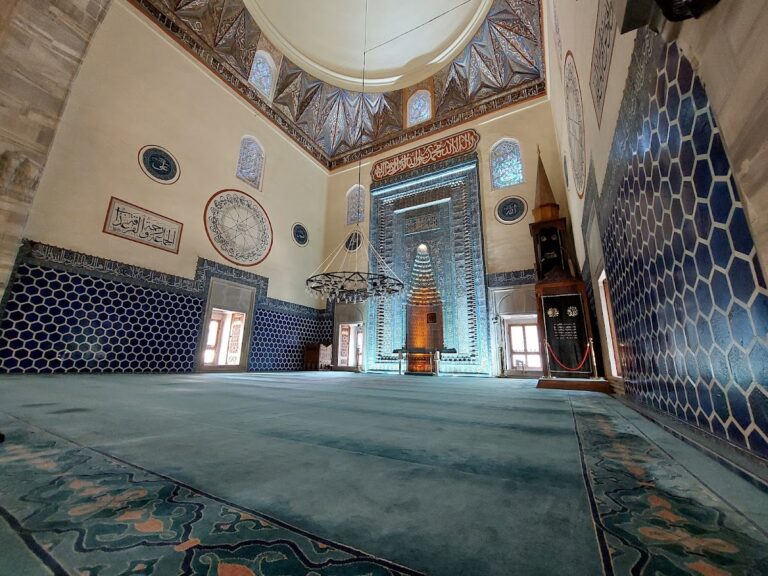
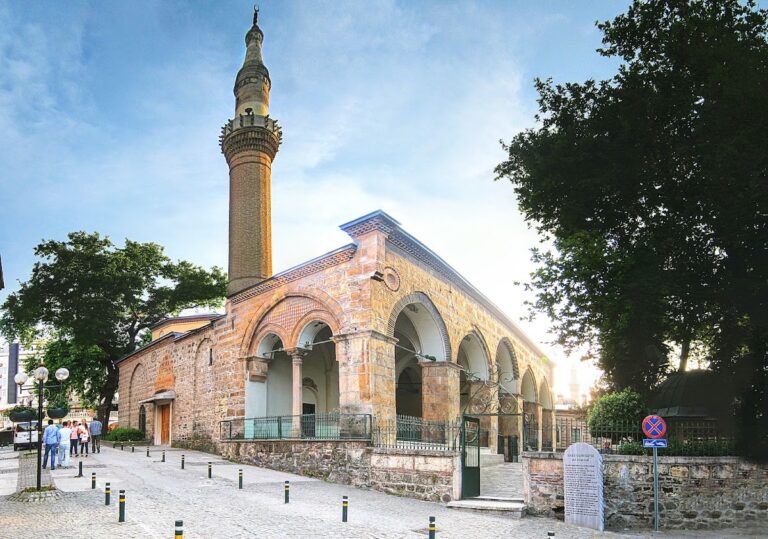
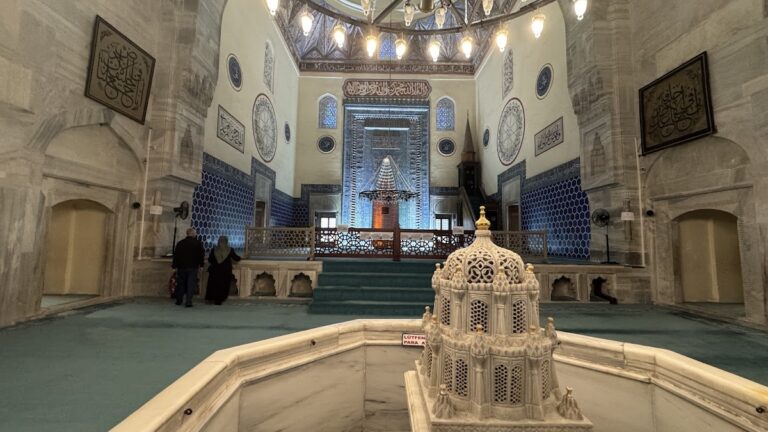
Sitti Hatun Mosque is a Bursa-type building with a rectangular plan. Its main prayer space measures 9 by 9 metres and is joined to a three-section last-congregation porch, the covered entrance area where worshippers gather before entering the prayer hall. The mosque, its adjacent school, and the fountain in front form the principal surviving elements described at the site.
Prayer Hall and Entrance
The entrance façade rises above the main roofline as a gabled shield wall, a tall projecting façade associated with Bursa mosques. It contains three arched openings. The central pointed arch leads into the three-bay porch, with a second lobed arch beneath it. Zigzag brickwork decorates the upper façade.
The prayer space is covered by a lead-clad dome resting on a band with a diamond pattern. Its walls use alternating courses of two rows of brick and two rows of rubble stone, made from irregular stones set in masonry. A single minaret occupies the northwest corner of the prayer space. It has a brick shaft and a short conical cap. The entrance inscription is written in thuluth, a large, flowing calligraphic style used for monumental religious texts.
Adjacent Buildings and Water Features
Kamberler School
An elementary school was built beside the mosque at the same time. Known as Kamberler School, it is described as the only surviving elementary school from the reign of Mehmed II. In 1956, the Bursa Association of Friends of Ancient Monuments purchased the school from its private owner, Imam Hafız Mehmed Özkurşuncu of Molla Fenari, and transferred it to the General Directorate of Foundations. The building is identified as a Roma Cultural Centre.
Fountain and Water Channels
A fountain in front of the mosque was uncovered during the 2008 landscaping of Kamberler Park. Its walls are built of brick and stone, while its basin is made of stone. The three underground water channels identified during the 1956 repairs provide a physical counterpart to the water endowment described in the entrance inscription.