Catacombs of Domitilla: An Early Christian Cemetery in Rome


Site at a Glance
- Rating
- 4.6
- Popularity
- Medium
- Country
- Italy
- Primary era
- Classical
- External website
- Open
- Eras represented
- Classical
- Civilizations
- Roman
- Site type
- Burial
- Remains
- Catacomb
On this page18 sections
History
The Catacombs of Domitilla are a Roman underground cemetery in Rome, Italy, developed on property associated with the Flavian imperial family during the late first century and expanded as an early Christian necropolis from the late second century onward. The site grew outside the ancient city walls, where Roman law required burials and cremations to take place. Its extensive galleries, painted tombs, and underground basilica preserve the changing relationship between family, imperial, communal, and Christian burial in ancient Rome.
Flavian Property and Early Burials
During the last third of the first century, members of the Flavian family owned the property. The Flavian dynasty was founded by Vespasian and continued by his sons Titus and Domitian. After about AD 95, the land became associated with Flavia Domitilla, who is identified either as the wife of Titus Flavius Clemens, a Roman consul and member of the imperial family, or as his niece, the Christian Flavia Domitilla.
Two inscriptions from the cemetery refer to burial concessions granted through Flavia Domitilla’s generosity. The later name of the catacombs derives from her association with the property. Early medieval guides and religious traditions continued to connect her memory with the Christian burials established there.
The first burials took place on the surface rather than in underground galleries. Christian tradition places Saint Petronilla’s burial there before AD 95, followed by the burial of the martyrs Nereus and Achilleus beside her tomb around AD 96. Nereus and Achilleus are associated with the cemetery and its later basilica. One nearby inscription describes them as soldiers, while Christian traditions call them chamberlains of Flavia Domitilla. Other people connected with the Flavian family were also buried on the property, including individuals who were not specifically Christian.
Formation of the Underground Cemetery
The first Christian hypogea, or underground burial chambers and complexes, were probably cut from the late second century, especially during the early third century. This development followed about a century of surface burial. At least one burial nucleus, the Flavi Aureli A, began as a Christian communal hypogeum. During the second and third centuries, separate burial clusters expanded and eventually joined to form a large underground complex.
The Flavian hypogeum probably dates from the middle or later second century. It served burials linked with the Arria and Aurelia families and with people attached to the household of Emperor Antoninus Pius, who ruled from AD 138 to 161. Despite its traditional name, the chamber may not have been used solely by members of the Flavian family. The wider cemetery preserves both Christian and non-Christian burial, reflecting its growth from several distinct family, imperial, and communal areas.
Expansion continued during the fourth century, when new underground regions and the basilica were constructed. A basilica dedicated to Nereus and Achilleus was added at the end of that century, traditionally during the pontificate of Pope Damasus, the bishop of Rome in the later fourth century. The monument may have developed through three structural phases, including an earlier crypt from the fourth century.
Pilgrimage, Closure, and Rediscovery
Funerary activity ended in the fifth century, but the basilica continued as a pilgrimage sanctuary associated with the tombs of Nereus and Achilleus. The cult of Petronilla was also connected with the underground basilica. In November 1965, shortly before the close of the Second Vatican Council, the Pact of the Catacombs was signed at the site.
In 755, Lombard forces devastated cemeteries and basilicas around Rome during their siege of the city. Pope Paul I subsequently transferred important relics to safer places. Petronilla’s sarcophagus was moved in 757 to a mausoleum built for her at the Vatican, although the sarcophagus is now lost.
Pope Leo III closed the basilica between 795 and 816 because it was regularly flooded. Its liturgical furnishings were removed, its use was abandoned, and its title and the relics of Nereus and Achilleus were transferred to the church now called Santi Nereo e Achilleo.
The catacombs were later forgotten and rediscovered at the end of the sixteenth century, when Antonio Bosio investigated them in 1593. Giovanni Battista De Rossi carried out the principal systematic archaeological investigations during the second half of the nineteenth century and uncovered the semi-underground basilica in the 1870s. A major part of the catacombs was restored in 1870. Surveys directed by N. Zimmermann between 2006 and 2009 supported a partial three-dimensional reconstruction of the complex. Since January 2009, the Society of the Divine Word, a Catholic missionary congregation, has been entrusted with the care of the catacombs. The basilica and burial chambers continue to be used for Eucharistic celebrations, services, and ecumenical liturgies.
Remains
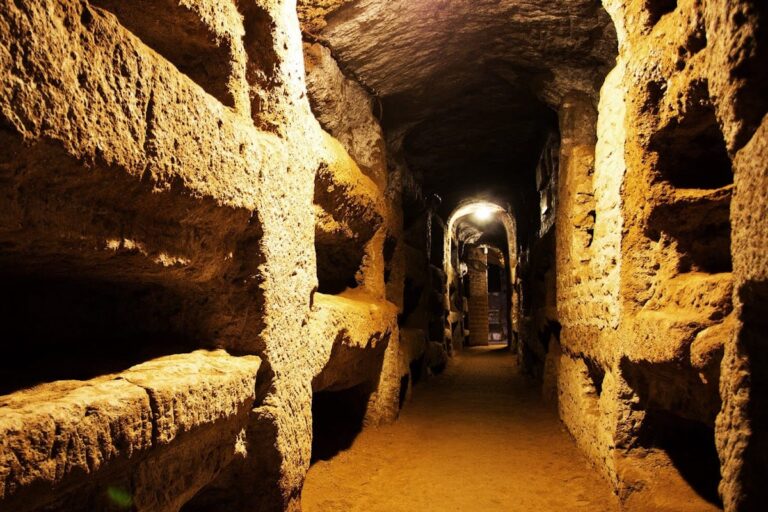
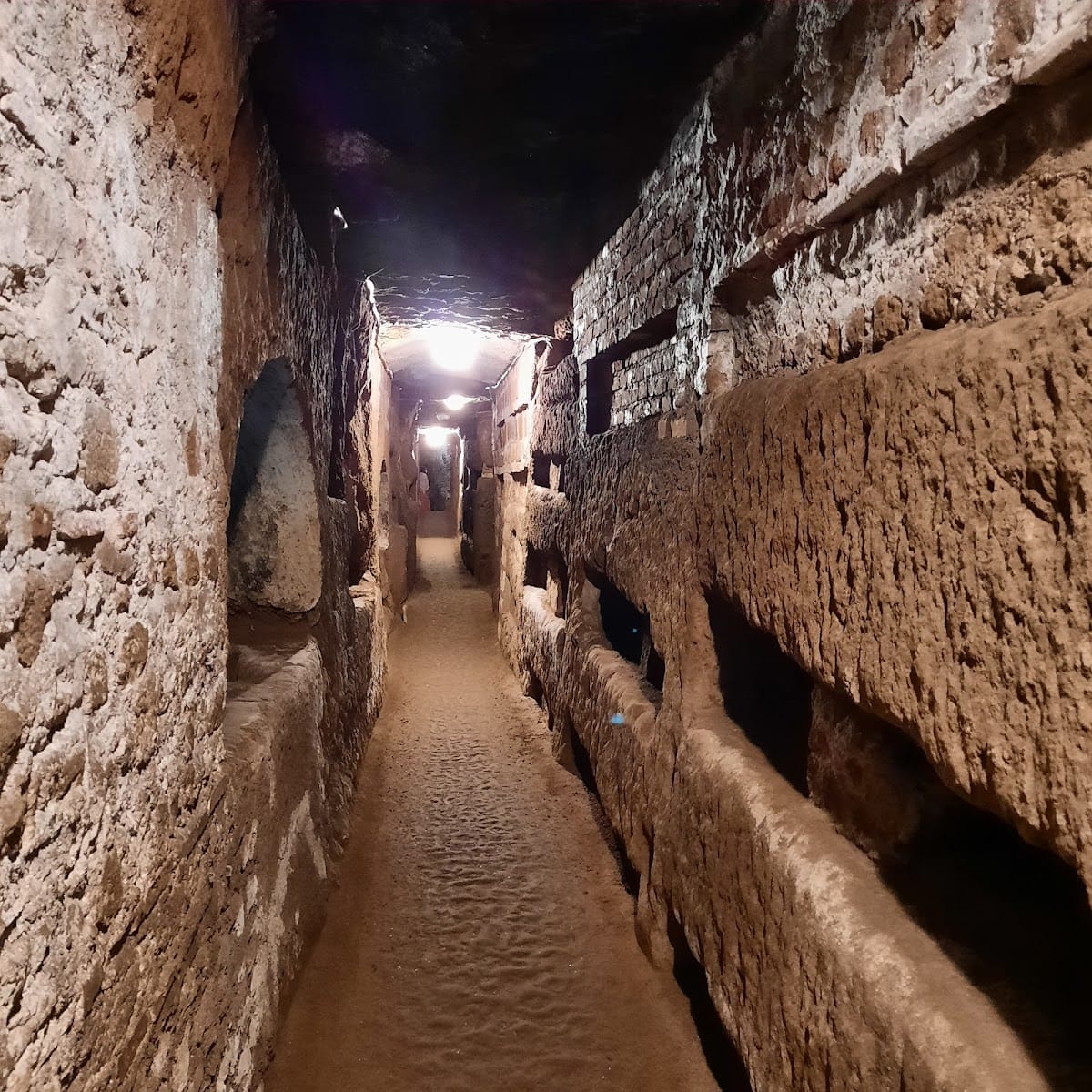
The Catacombs of Domitilla form a large man-made cemetery along the ancient Via Ardeatina, near the Catacombs of Callixtus. The galleries extend through four levels and were cut into soft, porous volcanic tufa, a stone that could be excavated for underground passages and chambers. The complex contains approximately 15,000 burials, and its gallery network extends for several kilometres. Three principal early regions, later joined by two fourth-century areas to the south and southwest, preserve family chambers, communal burial spaces, martyr shrines, and richly decorated hypogea.
Early Burial Regions
Cubiculum of Ampliato
The Cubiculum of Ampliato belonged to a family of imperial freedmen who excavated the hypogeum. A supporting arch divides its large interior into two sections. The decoration was applied in successive layers as different members of the family were buried there, preserving the chamber’s continuing use over time.
Flavi Aureli Area
The Flavi Aureli area contains a double burial chamber, an inscription mentioning “Happy Annio,” and intact tombs. Its entrance staircase was later destroyed when the basilica was built, linking the physical history of this early burial region to the transformation of the cemetery during the fourth century.
Southern and Southwestern Regions
The southern region includes a crypt with six saints placed in polygonal cubicula, or burial chambers with many-sided plans. One of these chambers carries a fresco of a coronation scene. To the southwest, regular galleries lead to the Cubiculum of the Great Apostles, another decorated burial space within the expanding fourth-century network.
Flavian Hypogeum
The Flavian hypogeum is a large gallery approximately 20 metres long and 2.5 metres wide, dating from around the second century. Four niches held sarcophagi belonging to important family members. Its vaults and walls are covered with delicate paintings that combine geometric patterns, pagan imagery, and subjects drawn from the Bible.
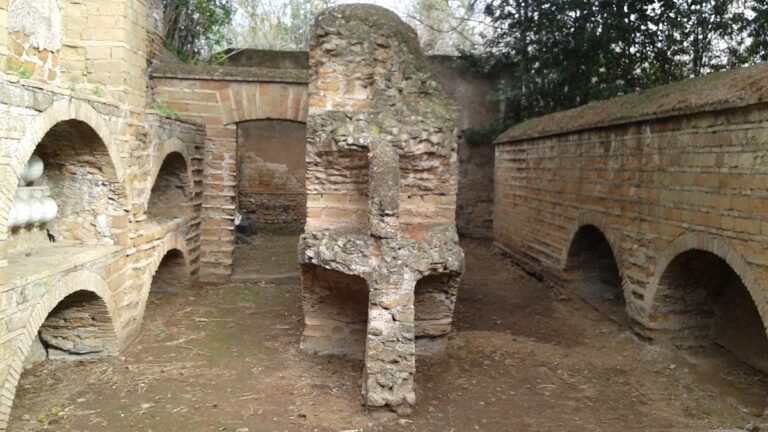
A monumental brick porch with terracotta ornaments gave access to the gallery. Rooms for funerary banquets were later added beside the entrance. They contained benches and a fountain, while a caretaker’s lodging stood above them. These additions preserve the changing practical and social uses associated with burial in the hypogeum.
Basilica of Nereus and Achilleus
Church and Crypt
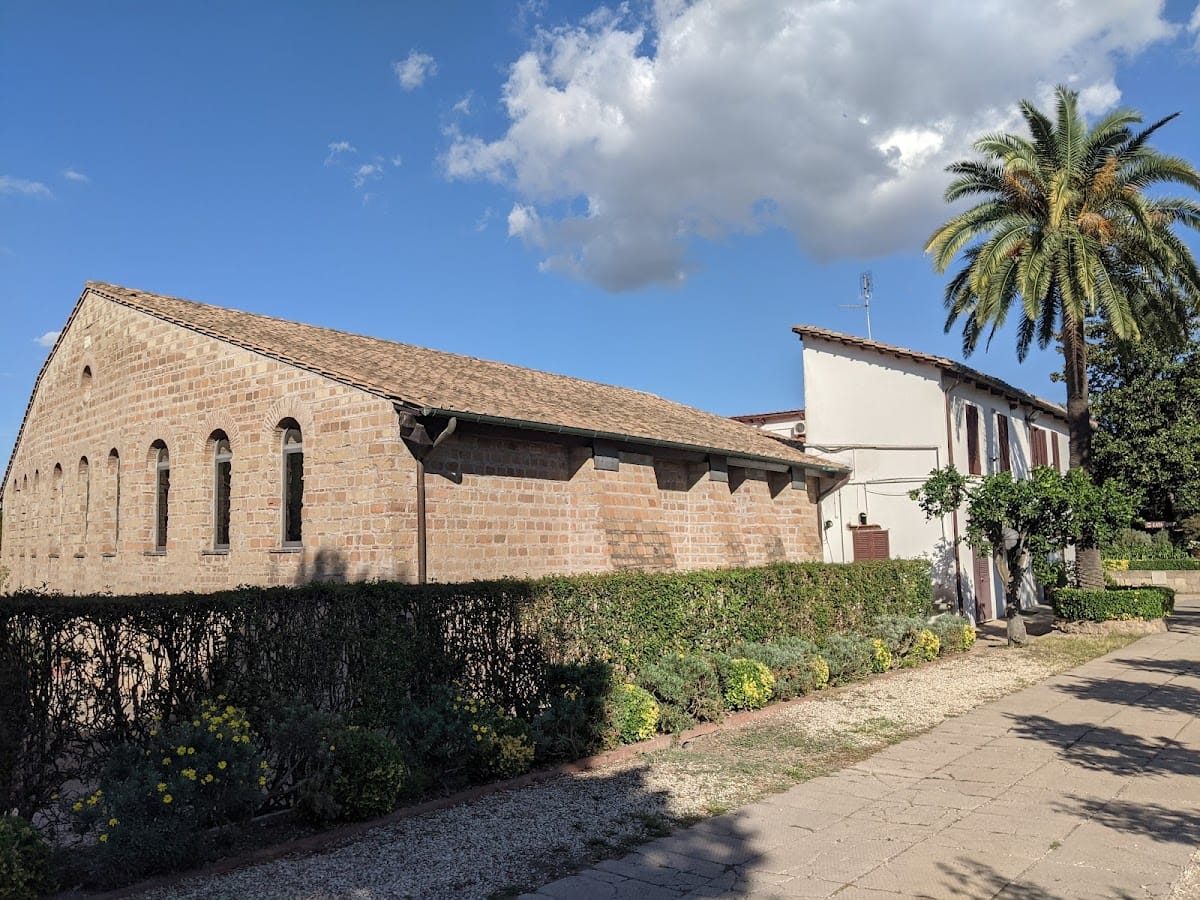
The late-fourth-century basilica of Nereus and Achilleus is semi-underground. It consists of a narthex, or entrance hall, three naves, an apse, and two rows of four columns. The building is also called the Basilica of Petronilla or the Basilica of Petronilla, Nereus, and Achilleus. It developed from a sanctuary around the crypt of Nereus and Achilleus. Walls at its northeast corner belong to a primitive crypt from the first half of the fourth century.
Altar and Petronilla Chamber
Only one column from the principal altar survives. Its relief shows the beheading of Achilleus, while a broken second column probably bore the name of Nereus. Behind the altar, a cubiculum contains an arcosolium, an arched recess enclosing a tomb, with a fresco of Petronilla leading the deceased Veneranda toward paradise.
A fourth-century inscription in the basilica confirms Petronilla’s name and shows her receiving Veneranda in heaven. Her funerary inscription is recorded as “Aureliae Petronillae Filiae Dulcissimae,” meaning “To Aurelia Petronilla, the sweetest daughter.”
Painted Tombs and Religious Imagery
Approximately 80 painted tombs survive in the catacombs, forming one of the largest collections of decorated catacomb burials. Important spaces include the Cubiculum of Veneranda, the Arcosolium of the Little Apostles, and the Cubiculum of the gravedigger Diogenes. Their paintings include Jesus with the apostles, Noah’s Ark, Daniel among the lions, the Virgin and Child, Adam and Eve, Jonah, the Good Shepherd, Peter and Paul, the multiplication of the loaves, water from the rock, and the binding of Isaac.
Baker’s Cubiculum
The late-fourth-century baker’s cubiculum may have belonged to a baker or to a senior official responsible for food supplies. Its corridor has a coffered ceiling, while four arcosolia carry opus sectile panels, a technique using cut pieces fitted into images or patterns. The panels depict episodes from the story of Jonah.
The chamber’s other imagery includes a figure standing behind a large grain container and a continuous scene showing wheat arriving at the harbor of Ostia, sacks being transported, and supplies distributed through Rome. The decoration connects the tomb’s funerary setting with the work of supplying food to the capital.
Christian and Seasonal Scenes
The western sector contains a pastoral scene with a shepherd and four sheep, together with personifications of the seasons. In the eastern sector, Christ sits enthroned between two groups of apostles, with Peter and Paul in the foreground. Other paintings show praying women in the orans pose, with their arms raised, Christ enthroned with the apostles, and Christ with the twelve apostles.
A second-century fresco depicts the Last Supper. Other scenes include Mary and Jesus in the Adoration of the Magi, the Good Shepherd with his flock, a shepherd playing panpipes, and a praying woman. A funerary feast with bread and fish has been interpreted as an image of the Eucharist, the central Christian rite commemorating Jesus’s Last Supper.
Orpheus and Earlier Imagery
Pagan and mythological decoration includes Orpheus surrounded by birds, wild animals, and sheep. In Greek mythology, Orpheus was celebrated for music that could charm animals. His presence in early Christian art allowed an older pagan image to be understood in relation to the taming of human passions and the hope of salvation. The mixture of pagan and Christian themes reflects the visual transition within the cemetery.
Conservation of the Frescoes
A seven-year restoration project exposed two frescoes that had been obscured by deposits. Laser treatment removed chalky accumulations, algae, and smoke residue from oil lamps, revealing images of Old and New Testament figures. The paintings were probably commissioned about 1,600 years ago. Twelve of approximately 70 rooms had been restored in the documented program, bringing both pagan and Christian frescoes into clearer view and preserving evidence of the cemetery’s changing religious decoration.