Schwerin Castle: A Princely Residence on Lake Schwerin
Site at a Glance
- Rating
- 4.7
- Popularity
- Very High
- Country
- Germany
- Primary era
- Modern
- External website
- Open
- Eras represented
- Medieval, Early Modern, Modern
- Civilizations
- Holy Roman Empire
- Site type
- Domestic
- Remains
- Palace
On this page21 sections
History
Schwerin Castle is a historic princely residence in Germany, standing on an island in Schwerin and developed from a Slavic-Obotrite fortification into the seat of the dukes and grand dukes of Mecklenburg-Schwerin. Its history spans more than a thousand years of construction, destruction, adaptation, and reuse, with surviving elements from the late Gothic period, the Renaissance, and the nineteenth-century revival of earlier styles.
The Obotrite fortress
The earliest known predecessor was established around 941–942 by the Obotrites, a medieval Slavic people who occupied parts of the southern Baltic region, including present-day Mecklenburg. The first rampart was built over a substantial wooden framework and measured about 45 metres across. Within roughly two decades it deteriorated and collapsed inward. A stronger rampart was erected around 963–965 or shortly afterward.
The Andalusian merchant Ibrahim Ibn Jakub, travelling from Magdeburg toward Weligrad in 965, described in notes written in 973 a seemingly unfinished fort beside a freshwater lake. The description probably referred to the Obotrite border fortress on the present castle island. Excavations in 1987 revealed parts of the old Slavic rampart, while work in the courtyard in 2014 uncovered remains probably belonging to the earlier fortress. Dendrochronology, the dating of timber through its annual growth rings, assigned recoverable wood from the early fortifications to 962, 964, 965, and 974. The full extent of the present castle island was apparently reached only through a later rampart.
Conquest and the Mecklenburg residence
In 1160, during the eastward expansion of German feudal lords, Heinrich the Lion led a campaign against Schwerin. Heinrich was a powerful Welf ruler and Duke of Saxony and Bavaria. The Obotrite defenders, commanded by Prince Niklot, destroyed and abandoned the fortress as the attacking force approached. The German conquerors then rebuilt it because of its strategic position. The town of Schwerin was founded in the same year, and a bishopric later increased the town’s importance.
In 1167 Heinrich granted his vassal Gunzelin of Hagen lands that had belonged to Niklot’s son Pribislaw. In 1358 the county was acquired by Duke Albrecht II, a descendant of Niklot. Albrecht moved his residence from Wismar to the more centrally located castle island at Schwerin, establishing the site as a long-term centre of Mecklenburg rule.
During the late Gothic period, buildings on the island were adapted to the growing residential and representational needs of a princely court. This marked a continuing transition from a fortified seat toward a princely residence. The transformation continued through Renaissance building campaigns that added both domestic and religious spaces.
Renaissance and early modern transformations
In 1560 Duke Johann Albrecht I commissioned Johann Baptista Parr to remodel and enlarge the castle in the manner of Italian Renaissance palaces. The work included the castle church and ducal living quarters. Built between 1560 and 1563, the church became one of the earliest Protestant church buildings in Mecklenburg.
Gerhart Evert Pilooth entered Mecklenburg service in 1612 and planned a comprehensive rebuilding in a Dutch-influenced Renaissance style. Work began under his direction in 1617, but the Thirty Years’ War, the European conflict fought from 1618 to 1648, disrupted the project. His plans nevertheless guided the raising and restyling of two castle buildings between 1635 and 1643.
During the eighteenth century, a timber-framed building was erected for the ducal picture collection, and a tea pavilion was added to the northeastern bastion. A bastion is a projecting fortified platform from which defenders could protect walls with flanking fire. In 1764, during the rule of Duke Friedrich the Pious, the court left Schwerin for the newly developed residence at Ludwigslust.
Nineteenth-century rebuilding
When the residence returned to Schwerin in 1835, the castle was in poor structural condition. Its buildings and service structures represented several periods and no longer met the requirements of the court. Grand Duke Paul Friedrich began a separate new-castle project at the Alter Garten, but the work stopped after a few months when his successor, the nineteen-year-old Friedrich Franz II, chose to transform the historic island complex instead.
The rebuilding initially envisaged the entire complex. At Georg Adolf Demmler’s urging, however, the four historic sixteenth- and seventeenth-century buildings on the lake side were preserved. A representative entrance front was planned on the axis of the road leading from the city to the castle. Gottfried Semper produced a highly praised alternative design in 1843, but it was not adopted. After studying French examples, Demmler developed an independent plan that incorporated ideas from Hermann Willebrand and elements related to Semper’s proposal. Its principal inspiration came from French Renaissance châteaux, especially those at Blois and Gaillon, while the silhouette is often compared with Chambord.
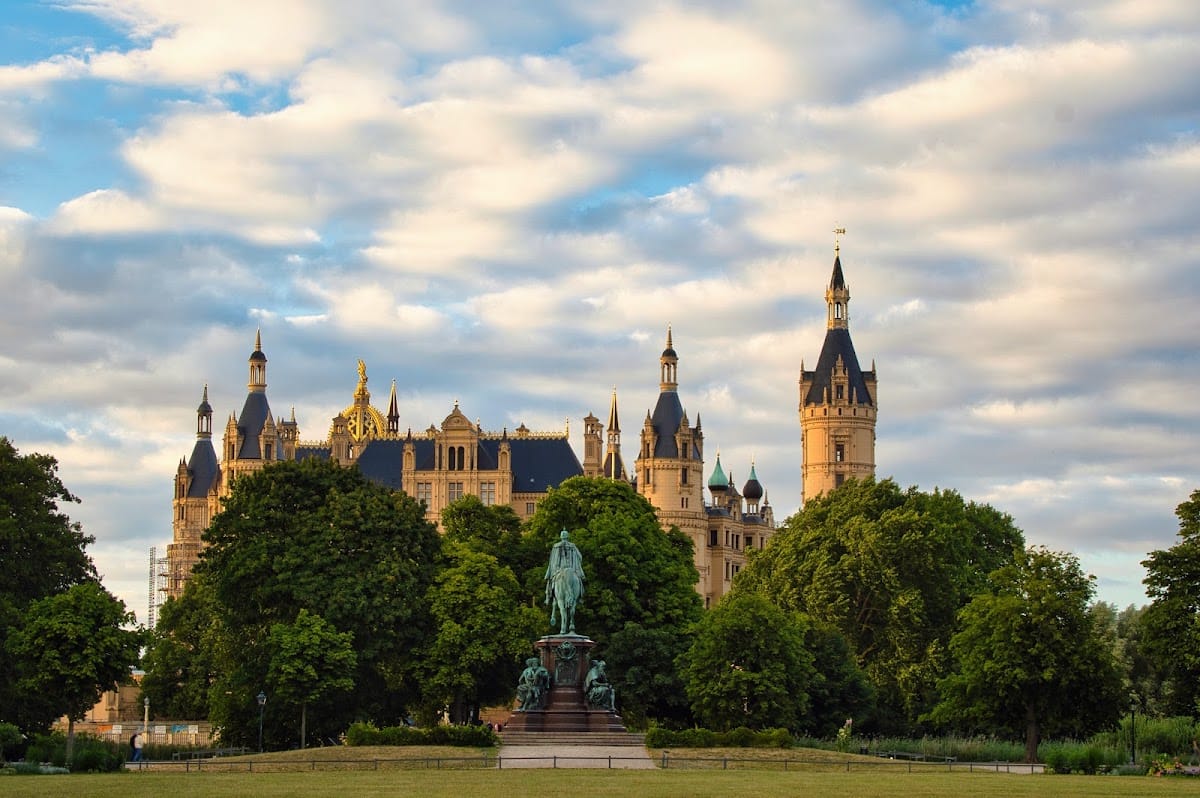
Demmler directed the castle works and the rebuilding of the castle bridge from the demolition campaign in 1843 until early 1851. He founded an accident and sickness fund for workers and repeatedly advocated fair wages. After his dismissal from Mecklenburg state service in 1851, Friedrich August Stüler took over. Stüler substantially changed the city-facing front, adding sculptural elements and the monumental equestrian figure of Niklot. He replaced Demmler’s proposed lantern with a dome crowned by a gilded zinc-cast statue of the Archangel Michael, installed in 1857. The rebuilt castle was ceremonially inaugurated on 26 May 1857.
From 1857 the castle again served as the principal residence of the Mecklenburg grand dukes. On the night of 14–15 December 1913, a major fire of uncertain cause destroyed about one-third of the complex. The lake-facing Burgsee wing burned to its foundations, the upper floors of the southern garden wing were destroyed, and the Golden Hall and principal staircase were lost.
State property, museums, and political use
Reconstruction began after the fire but was not completed because of the First World War and the collapse of the monarchy. Following the abdication of Grand Duke Friedrich Franz IV in November 1918 and the 1919 settlement concerning former princely property, the castle became state property. The grand-ducal family’s furnishings initially remained theirs and were lent to the museum; the state acquired these holdings in 1930.
A castle museum opened in 1921 under Walter Josephi and initially occupied about twenty rooms. During the 1920s, the complex also housed a radio studio operated by NORAG, a regional German broadcasting organization from the early era of public radio. The Mecklenburg Hygiene Museum opened in 1930 and closed in 1935. It was replaced by a farmers’ museum that presented Richard Wossidlo’s collection through the ideological lens of the National Socialist period. A prehistoric collection and a kindergarten operated by the Nazi welfare organization were also housed in the castle.
During the Second World War, material shortages and air-raid regulations restricted operations. The museums closed in 1944 and their collections were evacuated. The castle escaped war damage but served as a reserve military hospital in 1944–1945. After the war, American, British, and Soviet forces occupied it successively. In 1946 the Soviet Military Administration ordered the museums cleared, after which many objects were lost or removed by local authorities and private individuals.
A renewed museum project failed, and the state government moved into the castle. In 1949 it became the seat of the Mecklenburg parliament in the German Democratic Republic. After the Länder, Germany’s constituent states, were dissolved, the plenary chamber continued to serve the Schwerin district assembly and other bodies.
From the 1950s until 1981, much of the castle was occupied by the Schwerin teacher-training school, also known as the Pedagogical Institute. Former residential rooms were converted into classrooms, offices, and boarding accommodation, causing extensive alterations and the loss of historic furnishings. A polytechnical museum operated in the orangery complex from 1961 to 1994. A period-style festival hall was created in 1972 in the former Golden Hall area, while rooms in the ceremonial floor were restored and reopened for museum use in 1974–1975. A dedicated castle-construction administration established in 1975 initiated broader restoration.
Contemporary heritage
Extensive renovation resumed around 1989–1990. Since the re-establishment of Mecklenburg-Western Pomerania in autumn 1990, the state parliament has again had its seat in the castle. The museum section forms part of the State Palaces, Gardens and Art Collections of Mecklenburg-Western Pomerania.
The area of the former 283-square-metre Golden Hall, later used as a German Democratic Republic festival hall, was incorporated into new plenary facilities for the state parliament. The conversion, designed by Dannheimer & Joos, was completed in September 2017. The castle and its associated residence ensemble were placed on Germany’s UNESCO World Heritage tentative list in 2014, following an application submitted in 2012. The Schwerin Residence Ensemble was inscribed on the UNESCO World Heritage List on 27 July 2024.
Schwerin Castle has appeared on a German commemorative two-euro coin since 2007, issued in connection with Mecklenburg-Western Pomerania’s presidency of the Bundesrat in 2006–2007. It has also served as a filming location, including for the 1979 DEFA production The Goose Girl at the Well and the 2017 film Kingsman: The Golden Circle. A long-standing legend tells of Petermännchen, a fictional castle spirit said to inhabit the castle. The figure appears as a sculpture on the courtyard façade, and people dressed as Petermännchen continue to appear at some modern events.
Remains
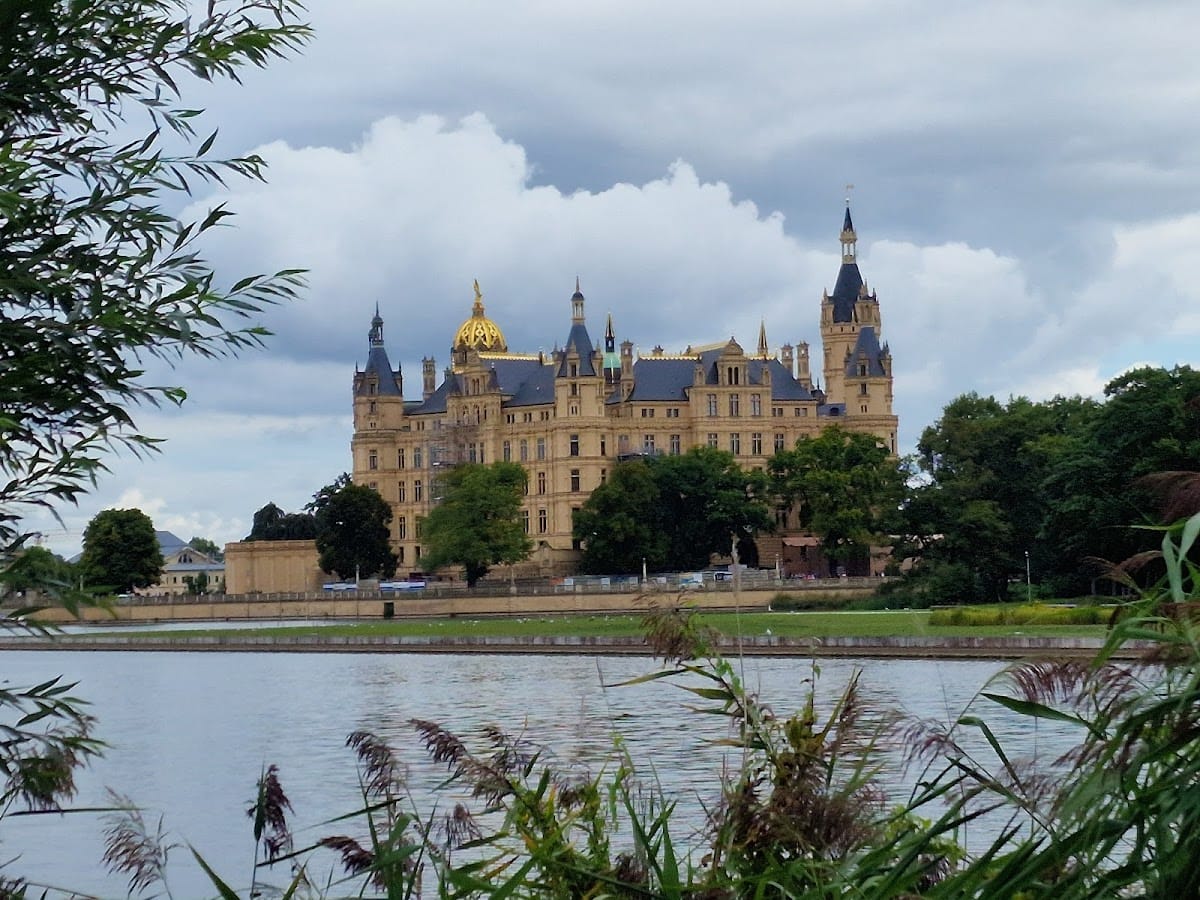
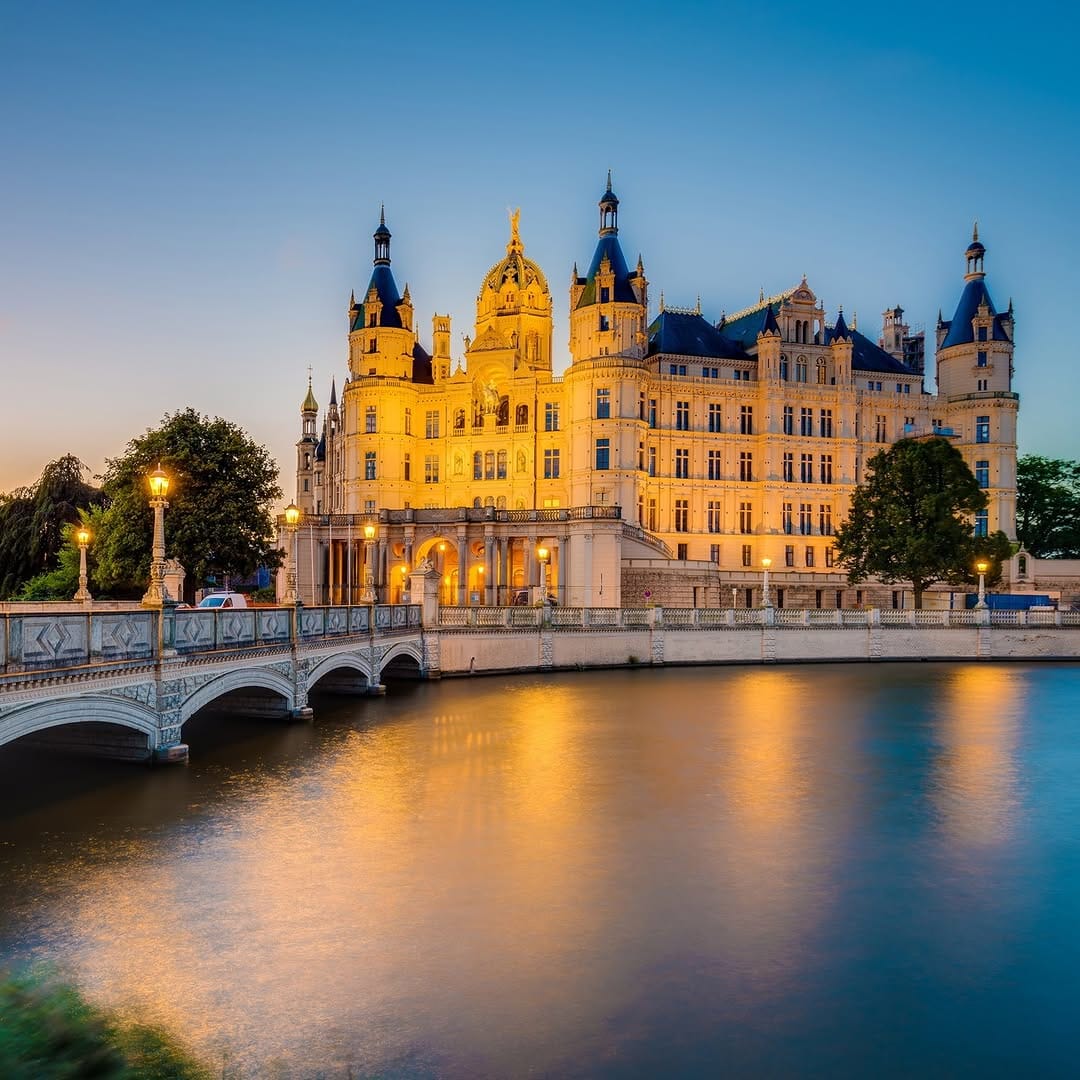
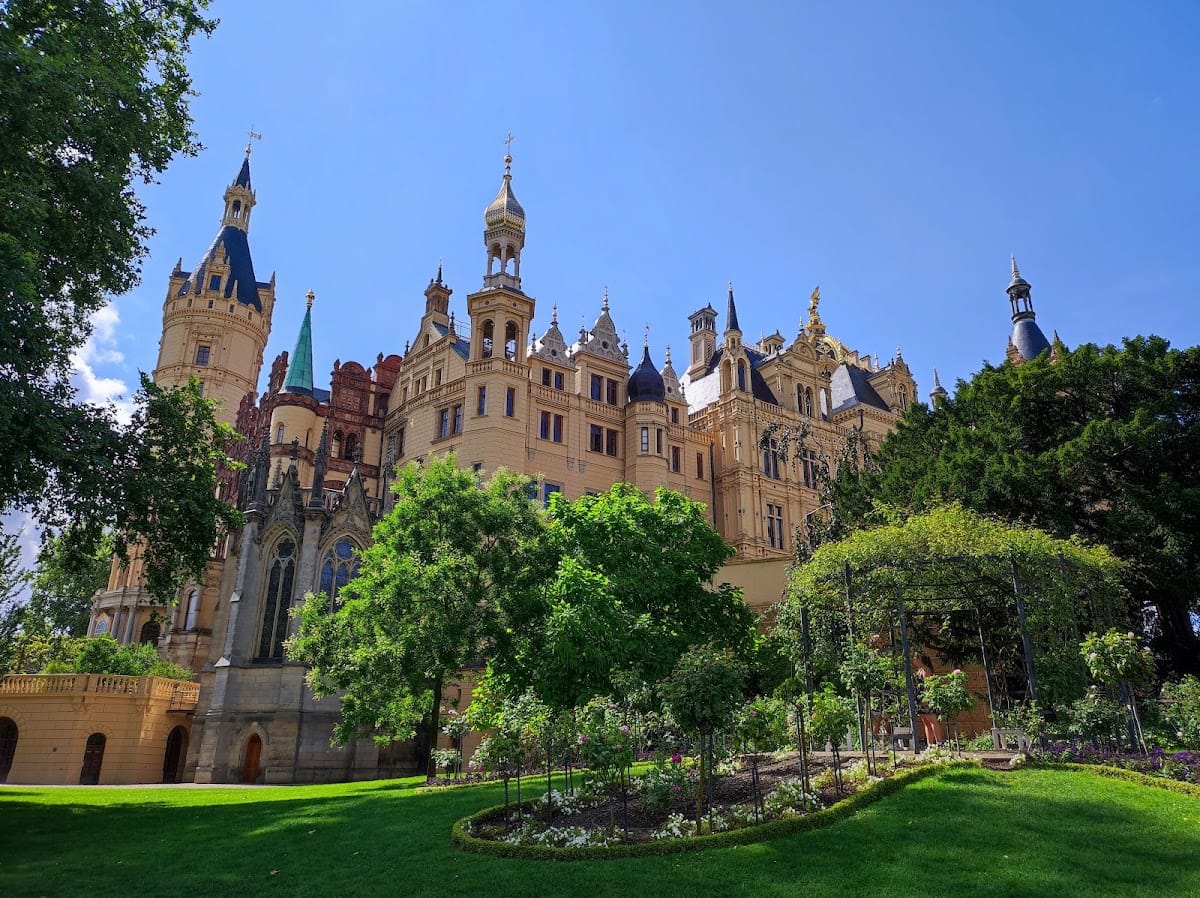
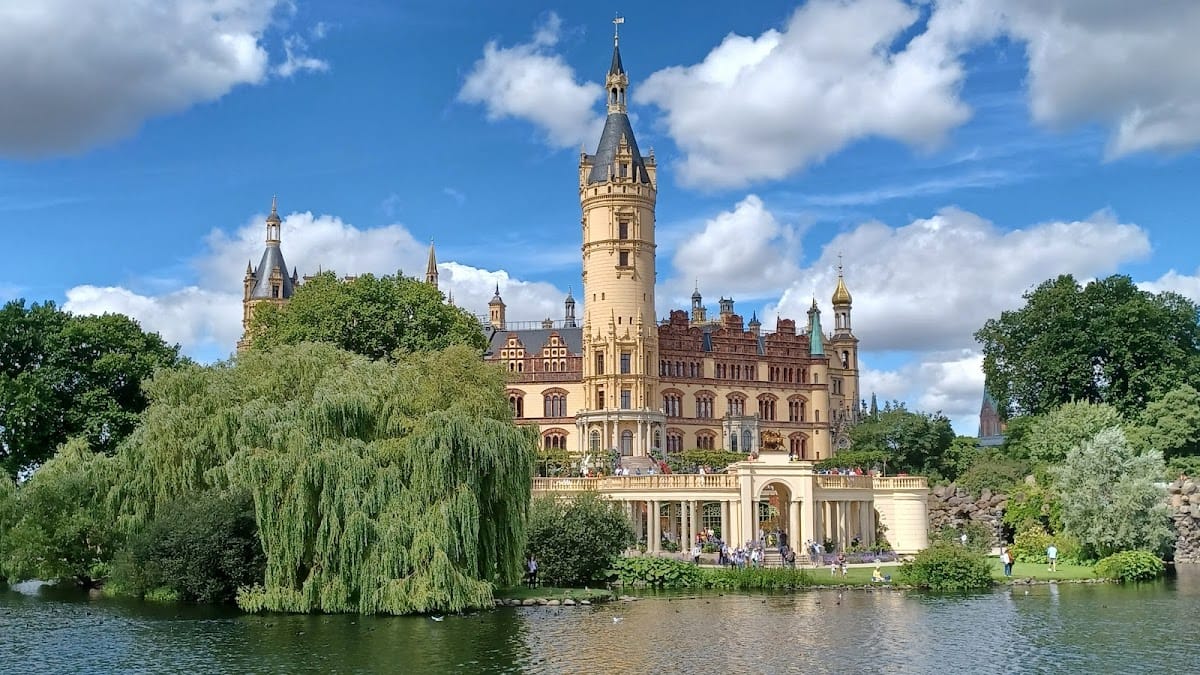
Schwerin Castle is an irregular five-wing complex arranged around an inner courtyard. Its ring-like form preserves the layout of the earlier island fortifications. The surviving architecture combines late Gothic elements, Renaissance buildings, Dutch Renaissance façades, nineteenth-century historicism, and later reconstructions. The castle island is linked by two bridges to Schwerin’s old town and to the Schlossgarten.
Historic core and castle church
House over the Castle Kitchen
The House over the Castle Kitchen forms one of the four oldest surviving buildings in the complex. Under Pilooth’s plans, it was raised between 1635 and 1643 and given Dutch Renaissance forms. Its two wings meet at an obtuse angle on the east-southeastern and southern sides of the castle. The building belongs to the historic core retained during the nineteenth-century rebuilding.
Bishop’s House
The Bishop’s House adjoins the main tower on its southwestern side. Its cellar vaults date from the late Gothic period, and its name comes from the residence of Bishop Magnus, who held office from 1516 to 1550. Together with the New Long House, it was among the first buildings on the island designed purely as a residence rather than as a defensive structure. Its façade and gable carry terracotta decoration from the workshop of Statius von Düren.
New Long House
The three-storey New Long House adjoins the main tower to the northeast. Like the Bishop’s House, it represents the change from defensive architecture to princely domestic accommodation. Its façade and gable are decorated with terracotta produced by the workshop of Statius von Düren, using the North German Brick Renaissance, a regional adaptation of Renaissance forms to brick and terracotta construction.
Castle church
The castle church was built between 1560 and 1563 at right angles to the New Long House. Its chapel has a rectangular ground plan and galleries along both the long and short sides, following models established at the castle chapels of Torgau and Dresden. The courtyard-side portal is sandstone and uses forms associated with the Venetian Early Renaissance. Its gable contains a relief of Christ Carrying the Cross from the workshop of the Dresden sculptor Hans Walther.
Biblical alabaster reliefs occupy the window niches of the northern gallery. Five were made by the Netherlands sculptor Willem van den Broeck, also known as Paludanus. The signed relief The Brazen Serpent Lifted Up is described as an especially rare work. The House over the Castle Church, another part of the historic core, was raised between 1635 and 1643 under Pilooth’s Dutch Renaissance plans.
Fortifications and nineteenth-century composition
Island bastions
The island’s position did not provide sufficient defence, so bastions were probably added around the middle of the sixteenth century by Italian military engineers working under Francesco a Bornau at Dömitz. They were placed to the northwest, southeast, and southwest. Although repeatedly altered, the bastions survive as part of the castle’s defensive framework.
Entrance front and dome
The present five-wing composition was produced by the nineteenth-century rebuilding, which retained the four historic lake-side buildings. Demmler’s work included the castle bridge and the representative city-facing entrance front. Stüler subsequently enriched that front with sculptural decoration, the equestrian statue of Niklot, and the monumental dome. The dome is crowned by a gilded zinc-cast statue of the Archangel Michael installed in 1857. In 2024, the figure underwent extensive restoration in a Berlin metal workshop, including renewal of its gilding.
Interiors and fire damage
Interior work involved Heinrich Strack and workshops in Schwerin and Berlin. Sculptural and decorative contributions came from Christian Genschow, Gustav Willgohs, Heinrich Petters, and Georg Wiese, while Albert Wolff supplied designs. The 1913 fire destroyed the lake-facing Burgsee wing to foundation level and the upper floors of the southern garden wing. It also destroyed the richly decorated main staircase. Between 1926 and 1931, the staircase was replaced by the Red Marble Staircase designed by Paul Ehmig.
The former Golden Hall covered 283 square metres. After its destruction in 1913 and the later creation of a German Democratic Republic festival hall in the area, the site was incorporated into the new plenary facilities of the Mecklenburg-Western Pomerania parliament. The present use therefore preserves the location within the working political complex while reflecting successive changes to the castle’s interior.
Gardens and associated grounds
Burggarten
The smaller Burggarten occupies part of the castle island. Its restored design follows the appearance of 1857 and includes an orangery, English landscape-garden elements, Italian Renaissance-style terraces, and rose gardens. An orangery is a building intended to shelter citrus and other tender plants during cold seasons. The garden is connected by two bridges to the old town and the Schlossgarten.
Schlossgarten and Burgsee
The larger Schlossgarten extends from Schwerin Lake and Burgsee in the north toward Fauler See in the south. Its central feature is the Cross Canal, aligned visually with the castle. Peter Joseph Lenné designed the garden as an English landscape park. Around Burgsee, the landscape was developed for the 2009 Federal Horticultural Show. Between April and August 2007, the lake was enlarged southward by dredging, and a floating meadow was connected by a bridge to a shore area planted with acacias. The southern shore also contained a tram-turning loop, maintenance facilities, and a colonnade.
Petermännchen
The castle’s best-known legendary figure is represented by a courtyard-façade sculpture made by Heinrich Peters. Petermännchen is traditionally portrayed as a small, dwarf-like character carrying a lantern, sword, and keys. The figure belongs to the continuing cultural interpretation of the castle and is also represented at some modern events by people dressed in costume.
Nearby sites