Schönburg: A Medieval Hilltop Castle above Oberwesel


Site at a Glance
- Rating
- 4.8
- Popularity
- Medium
- Country
- Germany
- Primary era
- Medieval
- External website
- Open
- Eras represented
- Medieval, Modern
- Civilizations
- Holy Roman Empire
- Site type
- Military
- Remains
- Castle
On this page14 sections
History
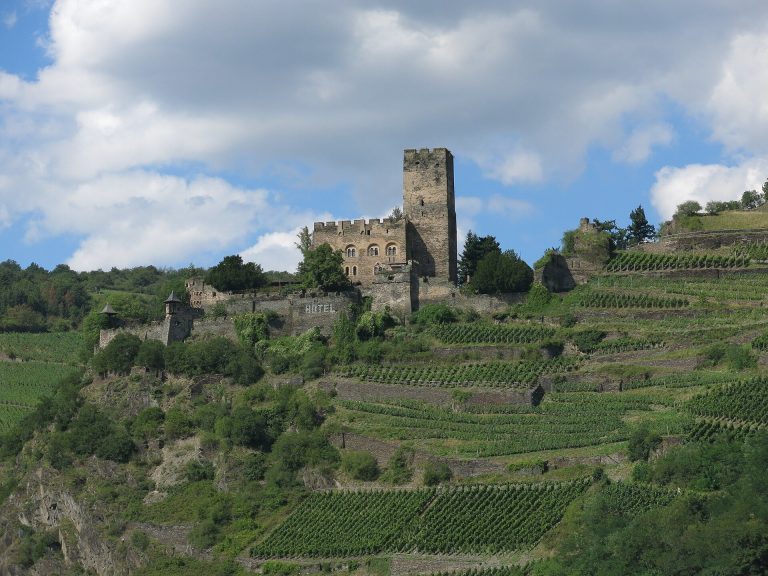
Schönburg is a medieval hilltop castle above Oberwesel in Germany, begun during the first half of the twelfth century in the medieval period. Its foundation probably took place between about 1100 and 1149, although it remains uncertain whether the Archbishop of Magdeburg or the emperor established it. The castle became the seat of the Lords of Schönburg, who ruled Oberwesel and controlled customs levied on the Rhine.
Early lords and imperial service
Schönburg was recorded in 1149 as a fief held by Hermann von Stahleck. At the castle, Hermann arranged the murder of Otto II of Rheineck, his rival for the Palatine countship of the Rhine. The earliest historical reference to Schönburg is placed broadly between 911 and 1166, while the 1149 record provides a specific medieval date for its political importance.
From the twelfth century, the Knights of Schonenberg served as imperial ministeriales, dependent officials who performed administrative, military, and governmental duties for powerful lords. Their allegiance shifted among the Archbishop of Magdeburg, the emperor, and later the Archbishop of Trier. This connection allowed the family to exercise authority in Oberwesel while operating within the changing political structures of the medieval Rhineland.
A castle shared by many branches
From the middle of the thirteenth century, the Schonenberg family divided into several branches. Inheritance created a system of co-ownership in which the different branches occupied Schönburg at the same time. By the fourteenth century, the castle had become a jointly owned and occupied noble fortress, with three separate residential areas and three defensive towers known as bergfrieds. A list from 1340 names 95 co-owners, although many of them did not live at the castle.
During the fourteenth century, Schönburg passed to the Electorate of Trier. Its expansion reached a major stage with the Hoher Mantel, a massive shield wall probably built under Balduin of Trier, the medieval Archbishop and Elector of Trier, during the first half of the century. The wall was first recorded in 1357 and altered the castle’s defensive character.
Destruction and decline
One prominent member of the Schönburg family was Friedrich von Schönburg, later known as Marshal Schomberg. In the seventeenth century he served as a colonel and general for the King of France in France and Portugal. He later served Prussian forces and William, Prince of Orange, in England.
French soldiers destroyed and burned Schönburg in 1689 during the War of the Palatine Succession, also called the War of the Grand Alliance, a European conflict fought by France against a broad coalition of opposing powers. The last Schönburger died in 1719, and the ruined castle then reverted to the Electorate of Trier. Schönburg remained a ruin for about two centuries.
Reconstruction and modern use
Victor Hugo, the nineteenth-century French writer and political figure, described Schönburg during his 1840 journey along the Rhine as one of Europe’s most remarkable groups of ruins. A later change began when the German-American T. J. Oakley Rhinelander purchased the castle and initiated partial reconstruction between 1885 and 1901. His ancestors had emigrated from the Rhineland to the United States in the late eighteenth century, and the family accumulated wealth through East Coast real-estate dealings, including land later associated with Wall Street in New York.
After Rhinelander’s death in 1947, the town of Oberwesel acquired Schönburg from his heir in 1950. The northern section became a Kolping youth castle between 1951 and 1953. The Kolpinghaus belongs to the tradition of the Kolpingwerk, a Catholic social and educational movement founded by the German priest Adolph Kolping. The southern section has operated as a hotel since 1957 and was reconstructed in close coordination with state monument-preservation authorities. The Hüttl family has run the hotel and restaurant under a long-term lease since that year.
Since April 2011, the 25-metre-high gate tower has contained a museum covering castle construction, monument preservation, and castles in wartime. Schönburg forms part of the UNESCO World Heritage Site of the Upper Middle Rhine Valley. The associated 72-hectare Schloss Schönburg vineyard lies within the Middle Rhine wine region, producing white grapes including Riesling, Müller-Thurgau, and Kerner, together with a small quantity of Schönburger, a variety named after the castle.
Remains
Schönburg occupies a slate-rock outcrop above Oberwesel. Its surviving layout preserves the division into three residential complexes, each historically linked with a bergfried, a largely uninhabited defensive tower characteristic of medieval German castles. The castle’s principal defensive feature is the Hoher Mantel, while residential, ancillary, religious, and later reconstructed buildings occupy the spaces behind it.
Defensive structures and entrance
Hoher Mantel
The Hoher Mantel is a massive shield wall, a particularly strong wall intended to protect the side most directly threatened by attack. It bends three times at obtuse angles and protects most of Schönburg from the principal direction of assault. A round-arch frieze decorates the wall, whose form is described as unique. The route into the inner courtyard follows the line of the Hoher Mantel, and two zones of blind arcades, shallow ornamental recesses, contain loopholes on its inner face.
Gate tower
A route through several half-timbered ancillary buildings reaches the massive square gate tower. Rising 25 metres, the tower leads into the northern residential complex. Its uppermost level contains a steel viewing platform, while the tower itself houses the museum devoted to castle construction, monument preservation, and castles in wartime.
Residential complexes
Southern residential complex
The southern palas, the main residential and representative building of a medieval castle, forms part of an architecturally varied hotel complex. Its reconstruction introduced new Gothic-style window openings. Red plaster and painted joint lines reproduce evidence associated with the earlier appearance of the building. The complex also includes a half-timbered building and a bergfried known as the Barbarossa Tower, a name connected with the tradition that Friedrich Barbarossa, the twelfth-century Holy Roman Emperor, visited Schönburg several times. Tapestries and other antiques are preserved inside the tower.
Northern residential complex
The northern complex has its own bergfried and contains the Kolpinghaus. Its compact palas is formed by two wings. The present core derives from the 1953 reconstruction, which was expanded in 1962 and altered during the 1970s and 1980s.
Castle chapel
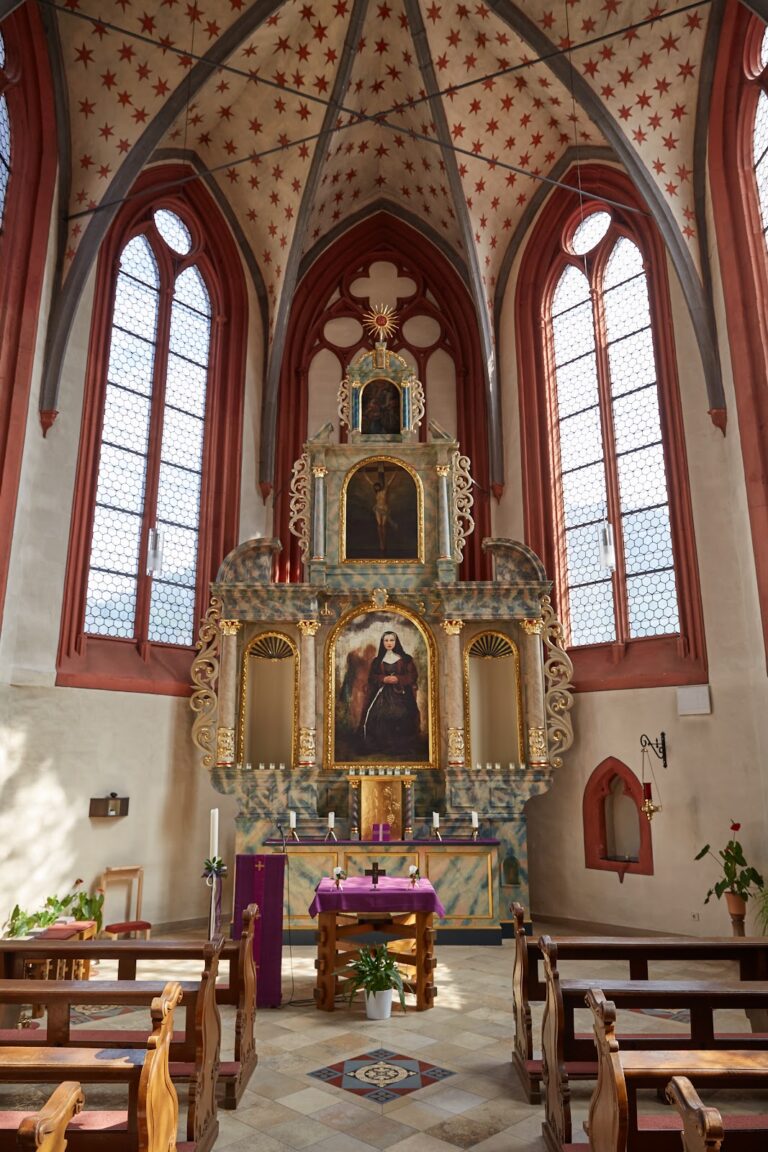
The castle chapel was restored in the Gothic style in 1983. It forms part of the surviving architectural group alongside the residential and defensive buildings.
Vineyard landscape
The 72-hectare Schloss Schönburg vineyard site belongs to the Middle Rhine wine region. Its steep slopes support Riesling, Müller-Thurgau, Kerner, and the smaller-cultivated Schönburger grape variety, whose name derives from the castle.