Meersburg Castle: A Medieval Residential and Defensive Castle in Germany


Site at a Glance
- Rating
- 4.6
- Popularity
- High
- Country
- Germany
- Primary era
- Medieval
- External website
- Open
- Eras represented
- Medieval, Early Modern
- Civilizations
- Holy Roman Empire
- Site type
- Military
- Remains
- Castle
On this page11 sections
History
Meersburg Castle is a medieval residential and defensive castle in Meersburg, Germany, above the town’s Lower Town and Lake Constance. Its origins are uncertain: tradition places a first fortification here in the seventh century, while architectural and historical interpretations date the principal surviving fabric to the twelfth or early thirteenth century, when many castles were being built around Lake Constance. Romanesque architectural elements remain part of the complex, which is known as the Old Castle in contrast to the neighbouring Baroque New Palace.
Early origins and medieval rule
The castle’s earliest history is surrounded by traditions that cannot be securely confirmed. One account attributes the construction of the Dagobert Tower, the keep, to Dagobert I, a Merovingian king of the Franks who ruled in the early seventh century. This tradition rests chiefly on a reference from 1548 and was strongly promoted by Joseph von Laßberg in the nineteenth century. Another interpretation places the castle, or at least its principal surviving structure, in the twelfth or early thirteenth century. No clearly identifiable building fabric from the seventh century survives.
A supposed reference to Meersburg in a lost charter of Otto III dated 27 August 988 is now generally understood to concern Merseburg. The earliest secure reference connected with Meersburg is the name “Merdesburch” in 1147. A Luitpold de Merdesburch had appeared as a witness in 1113, although it is uncertain whether that reference concerned the castle or the settlement. The claim that an older castle stood here and was later destroyed has no supporting evidence, and the associated story that Karl Martel temporarily lived in the Dagobert Tower is regarded as legendary.
Members of the Hohenstaufen dynasty, a medieval German ruling family that produced several kings and Holy Roman Emperors, stayed at Meersburg Castle. Frederick II and Conradin were among them. Meersburg received weekly-market town privileges in 1233, and the castle passed to the prince-bishops of Constance during the mid-thirteenth century, with the transfer complete by 1268. A prince-bishop combined episcopal office with secular territorial rule, so the castle became part of the administration of the bishops’ lands and later served, among other functions, as their summer residence.
Sieges, episcopal residence, and urban conflict
In 1334, a dispute over the vacant see of Constance brought Bishop Nicholas of Frauenfeld, also called Nicholas of Kenzingen, to the castle for refuge. Imperial troops supporting his rival, Albert of Hohenberg, besieged Meersburg for fourteen weeks but failed to take it. The siege is associated with the first use of gunpowder artillery on German soil, although the evidence for that claim remains uncertain. The imperial withdrawal and Emperor Louis the Bavarian’s eventual recognition of Nicholas represented a political defeat for Louis’s Swabian policy and strengthened the Habsburg position in the region.
Bishop Burkhard of Hewen built the Lower Town Chapel in 1390 as the castle chapel and dedicated it to John the Baptist. Emperor Sigismund stayed at Meersburg in 1414 during the Council of Constance, a major church council held to resolve a papal succession crisis and related divisions within the Western Church. Tensions between the town and the prince-bishops continued. During unrest over expanded town privileges in 1457 and 1458, the dispute involved an assault on the castle, a counter-siege, mediation by regional powers, and the suppression of the town’s leaders by Bishop Heinrich IV of Hewen.
Bishop Hugo von Hohenlandenberg, who held office from 1496 to 1532, made Meersburg his permanent residence in 1526 after conflicts with the city of Constance. The castle temporarily became the principal seat and administrative centre of the prince-bishops of Constance, whose territory was among the largest Catholic bishoprics north of the Alps. During this period the Dagobert Tower was incorporated into the residential and representational complex and received two additional storeys.
War and the New Palace
Swedish forces attacked Meersburg during the Thirty Years’ War in 1647. This conflict, fought mainly between 1618 and 1648, combined religious, dynastic, and political rivalries across Europe, while Swedish armies intervened extensively in the German lands. The attack did not capture the castle, but fire damaged the roof structure, particularly that of the main tower.
Construction of the neighbouring New Palace began in the early eighteenth century as a modern residence for the bishops. After 1750, the Old Castle served mainly administrative purposes rather than functioning as the episcopal residence. Secularization around 1802 transferred ecclesiastical property and political authority to secular governments, ending the territorial rule of many German bishops and abbots. Meersburg consequently passed to the later Grand Duchy of Baden.
The castle first housed the provincial authority of the Upper Principality on the Lake. In 1814 it became the seat of the newly established court of the Baden Lake District, a branch of the court at Donaueschingen. That court remained at Meersburg until 1836. By 1814, the complex also contained the chief tax office and apartments for four retired episcopal officials.
Laßberg, Droste-Hülshoff, and private ownership
Joseph von Laßberg, a collector of medieval books and manuscripts, bought the castle from the Karlsruhe Domain Chamber in 1838 for 10,000 gulden. His purchase helped prevent further deterioration and possible demolition. He moved in on 7 September 1838 with his wife, Maria Anna von Droste zu Hülshoff, known as Jenny, and their twins. Laßberg installed his library in the former archive and employed Levin Schücking during the winter of 1841 to 1842, through Jenny’s mediation, to catalogue it.
Meersburg then became a meeting place for scholars and writers, including Ludwig Uhland, Karl Simrock, the Brothers Grimm, Justinus Kerner, and Ignaz Heinrich von Wessenberg. Annette von Droste-Hülshoff, Jenny’s sister, moved into the castle in 1841 and spent much of the final eight years of her life there. She wrote a substantial part of her poetry at Meersburg, dedicated the poem The Old Castle to the building, and died there on 24 May 1848.
In 1849 ownership passed from the Grand Duchy of Baden to the town of Meersburg on the condition that neither the Lower Town Chapel nor its inventory be sold. After Laßberg’s death in 1855, the castle was divided into four equal shares among Jenny and their children Karl, Hildegard, and Hildegund. Hildegard and Hildegund sold it in 1877 for 12,000 marks to the Munich heraldist and antiquarian Carl Mayer von Mayerfels, while retaining a right of residence until Hildegard’s death in 1914.
Mayer von Mayerfels created a medieval museum and renovated parts of the castle, including the Knights’ Hall. After his death in 1883, ownership passed to his widow, then in 1910 to his daughter. In 1939 it passed to his granddaughter Maria, born von Miller, and her husband Hubert Naeßl. They expanded the museum and helped establish the castle as a major cultural attraction on Lake Constance.
The property later passed to Naeßl’s sister Ottilie Naeßl. Wilderich von Droste zu Hülshoff lived there in 1973 and 1974. Vinzenz Naeßl-Doms, Ottilie Naeßl’s adopted son, took over the castle in 1977, contributed to its preservation, opened a castle café, and promoted contemporary cultural events. After his death in 2018, ownership passed to his family. The castle remains privately owned, serves partly as a residence for the heirs, and houses a museum. Restoration measures on the south side received the Baden-Württemberg Heritage Protection Prize in 2026.
Remains
Hilltop layout and construction
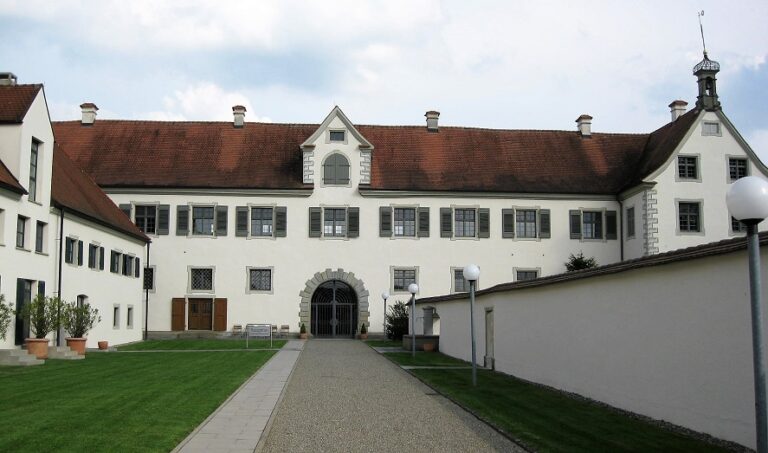
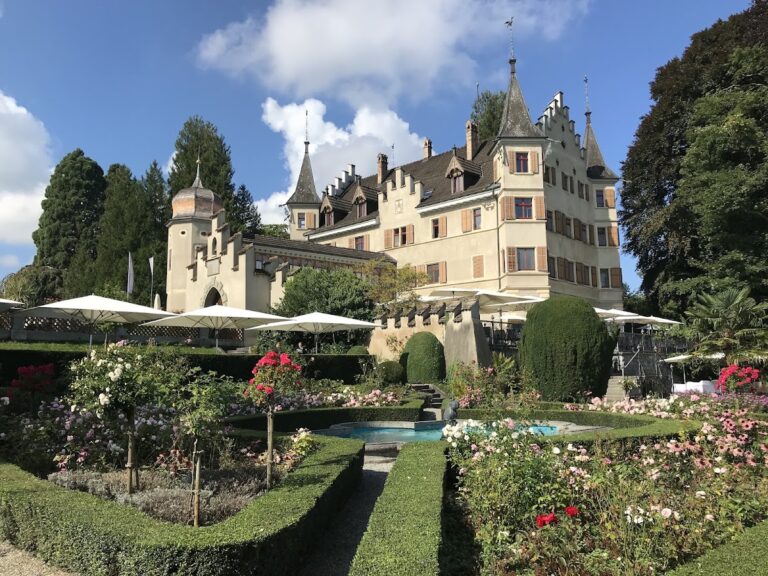
Meersburg Castle occupies a rocky elevation above the Lower Town on a south-facing slope descending toward Lake Constance. The site stands at approximately 440 to 444 metres above sea level and is now enclosed within the town settlement. Its surviving form combines residential and defensive functions with Romanesque elements. The complex is organized around massive medieval structures, later residential additions, defensive passages, chapels, service areas, and museum rooms.
The keep and residential complex
Dagobert Tower
The Dagobert Tower is the castle’s keep and is traditionally regarded as the earliest core of the complex. Its rectangular base consists of very large, roughly cut stone blocks. Architectural comparisons place this masonry either in the seventh century or in the twelfth to early thirteenth century, and modern interpretation describes it as a local form of bossage ashlar masonry, in which the central faces of the stones project from their edges.
The tower may originally have stood separately from the rest of the castle. In the early sixteenth century it was integrated into the residential and representational complex and gained two additional storeys. It also received the characteristic stepped gable associated with Bishop Hugo von Hohenlandenberg. Inside are a nineteenth-century prison room, a Renaissance hall with a treasury, and a deep section containing a torture chamber illustrating medieval jurisdiction. A guided ascent reaches the tower and looks toward Meersburg, Lake Constance, and the Alps.
Interior rooms and collections
The museum route extends through more than 30 furnished rooms and spaces. These include the old castle kitchen, the Dürnitz, a heated communal or residential hall used for dining or assembly, the Palas, the principal residential and representational building of a medieval castle, the well room, weapons hall, defensive passages, Knights’ Hall, dungeon, two chapels, stable, and North Bastion. A bastion is a projecting fortification designed to strengthen defensive fire and protect adjoining walls.
The former archive contains Joseph von Laßberg’s library, including medieval manuscripts and books. Other rooms preserve the living quarters and death room associated with Annette von Droste-Hülshoff. Together these spaces connect the surviving building with its episcopal, scholarly, literary, and museum histories.
Later repairs
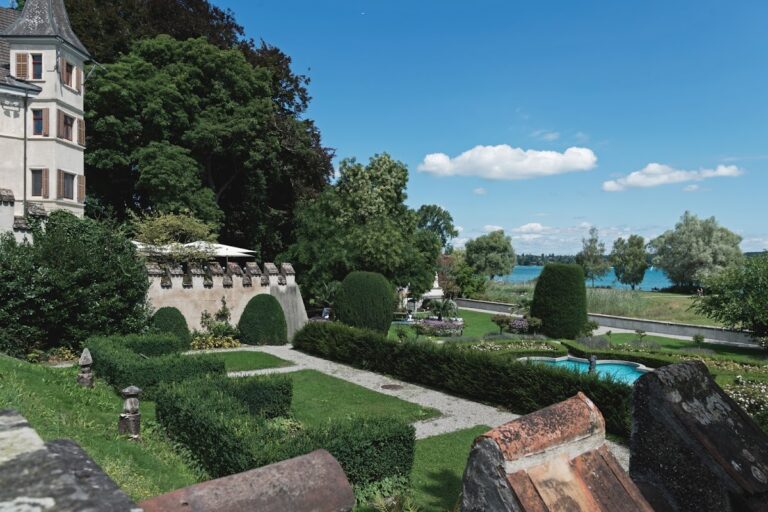
The eastern building’s roof was re-covered by 75 percent in the early 1990s. In 2018, workers renewed the basic plaster on the south side with a permeable finish that allows moisture to escape from the masonry. Drainage was installed in the castle garden, and the crenellated wall was repaired. In 2019, the south-side windows and their sandstone surrounds were renovated, and the final plaster coat was applied.