Maxstoke Castle: A Fourteenth-Century Moated Castle in England


Site at a Glance
- Rating
- 4.4
- Popularity
- Low
- Country
- United Kingdom
- Primary era
- Medieval
- External website
- Open
- Eras represented
- Medieval
- Civilizations
- English
- Site type
- Military
- Remains
- Castle
On this page9 sections
History
Maxstoke Castle is a privately owned moated castle in England, United Kingdom, built in 1345 and dating from the fourteenth century. Sir William de Clinton, 1st Earl of Huntingdon, founded the castle, which became a residence and fortified estate in Warwickshire. Its largely intact survival and continued occupation preserve a substantial example of medieval castle architecture.
Medieval foundation and noble ownership
Sir William de Clinton built Maxstoke Castle in 1345. After his death in 1354, his widow, Juliana Leybourne, continued to spend time at the castle following her subsequent marriage. In 1437, Humphrey Stafford, 1st Duke of Buckingham, acquired the property in exchange for other manors in Northamptonshire and added to the castle.
The castle also preserves several antiquities connected with major episodes in English history. A fifteenth-century chair is associated with the crowning of Henry VII after his victory at the Battle of Bosworth in 1485, an event that ended the Wars of the Roses. A table owned by Sir Everard Digby is associated with the planning of the Gunpowder Plot in 1605, the conspiracy to destroy Parliament and kill King James I. A feature known as the “Whispering Door” was brought to Maxstoke from Kenilworth Castle.
Family possession and the Civil War
The Fetherston-Dilke family first acquired Maxstoke Castle in the seventeenth century. In the eighteenth century, William Dilke of Maxstoke married Mary Fetherstone-Leigh of Packwood House, linking the two families and their estates.
During the English Civil War, the seventeenth-century conflict between Parliament and supporters of the monarchy, Maxstoke Castle was garrisoned for Parliament. Captain Layfield was the first known governor, serving in 1642 and 1643. From March 1644 until October 1645, command passed to Henry Kendall Senior, lord of the manor of Austrey. His son, Henry Kendall Junior, served as lieutenant, and several of Kendall’s tenants from Austrey also joined the garrison.
Parkland and protection
The castle’s surrounding parkland was formerly listed as a deer park, and deer are still found there. Since 1898, the parkland has been used as a golf course. Maxstoke Castle was designated a Scheduled Ancient Monument in 1935, giving legal protection to its archaeological and historic importance, and became a Grade I listed building in 1952, the highest level of listing protection in England.
Remains
Castle layout and construction
Rectangular enclosure
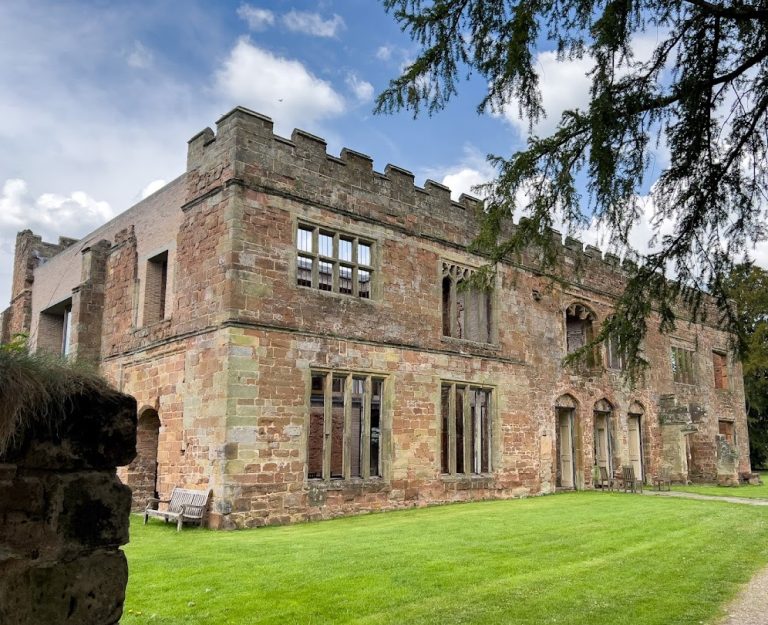
Maxstoke Castle follows a rectangular plan with an octagonal tower at each angle. The gatehouse stands on the east side, while a residential range occupies the west side. Sandstone is the principal stated building material. The arrangement combines defended corners, a controlled entrance, and accommodation within a single enclosed plan.
Moat and surrounding landscape
A broad moat surrounds the entire castle structure. A moat is a water-filled defensive ditch intended to make access more difficult. The castle stands at approximately 79 metres above sea level in a valley surrounded by predominantly flat terrain, with agricultural land forming much of the wider setting. The associated parkland forms part of the site’s landscape and was later adapted for use as a golf course.
Surviving condition and historic objects
The castle has survived largely intact and remains occupied. Its surviving contents include the fifteenth-century chair associated with Henry VII’s crowning after Bosworth, the table connected with Sir Everard Digby and the planning of the Gunpowder Plot, and the “Whispering Door” transferred from Kenilworth Castle. Together, these objects preserve links between the medieval building and later episodes in England’s political and religious history.