Castello Normanno: The Medieval Fortress of Aci Castello, Italy


Site at a Glance
- Rating
- 4.6
- Popularity
- Medium
- Country
- Italy
- Primary era
- Medieval
- External website
- Open
- Eras represented
- Medieval
- Civilizations
- Norman
- Site type
- Military
- Remains
- Castle
On this page10 sections
History
Castello Normanno, also known as Castello di Aci, is a fortress at Aci Castello in Italy, built and developed through Byzantine, Norman, and later Sicilian historical phases. Its origins are uncertain, but the stronghold became the focal point of the medieval development of the territory of Aci. A Byzantine castle was established in the sixth or seventh century on an earlier Roman-period fortification, possibly dating to AD 38, and was known as Castrum Jacis. Its purpose was to protect the local population from raids.
Byzantine and Muslim Sicily
In the summer of 902, during the Muslim conquest of Sicily, the inhabitants capitulated to Emir Ibrahim II. They paid the jizya, a tax imposed on non-Muslim communities under certain Islamic governments, and surrendered their weapons rather than resist what appeared to be inevitable defeat. The settlement was spared, but the castle and its fortifications were razed.
Under Arab rule in the tenth century, the settlement was called Al-Yag or Li-Yag and was regarded as an important center of eastern Sicily. Byzantine influence remained strong, however, and Aci was later described as a center of resistance to Muslim rule.
Norman and imperial administration
After the Norman conquest of Sicily, Robert Guiscard and Roger of Hauteville introduced western European feudal administration, in which land was granted to bishops, nobles, and military retainers, along with a new phase of castle-building. In 1092, Castello Normanno and the surrounding territory, then called Castrum Jatium, were granted to Angerio of Sant’Eufemia, the abbot and bishop of Catania. The territory included the areas of present-day Aci Castello, Acireale, Aci Catena, Aci Sant’Antonio, Aci Bonaccorsi, and Valverde.
The Arab geographer al-Idrisi described the land of Aci as an important territory at the court of Roger II. On 17 August 1126, Bishop-Abbot Maurizio of Catania received the relics of Saint Agatha at the castle. The relics had been brought back from Constantinople by the knights Goselmo and Gisliberto.
Eastern Sicily was struck by a devastating earthquake on 4 February 1169, accompanied by volcanic activity. Part of the population moved to the district of Aquilio, later called Aci Aquilia. The prehistoric lava flow surrounding the site was incorrectly attributed by nineteenth-century historians to the eruption associated with the 1169 disaster.
In 1239, Emperor Frederick II of Swabia, the Holy Roman Emperor and king of Sicily, removed the castle from the bishop of Catania and returned it to imperial control. By 1277, the settlement around the castle had approximately 1,200 inhabitants, recorded as 183 taxable households.
Aragonese conflict and the Alagona family
At the end of the thirteenth century, during the brief Angevin period, the castle again belonged to the bishop of Catania. During the Sicilian Vespers, the revolt against Angevin rule that led to prolonged conflict between Angevin and Aragonese powers, Frederick III of Aragon granted the territory of Aci to Admiral Roger of Lauria in 1297. The grant required an annual payment of 30 gold ounces to the bishop, but the payment was not made. It formally recognized the territorial unit formed by the fortress and the surrounding lands.
Roger of Lauria later joined the Angevin side, and Frederick III captured the castle with a mobile wooden siege tower called a cicogna. He restored it to the royal domain. In 1320, Frederick transferred the territory to Blasco II Alagona, who was succeeded by his son Artale I. In 1326, troops of Robert of Anjou commanded by Beltrando Del Balzo plundered the castle and its territory.
An earthquake and an eruption of Mount Etna devastated the territory in 1329. The settlement rebuilt farther north became Aquilia Nuova, the nucleus of the future Acireale, while the earlier settlement was called Aquilia Vetere. King Louis of Aragon died at the castle in 1353 at the age of 17. The following year, Marshal Niccolò Acciaiuoli, sent to Sicily by Louis of Anjou, devastated the territory and captured the castle.
Acciaiuoli returned in 1356 with troops and five Angevin galleys after a dispute between the governor of Messina, Niccolò Cesareo, and Artale I Alagona. The territory was plundered again and the castle was besieged. Artale repelled the attack and defeated the Angevin fleet in the naval engagement known as the “checkmate of Ognina,” fought between Ognina and the castle.
During the anti-Aragonese revolt of 1396, Artale II Alagona fortified himself in the castle. King Martin the Younger captured it after a prolonged siege. Tradition attributes the fall of the fortress to the interruption of its water supply while Artale II was away. In 1398, the Parliament of Syracuse declared that the lands of Aci should remain permanently in the royal domain, probably to prevent their return to baronial control. The territory received exemption from customs duties in 1399, and in 1402 Martin the Younger made the castle his residence with his second wife, Blanche of Navarre. The settlement had about 2,400 inhabitants in 1404.
Fifteenth-century grants and royal recovery
During the fifteenth century, Aci changed hands repeatedly. In 1421, the viceroy Ferdinando Velasquez acquired Aci and the nearby Bosco d’Aci for 10,000 florins and re-enfeoffed the territory, provoking popular discontent. On the order of King Alfonso the Magnanimous, he authorized the tax-free Fiera Franca in 1422. The fair became economically important.
After Velasquez died in 1434, the territory passed to Don Pietro, the Spanish royal infante, and returned to Alfonso in 1437. In 1439 it passed successively to the Platamone, Moncada, and Requisens families, and in 1468 to the barons of Mastrantonio.
On 28 August 1528, the inhabitants offered Emperor Charles V 20,000 florins to recover the territory from the barons and restore it to the royal domain. Charles accepted on 5 July 1530, granted full jurisdiction, and confirmed the Fiera Franca. The castle, together with the sea stacks of Aci Trezza, became a principal emblem on the seal of the new royal universitas, a recognized territorial community or municipality in medieval and early-modern Sicily.
Later use and preservation
From the mid-sixteenth century, the former University of Aci ceased to function as a unified territory as the surrounding settlements became independent. The castle was subsequently used first as a barracks and then as a prison. In 1647, Philip IV of Spain transferred it to Duke Giovanni Andrea Massa for 7,500 scudi. The Val di Noto earthquake of 11 January 1693 damaged the fortress.
The castle returned to municipal ownership during the Bourbon period in the nineteenth century. Giovanni Verga later used it as the setting of his novella Le storie del Castello di Trezza. Restoration took place from 1967 to 1969, and since 1985 the castle has served as the seat of a civic museum. It is identified today as an Italian cultural property.
Remains
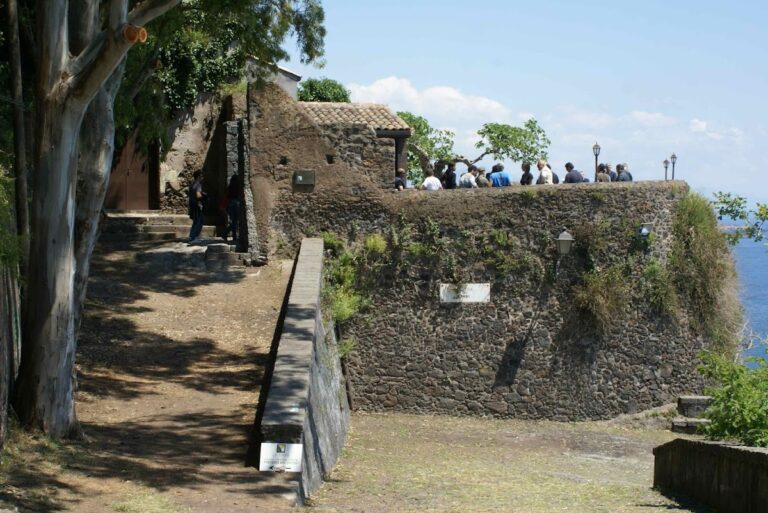
The fortress occupies a basaltic promontory formed by submarine pillow-lava flows, created when underwater lava cools into rounded masses, with a radiometric age of approximately 500,000 years. The rock rises above the sea and is surrounded by a prehistoric lava flow. The natural setting makes the site inaccessible except from the landward side, where a masonry staircase provides access. A wooden drawbridge once formed part of the entrance approach and has disappeared, although traces of its operating mechanism remain at the entrance.
Central tower and defensive layout
The square donjon, the principal fortified tower combining defensive, residential, and administrative functions, stands at the center of the fortress. This quadrangular residential tower forms the main structural and defensive focus of the castle. The surviving complex also includes the entrance, several rooms, a chapel, and a courtyard, preserving the principal elements of the compact stronghold on its rocky foundation.
Chapel and Saint Agatha tradition
A chapel occupies part of the castle and is regarded by some interpretations as Byzantine. Traces of a fresco remain visible in the area probably occupied by the small chapel. The painting commemorates the arrival of Saint Agatha’s relics at the castle on 17 August 1126, when Bishop-Abbot Maurizio of Catania received them after their return from Constantinople.
Museum rooms and terrace
Several surviving rooms now accommodate the civic museum’s mineralogical, paleontological, and archaeological sections. The courtyard contains a small botanical garden, while a broad terrace provides a view over the gulf in front of the castle.
On 23 May 2012, the municipality dedicated one room to the Catania-born painter Jean Calogero, whose work frequently depicted Sicily and the Aci Castello area. The former “Byzantine chapel” became the Jean Calogero Room. It permanently houses three oil paintings donated by Calogero’s family: Riviera dei Ciclopi, measuring 120 by 95 centimeters and dated 1967; Aci Trezza, measuring 102 by 71 centimeters and dated 1991; and Aci Castello, measuring 60 by 130 centimeters and dated 1967.