Castello Maniace: Hohenstaufen Fortress in Syracuse, Italy
Site at a Glance
- Rating
- 4.4
- Popularity
- Medium
- Country
- Italy
- Primary era
- Medieval
- External website
- Open
- Eras represented
- Medieval, Early Modern, Modern
- Civilizations
- Kingdom of Sicily, Kingdom of the Two Sicilies, Spanish
- Site type
- Military
- Remains
- Castle
On this page12 sections
History
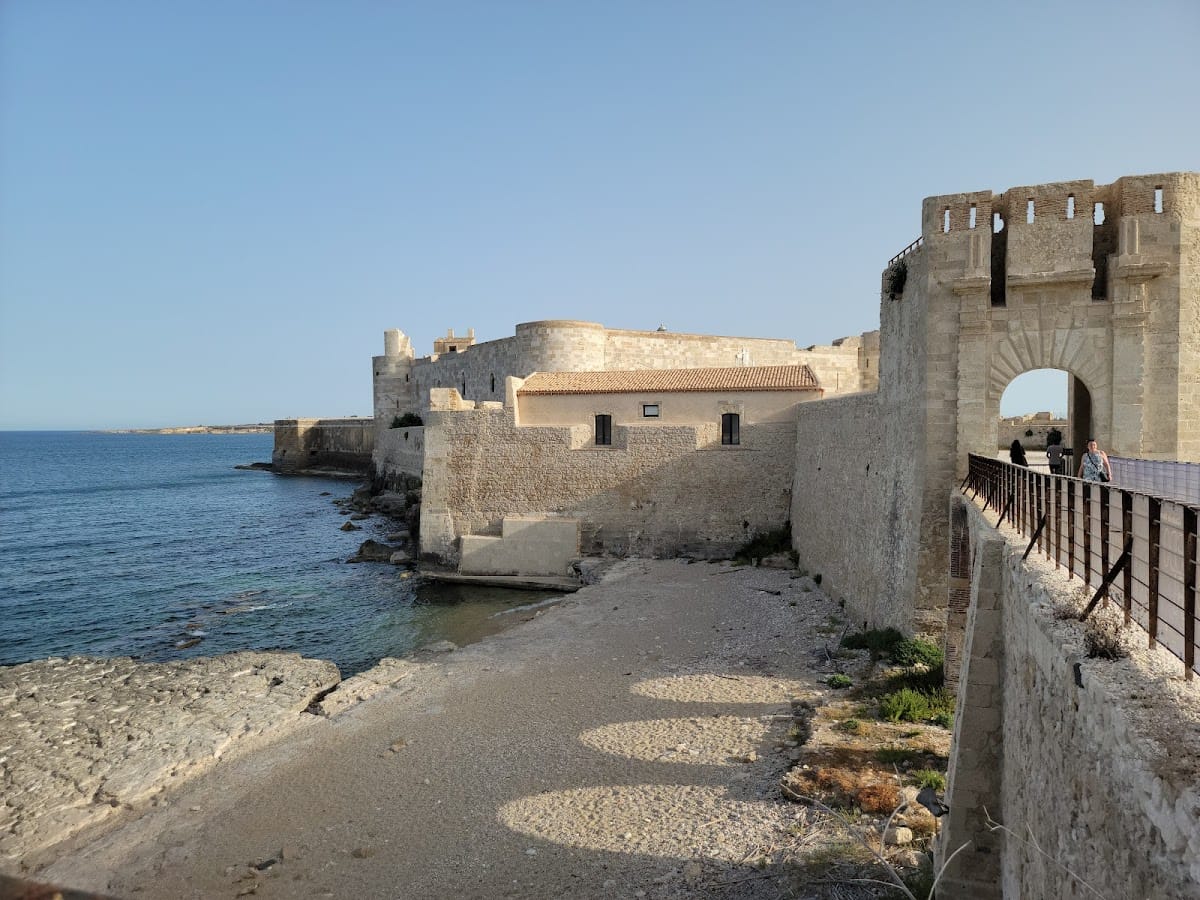
Castello Maniace is a medieval fortress in Syracuse, Italy, standing at the southern tip of Ortigia and controlling the entrance to the Porto Grande. The present castle was built for the Hohenstaufen emperor Frederick II between 1232 and 1239 in the Sicilian form of imperial Gothic architecture. It belonged to Frederick’s wider program of castle construction in southern Italy and Sicily, created shortly after his return from the Crusade to the Holy Land.
Byzantine and Norman origins
Earlier Byzantine defenses probably occupied the site. In 1038, the Byzantine commander George Maniakes may have restored or constructed fortifications there during a campaign that briefly returned Syracuse to Byzantine control. The extent and survival of those earlier works remain uncertain. Syracuse and its fortress later returned to Arab rule, which lasted until 1087, when the Normans expelled the Arabs from the city.
The Hohenstaufen and Angevin periods
Frederick II commissioned the present castle, and Riccardo da Lentini directed its construction between 1232 and 1239. In 1266, the fortress passed to the Angevins, the dynasty that took power in the Kingdom of Sicily after the Hohenstaufen period. The people of Syracuse captured it during their revolt on 11 April 1282. In 1302, Frederick of Aragon signed a truce with the Angevins at Castello Maniace.
The castle also became a royal and political center. The Sicilian Parliament met there in 1321, and in 1325 Peter II of Sicily ordered repairs to its ditches and the construction of two supporting forts. The fortress served as a residence for members of the royal family and became a dowry property of several queens between 1305 and 1536.
Baronial conflict and military conversion
Castello Maniace was drawn into conflicts between Syracuse’s barons and central authority. The barons opposed the Camera Reginale, the royal institution that administered a queen’s dower lands and revenues. In 1448, Alfonso the Magnanimous sent Giovanni Ventimiglia, Marquis of Geraci and captain general, to suppress the unrest. After inviting 20 leading participants to a banquet, Ventimiglia had them executed. The two bronze rams that had stood beside the entrance were awarded to him by the viceroy Lope Ximénez de Urrea and taken to Castelbuono.
After its decline as a royal residence, the castle served as a prison for much of the fifteenth century. From after 1535, the viceroy Ferdinando Gonzaga began strengthening eastern Sicily’s coastal defenses against raids by Muslim pirates. The military engineer Ferramolino da Bergamo adapted Castello Maniace for artillery, using stone taken from ancient monuments. The admiral Andrea Doria stayed at the fortress in 1540 during Charles V’s expedition against Muslim forces.
Spanish, Bourbon, and later military use
Earthquakes in 1542 and 1693 damaged the castle. During the seventeenth century, the Flemish military architect Carlos de Grunembergh added the diamond-shaped Forte della Vignazza at the end of the promontory. In 1614, during the reign of Philip III of Spain, an imperial shield made in 1545 for Charles V was installed above the medieval entrance.
In 1618, the castellan Joan de Roca Maldonato secured an official change of name from Maniace to Santiago de Maniace. He also renamed the four towers San Pedro, San Catalina, San Philipe, and Santa Lucia. Official documents used the new name until the nineteenth century, while the residents of Syracuse continued to call the fortress Castello Maniace.
On 5 November 1704, lightning struck the powder magazine during a severe storm. The explosion involved 300 quintals of gunpowder stored in 800 barrels, destroyed the watchtowers, brought down an entire floor, and killed 33 Spanish soldiers. It was the most serious recorded damage to the castle. Later rebuilding and alteration removed damaged sections, enlarged the dockyard, and added warehouses. A subsequent strengthening campaign associated with the English general Stuart renewed the fortress’s defensive capacity.
During the Bourbon period, the era of Bourbon dynastic rule in Sicily, and the Napoleonic era, the castle again served military purposes and was equipped with guns. In 1838, amid unrest in the Bourbon kingdom, another defensive structure was built. Castello Maniace remained a military establishment and barracks after Italian unification and continued in military use until the Second World War.
Restoration and cultural use
Near the beginning of the twenty-first century, a lengthy restoration campaign and the closure of the historic army barracks ended the site’s military use and returned the monument to public use. It was open for visits again by 2004. The Syracuse Superintendency for Cultural and Environmental Heritage administers the castle, which is designated as an Italian cultural heritage property. Following restoration, it hosted cultural activities including performances associated with the Ortigia Festival, as well as the G8 environment meeting in April 2009.
Remains
Fortress form and defenses
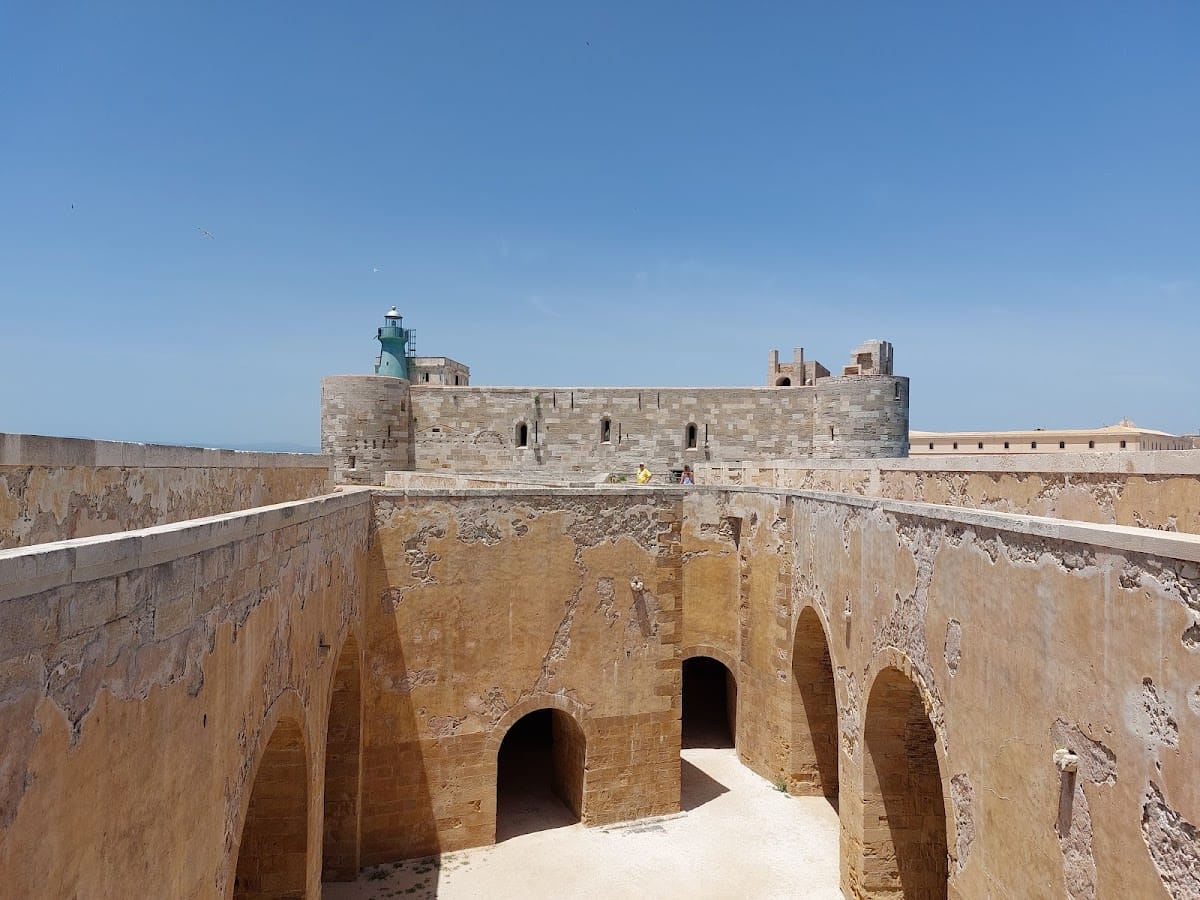
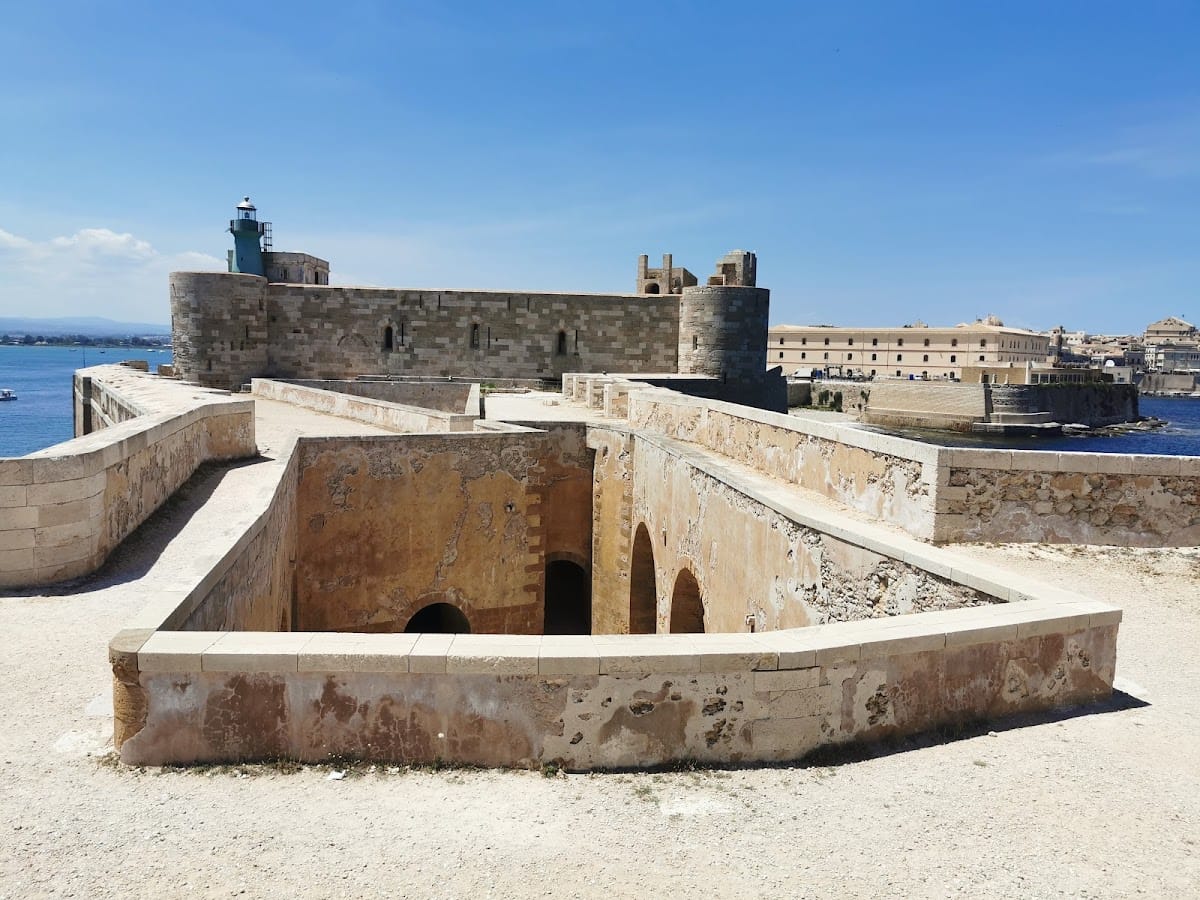
Castello Maniace is a massive square structure measuring approximately 51 metres on each side. Its present height is about 12 metres, while archaeological soundings indicate that the original walls rose to approximately 18 metres. The principal walls average about 3.5 metres thick and are built of stone in the Sicilian Hohenstaufen imperial Gothic style. Four cylindrical corner towers, each rising from an octagonal base, are integrated into the surrounding masonry. The castle originally had one or two upper stories, creating a tall keep-like profile. During the Spanish period, those upper levels were removed in part to reduce the surface exposed to artillery, producing the broader form visible today.
Great hall and vaults
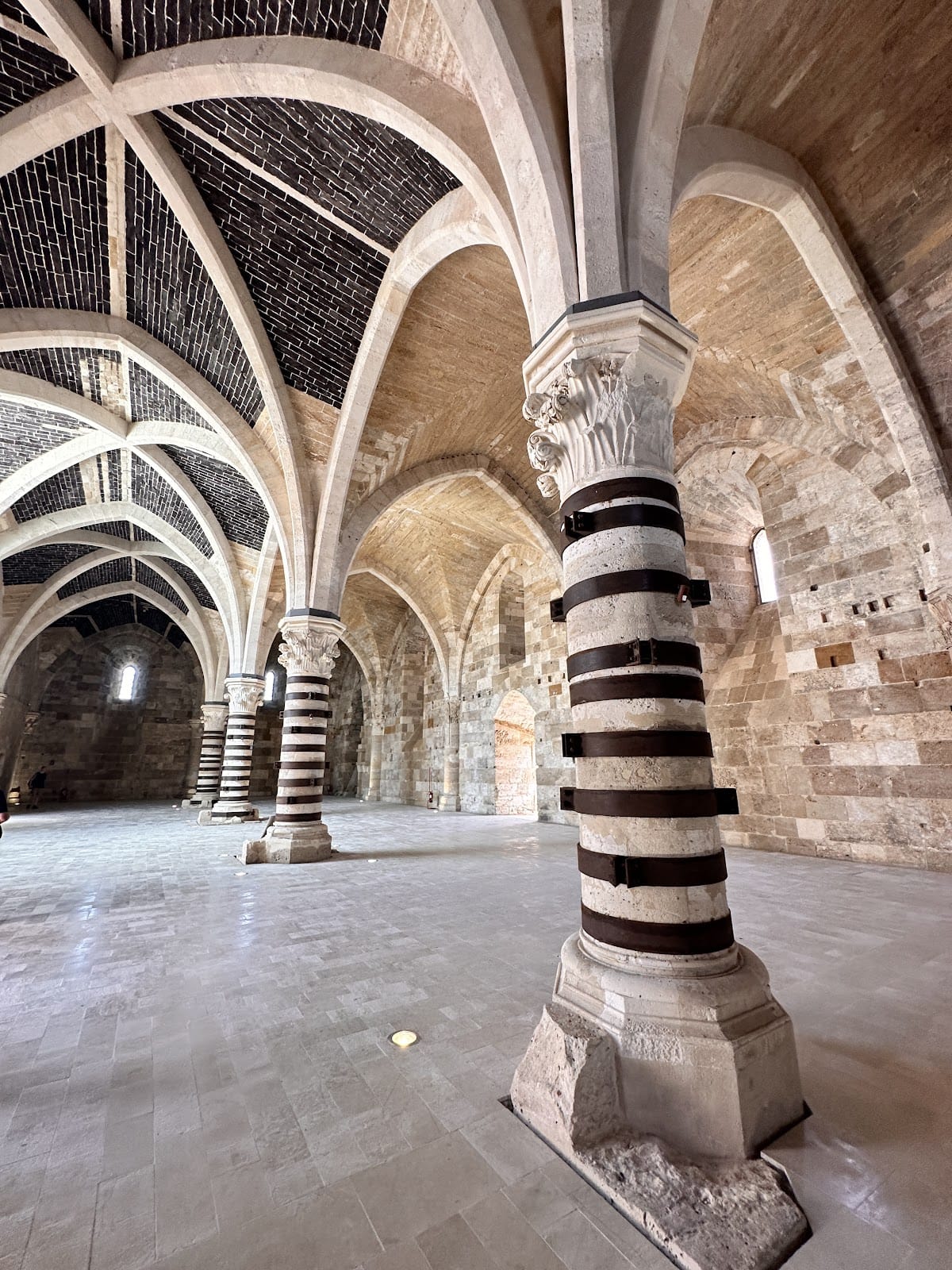
The interior was arranged around a single great hall. Its roof is formed by 24 pointed, ribbed vaults and one additional vault. These vaults were understood as representing Frederick II’s kingdoms, with Sicily at the center. Their boxed ribs are associated with Cistercian architectural traditions, including those of Clairvaux, an important medieval abbey. The vaults rested on powerful columns with exceptionally rich sculpted capitals, several of which survive.
Sea-facing sides and approach
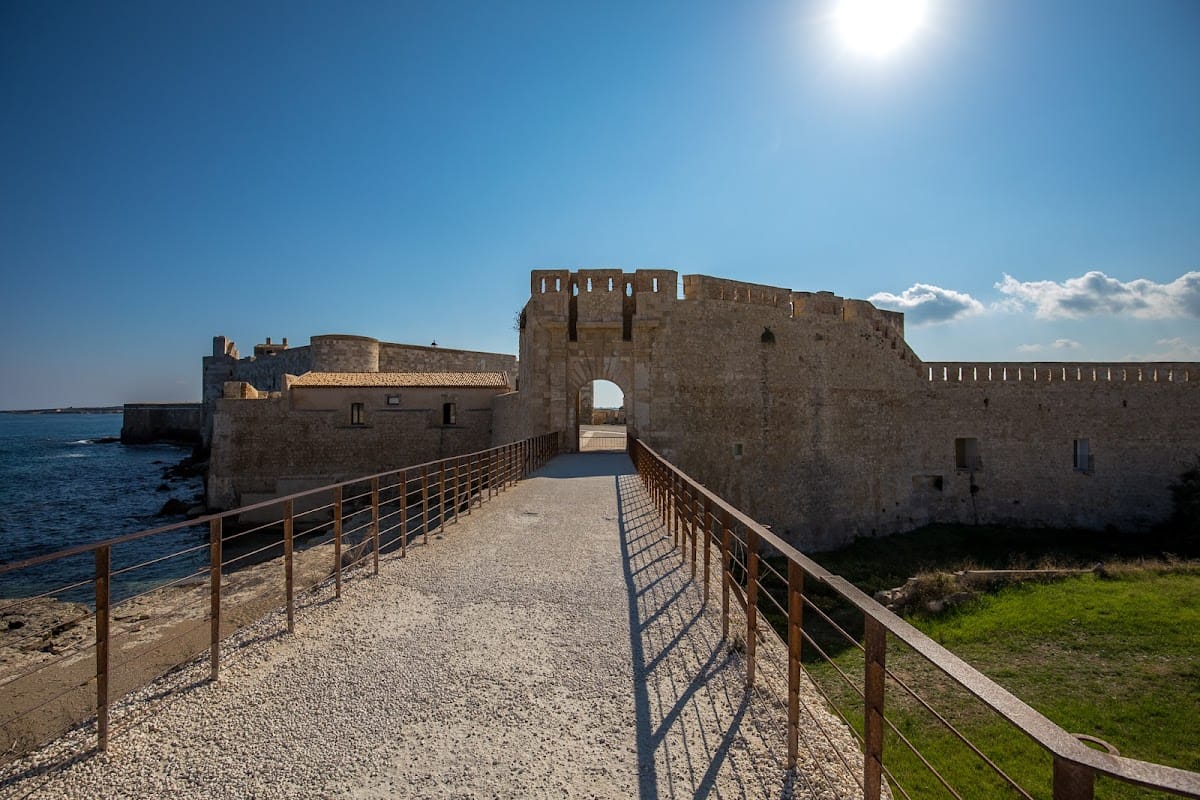
The principal facade faces Ortigia. When the castle was built, its northeastern and southwestern sides rose directly above the sea. During the sixteenth century, the Spanish added corresponding buttresses along those sides. The original approach included a broad ditch separating the fortress from the southernmost tip of Ortigia. Connected to the Porto Grande and the open sea, the ditch was crossed by a wooden drawbridge that strengthened the defense when raised. The ditch was filled during the sixteenth century. A masonry bridge now runs from the courtyard to a gate flanked by Spanish-period columns, and access is through the former Abela barracks.
Portal and entrance sculpture
The principal portal is a decorated marble entrance with deeply splayed sides that allowed extensive sculptural ornament. Erosion and damage have affected the portal, but marble colonnettes with capitals carved with hooked leaves survive between the outer jambs and inner piers. The entrance retains identifiable animal forms, including two lions and a hippogriff, a mythical creature with the foreparts of an eagle and the hindquarters of a horse. Floral motifs appear on the lower arch and on the archivolt, the decorative band that follows the curve of an arch.
Above the pointed portal is the Spanish imperial coat of arms made in 1545 and transferred there in 1614. It shows pairs of Pillars of Hercules, globes representing the earth, and flames associated with Spanish imperial power. Two Hellenistic bronze rams once decorated the entrance and were traditionally linked with George Maniakes, with an additional tradition claiming that they came from Constantinople. Removed in 1448, they were taken to Castelbuono. One is now in the Archaeological Museum of Palermo, while the other was destroyed during the disturbances of 1848.
Archaeological finds and commemorative features
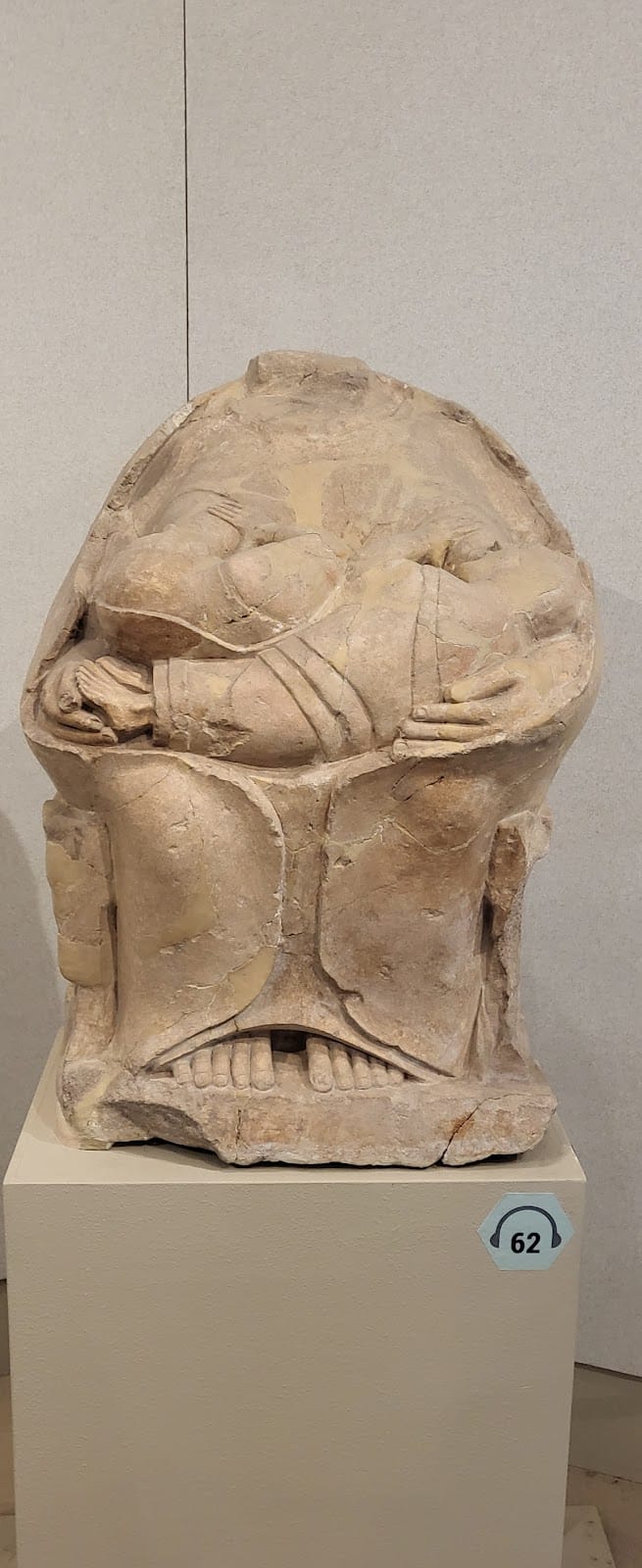
A colossal bust dating from the first or second century was found inside the building. It has been identified in turn as Poseidon, Zeus, and more recently Asclepius, so its precise identity remains unsettled. A small niche on the eastern exterior resembles the prayer niches of Islamic mosques, although its function within the castle is unknown. Many stone blocks bear marks identifying their quarry or the worker who applied them. These marks helped identify the blocks and organize later payment.
In June 2018, a Stauferstele, a commemorative stone column dedicated to the Hohenstaufen dynasty and associated figures, was erected to the left of the entrance to the square Hohenstaufen building. It commemorates Frederick II and connects the surviving fortress with the dynasty that commissioned it.