Gobustan Rock Art: A Prehistoric and Historic Rock-Art Complex in Azerbaijan
Site at a Glance
- Rating
- 4.5
- Popularity
- Medium
- Country
- Azerbaijan
- Primary era
- Stone Age
- External website
- Open
- Eras represented
- Stone Age, Bronze Age, Iron Age, Classical, Medieval, Modern
- Civilizations
- Unclassified
- Site type
- Civic
- Remains
- Rock Art
On this page9 sections
History
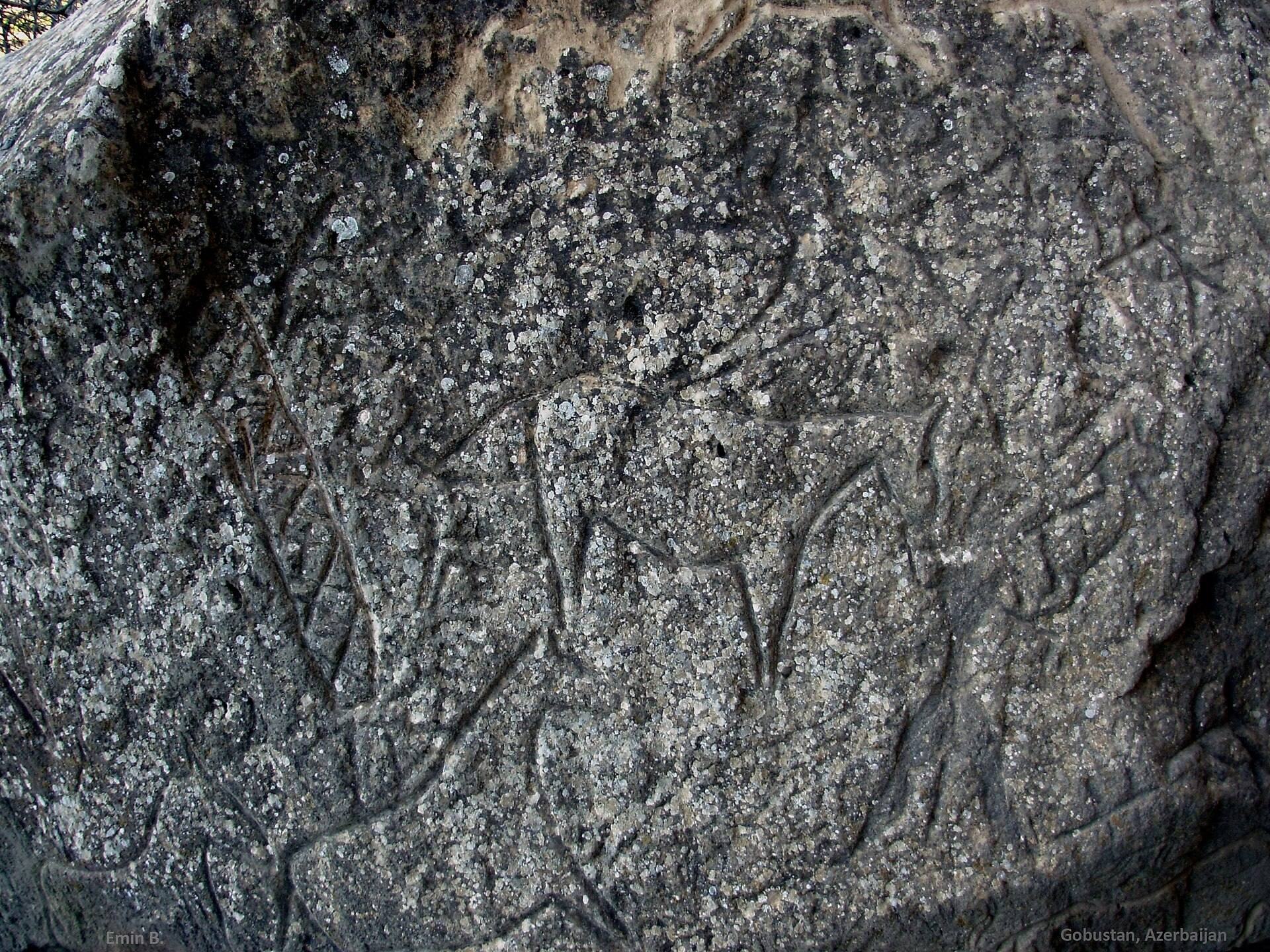
Gobustan Rock Art is a prehistoric and historic rock-art complex in Qobustan, Azerbaijan, created by communities from the Upper Paleolithic, the later part of the Old Stone Age, through the Middle Ages. Its sequence spans roughly 40,000 years, with individual carvings estimated at between about 5,000 and 20,000 years old and some considered at least 25,000 years old. The imagery traces changes in hunting, subsistence, social organization, religious ideas, and cultural expression.
Prehistoric and Ancient Phases
The earliest images belong to a long period of changing environments and economies. Representations associated with the Pleistocene, the geological epoch that included repeated ice ages, emphasize large game such as aurochs and wild horses. During the Holocene, the current geological epoch, deer, wild boar, and birds became more prominent. Later imagery reflects pastoralism, agriculture, hunting, fishing, seafaring, ritual activity, and communal gatherings.
Archaeological work has identified more than 6,000 carvings, along with settlements and burial sites dating from the Upper Paleolithic to the Middle Ages. Numerous Bronze Age structures were also found. The imagery became progressively smaller after the earliest large representations. By the eighth and ninth centuries, and in later periods, it became increasingly schematic. Hunting had declined in economic importance, while representations were more often transferred to ceramics and metal objects. The spread of Islam, a monotheistic religion with traditions that include restrictions on some depictions of living beings, was another factor associated with this later simplification.
Rock carving continued among shepherds in the Gobustan area until the end of the nineteenth century and in some cases beyond that time. The long sequence therefore combines prehistoric images with later historical marks, showing that the rocky landscape remained a place for recording signs and figures across many generations.
Rediscovery and Archaeological Research
Russian scholars knew of the Gobustan petroglyphs by the 1840s, but quarry workers accidentally brought the site to wider attention again in the 1930s. Archaeological research began in 1939 under the Azerbaijani archaeologist Ishag Jafarzadeh. He recorded approximately 3,500 petroglyphs on about 750 rocks and arranged them into six periods: the Neolithic, Late Neolithic, Eneolithic, Bronze Age, Iron Age, and Middle Ages. The Eneolithic was a period of copper use between the Stone Age and the Bronze Age.
Later investigations by F. Muradova and J. Rustamov revealed more than 1,500 additional petroglyphs. Other records preserve evidence of continuing interest in the site. A Russian-language inscription dated 1905 at the entrance to the principal cave records a visit by a person identified as Kruze. Oil engineers brought Oxford professors and their companions to the area, and the Norwegian explorer and ethnographer Thor Heyerdahl studied the boat depictions. Three or four earlier reports on the petroglyphs were also held in the archives of the St Petersburg Academy of Sciences.
Protection and Recognition
The area became the Gobustan State Historical Artistic Preserve in 1966 by decree of the Council of Ministers of the Azerbaijan Soviet Socialist Republic. The Gobustan State Historical and Cultural Reserve was established by presidential decree in 2007. That year, the Gobustan Rock Art Cultural Landscape was added to the UNESCO World Heritage List during the World Heritage Committee’s 31st session. UNESCO, the United Nations Educational, Scientific and Cultural Organization, uses the list to recognize cultural and natural properties considered to have outstanding universal value. The inscribed cultural landscape covers 537 hectares within the larger reserve, which protects archaeological, cultural, and natural landmarks.
Remains
Landscape and Distribution
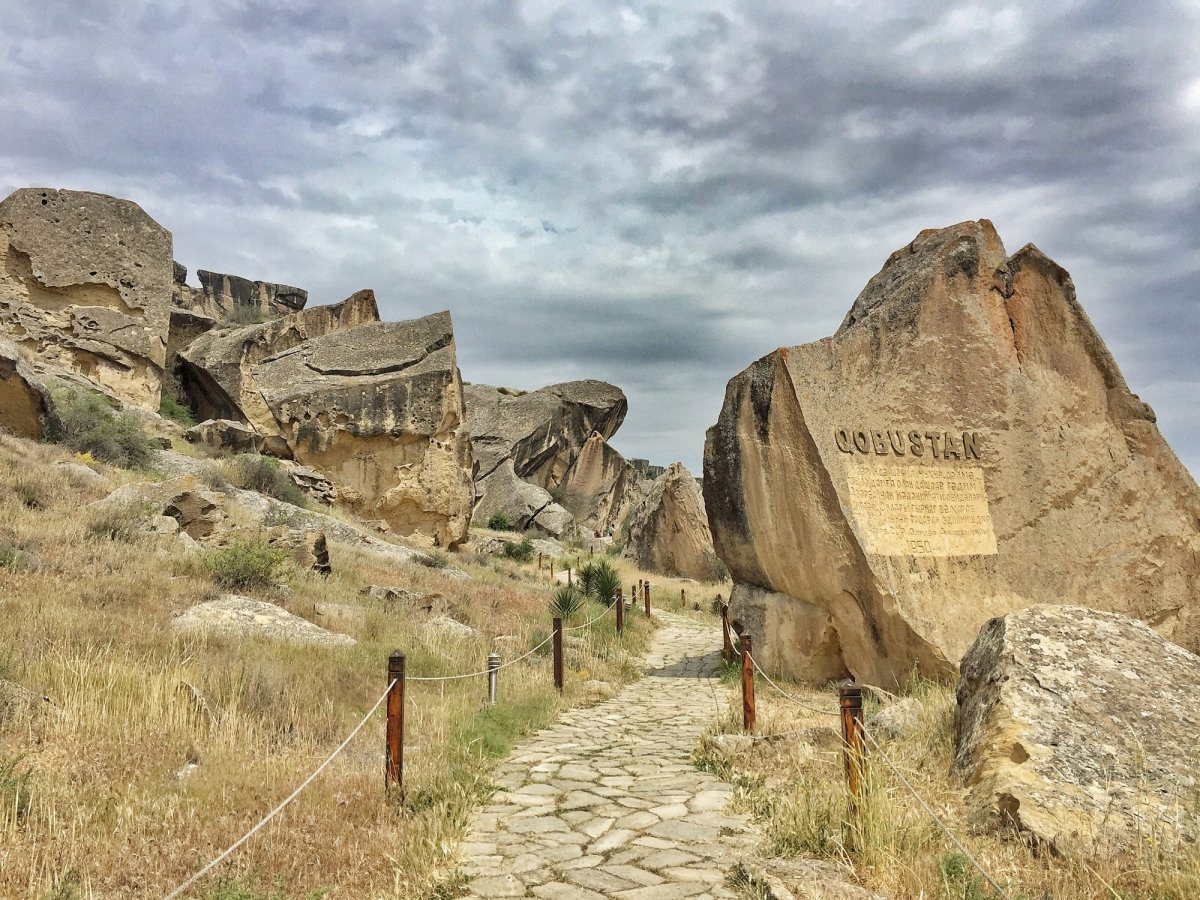
The rock-art landscape lies in the semi-arid region of central Azerbaijan, at the southeastern end of the Greater Caucasus and approximately 70 kilometres southwest of central Baku. The protected area covers 537 hectares, while the wider landscape is described as about 70 square kilometres. Its principal concentrations occupy three rocky highland areas, Boyukdash, Kichikdash, and Jingirdag. Additional carvings occur at Yazili Hill and around Kyanizadag, a large semicircular mud volcano. Most of the images are concentrated on upper surfaces and more sheltered faces of Boyukdash and Kichikdash.
More than 6,000 petroglyphs, images or signs made by carving, pecking, or incising rock, occur on more than 1,000 rock surfaces. Many are found in caves and on rock fragments. Excavations also recovered 104 small engraved stones from different layers of soil and sediment, adding portable evidence to the images cut into the landscape.
Figures, Animals, and Activities
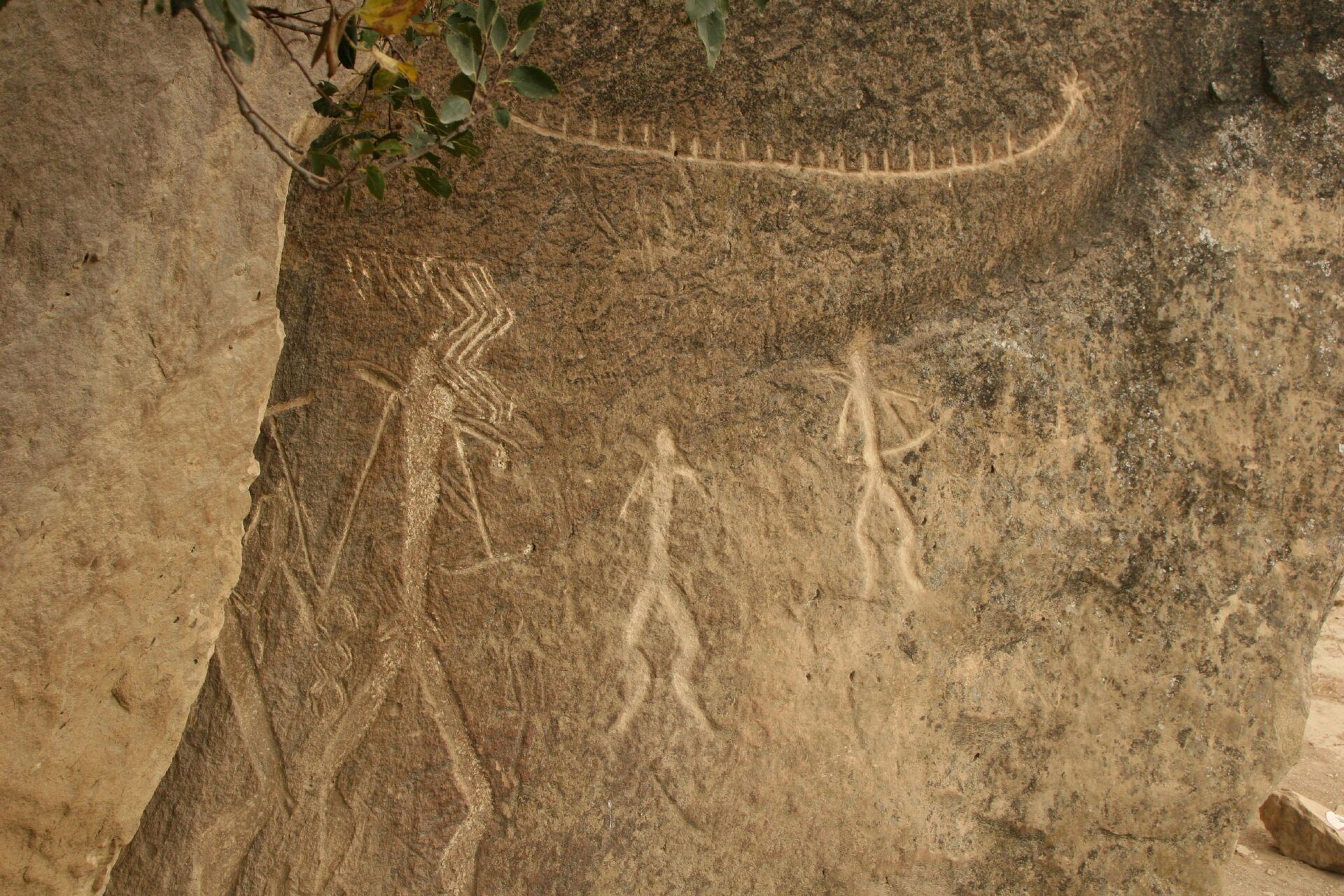
The carvings present men and women, hunters, archers, horsemen, dancers, a reaper carrying a sickle, fishermen, and people engaged in ritual or communal activity. Some male figures hold bows and arrows, while combat scenes show men carrying sticks or knives. Spears, tridents, and ropes or lassos also appear. The animal imagery includes wild goats, deer, gazelles, horses, lions, antelope, aurochs, wild boar, birds, fish, snakes, and domesticated dogs. Together, these scenes portray hunting, pastoralism, agriculture, fishing, transport, and social gatherings across successive periods.
Highland Groups and Special Sites
Boyukdash contains dance scenes tentatively dated to the third and second millennia BC, as well as mounted hunting scenes, boats, and figures carrying bows. Some boats have a sun symbol at the prow, an image associated with the Bronze Age sun cult in present-day Azerbaijan. Petroglyphs at Yazili Hill and Boyukdash include third- to second-millennium BC scenes of mounted hunting, especially of antelope, deer, and goats. Animals pierced by spears probably represented magical rituals. Sheltered rock faces carry images of hunters, dancers, men wearing tropical-style helmets, deer, and goats.
The cave known as the Seven Beauties contains representations of women. Some full-bodied figures have been interpreted as reflecting matriarchal representations, while slender women warriors carry bows. Other long boats, dated to approximately 5,000 to 8,000 years ago, have been compared with Viking ships. Their presence may indicate cultural connections or maritime interaction with the Mediterranean and other European regions, although that interpretation remains tentative.
Gaval Dash, meaning “tambourine stone,” is a resonant stone instrument associated with the early remains of Gobustan and prehistoric musical practice. The site also contains a Latin inscription dated to the reign of the Roman emperor Domitian, who ruled from AD 81 to 96. It indicates the temporary presence on the Caspian Sea shore of Legio XII Fulminata, a large permanent Roman military formation.
Chronological Imagery
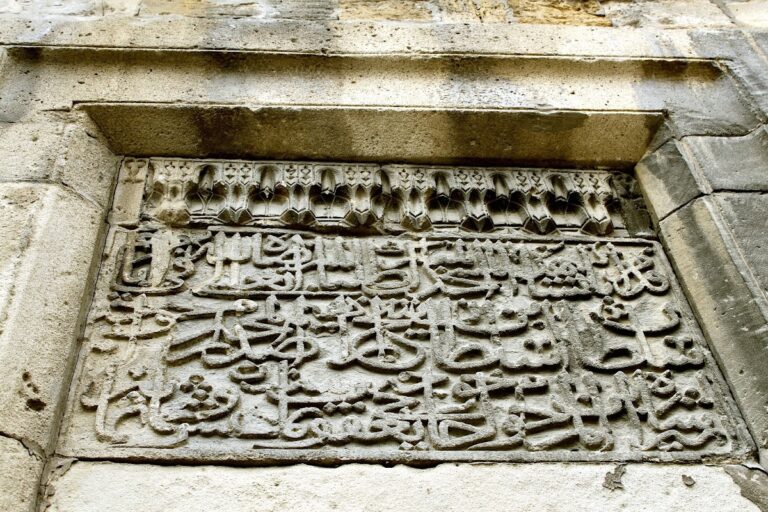
The sequence includes Neolithic men and women carrying bows and arrows, Late Neolithic bison, boats, and archers, and Eneolithic large-scale goats, lions, and deer. Bronze Age imagery includes wild animals, horses, and pigs. Iron Age figures include humans, goats, deer, and the Roman inscription. Medieval carvings include camel caravans, armed warriors, symbols, and inscriptions in Arabic and Persian. These successive groups give the rocky surfaces a layered record of changing activities and visual traditions.