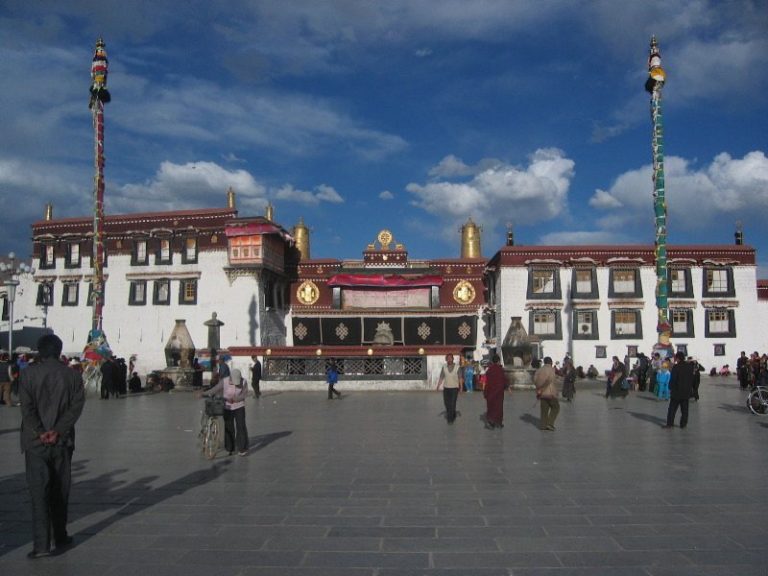
Tsurphu Monastery: Principal Seat of the Karmapa
Site at a Glance
- Rating
- 4.6
- Popularity
- Very Low
- Country
- China
- Primary era
- Medieval
- Eras represented
- Medieval
- Civilizations
- Tibetan
- Site type
- Religious
- Remains
- Monastery
On this page15 sections
History
Tsurphu Monastery is a Tibetan Buddhist monastery in Gurum, Doilungdêqên District of Lhasa, China, and the traditional principal seat of the Karmapa, the spiritual leader of the Karma Kagyu lineage. Founded by Düsum Khyenpa, the First Karmapa, in 1189, the monastery stands at roughly 4,267 to 4,300 metres above sea level and has remained an important centre of the Kagyu tradition for about eight centuries.
Foundation and the Karmapa lineage
Düsum Khyenpa first visited the site in 1159. He made offerings to local protective deities, blessed the area, and established a small retreat dwelling. Three decades later, he founded the main monastery and made Tsurphu his principal seat. It subsequently served as the residence of successive Karmapas, whose lineage forms the central institution of the Karma Kagyu school.
The monastery grew into an extensive complex that reportedly accommodated about 900 to 1,000 monks. Before 1959, it comprised four monasteries within one larger monastic domain. One of these served as the seat of the Gyaltsab Rinpoches, senior Karma Kagyu figures who traditionally act as regents between successive Karmapa incarnations. A Yelpa Kagyu monastery at Jang Tana in Nangchen, Kham, was regarded as a branch monastery of Tsurphu.
Expansion under Karma Pakshi
Karma Pakshi, the Second Karmapa, settled at Tsurphu late in his life and expanded the complex. His building work included a large shrine hall, a purification hall, and a courtyard. He also commissioned a monumental bronze image of the Buddha after experiencing a dream connected with the project.
The image became associated with a tradition that it leaned slightly to the left after it was completed. According to the story, Karma Pakshi straightened it by blowing three times, then consecrated it and named it “Blazing Splendour, Ornament of the World.” The image was about 16 metres high and contained relics attributed to Gautama Buddha and some of his disciples.
Ming connections and later religious art
In 1407, the Yongle Emperor of the Ming dynasty invited the Karmapa to Nanjing. The Karmapa taught there and conducted religious ceremonies, after which the emperor ordered illustrated records of miraculous events associated with these activities. The captions were written in five scripts. One of the scrolls remained at Tsurphu until shortly before the Cultural Revolution.
A later artistic commission came from Wangchuk Dorje, the Ninth Karmapa. Around 1582, when he was about 25, he ordered a monumental appliqué thangka, a religious textile image assembled from cut and sewn pieces of cloth, from artists of the Karma Gadri school. The work was displayed once a year during Saga Dawa, an important Tibetan Buddhist festival associated with sacred events in the Buddha’s life.
Destruction and reconstruction
Tsurphu was placed on the list of major protected historical and cultural sites of the Tibet Autonomous Region in 1962. Four years later, at the beginning of the Cultural Revolution, the monastery was completely destroyed. The destruction included the monumental Buddha image commissioned by Karma Pakshi.
Reconstruction began around 1980 at the initiative of Rangjung Rigpe Dorje, the Sixteenth Karmapa, who died in 1981. Lobsang Yeshe then led the restoration effort and obtained permission to rebuild the site. Government funding supported reconstruction from 1983, including the Zhiwa Tratsang monastic college, retreat centres, and the palace of Gyaltsab Rinpoche. Droupeun Detchen Rinpoche returned to Tsurphu in 1984 to supervise the rebuilding, and the present monastery emerged through his direction and the work of many contributors.
Ogyen Trinley Dorje, recognized as the Seventeenth Karmapa by the Tai Situpa, the Dalai Lama, and Chinese government offices, was enthroned at Tsurphu. He lived there until leaving Tibet for India in 2000. In 1997, he commissioned an approximately identical replacement for the monumental Buddha image destroyed during the Cultural Revolution. Tsurphu therefore combines a history reaching back to the late twelfth century with continuing restoration after the destruction of the twentieth century.
Remains
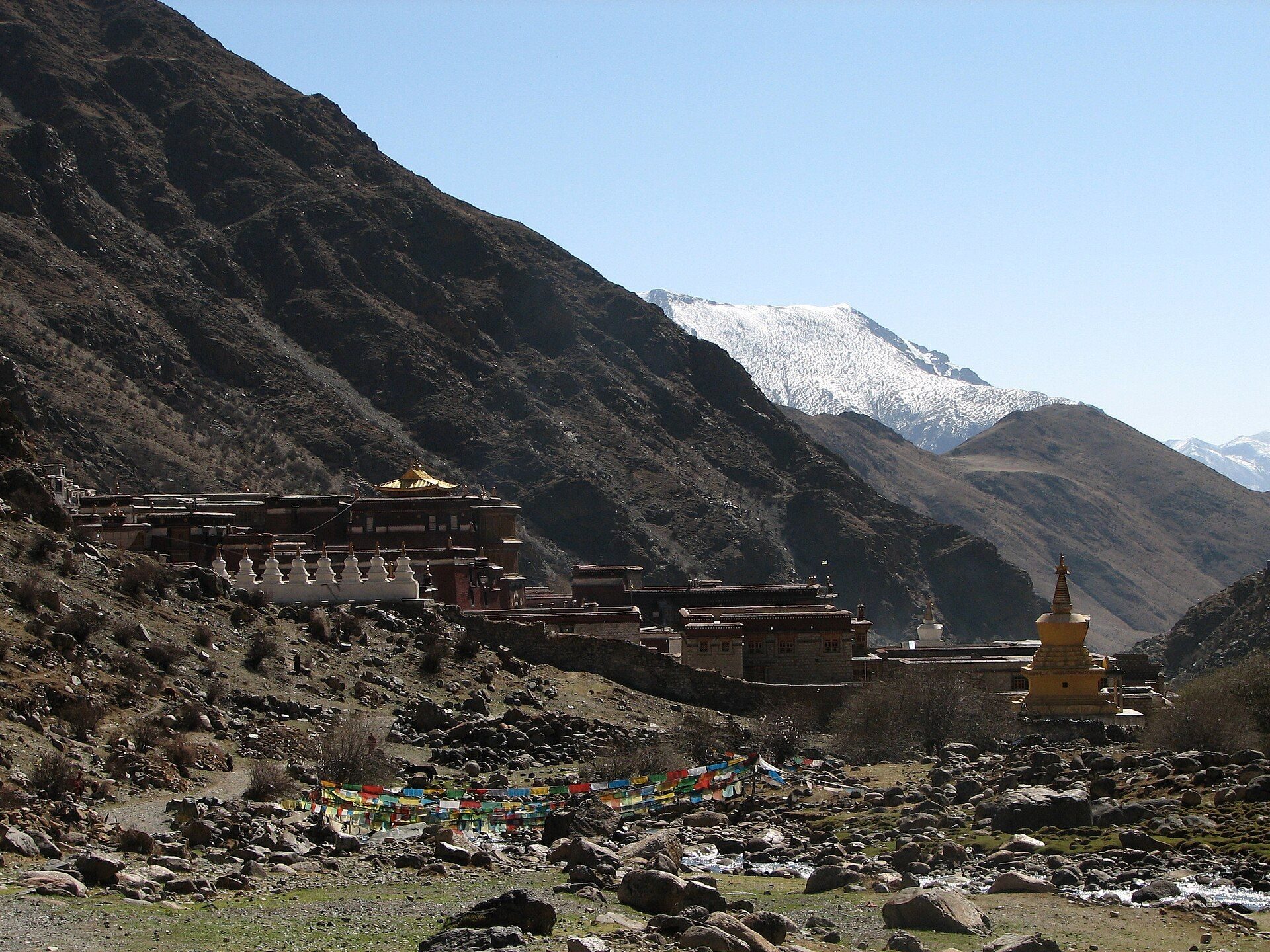
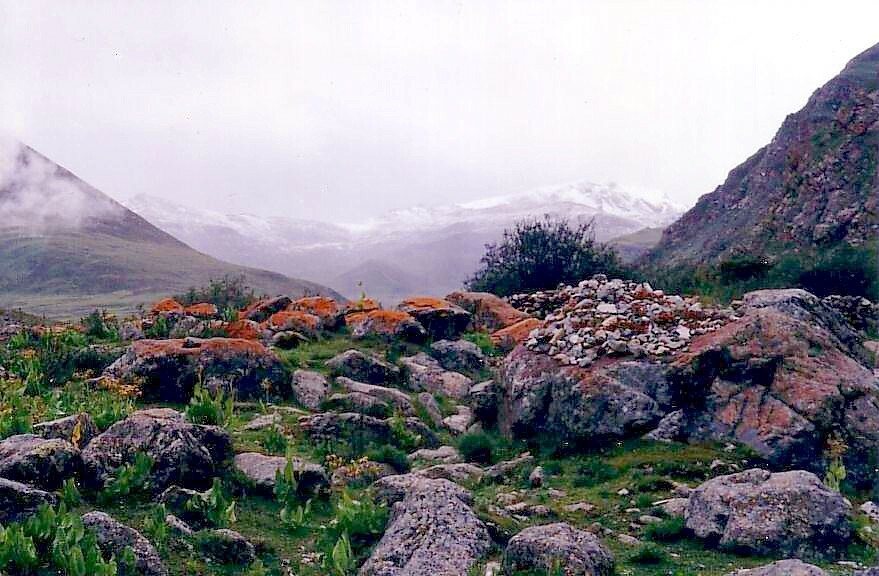
Tsurphu lies in a south-facing valley surrounded by high mountains, with a river beside the monastic complex. Three surrounding mountains are regarded by Buddhists as sacred residences of deities, while nearby caves have distinctive geomantic features, understood through the sacred qualities and spatial arrangement of the landscape. Together with the mountainside display slope and a nomadic camp above the monastery where juniper-burning ceremonies were held, these features form part of Tsurphu’s religious setting.
Monastic enclosure and rebuilt buildings
Enclosure and monastic domain
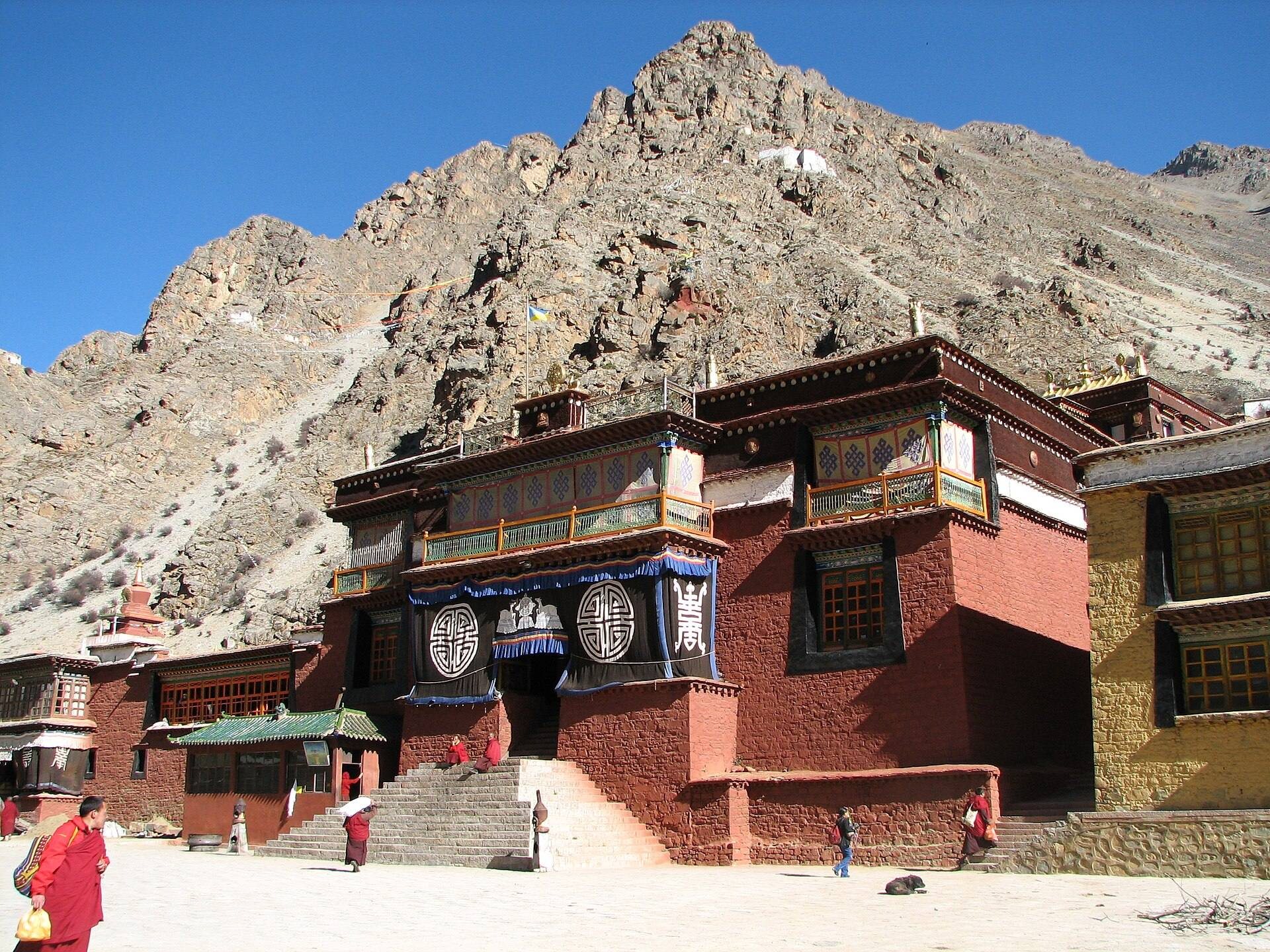
The older complex had walls up to 4 metres thick. Its main enclosure extended roughly 300 metres on each side, with monks’ residences along the eastern side. The rebuilt monastic area includes the Zhiwa Tratsang, retreat centres, and the palace of Gyaltsab Rinpoche, restoring several principal components of the complex after its destruction.
Mountainside display slope
Opposite the monastic domain, a large stepped slope faced with stone was used for the display of a huge thangka. The slope provided the physical setting for the annual presentation of the monumental textile image during Saga Dawa.
Images and commemorative monuments
Monumental Buddha image
The Buddha image commissioned by Karma Pakshi was cast in bronze and stood about 16 metres high. Relics attributed to Gautama Buddha and some of his disciples were placed inside it. Explosives destroyed the image during the Cultural Revolution, and a replacement of approximately the same form was constructed in 1997.
Reliquary stupas and shrine images
The complex contained large images of Avalokiteshvara, the bodhisattva associated with compassion, and the Five Tathagatas, a group of five buddhas in tantric Buddhist teaching. Reliquary stupas, Buddhist monuments used to enshrine sacred relics, were dedicated to Düsum Khyenpa and Karma Pakshi. Each was said to contain the associated figure’s heart, tongue, and eyes, and two flexible-bodied bodhisattva images stood beside them.
A later shrine dedicated to Great Compassion housed another image of Avalokiteshvara. A large finial, together with a pair of golden birds said to have come from a treasure source, was installed at the summit of a principal structure. A biographical account also places an image of the Buddha in the inner chamber of the Eight-Pillared Sleeping Quarters in the great encampment.
Thangka and ritual objects
Monumental appliqué thangka
The thangka commissioned by Wangchuk Dorje measured about 35 metres high and 23 metres wide. Made in brocade using the appliqué technique, it showed Shakyamuni Buddha at the centre, with the bodhisattvas Manjushri and Maitreya around him. The Karmapas and Vajradhara appeared above, while Mahakala Bernagchen, a protector deity associated with the Karma Kagyu tradition, appeared below. The work was displayed on the mountainside facing the monastery during Saga Dawa.
Sacred holdings
Tsurphu’s historic sacred holdings included relics attributed to Gautama Buddha, the heart, tongue, and eyes attributed to Gampopa, and a tooth attributed to an arhat. Objects associated with Milarepa included an alms bowl and staff. Other religious objects included robes associated with an early teacher, alms bowls associated with two revered figures, ritual bells, robes, and a white conch used for monastic assemblies.
The monastery also held about 150 volumes of the Kangyur, the Tibetan Buddhist collection of translated texts attributed to the Buddha, written entirely in gold and silver. A white conch offered by a Red Hat master to Karma Rangjung Dorje was later fitted with wings made from hammered green-gold metal. It was kept among ritual offerings associated with Vajrasana and Gandhola, two Buddhist sacred place-names.