Temple of Satet: An Ancient Egyptian Sanctuary of the Nile Inundation
Site at a Glance
- Rating
- 3.9
- Popularity
- Very Low
- Country
- Egypt
- Primary era
- Classical
- Eras represented
- Bronze Age, Iron Age, Classical
- Civilizations
- Egyptian, Ptolemaic, Roman
- Site type
- Religious
- Remains
- Temple
On this page19 sections
History
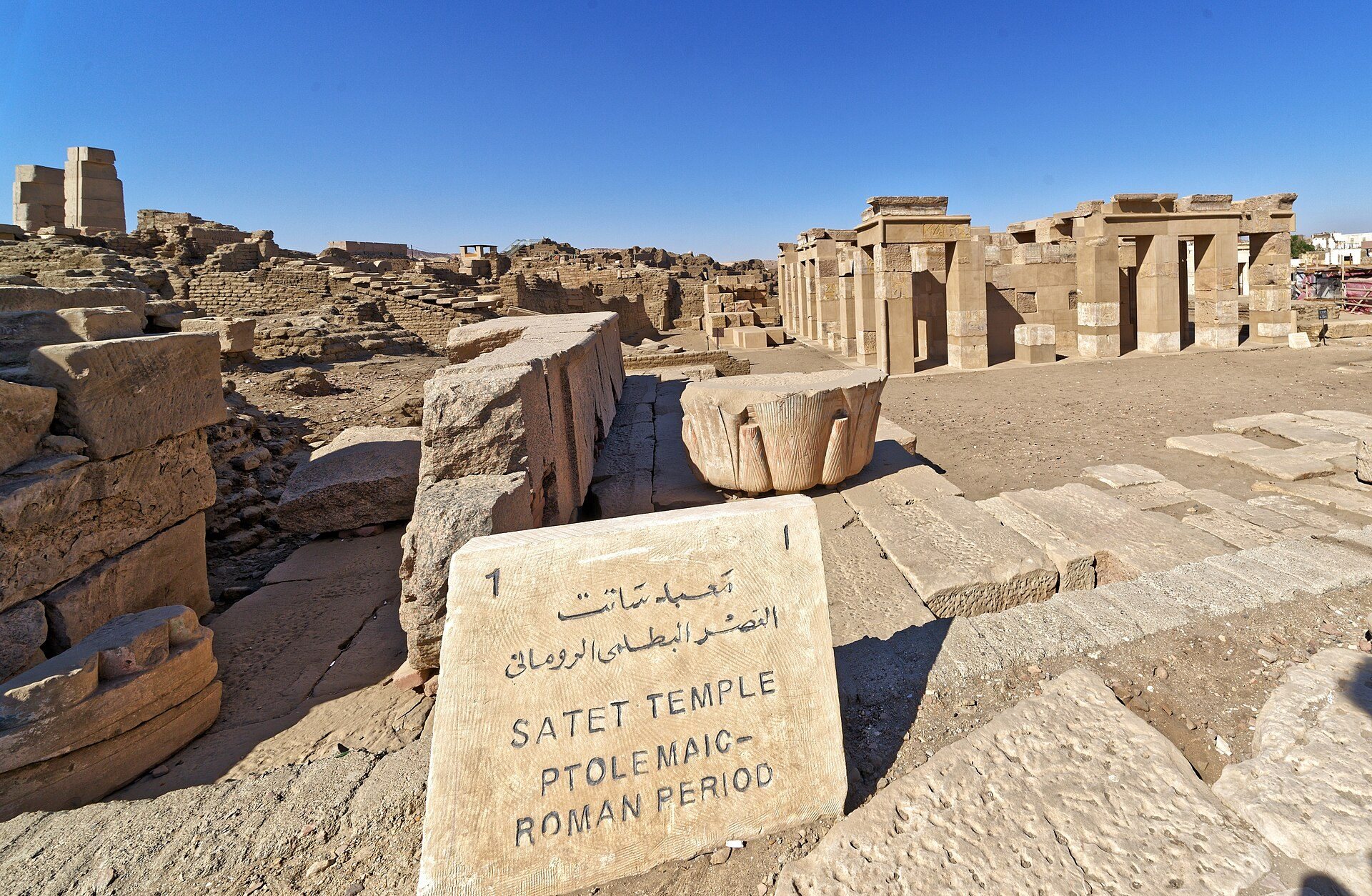
The Temple of Satet, also known as the Satis Temple, is an ancient Egyptian sanctuary on Elephantine Island at Aswan in Egypt. Dedicated to Satet, the goddess associated with the annual inundation of the Nile, it was founded around 3200 BC during the late Predynastic Period and developed through repeated rebuilding from the Early Dynastic Period to the Ptolemaic Period. Its long construction history reflects the religious importance of Elephantine at the First Cataract and the belief that the Nile flood began there.
Predynastic and Old Kingdom foundations
The earliest sacred place consisted of a very small mud-brick sanctuary set between three natural granite boulders. Fragments of Late Naqada III vessels belong to this early phase. During the First and Second Dynasties, the temple was enlarged, and it was rebuilt in the Third Dynasty while retaining its earlier plan. Maintenance and reconstruction continued during the Old Kingdom.
A major rebuilding took place during the Fifth Dynasty, possibly under Nyuserre Ini. The sanctuary was enlarged, a forecourt and open walkway were added, and granaries together with a mud-brick administrative building occupied the southern side. Pepi I later ordered another reconstruction during the Sixth Dynasty. The earlier sanctuary was retained, its brick walls were enlarged, and a granite shrine for the goddess’s image was installed. Khnum, the ram-headed creator god especially worshipped in the First Cataract region, was also venerated at the temple by this time.
In the fifth year of the reign of Merenre Nemtyemsaf I, Pepi I’s successor travelled to Elephantine to receive the submission of Nubian chiefs. He may also have visited the temple to renew the shrine erected by his father. These royal connections linked the sanctuary’s religious role with Egypt’s southern frontier.
First Intermediate Period and Middle Kingdom transformations
Near the end of the First Intermediate Period, Intef III of Thebes extensively renovated the temple while keeping the central chapel in its original position. Mentuhotep II later altered the complex, built a new sanctuary, added inscriptions, and installed facilities for ceremonies connected with the Nile inundation.
Early in the Twelfth Dynasty, Senusret I replaced Mentuhotep II’s structure with a new limestone temple and courtyard. The earlier sanctuary remained beneath the new building, preserving the traditional sacred location. Khnum was subsequently given a separate temple on Elephantine, while Satet’s sanctuary continued its distinct association with the Nile flood and the island.
New Kingdom and later rebuilding
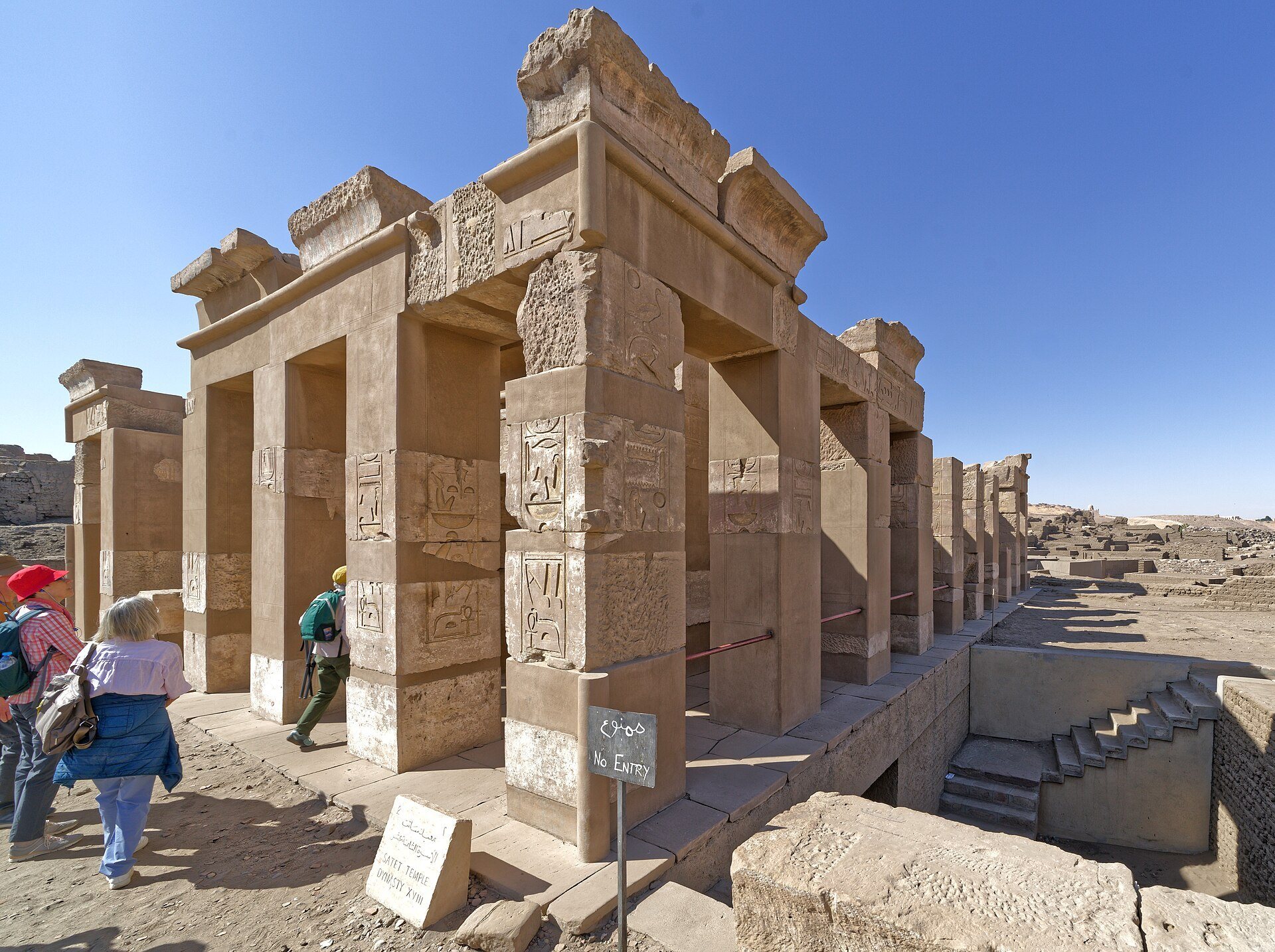
During the early Eighteenth Dynasty, Hatshepsut rebuilt the temple in sandstone, and Thutmose III enlarged it. Further construction took place during the Twenty-sixth Dynasty. Shortly before the Persian conquest of Egypt, Amasis II added a colonnade or kiosk, a small freestanding columned structure.
Satet was regarded as the Lady of Elephantine, the wife of Khnum and the mother of Anuket, a goddess associated with the Nile and its cataracts. The temple’s religious identity therefore rested on a divine family connected with the river and its southern landscape.
During the Ptolemaic Period, Ptolemy VI built an entirely new temple. Its sanctuary was no longer placed directly over the Old Kingdom sanctuary, indicating that the earlier location and its significance had by then been forgotten. Ptolemy VIII later added a columned pronaos, or vestibule in front of the temple sanctuary.
The temple’s associated Nilometer, a stairway used to measure and record the Nile’s level, was rebuilt and repaired during the Roman period. Its inscriptions and water-level records preserved the connection between the sanctuary and the annual inundation.
Remains
Early sanctuary and Old Kingdom complex
Rock sanctuary and early shrines
The earliest sacred installation occupied a niche between three natural granite boulders, each about 3.6 metres high. A mud-brick sanctuary measuring approximately 2 by 2 metres stood in this space. A nearby rock was associated with a tradition that sounds of rising water could be heard shortly before the inundation. During the Early Dynastic Period, a small shrine measuring about 1.6 by 2.2 metres was built and later supplied with a forecourt. Mud-brick structures occupied the eastern side, while granaries were added south of the rock niche.
Fifth-Dynasty sanctuary
The Fifth-Dynasty complex had an enlarged sanctuary centred on the rock niche, a forecourt of approximately 5 by 5 metres, and an open walkway around it. Granaries and a mud-brick administrative building stood along the southern side. Beneath the sanctuary floor, a deposit of votive offerings contained small faience figures of humans and animals dedicated over several centuries of the Old Kingdom by royal and private worshippers.
Pepi I’s shrine
Pepi I’s reconstruction preserved the established layout while enlarging the brick walls and sanctuary. It included a granite naos, an enclosed shrine for the goddess’s image. Additional offerings accumulated within the sacred area, creating deposits associated with the continuing use of the sanctuary.
Middle Kingdom buildings and sculpture
Intef III and Mentuhotep II works
In the renovation attributed to Intef III, the hall before the central chapel was paved and, for the first time, faced with decorated limestone slabs. Mentuhotep II’s complex included a new sanctuary, inscriptions, a northern columned courtyard, and a lakeside installation connected with ceremonies for the Nile inundation. Most of the construction remained mud-brick, while decorated limestone blocks were used for the most important walls.
Senusret I’s limestone temple
Senusret I’s temple and courtyard were built entirely of limestone above the level of the earlier rock niche. The principal sanctuary stood directly over the older sanctuary, maintaining the traditional sacred location. The building was extensively decorated, and surviving fragments include portions of a long royal inscription.
Royal statues
Several statues originally belonging to the Temple of Satet were found near the sanctuary of the local saint Heqaib. Their inscriptions identify a statue of the Thirteenth-Dynasty king Amenemhat V dedicated to Satet, a statue of Senusret III, and a dyad showing the Seventeenth-Dynasty king Sobekemsaf I worshipping the goddess.
New Kingdom and Twenty-sixth-Dynasty remains
New Kingdom temple
The New Kingdom temple was a solid rectangular building measuring approximately 15.9 by 9.52 metres. A walkway about 20.10 by 13.52 metres enclosed it on all four sides, with an outer arrangement of seven by ten pillars. Its sanctuary was built directly above the sanctuaries of earlier periods, continuing the long-established sacred position.
Gateway and kiosk
Blocks attributed to the Twenty-sixth Dynasty belonged to a gateway that was once approximately 7.35 metres high and opened onto a brick enclosure wall. Amasis II added a kiosk or colonnade with six limestone columns and screen walls, extending the architectural arrangement shortly before the Persian conquest of Egypt.
Ptolemaic temple and Nilometer
Ptolemy VI’s replacement temple
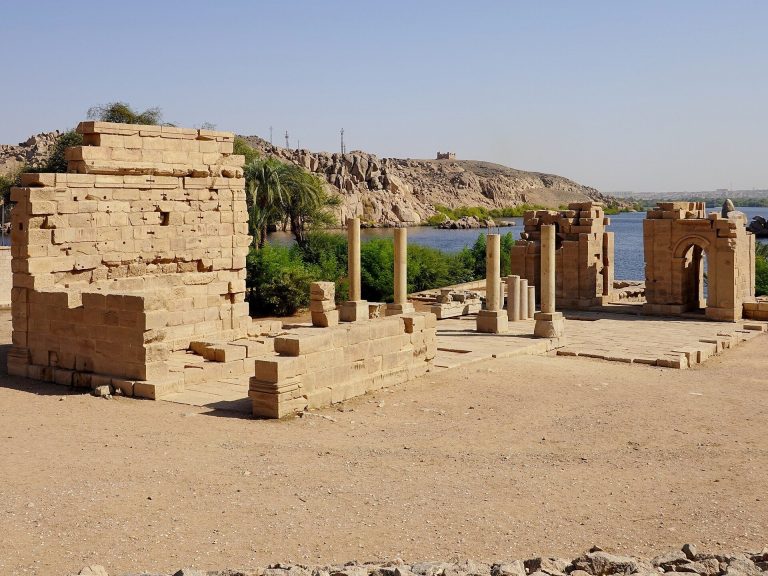
Ptolemy VI’s replacement temple had a rectangular plan. The main sanctuary occupied the western rear, preceded by a broad hall. Two smaller halls lay farther forward, with small rooms opening from their short sides. A freestanding kiosk stood in front of the temple, and Ptolemy VIII added a pronaos with eight columns arranged in two rows of four.
Nilometer
The Nilometer associated with the temple is among the best-preserved examples on Elephantine Island. Its stairway descends toward the water and bears numerals in Arabic, Roman, and hieroglyphic forms. A Seventeenth-Dynasty inscription appears at the waterline, while the western wall preserves records of high water written in Demotic and Greek.