The Underwater Harbor at Caesarea: An Artificial Roman Harbor
Site at a Glance
- Rating
- 4.7
- Popularity
- Low
- Country
- Israel
- Primary era
- Classical
- External website
- Open
- Eras represented
- Classical, Medieval
- Civilizations
- Crusader, Kingdom of Jerusalem, Roman
- Site type
- Infrastructure
- Remains
- Harbour
On this page10 sections
History
The Underwater Harbor at Caesarea is an ancient artificial harbor at Caesarea in Israel, built under Herod the Great in the late first century BCE. Herod began the port before establishing Caesarea Maritima, the city named in honor of Augustus, the first Roman emperor. Construction of the city and harbor lasted 12 years and was completed in the late first century BCE.
Foundation under Herod
In 31 BCE, after Augustus defeated his rival at the Battle of Actium and became the dominant power in the Roman world, he granted Herod the settlement and the entire coast of the Land of Israel. Herod chose the site for both strategic and economic reasons. The sandy coast had no substantial natural harbor, while its position offered access to agricultural areas and convenient land routes.
The port enabled Caesarea to participate in the grain trade between Rome and Alexandria, the empire’s principal grain-supplying center. It also allowed the new city to become an economic and political center of the region. At a time when Mediterranean ports generally relied on natural anchorages, the construction of a large artificial harbor demonstrated Herod’s power and reinforced his political influence.
Trade and later history
Trade through the harbor included spices used in preservation, medicine, cosmetics, and dyes, together with luxury textiles and gemstones. Demand for these goods expanded across the Roman Empire during Augustus’s reign. The harbor is described as the earliest discovered port from the Roman imperial period to apply engineering recommendations associated with Vitruvius, a Roman architect and engineer who was a contemporary of Herod. It is also described as the first artificial port in history and as the largest and most technologically advanced port in the Roman Empire in its time.
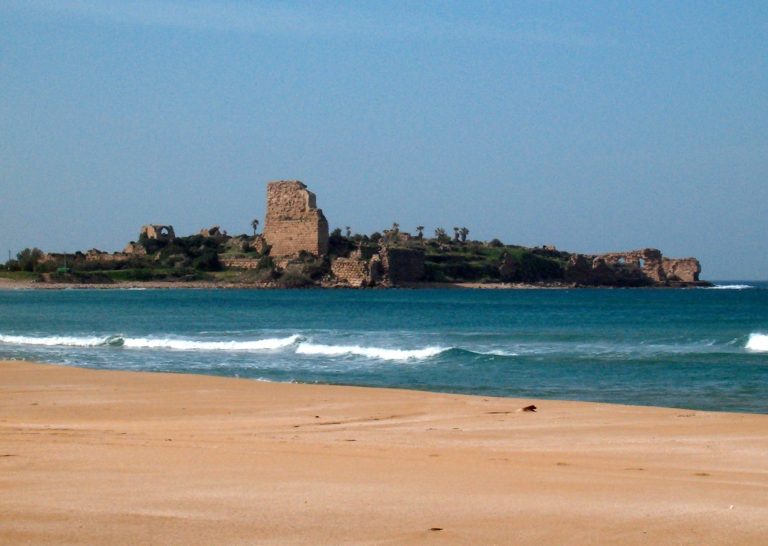
The ancient harbor remained in use for only about 100 years. The present-day port at Caesarea is a smaller Crusader harbor used during the eleventh and twelfth centuries. The location of the ancient harbor was forgotten until its rediscovery in 1960. Underwater excavations took place mainly between 1975 and 2004 under the direction of Professor Avner Raban at the University of Haifa’s Center for Maritime Studies.
In November 2024, the harbor became part of a marine national park declared by the Israel Nature and Parks Authority. Covering approximately 1,082 dunams, the park was the first marine national park declared in Israel.
Remains
Harbor infrastructure
Piers and breakwaters
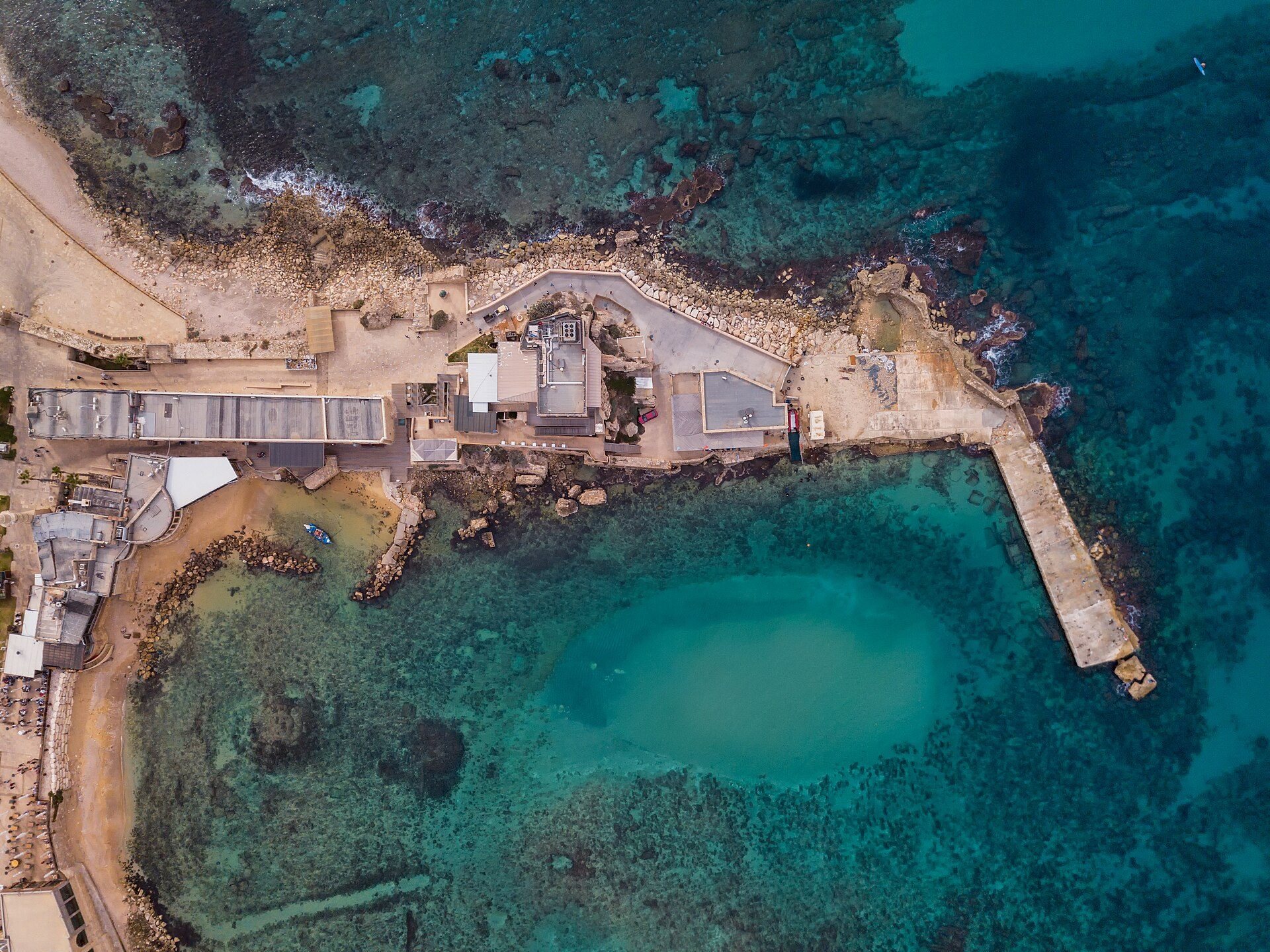
The harbor was the first pier harbor in the eastern Mediterranean and was constructed artificially on a sandy coast. Its piers were built at sea on wooden barges, creating a harbor capable of accommodating at least 100 large ships. A breakwater approximately 600 to 700 meters long sheltered the harbor from waves and currents.
Lighthouse and sailors’ lodgings
A lighthouse formed part of the harbor works, together with lodgings for sailors in the harbor area. These installations supported the operation of a large port whose remains now lie underwater. The surviving harbor structures can be viewed by diving in Caesarea harbor.
Warehouses and ceremonial buildings
Warehouses
Numerous warehouses stood east of the port for imported and exported goods. Their remains were still located east of the harbor, within the Crusader city, in 2017.
Platform and temples
An architect created a broad platform above the warehouses. Temples dedicated to Augustus and Roma, the Roman personification and goddess of Rome’s city and power, were built on the platform. Together, the platform and temples formed part of the architectural setting associated with the harbor and the city founded under Herod.