Bouchout Castle: A Medieval Stronghold and Neo-Gothic Estate in Belgium
Site at a Glance
- Rating
- 4.4
- Popularity
- Low
- Country
- Belgium
- Primary era
- Modern
- External website
- Open
- Eras represented
- Medieval, Early Modern, Modern
- Civilizations
- Belgian, Duchy of Brabant, Holy Roman Empire
- Site type
- Military
- Remains
- Castle
On this page11 sections
History
Bouchout Castle is a medieval castle in Meise, Belgium, first fortified around 1150 and given its present neo-Gothic character in the nineteenth century. It stands in territory that helped form the Duchy of Brabant, a major medieval principality in the Low Countries whose rulers competed with neighbouring powers and local lords for control of land and trade routes.
Origins in the Duchy of Brabant
In the twelfth century, the Bouchout domain occupied a strategic position between the County of Flanders and the Berthout lords of Grimbergen. The Berthouts controlled important routes linking Bruges and Cologne. After establishing Nedelaar Castle in 1148, Godfrey III of Leuven ordered a second fortification on the Bouchout Domain and granted the land to Wouter van Craaynem, with instructions to build a stronghold there.
The first Bouchout fortification probably arose around 1150, although its original form remains uncertain. It may have begun as a fortified residence rather than a large castle. Wouter’s son Willem held only about 120 to 160 hectares around 1160 to 1170, which is consistent with a relatively modest early establishment. The wider military setting was shaped by the Grimbergen Wars, a conflict between Brabant and Flemish forces and the Berthout family. The Berthout castle at Grimbergen was burned after their defeat in 1159.
The Van Bouchout family
Daniel van Bouchout, Willem van Craaynem’s grandson, was the first member of the family to use the name Van Bouchout. He fought at the Battle of Worringen in 1288 and played a major part in capturing Reinoud van Gelre. Following the Brabant victory, Daniel became an adviser to Duke Jan I of Brabant. He is closely associated with the transformation of the earlier fortified residence into a larger castle around 1300, although the donjon, the principal fortified tower of a medieval castle, is dated as early as the twelfth century in the heritage inventory.
During the Brabant succession conflict, Bouchout Castle was probably captured after Brabant’s defeat at Scheut in 1356. Daniel’s grandson Jan van Bouchout later became commander of Brussels. He fought at Baesweiler in 1371 and led the successful attack on Grave in 1386.
The direct Bouchout line ended when Margareta van Bouchout married Everhard van der Marck in the mid-fifteenth century. The castle remained with the Van der Marck family from 1476 to 1537 and then with the Transylvan family from 1537 to 1590. Inadequate maintenance led to deterioration during this period, probably compounded by Spanish rule and the iconoclastic disturbances of 1566.
Renovation and transformation
Maximilianus Transylvanus, a sixteenth-century humanist of the Transylvan family, acquired the castle from Robrecht van der Marck, Everhard’s brother. He undertook substantial renovations before his death in 1538. His daughter Johanna and her husband, the Habsburg diplomat and scholar Gerard Veltwijck, continued the work, including repairs to the wooden access bridge. After Veltwijck’s death in 1555, the castle again declined.
Christoffel d’Assonville acquired Bouchout Castle around 1590 and carried out major restoration work around 1600. In 1605, the Bouchout Domain became a barony, a territorial lordship whose holder possessed recognized noble rank and associated jurisdiction. This allowed d’Assonville to join the Council of Brabant. The restored castle appeared in a 1606 illustration by Jean-Baptiste Gramaye, the oldest known depiction of the site.
During the late seventeenth century, Peter-Ferdinand Roose acquired the castle from Renom de France. He reshaped the medieval stronghold into a Renaissance château and surrounded it with French ornamental gardens. After Roose died without direct heirs in 1700, an inheritance arrangement kept the property within his family for several generations.
Revolution, restoration, and the imperial residence
The French Revolution and the subsequent French occupation of the Southern Netherlands caused extensive damage. In the winter of 1795, French soldiers dismantled and burned the wooden bridge for fuel, filled part of the pond to make access easier, demolished the southern side of the castle, and looted the buildings.
Count Amadeus de Beauffort restored Bouchout Castle in 1832 under the supervision of the architect Tilman François Suys. The work created the castle’s neo-Gothic appearance, a nineteenth-century revival style that reintroduced medieval forms such as pointed openings, battlements, and arches. It also reflected the new Belgian state’s interest in medieval history. After de Beauffort died in 1858 and his wife Elisabeth Roose de Baisy died in 1873, their son Leopold inherited the domain.
In 1879, the Belgian court acquired Bouchout Domain under King Leopold II as a residence for his sister Charlotte, the dowager Empress of Mexico. A dowager empress retains her title after the death of her emperor husband. Charlotte had married Ferdinand Maximilian of Austria, who became Emperor Maximilian I of Mexico in 1864. Mexican Republicans captured and executed him in 1867. Charlotte thereafter lived privately and secluded at Bouchout, where she died on 19 January 1927.
War, public ownership, and conservation
During the First World War, occupying German forces respected the domain because of Charlotte’s family connection by marriage to Emperor Franz Joseph I of Austria. Local inhabitants also used the grounds as a refuge.
After Charlotte’s death, much of the castle’s furnishings was moved to the Palace of Laeken. The Belgian state acquired the domain, including Bouchout and Meise castles, in 1938. Belgian soldiers occupied the outbuildings in 1939, and the castle was looted in November of that year. During the Second World War, English and later German troops occupied the domain. German forces built an earthwork and four fortified shelters. After liberation, English tank exercises and truck parking took place on the domain. A flying bomb that struck the western part in November 1944 shattered most of the castle’s windows.
Poor maintenance caused renewed deterioration after the Second World War. Restoration planning began in the 1960s, followed by comprehensive work from 1987 to 1989. The domain became part of the National Botanic Garden of Belgium, which opened to the public in 1958 and was transferred to the Flemish authorities in 2014. It is now Meise Botanic Garden. Bouchout Castle functions within the garden as a venue for meetings, lectures, and exhibitions, and is protected heritage in Flanders.
Remains
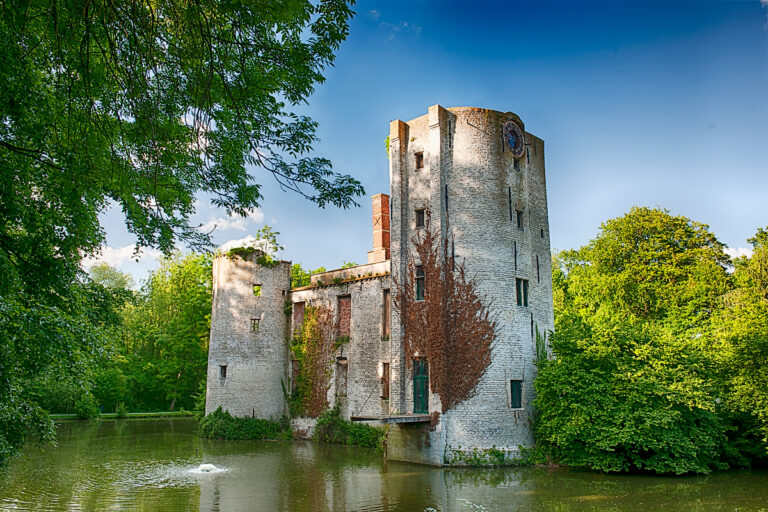
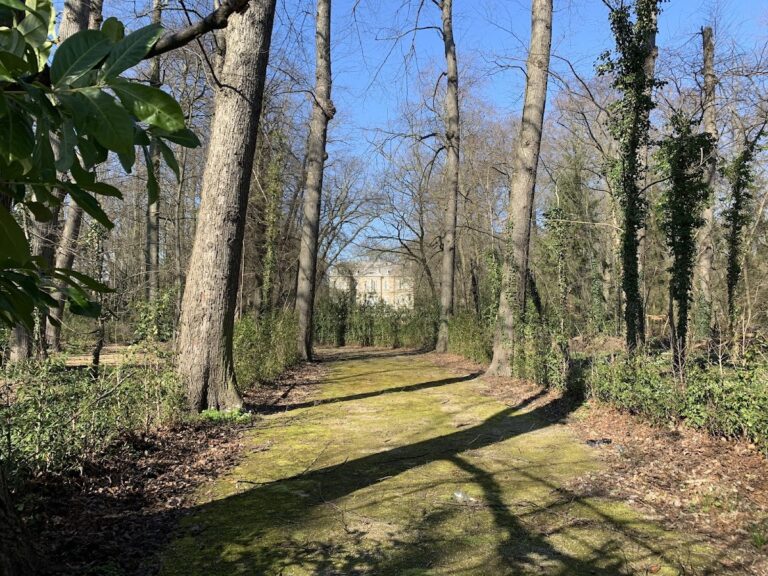
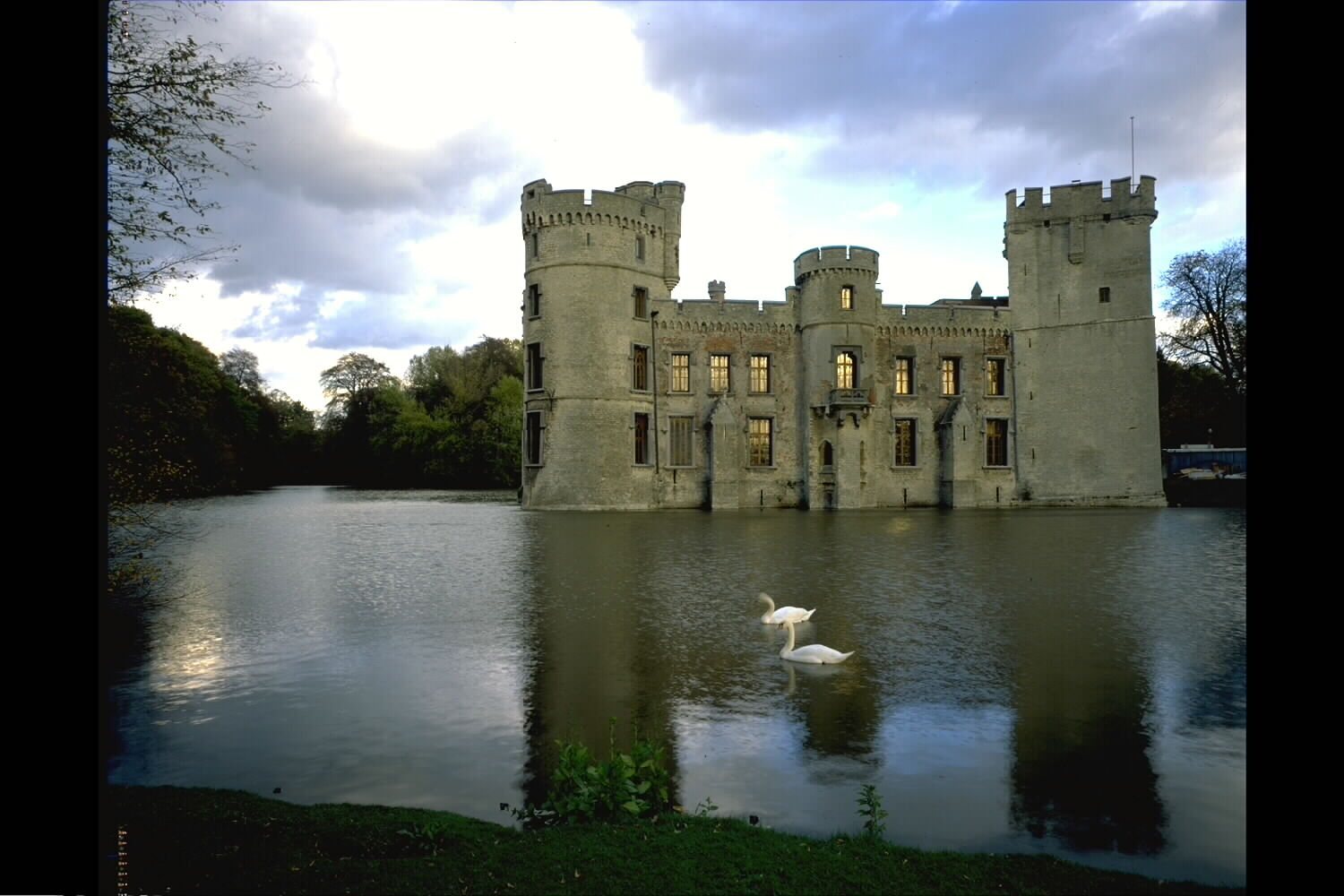
Bouchout Castle is a former water-castle standing at about 32 metres above sea level within the 92-hectare Meise Botanic Garden. Its early surroundings were swampy and densely wooded with beech trees. The name Bouchout is generally understood as a Flemish form connected with “beech wood”; an alternative interpretation meaning “keep your bow tensed” is unsupported. The castle lies somewhat south of the garden’s centre, with the former orangery to the east and other associated features including the Tenant Farm, greenhouses, and plantings of oaks, lime trees, maples, and other vegetation.
Water defences and castle plan
The medieval castle had a rectangular plan with defensive towers at its corners, a main building along the rear of the inner courtyard, and extensive water defences. Five surrounding canals were later combined into one large pond. A long wooden drawbridge, approximately 10 metres in length, provided access across the water. The southern wing was demolished during the 1832 restoration, opening a structure that had previously enclosed the courtyard.
The medieval donjon
The square donjon is approximately 20 metres high, with walls about 1 metre thick. It contains two levels and an upper platform, and its loopholes, narrow openings designed for weapons, appear on both levels. The tower is considered the oldest surviving part of the castle, although its date remains uncertain. The heritage inventory places it in the twelfth century, while Daniel van Bouchout is associated with the enlargement of the earlier fortified residence around 1300.
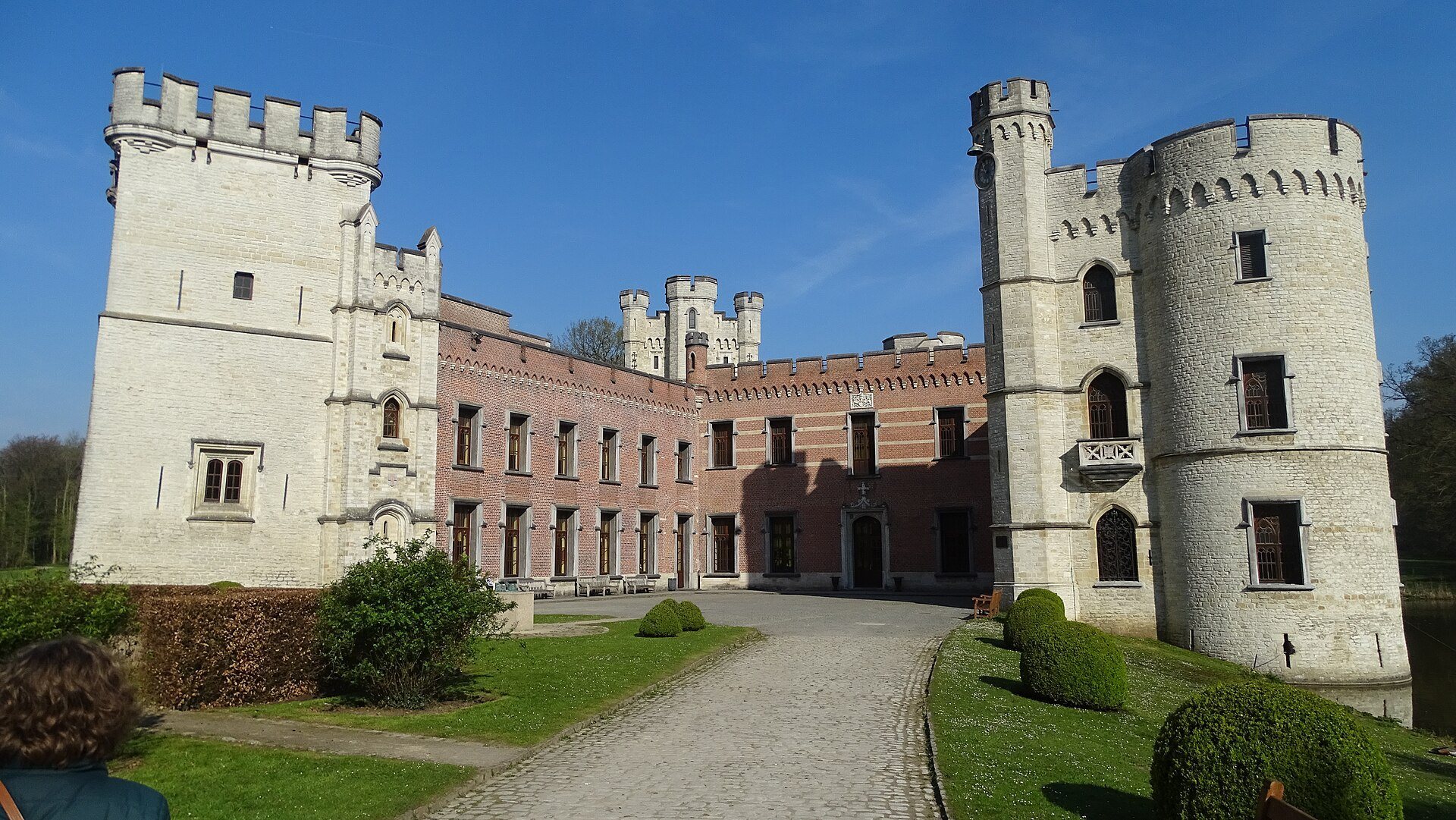
Small rectangular windows on the second level probably belong to the medieval period. The first-level windows have neo-Gothic forms and were probably inserted during the 1832 restoration. The upper platform has battlements and merlons, the raised sections between the openings of a defensive parapet. On the courtyard side, the tower displays the Bouchout family arms, a red cross. The restoration also added a balcony and a ground-floor doorway.
Neo-Gothic court and interiors
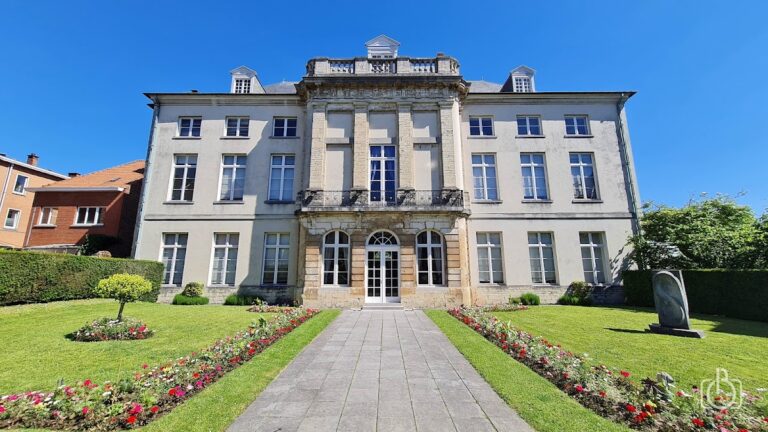
The 1832 work altered the roof façades with Gothic battlements and inserted large neo-Gothic windows. Neo-Gothic details were also introduced into the Court of Honour, including arched elements, battlements on the defensive towers, a statue of Daniel van Bouchout, and his coat of arms.
Inside, the neo-Gothic rooms incorporate neo-Renaissance features. These include the dining-room fireplace and the ceilings of the Empress Room and White Room. The first floor formerly contained the Armoury Gallery, where Count de Beauffort’s collection included armour, old paintings, and a cannon. Its adjoining rooms were later removed, and the area now forms a conference room of approximately 165 square metres.
Later fabric and present use
During the 1987 to 1989 restoration, the original pointed roofs were replaced with flat roofs. The restored rooms and surviving castle fabric now accommodate conferences, lectures, and exhibitions within Meise Botanic Garden.