Surawana (Candi Surowono): A Majapahit Hindu Temple in East Java
Site at a Glance
- Rating
- 4.4
- Popularity
- Medium
- Country
- Indonesia
- Primary era
- Medieval
- Eras represented
- Medieval
- Civilizations
- Unclassified
- Site type
- Religious
- Remains
- Temple
On this page9 sections
History
Foundation and Commemoration
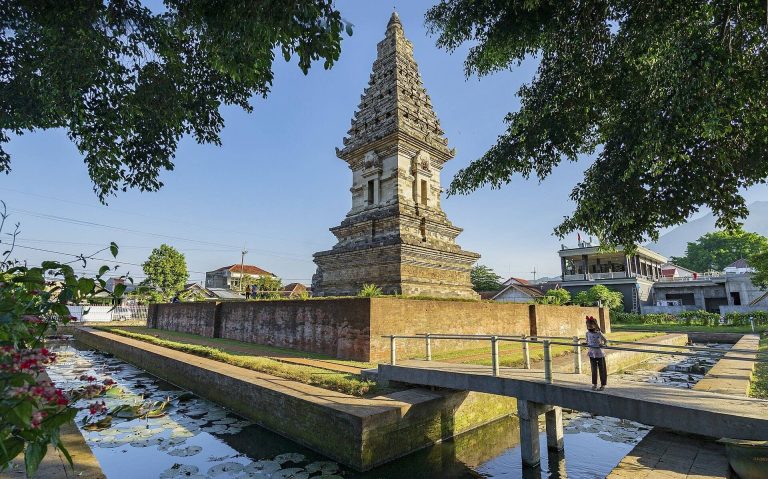
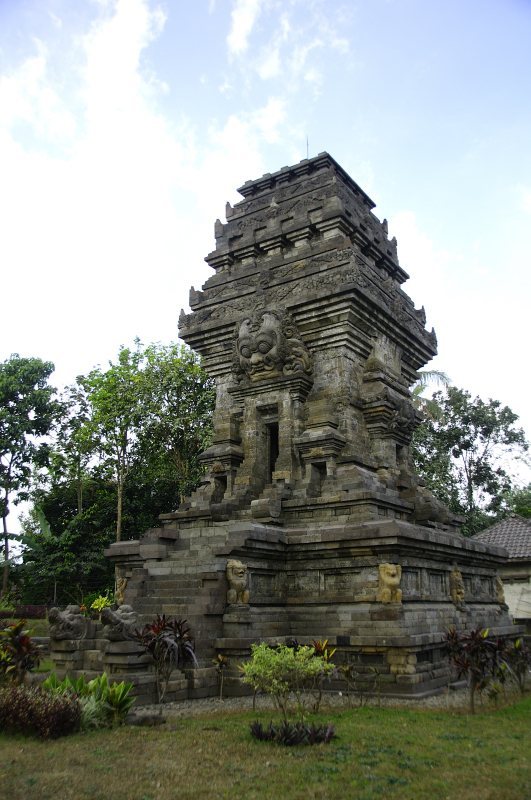
Surawana is a Hindu temple in Canggu village near Kediri, East Java, Indonesia, built under the Majapahit Kingdom in the late fourteenth century. Construction began in 1390, and the monument is associated with Wijayarajasa, the Prince of Wengker, who was related by marriage to Rajasanagara, also known as Hayam Wuruk, a fourteenth-century Majapahit ruler. Wijayarajasa held considerable political influence in the kingdom.
The temple is generally understood as a memorial to Wijayarajasa. Another interpretation holds that he commissioned the structure during his lifetime and that its commemorative purpose developed later. This difference affects how the completion date is understood. Work started in 1390, but the temple was regarded as formally complete in 1400, when the sraddha, a posthumous royal funerary ceremony, was performed for the deceased. Some interpretations therefore treat 1400 as the monument’s actual completion date.
Later History and Interpretation
Little is known about Surawana’s later history or the stages through which the monument became dismantled. Its sculptural program reflects the religious and literary culture of Majapahit Java, especially through its presentation of Arjunawiwaha, a Javanese poem composed by Mpu Kanwa in 1035. The work adapts episodes from the Mahabharata, drawing on Bharavi’s Sanskrit poem Kiratarjunya, and presents King Airlangga as a model of ideal kingship.
The temple’s surviving decoration continues to shape its interpretation. Modern specialists are working to restore or reconstruct the base toward its original form, using the surviving masonry and additional bricks associated with the monument.
Remains
Base and Orientation
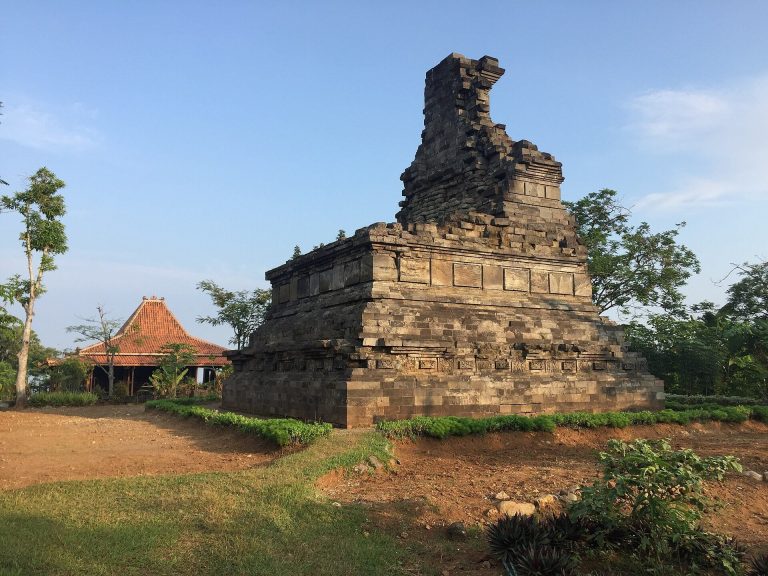
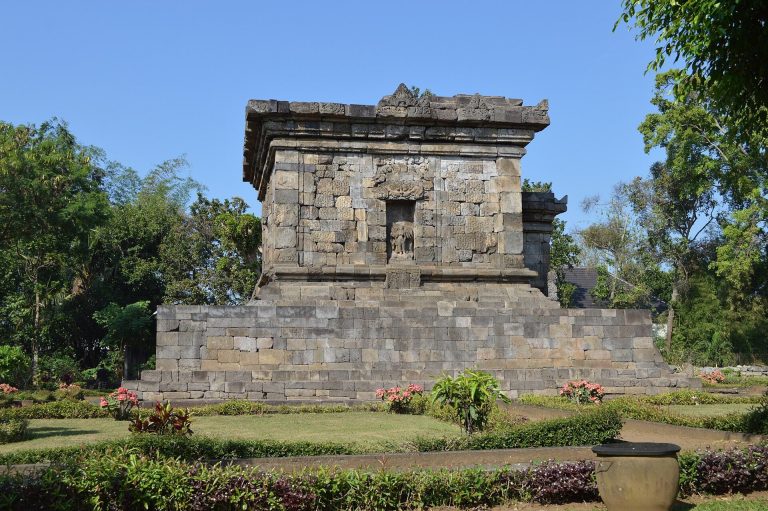
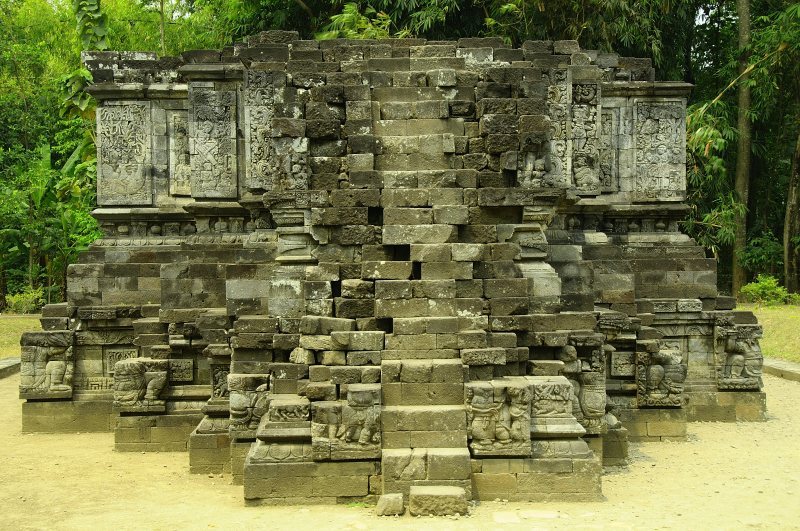
Surawana is a moderately sized temple whose base measures 7.8 square metres and whose original structure reached 4.6 metres in height. The surviving monument is centered on its foot or base, while further bricks remain around it for possible reassembly. Restoration has returned the base to a form with graduated projections supporting the stairs that lead to the cella, the temple’s inner chamber or sanctuary. The temple faces west.
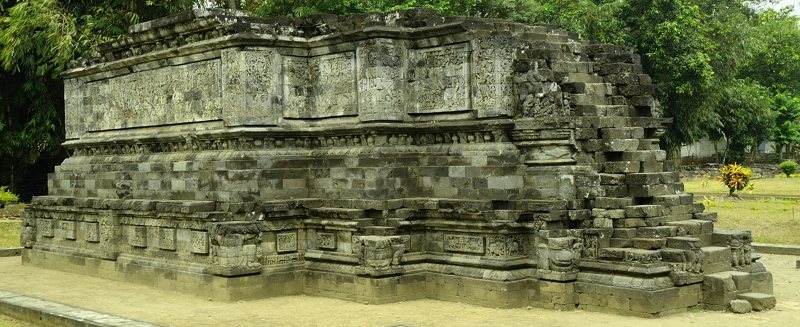
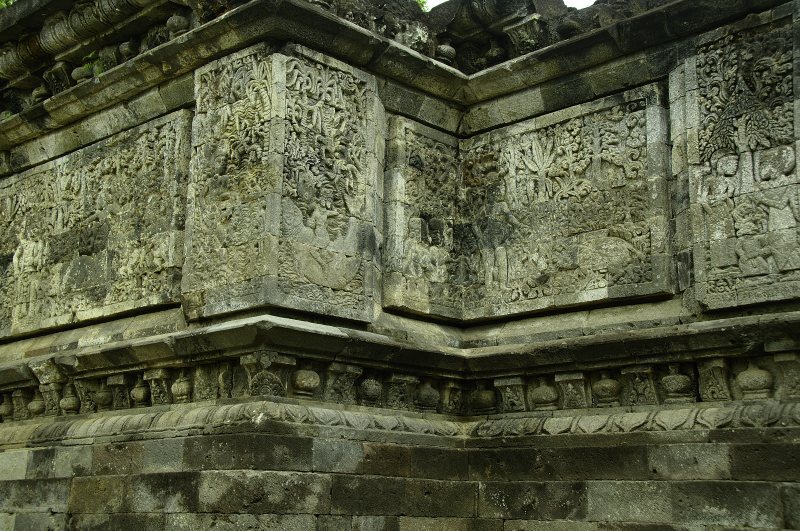
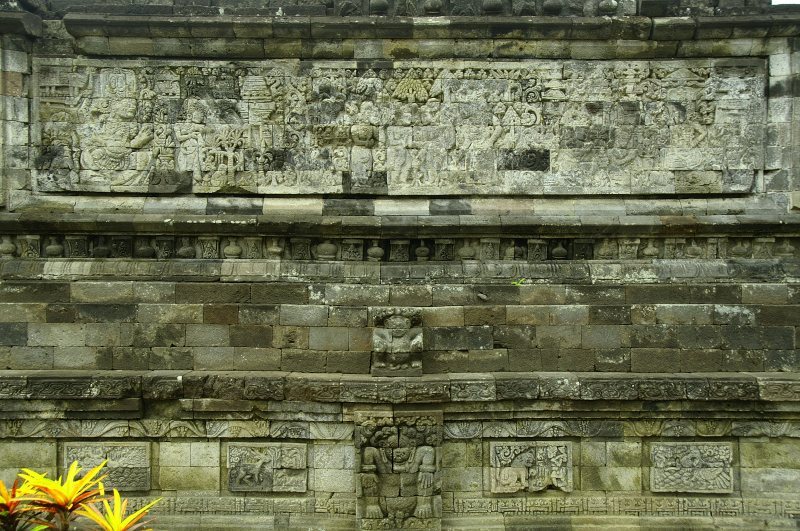
The base contains eighteen horizontal plaques and nine vertical panels, separated by a plain central band representing the middle section of the temple. This arrangement provides the framework for the reliefs that extend around the monument. Their subjects follow a directional scheme. East-facing carvings, linked with the rising sun and a sacred mountain, emphasize religious scenes, while west-facing carvings give greater attention to demons, monsters, battles, and death.
Sculptural Program
Arjunawiwaha Reliefs
The principal narrative is Arjunawiwaha, a literary adaptation of episodes concerning the hero Arjuna. Its scenes present Arjuna’s meditation, his battle with Niwatanawalan, and his reward in svargaloka, the heavenly realm of Hindu cosmology. The story also includes three tests imposed by the gods, assistance from Suprabha during the battle, and Arjuna’s marriage to seven celestial apsaras.
The sequence begins on the east-facing wall, resumes on the northeast side, and continues along the north wall. It then proceeds toward the south and west in the opposite direction. Framed scenes form a continuous narrative, although some corners are interrupted by vertical panels showing Sri Tanjung and Bubuksha. These panels were treated as part of Arjunawiwaha until they were identified as separate subjects in 1939.
Attendant Figures and Stair Ornament
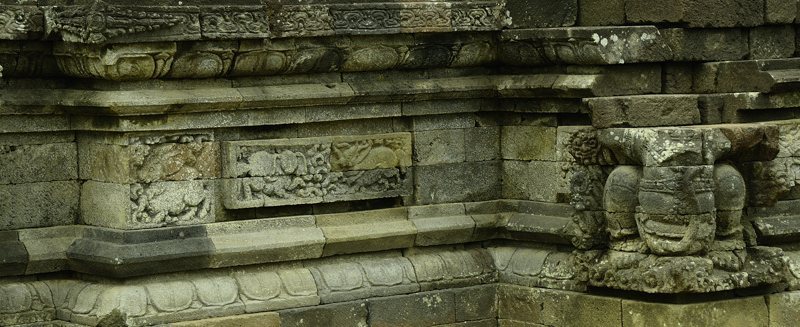
Ganas, attendant figures associated with Shiva, appear along the sides of the temple with their arms extended as though supporting the building. Other sculpted figures wear earrings, breastplates, necklaces, jeweled belts, bracelets, armbands, and anklets. The stairs carry naga and makara motifs. Nagas are serpent beings or serpent forms in religious art, while makaras are mythical aquatic creatures. Here they appear as flat ornamental reliefs combining triangular and animal shapes, with tails developing into elaborate arabesques.
Folkloric and Moral Narratives
Alongside the extended mythological stories, the reliefs include scenes from everyday life and shorter moral tales. The major narrative subjects are Arjunawiwaha, Sri Tanjung, and Bubuksha and Gagang Aking. Other panels portray “Crocodile and Bull,” “Heron, Fish, and Crab,” and “Frog and Snake.”
The “Heron, Fish, and Crab” story centers on deception. A heron disguises itself as a shaman in order to catch fish, but a crab recognizes the trick and kills the bird by pinching its neck. The relief thus conveys a warning about deceit through a compact animal tale.