Candi Sawentar: A Majapahit-Era Temple Site in East Java
Site at a Glance
- Popularity
- Medium
- Country
- Indonesia
- Primary era
- Medieval
- Eras represented
- Medieval
- Civilizations
- Majapahit
- Site type
- Religious
- Remains
- Temple
On this page16 sections
History
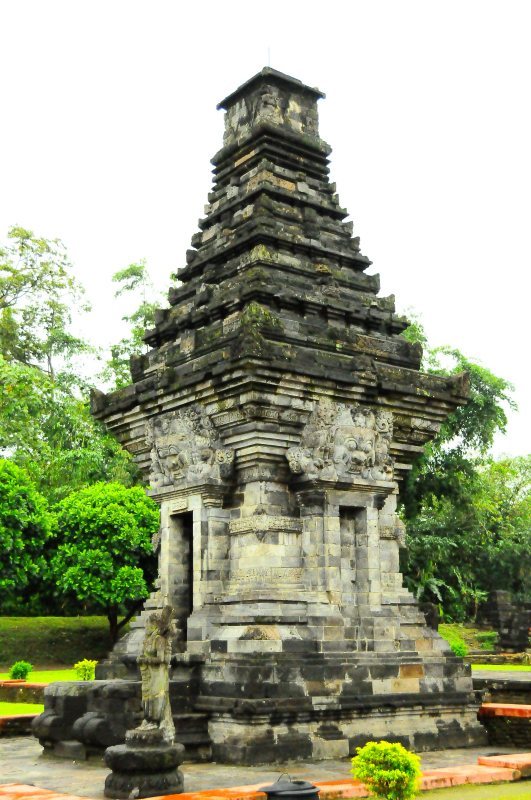
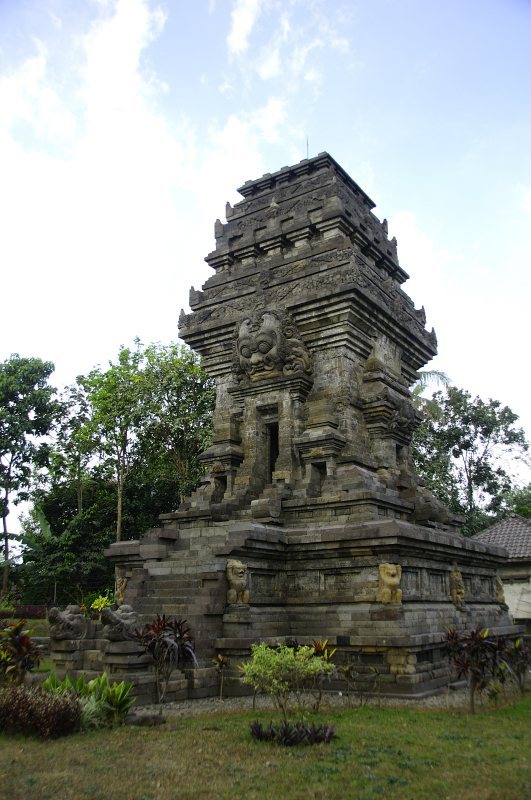
Candi Sawentar is a group of temple remains in Sawentar, Blitar Regency, Indonesia. Candi Sawentar I is thought to date to the early period of Majapahit, a Javanese kingdom, and has the tall, slender form associated with East Javanese temple architecture. A second temple site lies nearby.
Majapahit references and memorial interpretations
The Nagarakertagama, a historical Javanese text, describes King Hayam Wuruk’s visit in 1361 to a place called Lwa Wentar, after he had worshipped at Palah. Sawentar is identified with that place, but the text does not say which building the king visited. Candi Sawentar I may not yet have existed at the time.
One proposal identified Candi Sawentar I as a memorial religious foundation for Hayam Wuruk, connecting a wing-like carving on its stairway with his name. The carving is understood instead as part of a dragon’s wings, making that association unlikely. Another interpretation links Sawentar with Sabyantara, a memorial place for Bhre Paguhan named in the Pararaton, another historical Javanese text. Bhre Paguhan was a Majapahit-era noble. The proposed connection rests on linguistic grounds, and the identification of Candi Sawentar I as his memorial remains uncertain.
Candi Sawentar II and the Paregreg conflict
Candi Sawentar II has been interpreted as a memorial to the Paregreg, a conflict between rival Majapahit power centers. One was led by Wikramawardhana in the west; the other by Bhre Wirabhumi, ruler in the east. The temple may have been commissioned by Queen Suhita, a later Majapahit ruler, in memory of her father, Wikramawardhana.
A carved date riddle, or candra sengkala (a date encoded through images or words assigned numerical values), is read as “naga-king-swallowing-sun” and interpreted as 1318 Saka (1396). One interpretation connects that date with earlier struggles for the throne. Another places the temple’s construction in 1435-36, roughly 40 years after the conflict. The Pararaton places the conflict’s beginning in 1323 Saka, but its account was written long after the events, and that date has been considered potentially imprecise.
Excavation and restoration
The Dutch East Indies Archaeological Service excavated Candi Sawentar I in 1915 and again in 1920-21, exposing parts buried by volcanic mudflows from Mount Kelud. The temple was restored in 1992-93.
Sugeng Ahmadi discovered Candi Sawentar II while digging a well near Sawentar Market. After stones had been moved, the temple custodian, Sunarno, halted the digging and reported the find. In August 1999, the East Java Cultural Heritage Preservation Center at Trowulan and the Yogyakarta Archaeological Center began exposing the site. Excavation identified its two courts in October 2000. A 2004 campaign opened nine trenches and found another group of buildings in the northeastern part of the southern court. Investigations continued in 2005 and 2006.
Remains
The two temple areas lie on the eastern slope of Mount Kelud, with Candi Sawentar II about 100 m south of Candi Sawentar I and the Ngasinan River between them. Volcanic deposits buried parts of the sites, and the original ground level was below the present settlement surface. Candi Sawentar I is built of andesite stone; the remains at Sawentar II include both stone and brick structures.
Candi Sawentar I
Court and approach
Brick foundations near Candi Sawentar I have been taken as evidence that it formed part of a larger temple complex. The remains also indicate a nearly square central court enclosed by a stone wall. A surviving wall foundation directly in front of the western entrance stairway once screened the approach. It may also have been intended to protect the entrance from harmful supernatural forces.
Form and exterior
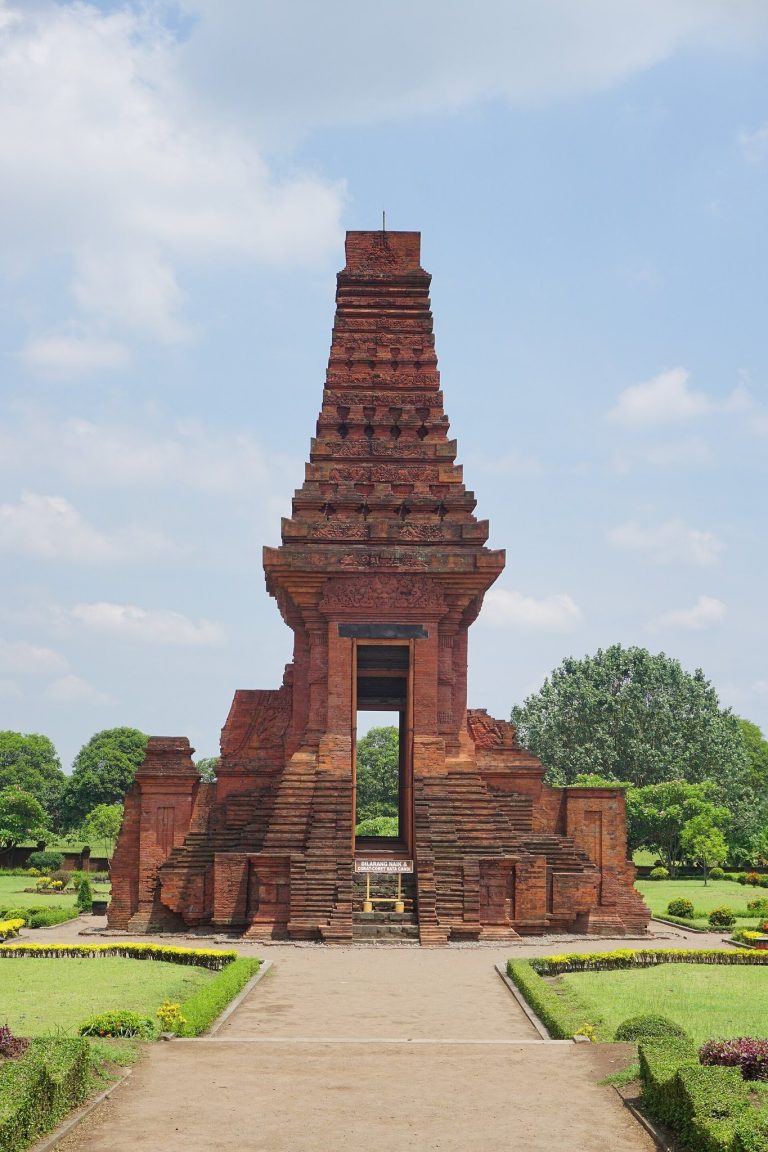
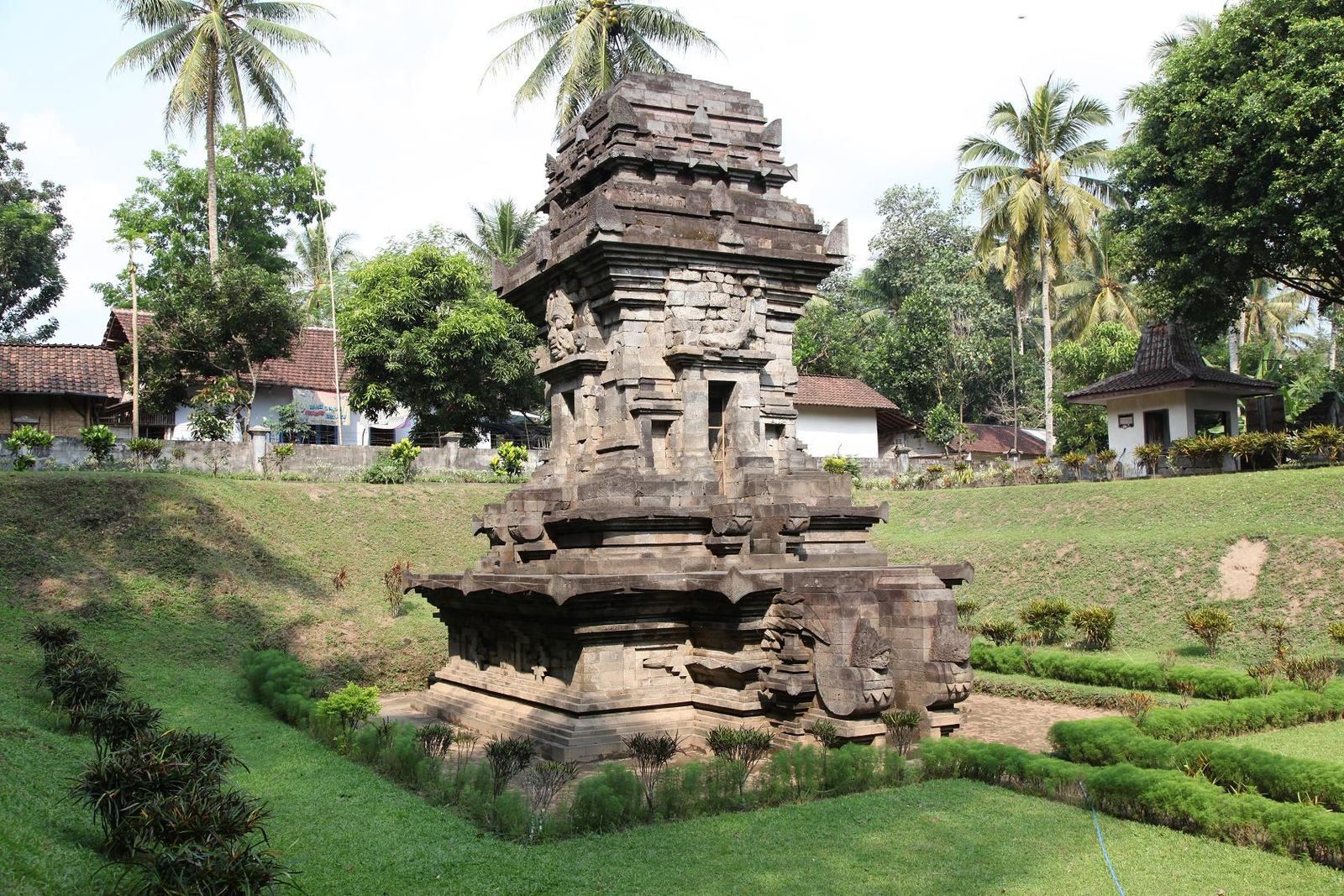
The temple is a stepped pyramid assembled from interlocking andesite blocks laid in an irregular pattern. It has a raised base, a body, and a summit. The base plan is nearly square, although its measured dimensions are 9.53 by 6.86 m; the structure stands 10.65 m high. Its narrow, upright proportions are characteristic of East Javanese temples, unlike the squatter forms associated with Central Java. Comparisons have been made with Candi Kidal and Candi Bangkal. Candi Bangkal is built largely of brick, while Candi Sawentar I and Candi Kidal use andesite. The temple’s three-part form has been described as representing the human, intermediate, and divine realms.
Stairs on the western side lead to the entrance. Their curved side walls end in crowned dragon- or serpent-heads and wing forms. Cross-pattern reliefs decorate the base on its north, east, and south sides. The body has a western doorway with a projecting entrance and small niches on either side. A damaged kala, a fierce protective face motif, sits above the doorway. Circular designs decorate the lower, middle, and upper bands of the body walls.
Chamber and roof
The doorway’s northern niche formerly held Mahakala, a fierce form of Shiva, and the southern niche held Nandiswara, a human-like form of Nandi, Shiva’s bull mount. Niches around the central chamber formerly contained Durga, a form of Parvati, shown defeating the buffalo demon; Ganesha, the elephant-headed deity associated with knowledge and removing obstacles; and Shiva in the form of an ascetic. The southern figure has also been identified as the sage Agastya.
A yoni, a symbol associated with Parvati, remains in the central chamber and bears a Garudeya motif linked to Garuda, Vishnu’s mount, and the myth of divine nectar. A motif of Surya, the sun deity, occupies the center of the chamber’s roof. It shows him riding a horse with rabbit-like ears and may have provided light within the chamber.
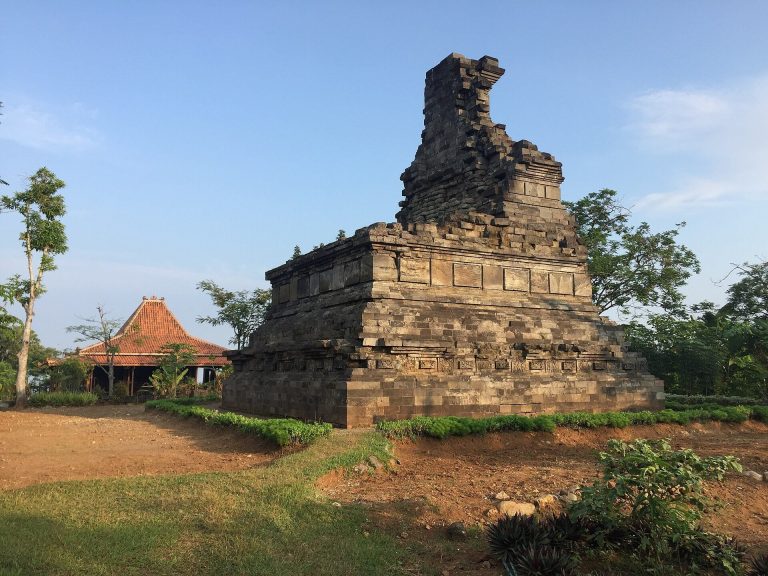
The roof is partly collapsed, particularly at the summit. The original summit was cubic, and fragments thought to belong to it have been gathered with other rubble near the temple. Winding-line, plant, and pointed-triangle designs decorate the roof; the summit fragments also carry scrolling plant ornament. They have been tentatively compared with summit pieces from Candi Kidal and Candi Bangkal.
Candi Sawentar II
Enclosure and courts
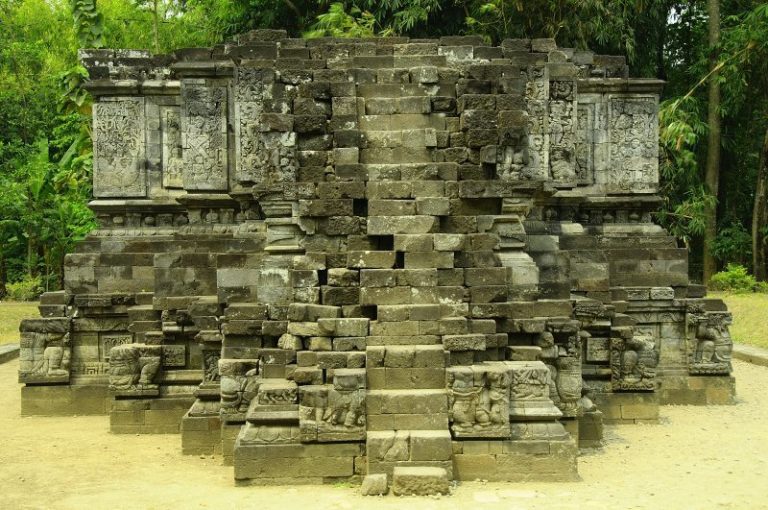
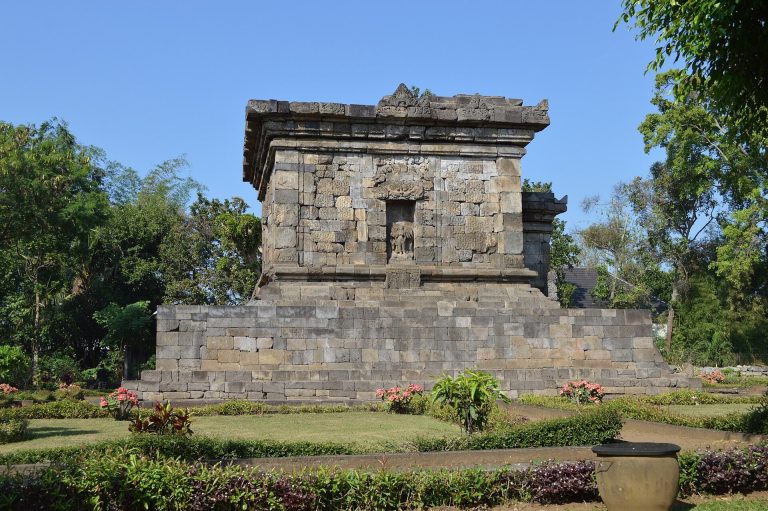
Candi Sawentar II, a Hindu-Buddhist temple site in Centong hamlet near Sawentar Market, has a rectangular enclosure measuring 38.80 by 29.70 m and aligned north to south. Its northern court measures 29.70 by 21.30 m; its southern court measures 29.70 by 17.50 m. Two rectangular andesite platforms, also aligned north to south, stand with a brick floor between them. Two brick structures, probably square in plan, lie to their west. A buried north-south wall on the east may be part of the enclosure.
Structures in the courts
The northern court contains platforms and foundations of miniature temples. Another group of buildings lies in the northeastern part of the southern court. It consists of two cube-shaped structures aligned north to south, each with horse reliefs on its walls. The southern building is relatively intact, while the northern one survives in part.
Excavated objects
Architectural stones from Sawentar II
Finds include a pale andesite lintel, a horizontal stone above a doorway, measuring 73 by 36 by 20 cm. It bears a carved date and kala faces at both corners. Another temple stone measures 24 by 23 by 17 cm. Other pieces include two kala heads, two corner stones with projecting roof-edge ornaments, and two undecorated corner stones that may have fallen. A miniature-temple body fragment with a doorway niche measures 74 by 56 cm; a roof lintel decorated with a kala measures 65 by 30 by 29 cm. The collection also includes 14 notched square stones, each 51-62 cm long, 24-26 cm wide, and 13-15 cm thick; two molded summit corner stones; and a brick measuring 31 by 18 by 6 cm. Two summit fragments were reported, one measuring 85 cm long and 27 cm high.
Carved relief panels
Three pale andesite panels, each measuring 61 by 32 by 29 cm, show different scenes. One depicts Ganesha biting the sun between two tigers. Another shows two horses chasing, with the leading horse looking back. The third shows two horses facing each other over a ball.
Finds at Kanigoro cemetery
Stones found at the Kanigoro cemetery, about 2 km from Sawentar, have been tentatively associated with a wider temple complex, though their connection with the Sawentar temples is uncertain. They include a temple-related stone dated 1274 Saka (1352), possibly linked to a restoration under Hayam Wuruk, and an inscribed stone thought to have served as a doorway lintel. The inscription is upside down and reads, when turned around, “Arrogance is bad.” Roof and body fragments were also found, along with two andesite grave-marker fragments whose antiquity remains uncertain.