Trowulan: Archaeological Site of the Majapahit Capital
Site at a Glance
- Popularity
- Very High
- Country
- Indonesia
- Primary era
- Medieval
- Eras represented
- Medieval
- Civilizations
- Unclassified
- Site type
- City
On this page25 sections
History
Trowulan is an archaeological site in East Java, Indonesia, generally believed to contain the former capital of the Majapahit Empire, known as Majapahit or Wilwatikta. Majapahit was a major Javanese kingdom, and archaeological evidence shows dense settlement at Trowulan during the fourteenth and fifteenth centuries. The date when the city was founded is unknown.
The Majapahit capital
Mpu Prapanca, a Javanese court poet, described the capital in his fourteenth-century poem, the Nagarakretagama. His account presents the palace as the centre of a wider arrangement of royal and religious quarters, but it is selective and some passages are unclear. As a result, proposed reconstructions of the city differ. A Chinese account from the fifteenth century also describes the palace. Another Chinese travel text names Man-The-Po-i, a rendering of Majapahit, as a large royal city, although its identification with Trowulan is uncertain.
In Prapanca’s description, a high, thick brick wall enclosed the royal compound. A guard post stood nearby, and the main gate pierced the northern wall. Outside it were a long building for an annual court gathering, a marketplace, and a sacred crossroads. Within the compound, courtyards held religious buildings, bathing pavilions stood beside canals, and houses and audience halls served palace workers and visitors. Beyond the palace, the poem places quarters for Shiva priests, Buddhists, and nobles, as well as other royal compounds farther across the fields, including one associated with chief minister Gajah Mada.
The Chinese description portrays a well-kept palace behind a brick wall more than ten metres high, entered through a double gate. It describes houses raised on pillars and standing 10 to 13 metres high, with wooden floors covered by fine mats. The palace roofs were shingled, while commoners’ homes had thatched coverings. A text on court etiquette defined the capital as the area that could be crossed without passing through rice fields. Temple reliefs show walled settlements, and the term kuwu appears to describe enclosed groups of buildings governed by a noble. The capital may therefore have comprised a number of such local units.
Urban life involved more than royal administration. The Nawanatya, a text on court government, describes an official responsible for market security who received 8,000 cash each day from the markets. Around 1300, Chinese bronze coins became Majapahit’s official currency, taking the place of gold and silver money used for centuries. Their small denominations suited market purchases and were associated with paid work, specialized crafts, and the buying of everyday goods.
Conflict, decline, and archaeological study
In 1478, Girindrawardhana’s campaign against Kertabhumi destroyed the city. The Majapahit capital then moved to Daha, identified with present-day Kediri. Ruins of the former city had come to notice by the nineteenth century. Sir Thomas Stamford Raffles described temple remains scattered across the region, but thick teak forest made a close survey difficult. He praised Trowulan as Java’s pride.
Surveys and excavations from the nineteenth into the twentieth century revealed buried settlement remains and broadened understanding of the site. Early investigations concentrated on major monuments; later work also brought residential areas, water systems, and evidence of industrial, commercial, and religious activity into view. In 2008, an Indonesian government exploration programme and a proposed Majapahit Park formed part of efforts to protect the area from damage associated with local brickmaking. Plans for construction near Segaran Pool were halted while their archaeological effects were assessed. In October 2009, Indonesia submitted Trowulan to UNESCO’s tentative World Heritage List, a preliminary step rather than inscription as a World Heritage site.
Remains
The archaeological landscape covers about 100 square kilometres, with remains dispersed across the Trowulan area. Red brick is the most common building material described, and surviving structures range from damaged masonry to reconstructed monuments. Some parts of the settlement remain beneath several metres of mud and volcanic debris deposited by eruptions of nearby Mount Kelud and flooding of the Brantas River.
Temples and gateways
Tikus Temple
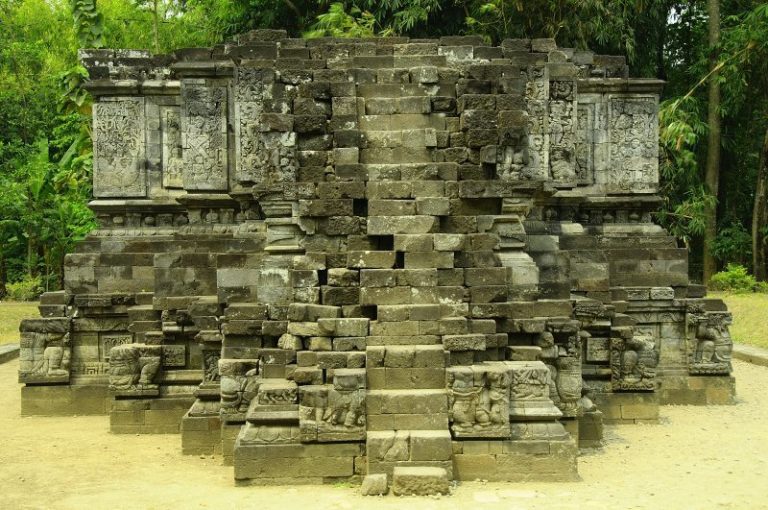
Tikus Temple is a red-brick ritual bathing pool, built around a sunken rectangular basin reached by steps on its northern side. A larger structure projects from the southern edge and appears to represent Mount Mahameru, the sacred cosmic mountain in Hindu and Buddhist traditions. Its incomplete, terraced base would have supported rings of smaller towers rising toward a central high point. The name means Rat Temple and dates from the site’s discovery in 1914, when it was thought to be an enclosure for breeding rats. Restoration took place in 1985 and 1989.
Bajang Ratu
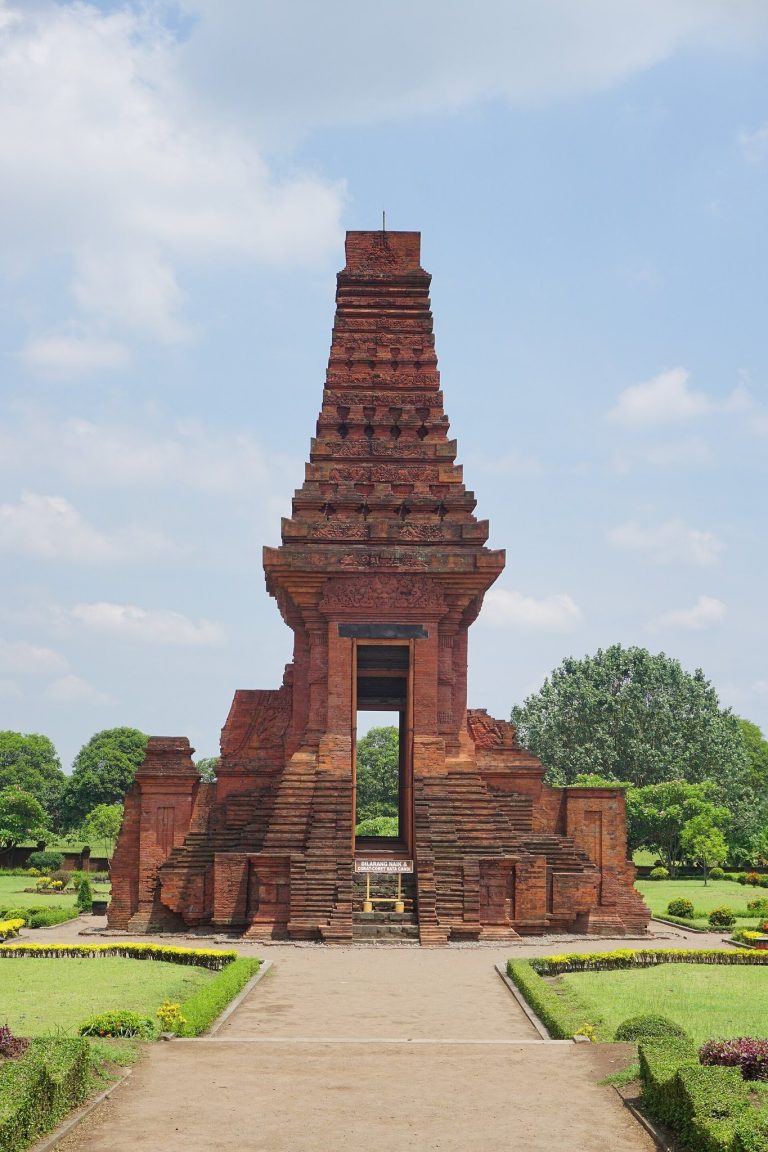
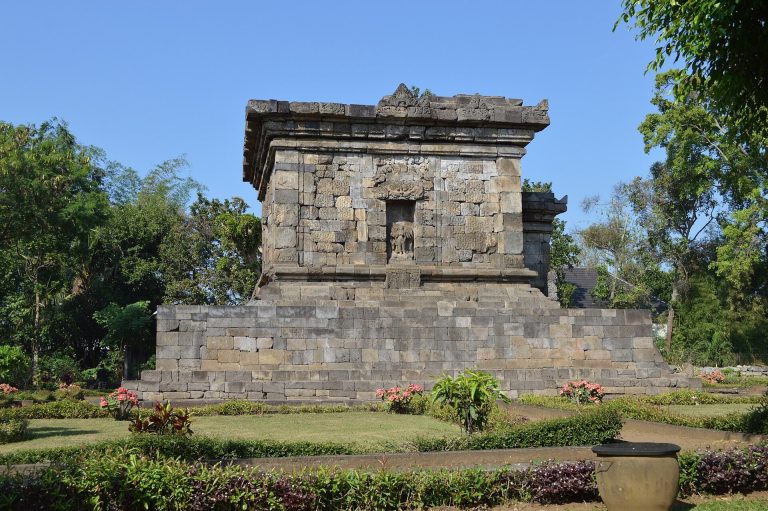
Bajang Ratu is a slender, roofed red-brick gateway from the middle of the fourteenth century, standing 16.5 metres high. Detailed reliefs, particularly on the roof, include episodes from Sri Tanjung, a Javanese tale, and the Ramayana, an ancient South Asian epic. The gateway has been restored. Local tradition connects it with Jayanegara, Majapahit’s second king: one version says he fell there as a child and was injured, while another explanation of the name, little monarch, refers to his youth when he became king. Historians associate the monument with a shrine for Jayanegara after his death in 1328.
Wringin Lawang
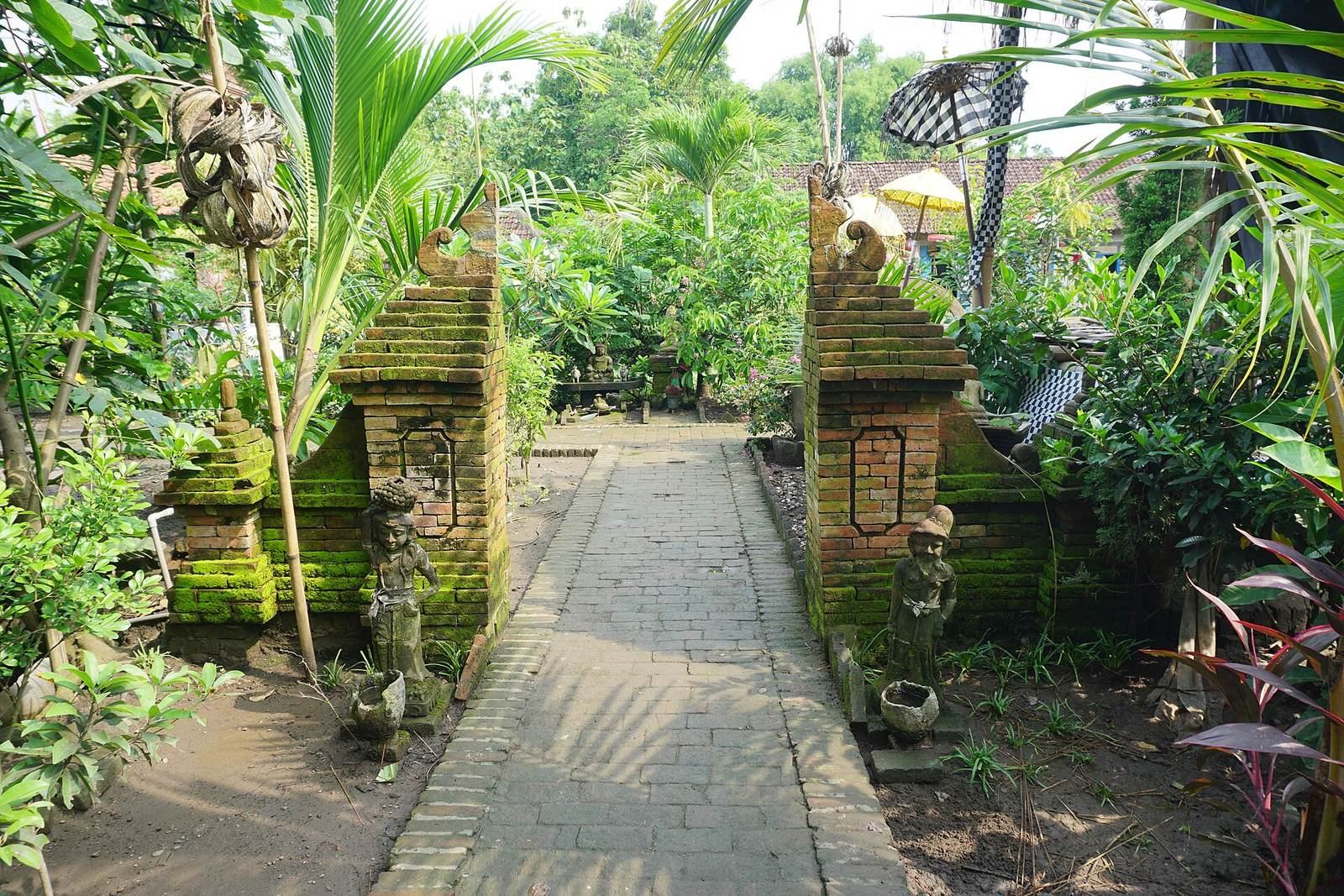
Wringin Lawang is a fourteenth-century split gateway made of red brick. Its base measures 13 by 11 metres, and the structure rises 15.5 metres. Two matching halves frame an open central passage. This form narrowed the entrance but was not designed as a substantial defensive barrier; its appearance and ceremonial use may have been more important. Its original purpose remains uncertain. It is generally understood as the entrance to an important compound, and one popular proposal identifies that compound as Gajah Mada’s residence.
Brahu Temple
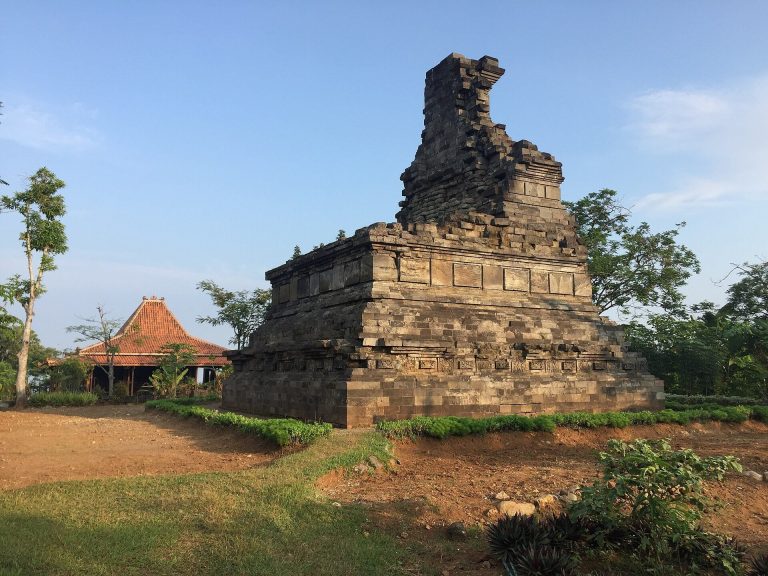
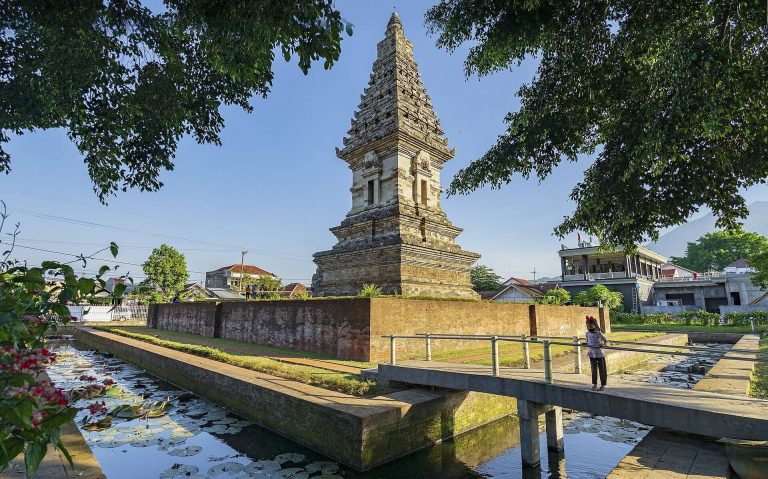
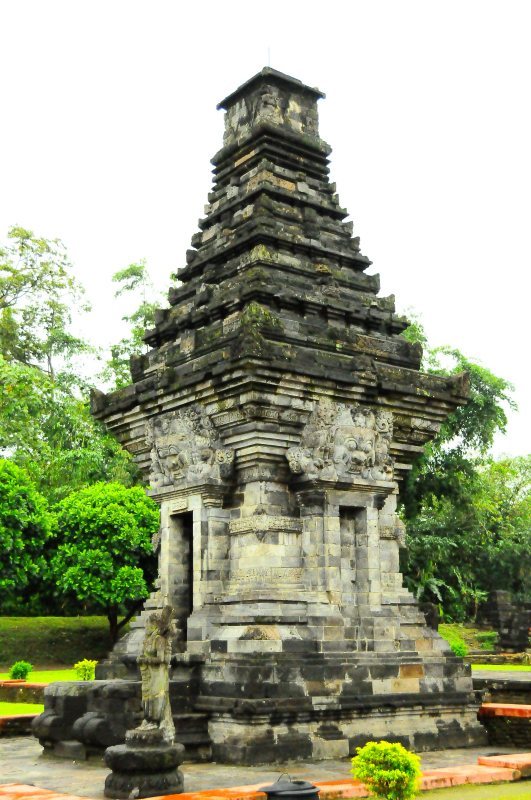
Brahu Temple, in Bejijong village, is the surviving structure of a former group of historic buildings. Local tradition places the cremations of Majapahit’s first four rulers nearby. Material evidence has also been interpreted as indicating that the temple served as a royal memorial shrine, a sacred structure for honoring the dead, although the person commemorated is not known.
Candi Gentong
The ruin of Candi Gentong lies about 360 metres east of Brahu Temple. It was one of three temples Henri Maclaine Pont described as aligned from west to east, alongside Candi Gedong and Candi Tengah.
Menak Jingga Temple
Ruins of Menak Jingga Temple lie near the northeastern edge of Segaran Pool. Stones are scattered around the site, while the base remains buried. Its outer facing is carved andesite, and its inner layer is red brick. Some decorated fragments, possibly from the roof, depict the qilin, a mythical creature in Chinese tradition. Excavation and restoration continue at the site.
Water features
Segaran Pool
Segaran is a large rectangular brick basin, slightly raised above the surrounding ground. Its brick walls and embankment are 1.60 metres thick and 2.88 metres deep, with the bricks set without binding material. At the western entrance, a landing projects over steps leading down into the pool. An inlet in the southeast and an outlet in the northwest connect it to water channels. The outflow runs toward Balongdawa, a long pond to the northwest, and Balongbunder, a round pond to the south.
The brick structure dates to the fourteenth and fifteenth centuries, but its original use is uncertain. It may chiefly have stored freshwater for the city, especially during dry months. Other local explanations propose bathing, swimming practice for Majapahit troops, or recreation for rulers receiving guests and envoys. Henri Maclaine Pont found the structure beneath soil and mud in 1926. Restoration followed in 1966, and a more extensive programme ran from 1974 to 1984. The pool is now used for fishing and recreation, and its water irrigates nearby rice fields.
Houses, graves, and other archaeological areas
Residential remains
Excavations have exposed brick floors and walls from houses, with some building layers set two or three deep. The domestic remains include wells and drains, alongside traces of a large reservoir and wells lined with brick or clay. Together, these finds provide evidence of a settled urban area beyond the monumental buildings.
Sentono Rejo
Sentono Rejo consists of brick flooring and wall remains. The ancient floor lies about 1.80 metres below the surrounding ground and runs broadly east to west, with a compass bearing of 80 degrees clockwise from north.
Watu Umpak
At Watu Umpak, stone bases once held wooden pillars, probably belonging to a wooden building. The timber structure decayed, leaving its stone supports.
Troloyo graves
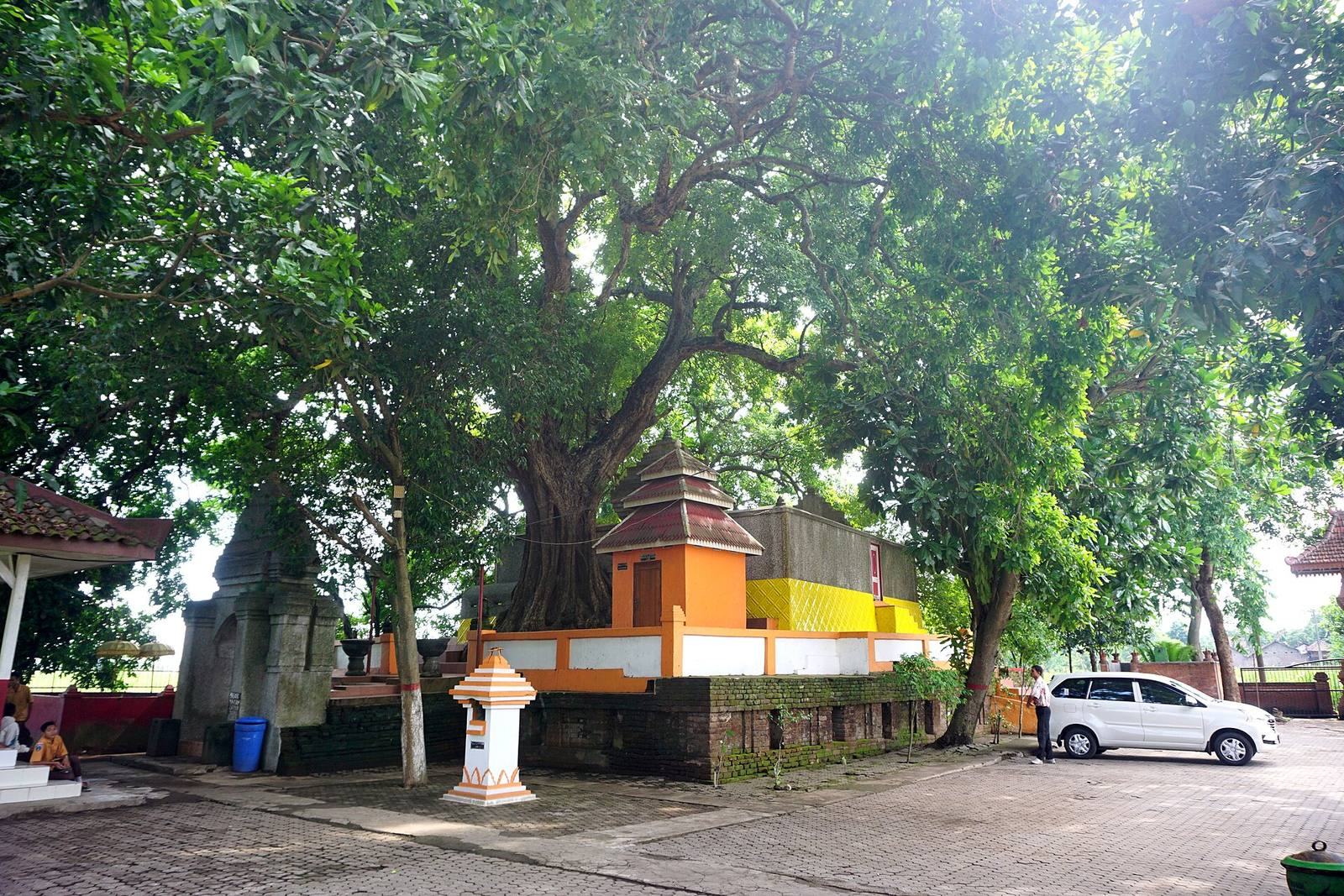
Troloyo contains numerous Islamic tombstones, most dated between 1350 and 1478. They indicate an established Muslim community in Java by the mid-fourteenth century and the practice of Islam within the royal capital. Local belief also places Raden Wijaya, Majapahit’s founder, among the dead buried there. People make pilgrimages on Fridays that coincide with Legi, one of the five days in the Javanese market-week cycle.
Tomb of the Champa princess
The tomb associated with the Champa princess is an Islamic-style grave. Local tradition identifies her as the wife or consort of a late Majapahit king. In the tradition, she married the ruler, converted him to Islam, and died in 1448.
Kumitir
Kumitir includes remains associated with a commemorative building described in written traditions as a shrine for Mahisa Campaka, also called Narasinghamurti. He ruled Tumapel jointly with Ranggawuni, also known as Wisnuwardhana, and was the grandfather of Raden Wijaya. The archaeological complex is thought to have marked the eastern edge of the former capital. An ancient reservoir nearby survives as a marsh known locally as Rawa Kumitir.
Crafts and household objects
Goldworking
Finds near Kemasan include gold ornaments and tools for working gold. Small clay cups may have been used to melt the metal for lost-wax casting, a process in which a wax model forms a mould. Bronze anvils and flat, three-legged circular stones may have served as work surfaces. Gold used by Javanese craftspeople came from Sumatra, Borneo, and Sulawesi.
Bronze and ironworking
Excavations at Pakis, in the southern part of the site, uncovered many clay vessels used to melt bronze. Stone moulds were used to cast large bronze pieces that served as coins or amulets. Other finds include decorated lamps, water containers, bells, objects likely used in religious ceremonies, and slit drums, percussion instruments made from hollow objects with a cut opening. Many iron tools have also been found; they were probably imported because Java had little iron ore.
Pottery and terracotta objects
Many objects made of terracotta, or fired clay, have been found at Trowulan. Everyday pottery was mainly used for cooking and storage, and its decoration often consisted of red-painted stripes. Coconut-oil lamps were common. Finer vessels, including water ewers, have thin walls, graceful profiles, and glossy red surfaces polished by rubbing. Larger containers include round water jars and square vessels decorated with aquatic and other scenes.
Terracotta figurines represent deities, people, animals, buildings, and scenes. Their purposes are uncertain. Some may have belonged to household shrines, while comic figures of foreigners may have been toys for children.
Coin containers
Clay piggy banks with openings wide enough for coins, along with coin containers in other forms, have also been found at Trowulan.