Neak Pean: A Buddhist Healing Temple on an Angkorian Reservoir
Site at a Glance
- Rating
- 4.6
- Popularity
- Medium
- Country
- Cambodia
- Primary era
- Medieval
- Eras represented
- Medieval
- Civilizations
- Khmer
- Site type
- Religious
- Remains
- Temple
On this page11 sections
History
Neak Pean is a sandstone Buddhist temple on an artificial island in Jayatataka Baray, the northern baray, in Krong Siem Reap, Cambodia. Constructed in 1191 during the reign of Jayavarman VII, the Khmer king who sponsored major Buddhist foundations and public works at Angkor, it belongs to the Bayon architectural style and was dedicated to Mahayana Buddhism.
Foundation and religious purpose
The temple was originally called Rajyasri, meaning “the prosperity of the kingdom.” This name appears in inscription K-908 and in an inscription connected with Preah Khan. Neak Pean was designed as the mebon, or island temple, of Jayatataka Baray, whose planned island setting formed part of the original conception rather than a later alteration.
Neak Pean served both medical and religious purposes. It was regarded as a royal hospital where medicinal plants and healing waters were used. Its four connected pools represented Water, Earth, Fire, and Wind, and bathing in them, or passing through them, was believed to restore the balance of these elements and cure illness.
The temple also attracted pilgrims. An inscription associated with Preah Khan describes its island and pools as places where visitors could be cleansed of their sins, while comparing the journey to a vessel crossing the “Ocean of Existence.” Pilgrims came to bathe, and the sick were believed to return healed. Some interpretations identify Neak Pean with Anavatapta, the mythical lake of Buddhist and Hindu cosmology whose pure waters were associated with freedom from disease. The complex therefore joined Buddhist beliefs with the sacred geography of a lake having four outlets.
Mythic associations and later history
The horse sculpture near the temple reflects the story of Balaha, the horse form of Avalokitesvara, the bodhisattva associated especially with compassion. In the legend, sailors caught in a storm raised by an ogress prayed for help. Avalokitesvara appeared as Balaha and carried the survivors safely to shore.
Jayatataka Baray later dried out, and the central pool retained water only during part of the rainy season. After water returned to the northern baray, all five pools again held water throughout the year. Their connection with the reservoir illustrates the hydraulic system of the Angkor region, now included within the Angkor World Heritage area.
A description written by the Chinese envoy and travel writer Zhou Daguan in the late thirteenth century may refer to Neak Pean. It places a square golden temple about five li north of the city enclosure and describes stone chambers, images of a golden Buddha, lions, elephants, horses, and many bronze objects. The identification remains interpretive.
Investigation and conservation
Architectural researchers knew of Neak Pean before 1866. Farut cleared vegetation from the monument between 1866 and 1876. Henri Marchal cleaned the site and rearranged fallen stones from 1922 to 1924, and M. Glaize undertook further cleaning and stone reassembly from 1938 to 1939. A large fig tree that had grown around the central sanctuary collapsed during a storm in 1935.
Excavation also recovered important sculptural elements. In 1911, the human head in the eastern chamber and the elephant head in the northern chamber had been found. J. de Mecquenem discovered the horse head in May 1912, while Henri Marchal found the lion head in 1922. Marchal’s excavation also revealed an image of Avalokitesvara.
Remains
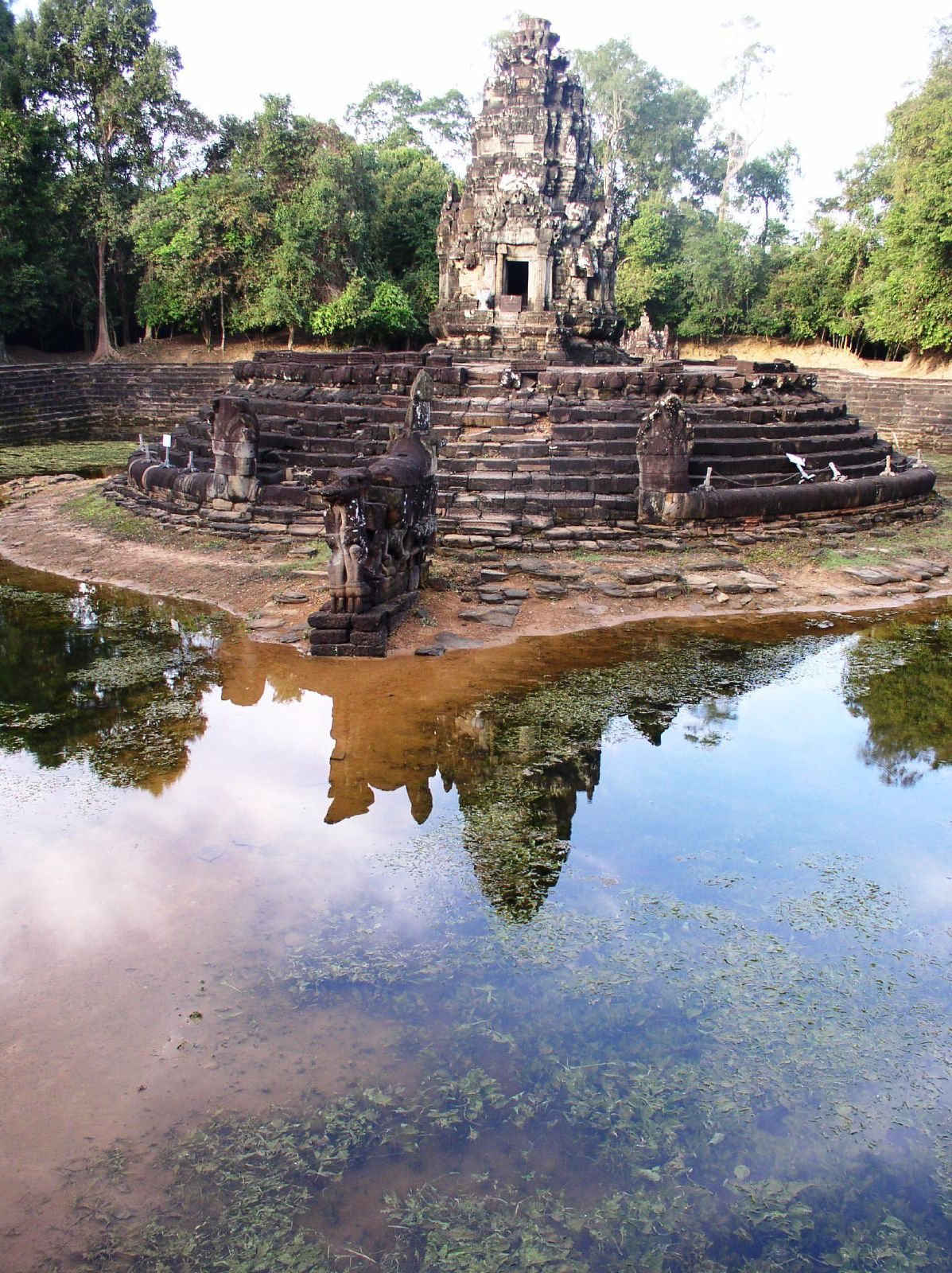
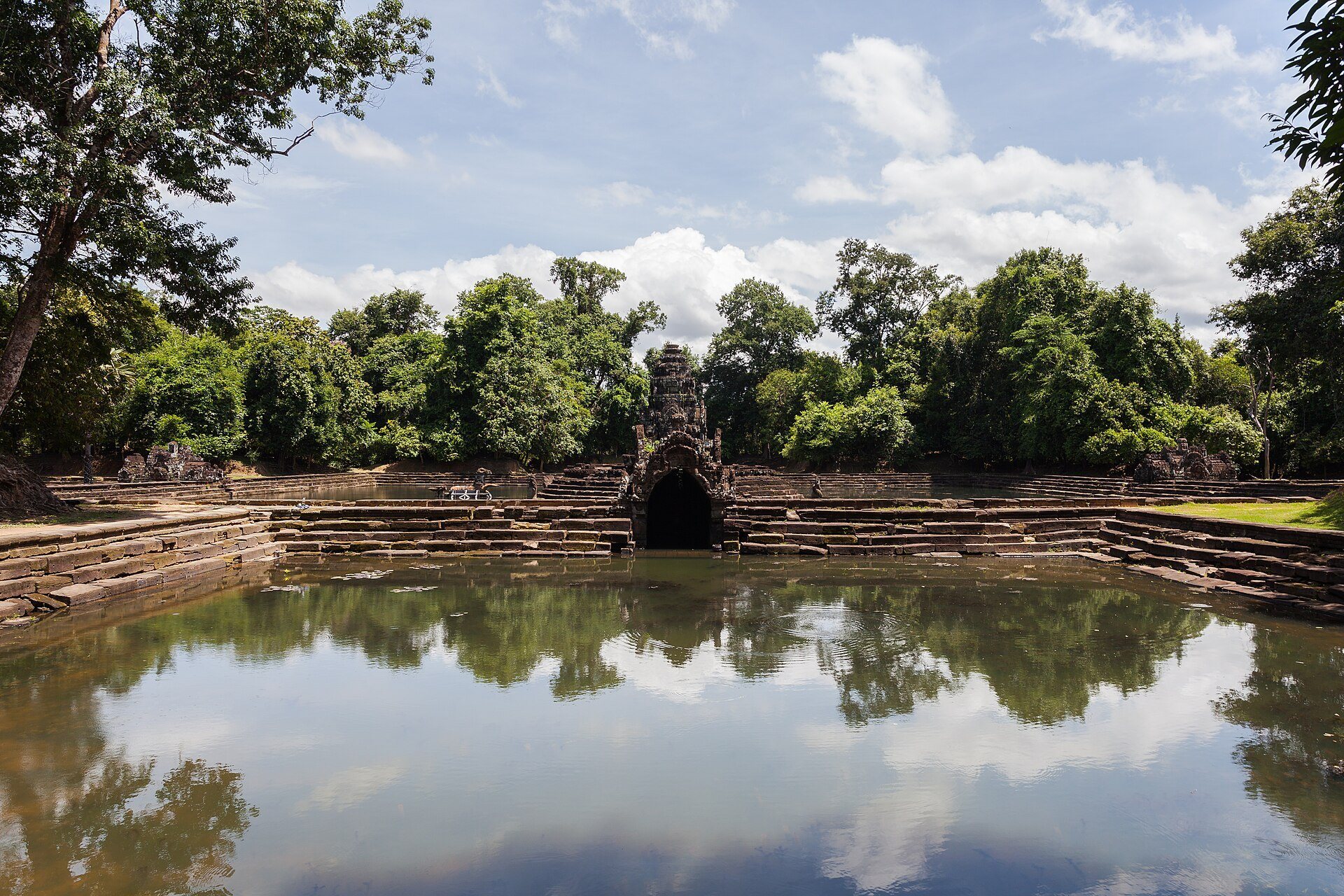
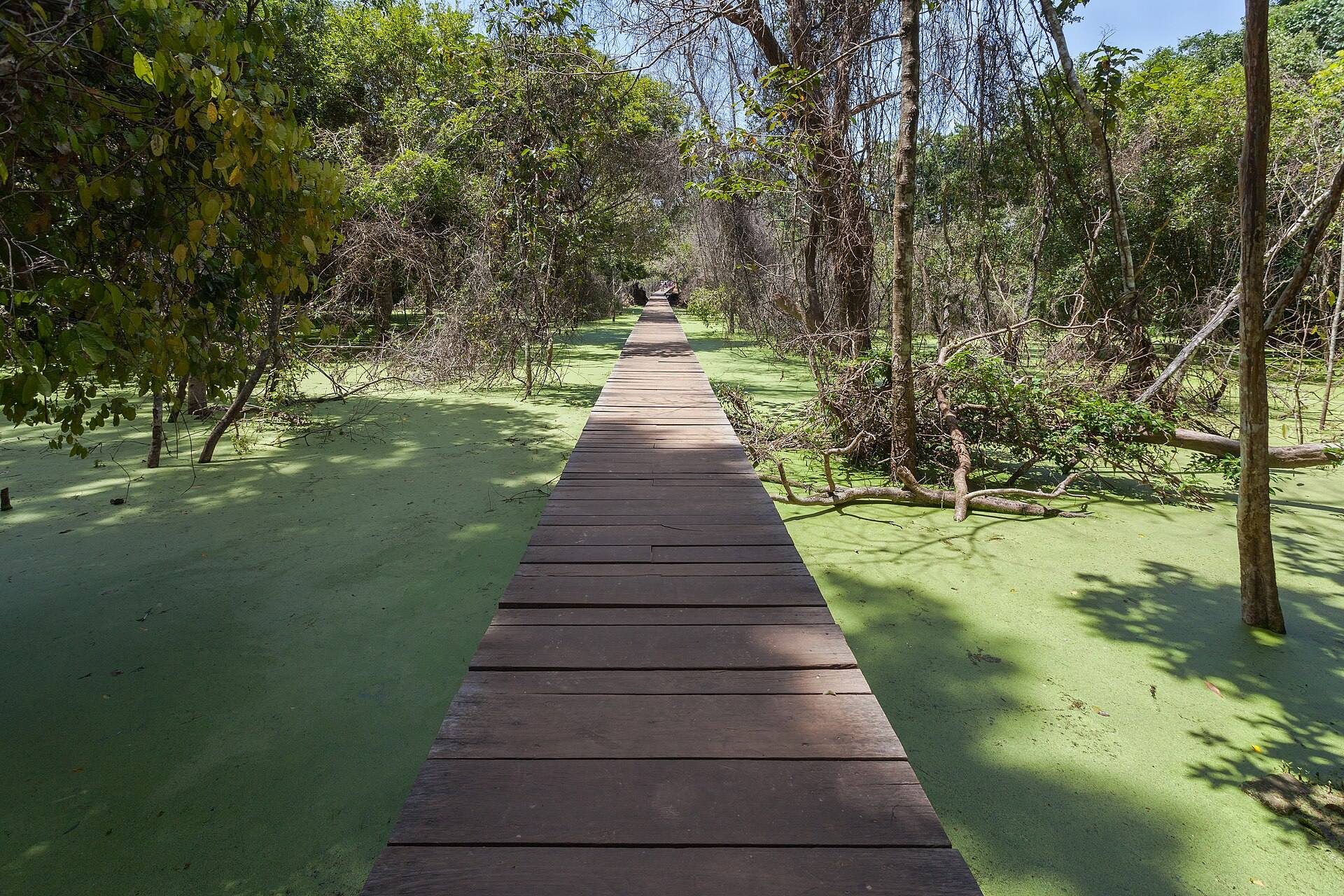
Neak Pean occupies a circular central island within a large square pool, with four smaller square pools arranged toward the cardinal directions. The temple stands in the middle of Jayatataka Baray, a reservoir measuring approximately 3,500 by 900 metres. The larger island is about 350 metres square, the central pool measures roughly 70 metres on each side, each subsidiary pool about 25 metres, and the inner circular island approximately 14 metres in diameter. A route enters the complex from the north.
Water layout and central sanctuary
Connected pools
Stone conduits connect the central pool to the four smaller pools and allow water to flow outward from the central source. Together, the pools form a cross-shaped water plan. Their arrangement gives physical form to the four elemental forces represented in the temple’s healing tradition and links the island sanctuary to the wider reservoir system.
Central island temple
The central sanctuary rises on a small circular base formed by stepped stonework. Two entwined, seven-headed nagas, serpent beings associated with water and protection, encircle the base. Their heads face east, while their tails meet toward the west. The figures are associated with Nanda and Upananda, traditional serpents connected with Anavatapta. A lotus carving supports the sanctuary above the circular base, whose encircling serpents give the temple its name.
Sculpture and sacred imagery
Directional heads
Four sculptures express the elemental scheme of the pools. A human head represents Earth, a lion head Fire, a horse head Wind, and an elephant head Water. The lion is associated with the south and the elephant with the north, while the human and horse complete the four-part arrangement. These sculptural forms were recovered through excavations and later conservation work.
Balaha and Avalokitesvara
A stone statue of Balaha stands near the island. Several human figures cling to or surround the horse, representing the sailors rescued from drowning in the legend of Avalokitesvara’s intervention. Avalokitesvara imagery is also associated with the sanctuary, and an image of the bodhisattva was recovered during excavation. The central temple is Buddhist, while its surviving sculptural program expresses the healing, protective, and water-related themes of the complex.