Ecbatana: Capital of the Medes and Royal City of Ancient Iran
Site at a Glance
- Rating
- 4.8
- Popularity
- Very Low
- Country
- Iran
- Primary era
- Classical
- Eras represented
- Iron Age, Classical
- Civilizations
- Achaemenid, Median, Parthian
- Site type
- City
On this page11 sections
History
Ecbatana was the capital of the Median kingdom at modern Hamadan in western Iran. It later served as a summer capital of the Achaemenid and Parthian empires, while remaining an important city under the Seleucids and a provincial center under the Sasanians and early Islamic rulers. The city stood in the Zagros Mountains, east of central Mesopotamia, near Mount Alvand and on routes linking western and eastern Iran.
Median Foundation
Ecbatana was also known as Hagmatana, a name preserved in the name of the ancient mound at Hamadan. It is regarded as the first capital in Iranian history. The city’s strategic position, local resources, and proximity to Mount Alvand may have encouraged settlement before the first millennium BC, although earlier occupation has not been confirmed archaeologically.
Herodotus attributed the choice of Ecbatana as the Median capital to Deioces, traditionally regarded in Greek historical writing as the first Median ruler. The foundation is commonly dated to about 678 BC, while another chronology places the formation of the Median kingdom around 708 BC. Both the date and circumstances remain uncertain. Some archaeologists instead associate the main construction of the royal complex with Phraortes, the second Median king. Older legendary traditions credited Semiramis or Jamshid with the city’s origin.
Under Median rule, Deioces was said to have established a palace, treasury, and military residence within a fortified complex of seven concentric enclosures. Median communities were reportedly moved to the capital and settled around the royal compound. Herodotus described the inner walls as rising above those outside them, with the palace and treasury inside the seventh enclosure. The extent to which this literary description reflects the excavated settlement remains uncertain.
Achaemenid Rule
Cyrus the Great defeated Astyages and captured Ecbatana about 550 BC, bringing the city into the Achaemenid Empire. Ecbatana no longer served as the empire’s principal center, but its position on the Royal Road between Persepolis and Sardis preserved its political and logistical importance. At the foot of Mount Alvand, it became an Achaemenid summer capital, treasury, and royal archive. A satrapy, the province of an ancient Iranian empire governed by an appointed official, was administered from Ecbatana from the Achaemenid period into the Sasanian period.
The Nabonidus Chronicle records Astyages’ overthrow and Cyrus’s seizure of the royal residence and its valuables. The citadel is also mentioned in Ezra 6:2 in connection with state archives during the reign of Darius I. These references place Ecbatana within the administrative and royal networks of the Achaemenid state.
By the time Darius III confronted Alexander in 330 BC, Ecbatana was described as being in ruins. Darius ordered hundreds of hiding places for treasure and property to be made in the middle of the city. Alexander conquered Ecbatana shortly before Darius III was killed in July 330 BC. He seized the treasury and removed the gold and silver decoration from the palace. Further stripping took place under Antigonus and Seleucus. The fall of Ecbatana, together with the destruction of Persepolis, marked the end of the Achaemenid Empire. Ecbatana was also where Alexander ordered the assassination of the Macedonian general Parmenion.
Seleucid and Parthian Periods
Ecbatana came under Seleucus I in 305 BC, after Alexander’s conquests had divided much of the former Achaemenid realm among his successors. In about 130 BC, Antiochus VII stayed briefly at the city while attempting to restore Seleucid power in Iran. Tigranes II stayed there the following year while preparing to attack Mithridates II.
In 129 BC, the Battle of Ecbatana was fought between Antiochus VII Sidetes of the Seleucid Empire and Phraates II of the Parthian Empire. The battle formed part of the Seleucid attempt to recover territory in eastern Iran. The Seleucid defeat restricted the kingdom largely to the region of modern Syria.
Under the Parthians, Ecbatana became a summer capital and a major royal mint, an official facility for producing state coinage. Its mint struck drachms, tetradrachms, and bronze denominations. The city’s wealth was linked to its position at a crossroads on the east-west High-Road, a major regional highway, and to the surrounding region’s reputation for horses and wheat. Numerous Parthian structures also show the city’s continuing importance during this period.
Sasanian and Later History
Ecbatana remained loyal to the Parthians until AD 226, when Ardashir I defeated Artabanus IV and conquered the city from the north together with Atropatene. Whether Ecbatana served as a Sasanian summer capital is disputed. One account places Sasanian construction between Ctesiphon and Mount Alvand, but not beyond the mountain.
After the Battle of Nahavand in AD 642, Ecbatana fell to Muslim forces and became a provincial center. The city was completely destroyed during the Mongol invasion around 1220 and was sacked by Timur in 1386, after which its inhabitants were massacred.
Identification and Archaeology
Ancient Greek writers, including Herodotus, Polybius, Ctesias, Justin, and Xenophon, described Ecbatana as a major royal city. Its identification with modern Hamadan is now considered secure on historical and archaeological grounds. The scarcity of clearly pre-Islamic remains once led some visitors and scholars to suggest Susa, Kangavar, Takht-i Suleiman, or Tabriz instead. Proposals linking Ecbatana with an Assyrian city called Sagbita or Sagbat, or with a second city at Takht-i Suleiman, remain theories rather than the accepted identification.
Excavation began in 1913 under Charles Fossey. Modern work has been restricted because Hamadan covers much of the ancient settlement. Property acquisition for archaeological purposes began in 1969, systematic excavation started in 1983, and twelve excavation seasons had taken place by 2007. A Parthian cemetery southeast of Hamadan was partly excavated in 1974, while work on the mound has continued.
Ecbatana received national protection in 1931 and was inscribed as a UNESCO World Heritage Site in 2024 under criteria ii and iii. The inscribed area covers 75 hectares and has a 287-hectare buffer zone. The Ecbatana Museum opened in 1994 in a repaired former nursery-school building east of the mound. It occupies more than 600 square metres and holds many finds from the site, while others are kept by the National Museum of Iran and the Reza Abbasi Museum.
Remains
Citadel and Fortifications
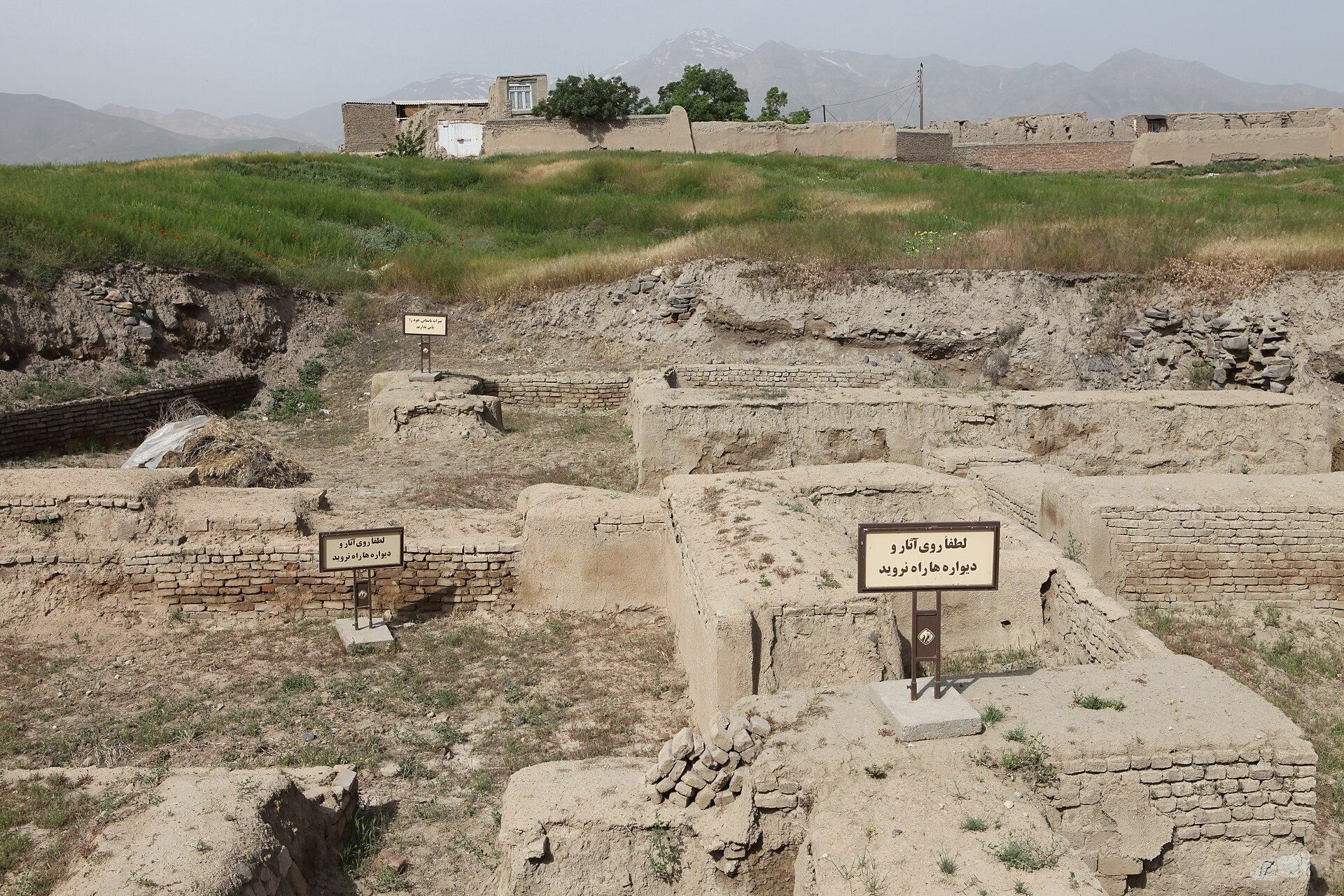
The ancient settlement occupied Hagmatana Hill, also called Tell Hagmatana or Tepe Hegmataneh, within modern Hamadan. The mound is identified with the ancient citadel and rises about 30 metres above its surroundings. It has a circumference of approximately 1.4 kilometres and covers about 40 hectares, while descriptions of the excavated area give a figure of about 35 hectares. The UNESCO inscribed area is larger, covering 75 hectares.
Herodotus described the citadel as a gently rising hill enclosed by seven fortified circuits. Each inner wall was higher than the one outside it. He compared the outer circuit’s size with the walls of Athens and described battlements painted white, black, scarlet, blue, and orange from the outer enclosure inward. The final two enclosures were said to have silver- and gold-covered battlements. Neo-Assyrian reliefs showing Median citadels with concentric walls offer a partial comparison, but the correspondence between the literary account and the actual complex remains uncertain.
Polybius portrayed the royal complex as an artificial citadel with powerful defenses and a palace about seven stories high. His description included silver- or gold-plated rafters, decorated ceiling compartments, portico and colonnade columns, silver roof tiles, and richly ornamented wooden elements. After Alexander removed much of the precious metal, Antigonus and Seleucus stripped the complex further. In the second century BC, Antiochus found gilded columns in the Temple of Aene, as well as silver tiles and gold bricks.
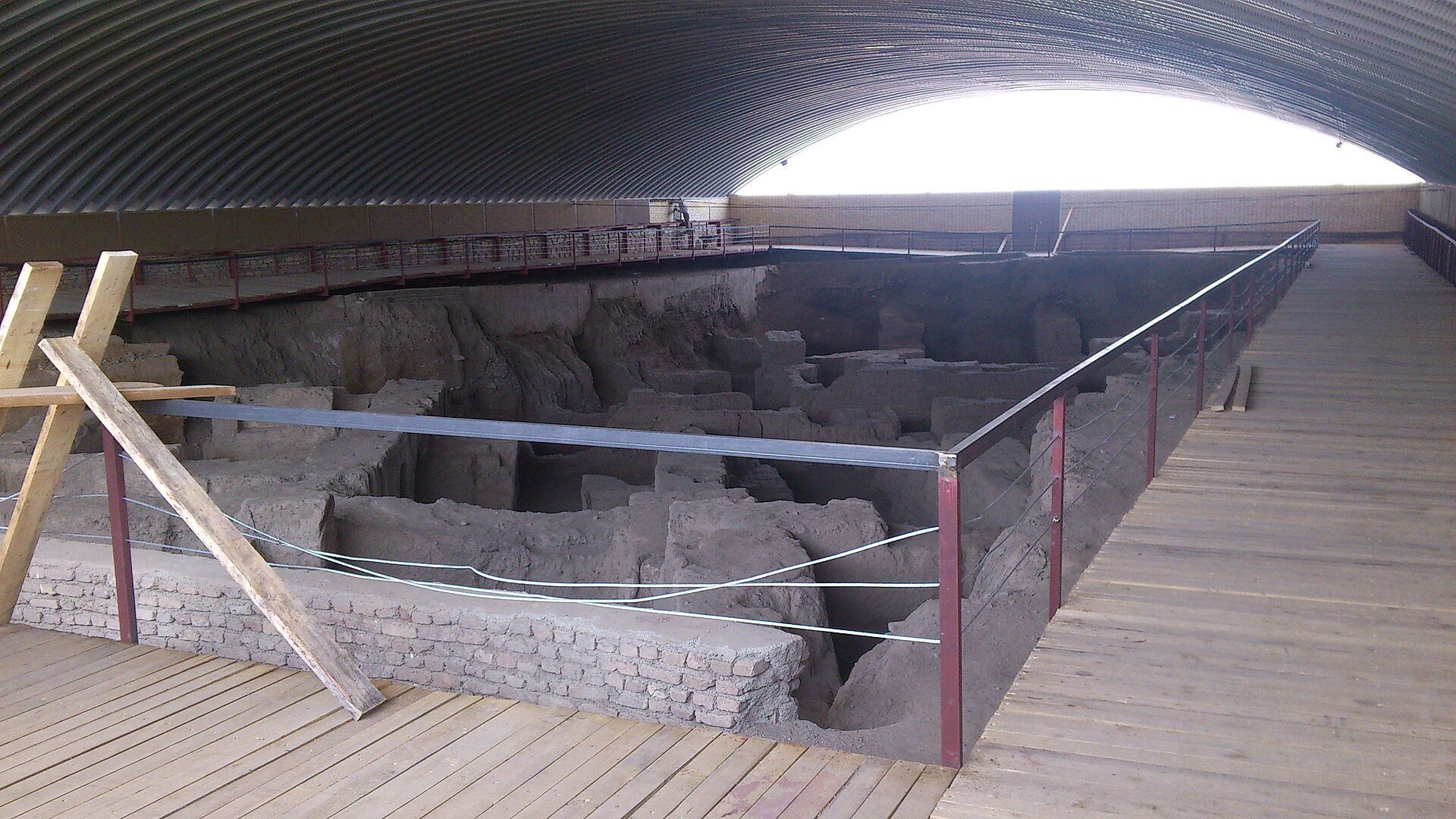
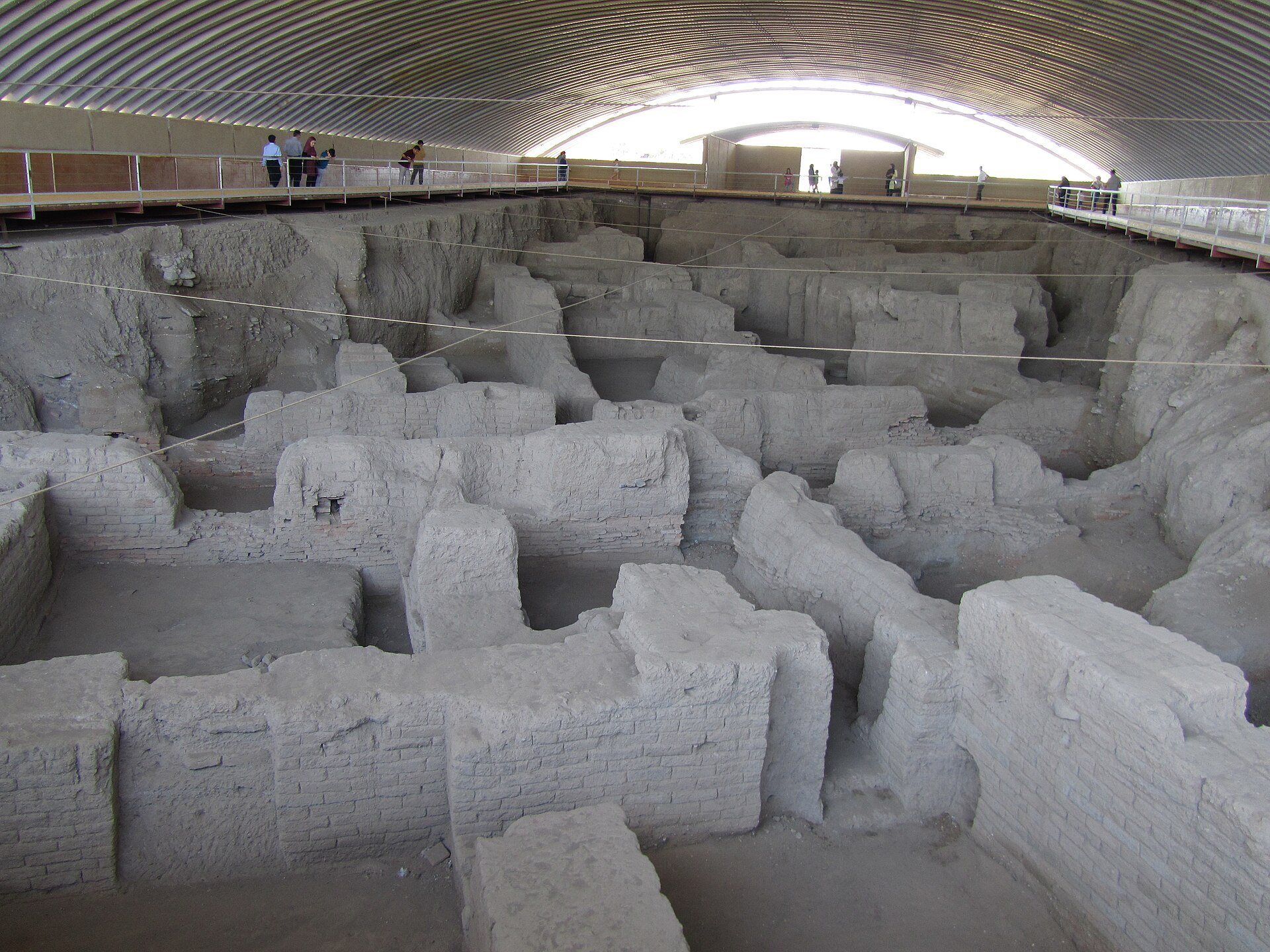
Excavations have exposed a massive mud-brick defensive wall attributed to the Median period through comparison with structures at Tepe Nush-i Jan and Godin Tepe. Another excavation revealed a long fortification approximately 9 metres high and 9 metres thick, with two large towers. Other descriptions give the wall a height of about 8 metres and note regularly spaced monumental towers.
Urban Plan and Religious Architecture
Investigations have revealed a notably regular urban plan and an advanced water-supply network. Streets about 3.5 metres wide ran between channels, rested on brick foundations, and had surfaces paved with regularly arranged square bricks. The excavated streets ran from northeast to southwest.
At intervals of about 35 metres, two rows of symmetrical building units stood along the streets. Each unit measured approximately 17.5 by 17.5 metres and contained a central courtyard or hall surrounded by rooms and storerooms. This repeated arrangement provides a physical view of the settlement’s organized internal layout.
A small open-sided room with four corner columns supporting a domed roof resembles a Median-period structure at Tepe Nush-i Jan. It has been interpreted as a Zoroastrian fire temple, a place associated with preserving and ritually using sacred fire, although that interpretation is not certain. Two column bases belong to the Achaemenid period, and other mud-brick structures are attributed broadly to either the Median or Achaemenid period.
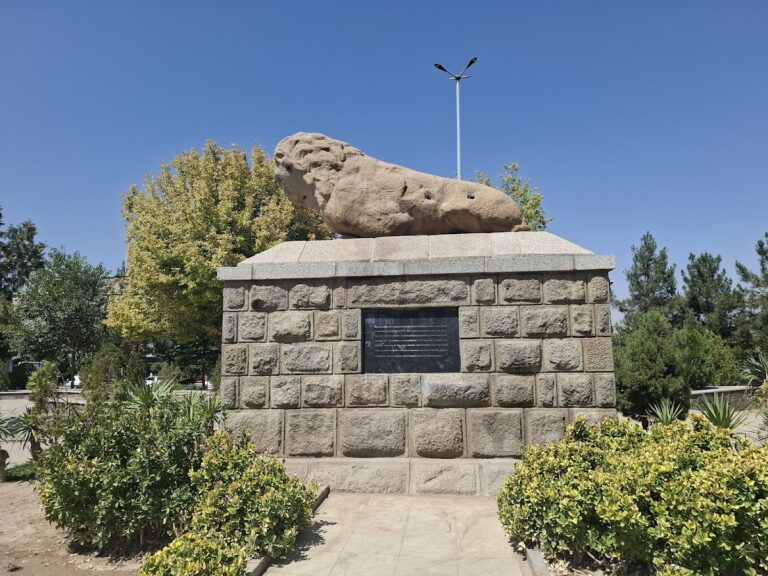
A badly damaged limestone lion sculpture has a disputed date and may be Achaemenid or Parthian. The summit of the rocky Mosalla hill in southeastern Hamadan contains stone and brick remains of a rectangular citadel marked by towers. The hill rises about 80 metres, and the citadel is considered no earlier than the Parthian period. Fossey’s six-week excavation there uncovered fragments of column bases decorated with arabesques and inscriptions, glazed bricks, and faience tiles. A carved head of a prince was found during a three-month excavation in the eastern sector.
Inscriptions and Royal Objects
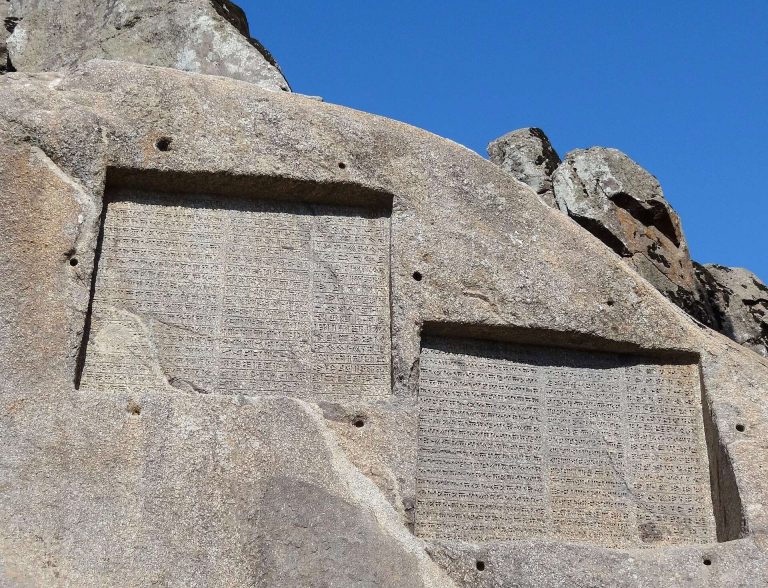
The mound has produced inscribed royal objects in gold, silver, stone, and other materials. A gold tablet attributed to Ariaramnes measures 12 by 8 centimetres and carries ten lines of cuneiform, a writing system formed from wedge-shaped marks pressed or incised into a surface. It is now in the Berlin Museum. Another gold tablet, attributed to Arsames, measures 8 by 13 centimetres and is held in a private collection in the United States.
Two equal-sized tablets, one gold and one silver, were found when foundations were being dug for a house on Hagmatana Hill. Each measures approximately 19 by 18.8 centimetres and bears the same cuneiform text. The silver tablet is in the Marble Palace Museum, while the gold tablet is in the National Museum of Iran.
A gold tablet attributed to Darius II measures approximately 20.5 by 18.5 centimetres and contains 23 lines of cuneiform. It is held by the National Museum of Iran, which acquired it after it had been outside Iran. Another tablet there measures about 16.2 by 13 centimetres and contains 29 lines. A gold tablet associated with Artaxerxes II, the son of Darius II, measures 13 by 13 centimetres and contains 20 lines of cuneiform.
Other Achaemenid objects include a broken silver vessel attributed to the reign of Xerxes, son of Darius the Great. It is about 7.5 centimetres across the mouth and 12 centimetres high, with a partly surviving cuneiform inscription, and is now in the National Museum of Iran. A silver plate from the Achaemenid period has a mouth diameter of 20 centimetres and is held by the same museum. A silver plate or bowl attributed to Artaxerxes I measures approximately 26.7 centimetres across the mouth and bears a long cuneiform inscription on its inner rim. It is held by the Metropolitan Museum of Art.
An Achaemenid gold bowl measures about 18.4 centimetres across the mouth and 10.7 centimetres high. Its relief decoration consists of repeated bosses, while a trilingual inscription, written in three languages or writing traditions, runs around the upper part and means Darius, great king. The bowl is in the Gorgian Collection in New York.
A monolithic square stone column base associated with Artaxerxes II measures 93 centimetres on each side. Its upper surface has a circular socket for a column, and its cuneiform inscription identifies it as a base for a column of the Apadana, a large Achaemenid audience hall, of Artaxerxes. Found at Hagmatana before 1935, it is now in the National Museum of Iran. A second stone column base associated with Artaxerxes II bears a seven-line cuneiform inscription and was found at Hagmatana. It is in private ownership in England. Its inscription records the construction of a palace by Artaxerxes and invokes Ohrmazd, Anahita, and Mithra.
Related Median Evidence
Tepe Nush-i Jan, which contains a fire temple, is a separate archaeological site associated with Ecbatana’s Median religious landscape. Excavations there began in 1967 under David Stronach and identified Parthian, Achaemenid, and Median architectural levels. Its earliest level dates from the second half of the eighth to the first half of the sixth century BC. Comparisons between its Median structures and features at Hagmatana have helped inform the interpretation of Ecbatana’s mud-brick architecture.