Tomb of Esther and Mordechai: A Jewish Mausoleum in Hamadan, Iran


Site at a Glance
- Rating
- 4.2
- Popularity
- Low
- Country
- Iran
- Primary era
- Early Modern
- Eras represented
- Medieval, Early Modern
- Civilizations
- Ilkhanate, Safavid
- Site type
- Religious
- Remains
- Tomb
On this page12 sections
History
The Tomb of Esther and Mordechai is a Jewish mausoleum in central Hamadan, Iran, traditionally identified with the burial place of Esther and Mordechai, the central figures of the biblical Book of Esther. Esther is presented in that narrative as a Jewish queen of Ahasuerus, an Achaemenid ruler, while Mordechai is her relative and adviser. The mausoleum is traditionally dated to the sixteenth or seventeenth century, although its identity and age have been disputed.
The burial tradition
The Book of Esther and the Babylonian and Jerusalem Talmuds do not mention a tomb at Hamadan. Jewish communities outside Iran have generally not accepted the Iranian tradition. One of the earliest known references appears in the medieval travel writing of Benjamin of Tudela, who described a tomb of Esther and Mordechai at Hamadan during his visit, conventionally dated to 1067. His wording may have referred either to an actual tomb or to a shrine named for the two figures.
Iranian Jewish tradition holds that Esther and Mordechai fled to Hamadan after the death of Ahasuerus and after supporters of Haman attempted to kill them. They are said to have taken refuge among the city’s large Jewish community and to have died there in old age. A later Persian Jewish narrative states that Mordechai died in the synagogue and that Esther died one hour later.
The shrine became one of the most important pilgrimage sites for Iranian Jews and Iranian Christians. Visits by local Jews, monthly pilgrimages, and the reading of the Book of Esther at the tombs during Purim formed part of its religious use. Some historical accounts also describe worshippers striking the tombs with their palms. In 1850 Hamadan’s Jewish population was described as approximately 500 families with three synagogues. The tomb was then said to stand just inside the city walls, while later accounts placed it at the center of the Jewish quarter and called it the principal national Jewish holy place in Persia.
Alternative identifications
The burial tradition has competing explanations. The site has been interpreted as the tomb of Shushandukht, traditionally identified as the Jewish wife of the Sasanian king Yazdegerd I, who ruled Iran from 399 to 420 and was said to be the mother of Bahram V. The archaeologist Ernst Herzfeld rejected the identification with Esther and Mordechai and argued that the two figures were buried at Susa. A later interpretation likewise regarded Shushandukht as the more probable occupant.
Another medieval tradition places Esther’s grave at Kfar Bar’am in the Upper Galilee. Medieval references initially mention Esther alone, while the tradition that Mordechai was brought from Elam and buried beside her at Bar’am appears only in the early seventeenth century. Other proposed locations include the Safed area, Awarta, Tiberias, and Gush Halav. A reference to “Samarion” is generally regarded as a corruption of Hamadan. At Bar’am, one marker for the joint graves was established in the late twentieth century, while another site identifying Esther alone was marked near the settlement’s southern entrance during the first decade of the twenty-first century.
Construction and modern history
The present mausoleum is traditionally dated to the sixteenth or seventeenth century. The Iranian government has also maintained that the structure dates from the Ilkhanate, the Mongol dynasty that ruled Iran during the thirteenth and fourteenth centuries. A Hebrew inscription recorded in 1910 gives a construction date of “1618,” although the calendar used for that date is uncertain. The building has undergone several repairs and reconstructions.
In 1970 Iranian Jews acquired the building with assistance from Shah Mohammad Reza Pahlavi and his government. Iran designated it a national heritage monument in 2008. In December 2010, individuals identified by Iranian state media as students from Bu-Ali Sina University in Hamadan threatened to destroy the shrine if Israeli archaeologists damaged the Al-Aqsa Mosque. In 2011 the government announced that the graves were no longer a state site and removed official protection. The entrance sign also lost its designation of the building as a pilgrimage site, though that wording was later restored after pressure from Hamadan residents.
The mausoleum suffered an arson attack in May 2020, causing limited smoke damage without reported major structural destruction, and Hamadan officials announced restoration work. The tombs were desecrated in October 2023. On 3 April 2024, attackers threw Molotov cocktails at the shrine, causing minor damage. In 2024 the historic center of Hamadan, including ancient Ecbatana and the Tomb of Esther and Mordechai, was inscribed on the UNESCO World Heritage List under criteria 2 and 3. In March 2025 Iran’s chief rabbi read the Book of Esther at the tombs.
Remains
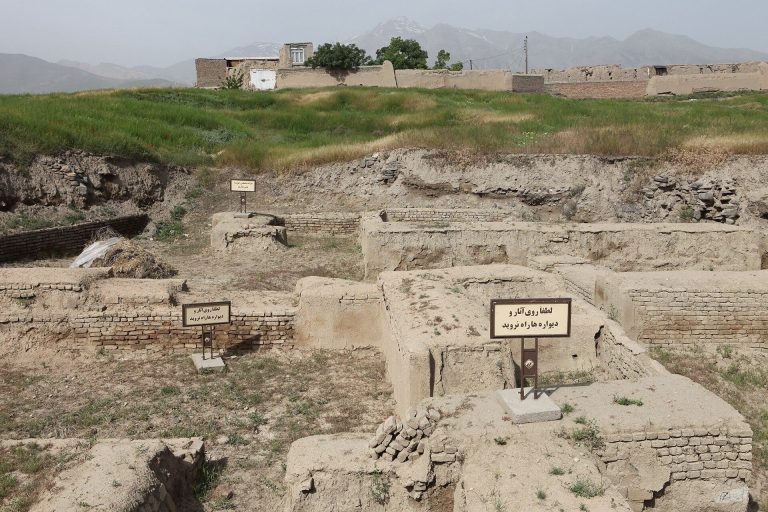
The mausoleum stands at the beginning of Dr. Shariati Street in central Hamadan. Hamadan occupies the site of ancient Hagmatana, or Ecbatana, which served as a capital of the Median Empire and later as one of the simultaneous capitals of the Achaemenid Empire. The complex is a simple stone-and-brick tomb building with a subterranean burial chamber and an upper structure raised over the graves. A rounded tower or dome rises above it.
Burial chamber and tomb structures
The burial chamber is reached within the underground part of the building. Descriptions from 1891 record an inner chamber and an outer chamber beneath a dome approximately 50 feet, or about 15 to 16 meters, high. Several graves of prominent Jews were situated in the outer chamber. The principal burials are represented by two large wooden cenotaphs, commemorative tomb structures that do not necessarily contain the named person’s remains, each covered with textile coverings.
Esther’s cenotaph
The cenotaph on the right is attributed to Esther. Its inscription reads, “This is the coffin in which Esther the righteous was buried.” The Hebrew lettering on the cenotaph has been dated to the eighth or ninth centuries of the Islamic calendar.
Mordechai’s cenotaph
The cenotaph on the left is attributed to Mordechai. Its inscription calls it “the holy coffin of Mordechai the righteous” and includes his genealogy. One of the wooden cenotaphs is described as very old and associated with the Mongol period in Iran, while the other is described as a later imitation that replaced an earlier original. Construction or refurbishment of the wooden frames in 1291 is attributed to members of the Jamal al-Dawla family, including a financial minister of the Mongol ruler Arghun Khan.
Chamber opening and communal spaces
Opening beneath the cenotaphs
A stone between the two principal cenotaphs covers an opening into a deep pit or cave beneath the chamber. The opening could be reached for maintenance. Local tradition identifies it as a passage leading directly to Jerusalem.
Prayer room and communal hall
A small prayer room stands beside the graves. The complex also contains a larger hall used for bar mitzvahs, circumcisions, communal events, and the reading of the Book of Esther during Purim.
Dome, decoration, and associated features
The dome was covered with blue tiles, most of which had fallen away by 1891. Hebrew inscriptions and raised plasterwork decorate the building. The inscriptions include passages from the Book of Esther, the declaration “The Lord reigns; the Lord has reigned; the Lord will reign forever and ever,” and a quotation from Isaiah 26 above the entrance. The raised plaster decoration has been dated to the eighth or ninth centuries of the Islamic calendar.
A French representative is traditionally said to have investigated a nest-shaped or egg-shaped object in the inner ceiling or upper part of the dome at the beginning of the twentieth century. The object reportedly contained a pottery vessel with jewelry and a crown decorated with pearls and gemstones, allegedly taken to the Louvre. The Jewish community of Hamadan identifies the crown with Esther’s crown.
A nineteenth-century description states that the first room had been built above the graves of a physician and a messenger from Hebron. A chief rabbi of Hamadan in the nineteenth century was reportedly buried at the center of that room. The entrance transom contains a Star of David that was partially damaged in 2017, before the 2020 fire. The 2024 attack caused minor damage to the complex.