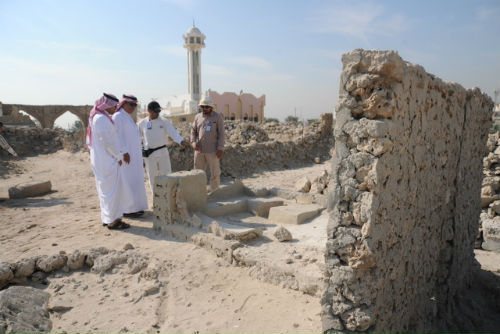
Barbar Temple: A Dilmun Sacred Complex in Bahrain
Site at a Glance
- Rating
- 4
- Popularity
- Low
- Country
- Bahrain
- Primary era
- Bronze Age
- External website
- Open
- Eras represented
- Bronze Age
- Civilizations
- Dilmun
- Site type
- Religious
- Remains
- Temple
On this page8 sections
History
Barbar Temple is a ruined Dilmun religious complex in the village of Barbar, Bahrain, built in three successive phases between about 3000 and 2000 BC. Dilmun was an ancient Gulf culture and trading region centred on present-day Bahrain, whose remains include settlements, temples, burials, and evidence of long-distance exchange.
Three Dilmun temples
The earliest sanctuary, Temple I, dates to around 3000 BC. Temple II followed approximately 500 years later, around 2500 BC, and Temple III was constructed between 2100 and 2000 BC. Each temple was built above the remains of its predecessor, creating a sequence of sacred buildings on the same site. Temple III continued in use after 2000 BC and was larger than the earlier temples.
The temples are generally believed to have been dedicated to Enki, the Mesopotamian god of wisdom and freshwater, and Ninhursag, a major goddess associated with fertility and creation. A natural spring at Barbar appears to have held religious importance and may have influenced the choice of location. The underground shrine associated with Temple II has been interpreted as a symbolic abzu, the deep or cosmic freshwater realm linked particularly with Enki.
An alternative interpretation proposed by Dr. K. Lognathan connects the name Barbar with a Tamil name for the god Shiva and understands Dilmun through Tamil religious concepts. This remains a theory about the name and religious associations rather than an established historical identification.
Discovery and archaeological work
A Danish archaeological team led by the archaeologist P. V. Glob discovered the site in 1954. Excavations began that year under Hellmuth Andersen and Peder Mortensen, both Danish archaeologists, and continued until 1962. The gravel mound over the upper temple was removed in the winter of 1955, while its walls were excavated in February and March 1956. Archaeological work resumed in 2004.
Excavation recovered tools, weapons, pottery, and small pieces of gold. These objects are displayed at the Bahrain National Museum, while the best-known find is a copper bull’s head. Barbar Temple has been on Bahrain’s tentative list of UNESCO World Heritage Sites since 2001. Such a list identifies places proposed for possible future nomination and does not constitute inscription on the World Heritage List.
Remains
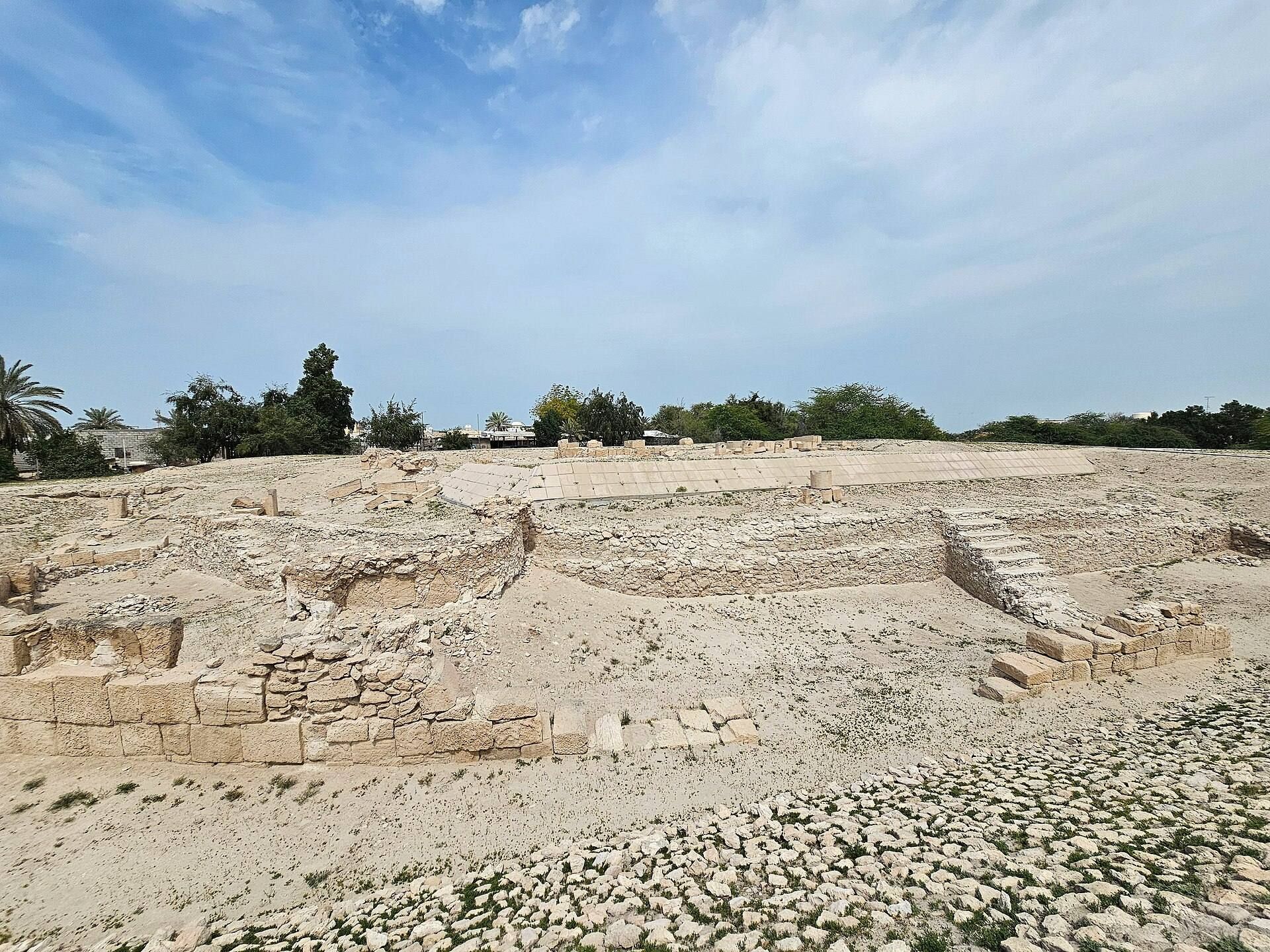
The three temples occupy successive levels, with later construction placed over earlier buildings. Limestone formed the principal building material. Some of the stone is local to Bahrain, while larger blocks used in later work are believed to have been quarried on Jidda Island and transported to Barbar. The surviving site is in ruins, but its terraces, wells, shrines, altars, channels, and offering installations preserve evidence of changing religious architecture.
Temple I platform and shrine
Temple I stood on a rectangular platform about 25 metres long and between 16 and 18 metres wide. The platform was laid over clean sand apparently strengthened with blue clay, then covered with a second layer of clean sand. Offerings were placed within the clay core of the foundation. They included dozens of clay goblets, deliberately broken and buried in separate groups of seven, together with copper objects deposited singly or in small heaps.
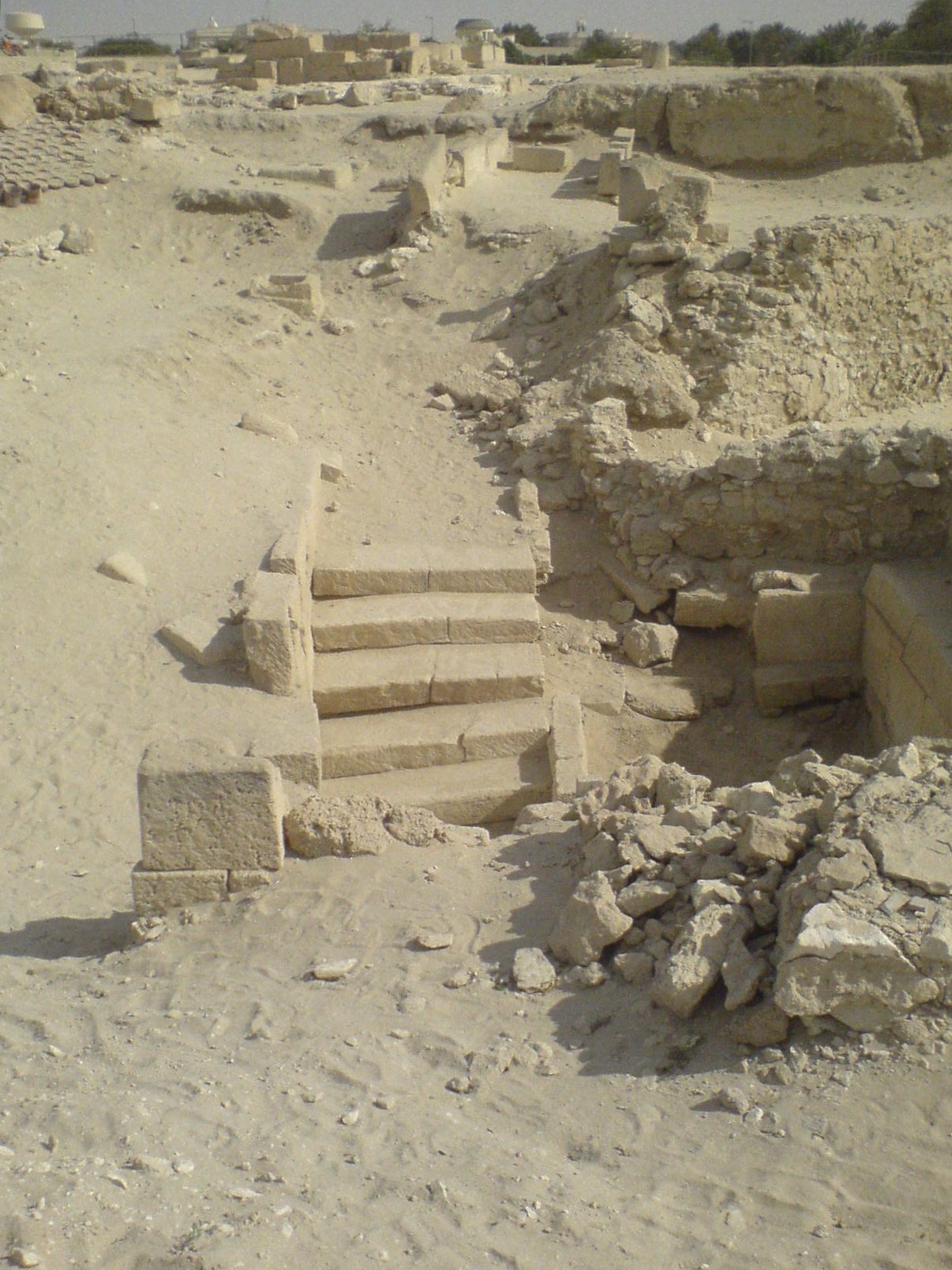
Steps at the south-west corner led to a square-built well. The central terrace survives to about 2 metres high and contains the remains of a trapezoidal shrine with adjoining rooms. The structure was built from local Bahraini limestone.
Temple II terraces and sacred water installations
Temple II is better preserved than Temple I. Its remains include walls, roof supports, terraces, and carefully dressed masonry, particularly around the sacred well. The first oval terrace was made from local stone, while its enlargement used limestone blocks believed to have come from Jidda Island. A double circular altar and an offering table stood at the centre. Three cult stones to the south were shaped like anchors used by merchant ships, and the central stone also carried a projecting animal head.
A stone-lined pit at the north-eastern end contained a temple treasure. Around a cut-stone shrine with a paved floor, smaller buildings occupied the central terrace. The outer oval terrace held altars and cult symbols. South of the temple stood a stone plinth with a recessed cylinder, while another plinth with three pillars stood near the north-western wall. Double rows of plinths flanked the stairs from the upper terrace. Each plinth had two square holes lined with bitumen and copper sheeting, which may have supported copper poles bearing divine emblems or wooden statues.
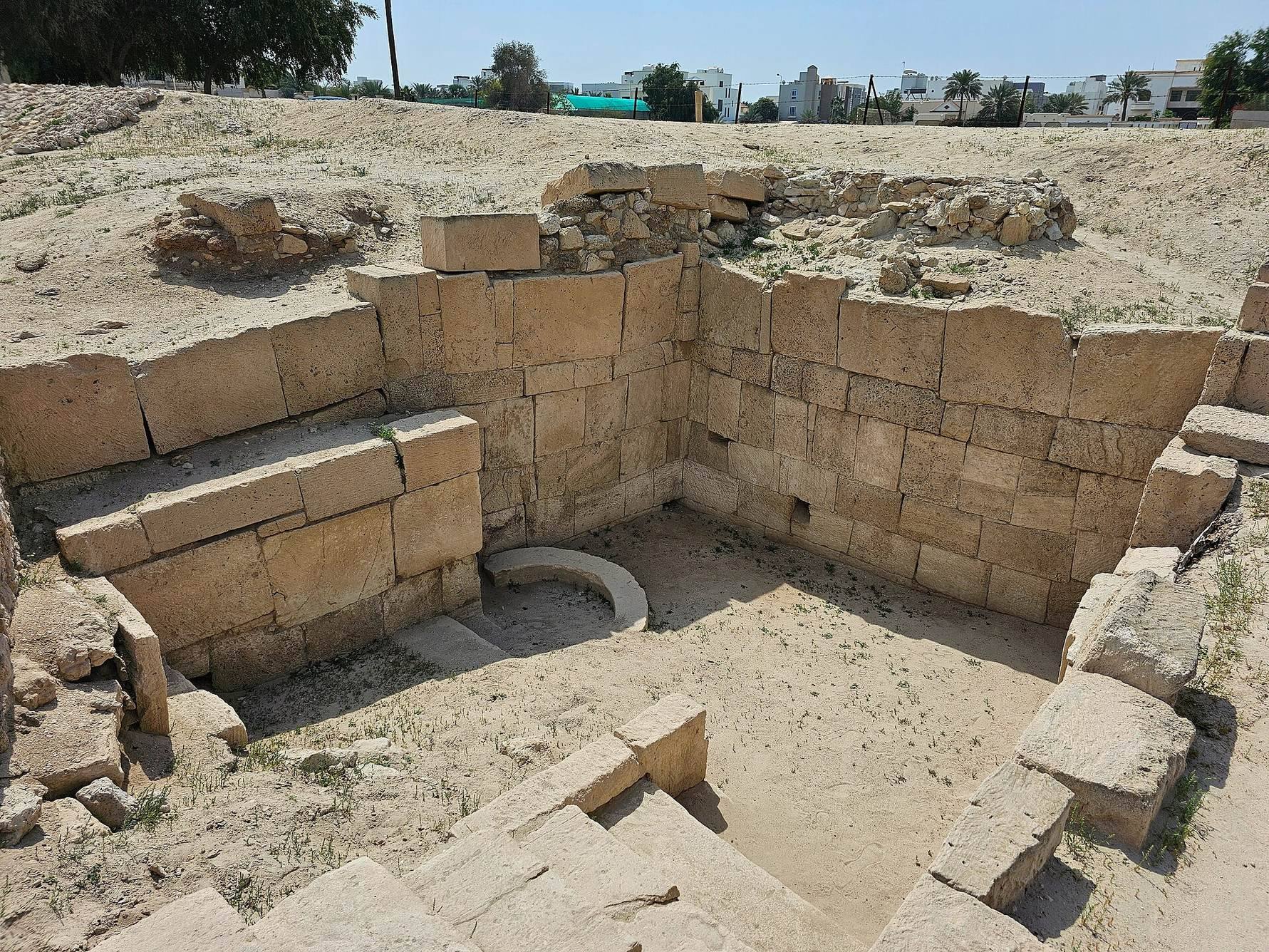
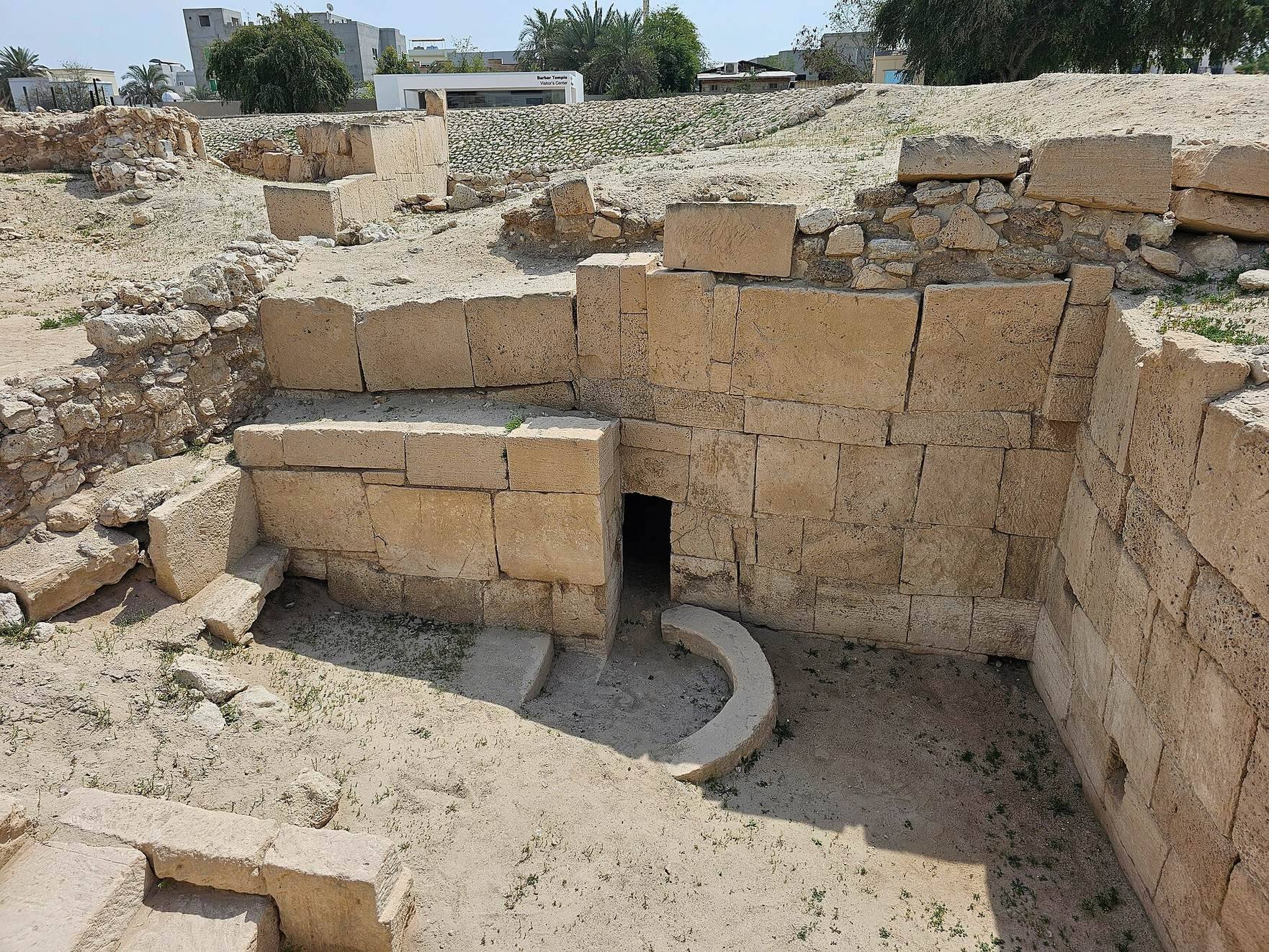
A ceremonial stairway descended from the central terrace to a subterranean shrine, where water-related ceremonies probably took place. Part of the stairway was roofed and included a portal. The spring filled a small pool, and water flowed from a perforated stone vessel beside a semicircular stone fountain or basin at the entrance to a dry chamber. Deep stone-built channels carried water from the corners of the shrine towards surrounding fields and gardens.
Temple II sacrificial court
East of Temple II, an oval sacrificial court was connected to the central platform by a paved ramp and stairs. Its floor was covered with ash and the bones of cattle and sheep, apparently animals sacrificed during ceremonies. The court formed a separate element of the temple complex while remaining connected to the raised central platform.
Temple III courtyard
Temple III was larger than its predecessors, and its terrace probably covered about 30 square metres. Two circular offering tables made from finely cut stone remain standing in the centre of its courtyard, with a low altar between them. Three additional upright stone blocks contain circular holes and are believed to have served as tethering points for animals intended for sacrifice.
નાર