White Horse Temple: A Historic Buddhist Temple in Luoyang, China
Site at a Glance
- Rating
- 4.5
- Popularity
- Low
- Country
- China
- Primary era
- Early Modern
- Eras represented
- Medieval, Early Modern, Modern
- Civilizations
- Jurchen Jin
- Site type
- Religious
- Remains
- Monastery
On this page19 sections
History
White Horse Temple is a Buddhist temple in Luoyang, Henan, China, traditionally founded in AD 68 under Emperor Ming of the Eastern Han dynasty. Built outside the walls of the Eastern Han capital, it is widely regarded as the first Buddhist temple in China and is associated with the arrival of Buddhism from India and Central Asia. Its institutional tradition also has a strong connection with Chan Buddhism, a Chinese tradition centered on meditation and the transmission of religious insight through teacher lineages.
Foundation traditions
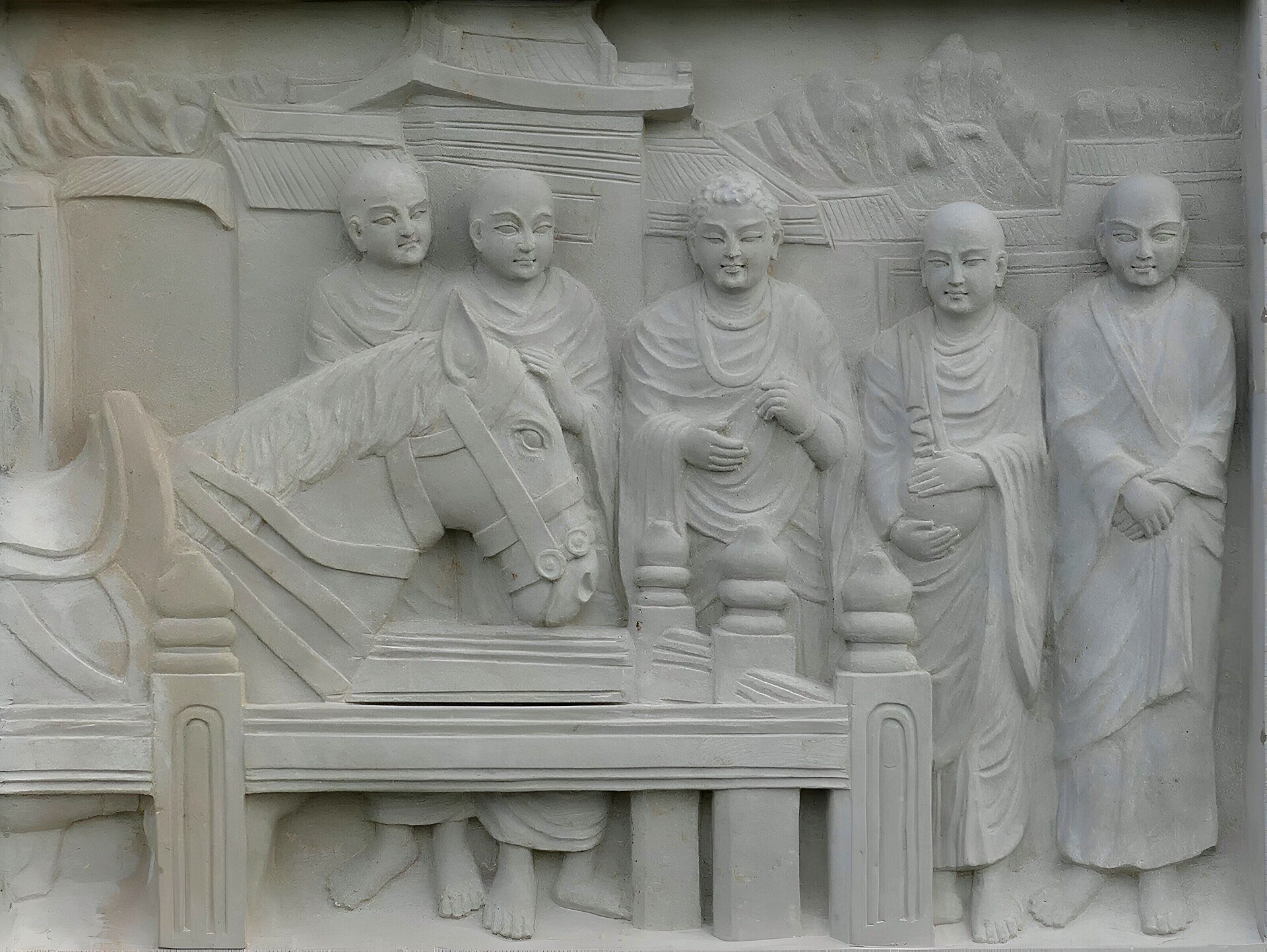
The temple’s foundation is traditionally connected with the Indian monks Kasyapa Matanga and Dharmaratna. According to the best-known account, they reached Luoyang carrying Buddhist scriptures on two white horses. Emperor Ming had supposedly dreamed of a radiant Buddhist figure, after which he sent eighteen envoys westward. The envoys returned with the monks, the Sutra of Forty-two Chapters, Buddhist images, and sacred relics. The emperor then supported the establishment of the temple outside the capital to house the visitors and their scriptures.
This story also explains the temple’s name, although the explanation remains uncertain. Other early temples carried the same name, and the name may instead have been associated with peoples known as the White Horse Qiang or White Horse Di. Another tradition states that, after Emperor Ming’s death, a meditation hall was built over his tomb. The account of a fire test between Taoist and Buddhist scriptures is widely regarded as a Buddhist legend rather than a securely historical event.
Evidence for the temple’s earliest history is limited. Yang Xuanzhi’s account, completed around AD 547, records Emperor Ming’s order to erect Buddhist images at sites in the Southern Palace but does not mention White Horse Temple. The temple is not securely recorded in surviving contemporary sources before AD 289, although other temples with the same name appear in records from the third and fourth centuries.
Early translations and Buddhist activity
White Horse Temple became associated with the translation of important Buddhist works. In AD 258, the royal Kuchean monk Po-Yen translated six Buddhist texts there, including the Infinite Life Sutra. The Indo-Scythian translator Dharmaraksa reached Luoyang in AD 266 and lived at the temple from at least the spring of AD 289 to 290.
The temple is also linked with Xuanzang, the Buddhist monk who began his pilgrimage to India from Luoyang. After returning, he served as the temple’s abbot until his death. During his residence, he taught, conducted religious activities, and translated Buddhist scriptures brought from India into Chinese. These associations helped establish the temple’s reputation as a place connected with the transmission and translation of Buddhist learning.
A community of approximately ten thousand monks is said to have resided at the temple during the Tang dynasty, which ruled China from AD 618 to 907. The complex therefore continued to function not only as a place of worship but also as a major monastic and intellectual institution.
Destruction, rebuilding, and later history
A fire reportedly destroyed the temple and an earlier stupa associated with Tathagata relics approximately five decades before an inscription dated AD 1175. The same inscription records that a Jin official later erected the Qilun Pagoda. The Jin dynasty ruled northern China from 1115 to 1234, and the surviving pagoda preserves a connection with this period of rebuilding.
Further restoration and renovation took place during the Ming and Qing dynasties. Major work occurred during the sixteenth century, and several surviving buildings originated in that period even though they were renovated later. The Ming dynasty ruled from 1368 to 1644, followed by the Qing dynasty from 1644 to 1912.
The Cultural Revolution, a political and social campaign in the People’s Republic of China generally dated from 1966 to 1976, damaged the temple, burned several buildings, and left the complex depleted of religious objects. Renovation and restoration under the People’s Republic of China took place between 1952 and 1973. In 1973, before a visit by the Cambodian Buddhist prince Norodom Sihanouk, 2,900 objects from other Chinese palaces and museums were secretly transferred to the temple. The complex was restored, and Premier Zhou Enlai subsequently declared the transfer permanent.
Modern cultural connections
A Thai-style Buddha hall was built slightly west of the older temple in 1992 with assistance from Thai and Chinese donors. Visits by the Indian Prime Ministers P. V. Narasimha Rao in 1993 and Atal Bihari Vajpayee in 2003 drew attention to the temple’s symbolic role in the historical cultural relationship between China and India.
On 11 April 2005, China and India signed a memorandum of understanding that led to the construction of an Indian-style Buddhist shrine within the temple complex. India supplied the design, construction materials, Buddha image, landscaping, and technical advice, while Chinese authorities allocated 2,666.67 square metres of land. The shrine was completed in 2008 and inaugurated on 27 May 2010 by Indian President Pratibha Patil. Its construction reinforced the temple’s modern role as a place of Chinese-Indian Buddhist cultural exchange.
The temple is also associated with Luoyang’s annual Peony Festival, held from 10 to 25 April. A legend says that Empress Wu Zetian ordered peonies expelled from Chang’an to Luoyang after they failed to bloom in winter. The festival remains connected with White Horse Temple.
Remains
White Horse Temple lies approximately 12 to 13 kilometres east of present-day Luoyang, just outside the walls of the ancient Eastern Han capital. Manghan Mountain and the Luo River are identified as geographical landmarks to the south. The complex faces south and extends along a central axis from the entrance through successive halls and courtyards. It covers approximately 200 mu, or 13 hectares, and combines historic buildings, later religious structures, courtyards, gardens, pagodas, tombs, and ritual furnishings.
Entrance and central temple
Gateway and stone horses
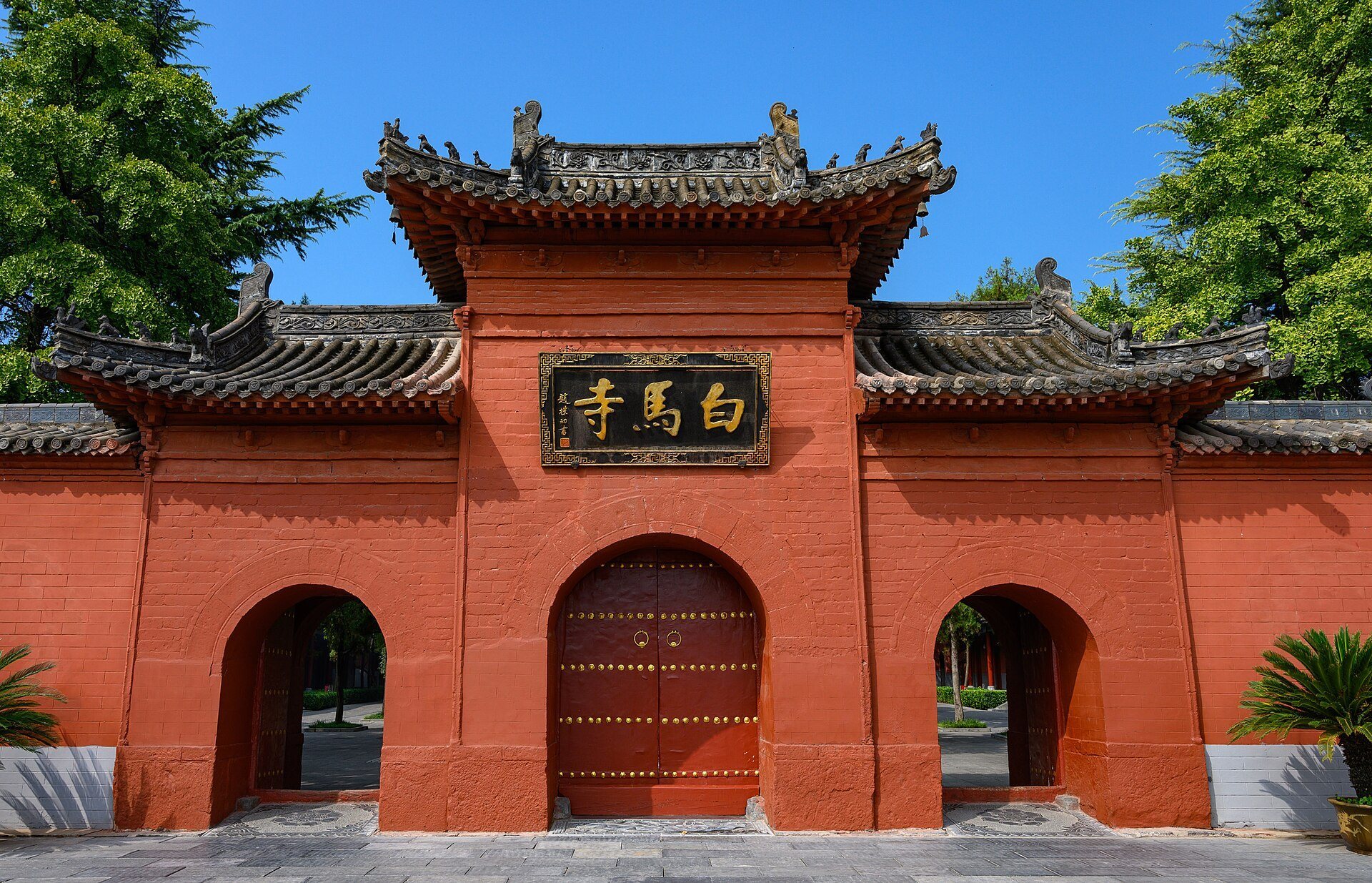
A recently constructed stone paifang, a Chinese ceremonial gateway, stands about 150 metres in front of the original entrance gate. It has three covered openings. A fountain pool crossed by three stone bridges lies between the paifang and the gate. Two green-stone horses stand opposite one another at the entrance. Dated to the Song dynasty, they represent the white horses traditionally said to have carried the Indian monks and Buddhist scriptures to China. Additional stone horses in Ming architectural style stand at the front of the temple, where two mythical lions are also positioned.
Principal halls
Numerous halls are arranged within courtyards and landscaped gardens. The Hall of Greetings, the Hall of the Six Founders, the Hall of the Jade Buddha, the Hall of the Heavenly Kings, Mahavira Hall, and the Hall of Changing Ge form the principal groups of buildings. English- and Chinese-language plaques identify the halls and explain the principal Buddhist images installed in them.
The Hall of Greetings is the smallest hall and replaced an earlier building destroyed by fire. It contains Amitabha, Guanyin, and Mahasthamaprapta, the three sacred figures of the Western Pure Land. The Hall of the Six Founders contains statues of six successive founders of the Chan tradition: Bodhidharma, Huike, Sengcan, Daoxuan, Hongren, and Huineng.
The Hall of the Jade Buddha contains a 1.6-metre-high jade image of Sakyamuni Buddha. A Chinese donor who had settled in Burma presented the image in 1988. It was transferred to the temple in 1992 after being kept in the Pilu Pavilion, and a precious stone is set in its forehead.
The Hall of the Heavenly Kings contains a principal image of Maitreya, the Buddha expected to appear in the future and represented in China as the laughing Buddha. Four heavenly kings flank the image. Chigua holds a pipa, Guangmu holds a dragon, Zengzhang holds an umbrella, and Duowen holds a pagoda. A statue of Wei Tuo, a Buddhist guardian associated with the protection of religious teaching, stands behind Maitreya.
Mahavira Hall and scriptures
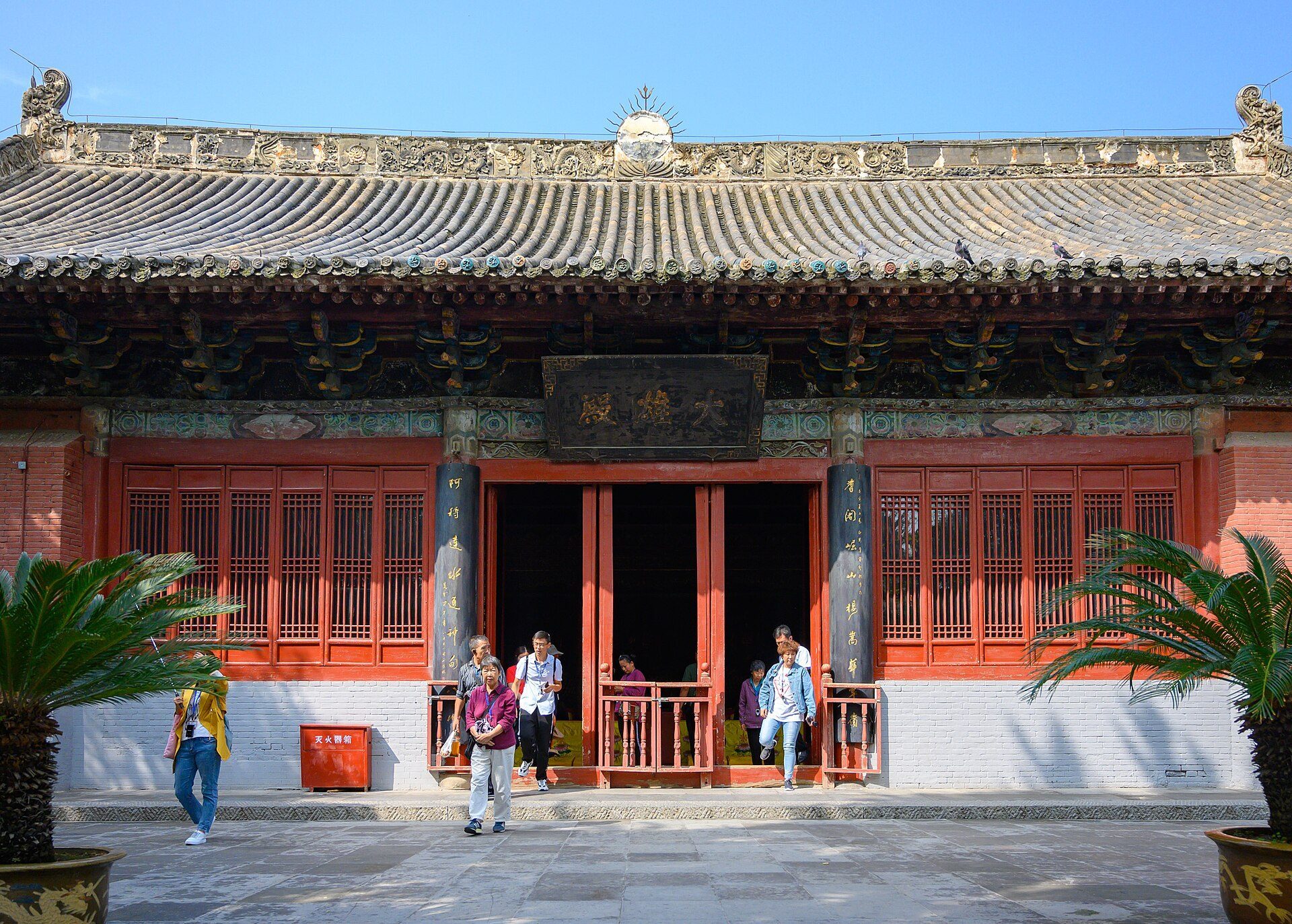
Mahavira Hall contains images of Sakyamuni Buddha, Bhaisajyaguru, and Amitabha, accompanied by the heavenly generals Wei Tuo and Wei Li. Eighteen arhat statues line the sides. An arhat is a person who has attained advanced spiritual realization. Made from ramie cloth, the statues date from the Yuan dynasty, which ruled China from 1271 to 1368. The side walls bear carvings depicting ten thousand Buddhas, while a statue of Jialan, a guardian associated with the protection of a monastery, faces north near the rear door.
The main hall contains Sakyamuni Buddha flanked by Manjushri and Samantabhadra, bodhisattvas associated respectively with wisdom and religious practice. A large bell weighing more than one tonne stands near the altar. Installed during the reign of the Ming Jiajing Emperor, it is struck during monastic prayers. Its inscription states that the bell’s sound makes the spirits of hell tremble.
The Hall of Changing Ge was built in 1995 as a repository for ancient Buddhist scriptures. It contains more than ten types of Buddhist texts and a Buddha image associated with the Eastern Han period. The original image was misplaced in the early twentieth century and later found in Thailand. Two bronze replicas, each 97 centimetres high, were made and gilded, with one retained for the temple library and the other sent to Thailand. A sixth-century stone statue of Maitreya associated with the temple was stolen and is now preserved at the Museum of Fine Arts, Boston.
Qingliang Terrace
The Qingliang Terrace, or Cool and Clear Terrace, lies behind the main hall. It is associated with the translation of Buddhist scriptures and is surrounded by bamboo and old pine trees. Its four sides are faced with green brick, and its buildings are interconnected.
Vairocana Pavilion
The central building on the terrace is the Vairocana Pavilion. Although its origins are attributed to the Han period, the present structure dates from the Ming dynasty. It has a double-eaved xieshan roof, a traditional East Asian roof form combining a hipped upper section with gabled sides. The pavilion contains images of Vairocana Buddha, Manjushri, and Samantabhadra, together with 5,050 wood-carved Buddha images made from incense ash.
Kunlu Pavilion and monk memorials
The terrace also includes the Kunlu Pavilion and eastern and western halls containing statues of the monks She Moteng and Zhu Falan. Their tombs lie within the temple complex. A Bell Tower and Drum Tower stand in front of the tombs, adding further structures to this area associated with the temple’s early Buddhist tradition.
Pagodas and historic tombs
Qilun Pagoda
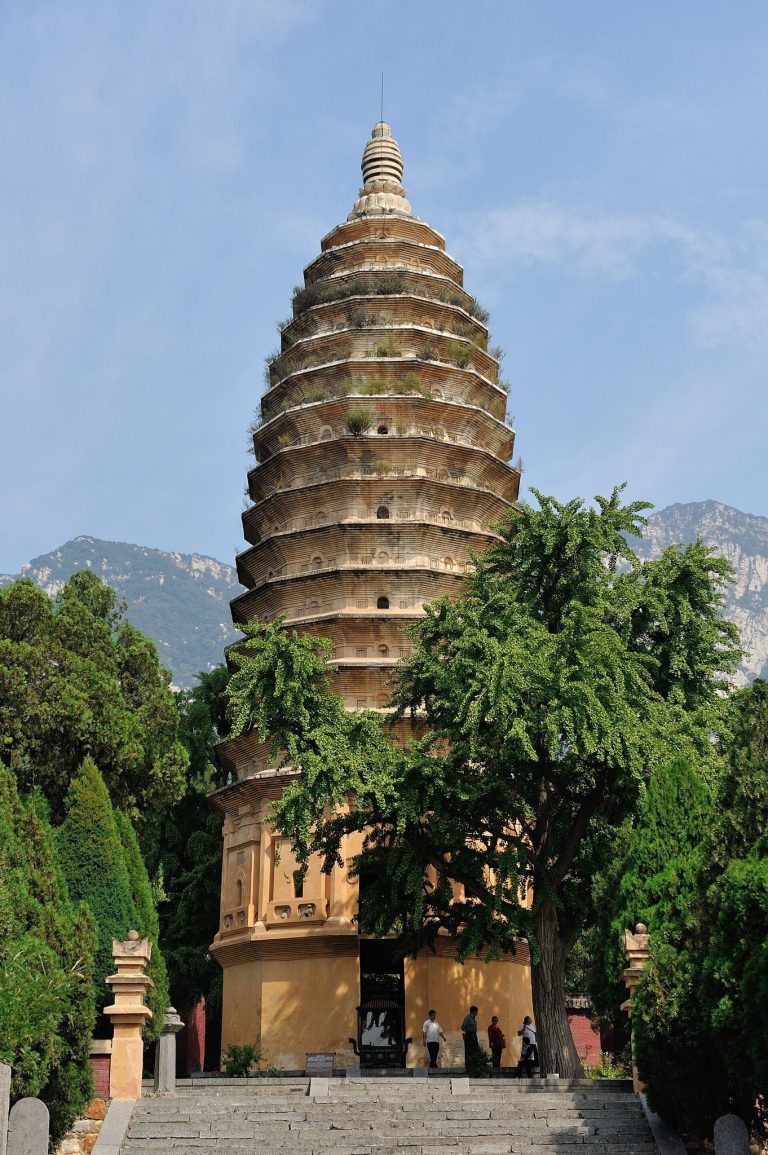
Qilun Pagoda stands southeast of the temple beside the stone inscription dated AD 1175. It is a square-based brick tower with multiple eaves, built in the style of Tang-period pagodas. The structure is approximately 35 metres high and is associated with the rebuilding that followed the earlier fire.
Qiyun Pagoda
Qiyun Pagoda is a brick tower containing monastic quarters. Built in the twelfth century during the Jin dynasty, it has thirteen tiers and is approximately 25 metres high. Later periods brought renovation or alteration, and the tower is reached across a bridge through a landscaped garden.
Tomb of Di Renjie
The tomb of Di Renjie, a Tang official, lies at the eastern end of the complex. Its position forms part of the wider arrangement of religious buildings, memorial structures, and historic remains within the temple grounds.
Indian-style shrine
The Indian-style Buddhist shrine completed in 2008 is a close architectural adaptation of the Sanchi Stupa, an ancient Buddhist complex in India known for its stupa and gateways. The shrine includes an east gate modeled on Sanchi and is a two-storey structure with circular walls on both floors. Murals depict Jataka stories and episodes from the life of the Buddha.
The central assembly hall contains a Buddha image transported from India and consecrated according to Indian Buddhist practice. Its form follows the pattern of a fifth-century Buddha from Sarnath, the Indian pilgrimage site associated with the Buddha’s first sermon. The shrine introduces a modern Indian architectural and ritual element into the historic Chinese temple complex.
Ritual furnishings and images
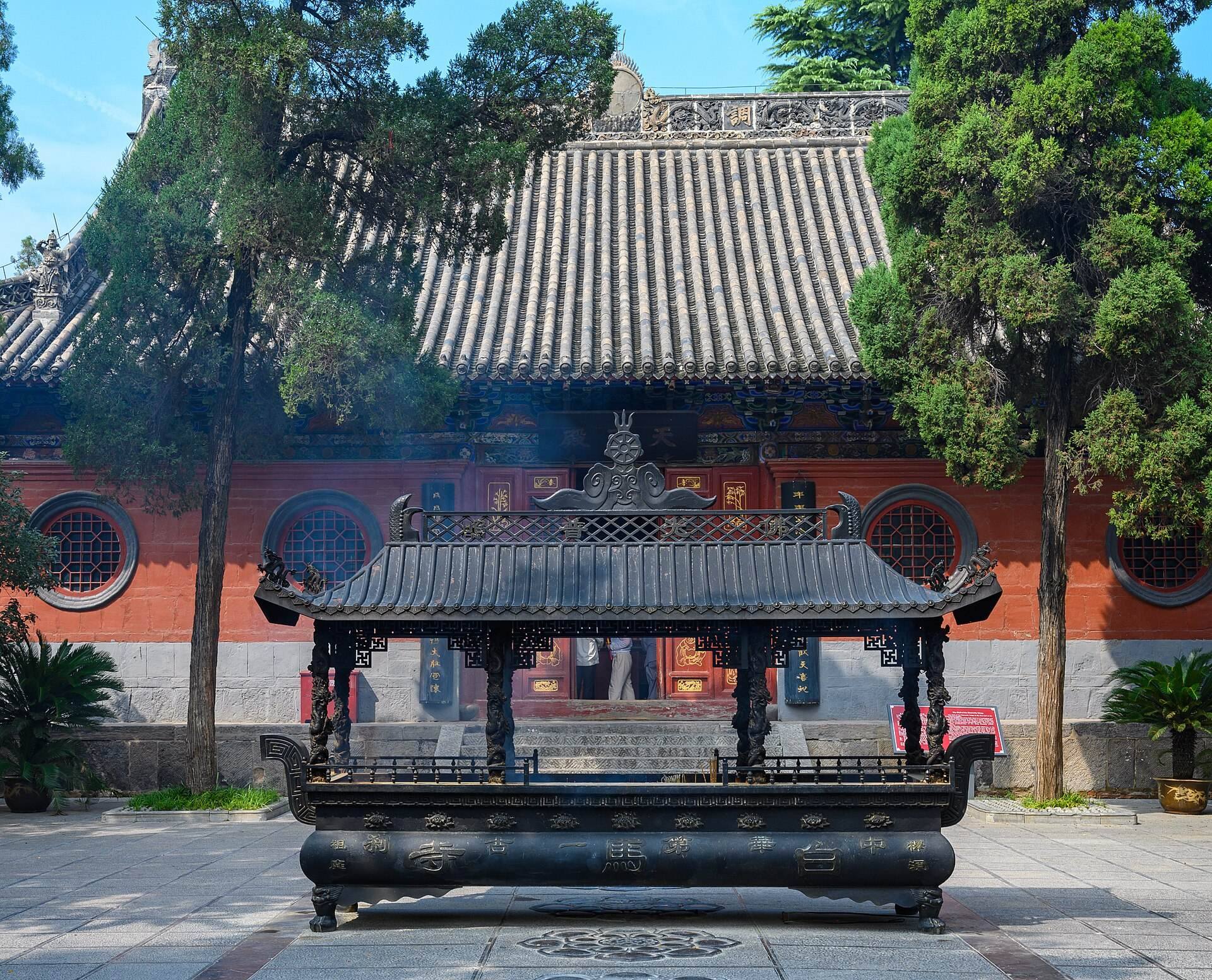
Ritual furnishings throughout the complex include large incense burners in the courtyards, offering-filled altars, multicoloured hanging textiles, and candles floating in basins. The principal images include Sakyamuni Buddha, Maitreya, Amitabha, the Jade Buddha, Guanyin, other bodhisattvas, and arhats. Together with the stone horses at the entrance, these images and furnishings continue the temple’s visual connection with Buddhist worship, teaching, and historical memory.