Bujang Valley: A Hindu-Buddhist Archaeological Complex in Malaysia
Site at a Glance
- Rating
- 4.4
- Popularity
- Medium
- Country
- Malaysia
- Primary era
- Medieval
- External website
- Open
- Eras represented
- Classical, Medieval
- Civilizations
- Unclassified
- Site type
- City
On this page9 sections
History
Bujang Valley is a large Hindu-Buddhist archaeological complex near Sungai Batu, Bukit Batu Pahat, Merbok, in Kedah, Malaysia. It developed as an Indian-influenced polity during the early historic period, with trade-related evidence dating from the 5th to the 14th century CE. The valley occupied a strategic position near the northwestern entrance to the Strait of Malacca and faced the Bay of Bengal, linking the Malay Peninsula with India, China, and western Asia.
Maritime networks and early political development
Chinese and southern Indian traders reached the valley through these maritime connections. The associated settlement first covered about 224 square kilometres, while the discovery of further iron-smelting sites at Sungai Batu has expanded the archaeological landscape under consideration to roughly 1,000 square kilometres. The remains indicate a Hindu-Buddhist polity whose rulers adopted Indian cultural and political models earlier than the rulers of Kutai in eastern Borneo, Tarumanegara in western Java, and comparable states in southern Sulawesi.
At different times, the valley was administered by Funan, an early mainland Southeast Asian polity centred in the lower Mekong region; Srivijaya, a major maritime power based in Sumatra; and Majapahit, a powerful Javanese kingdom whose influence extended across the Malay world during the late medieval period. Long-distance trade later declined. The historical relationships between these powers and the valley remain partly unclear because relatively few inscriptions and documents have survived.
Names, traditions, and historical interpretation
The name Bujang Valley has several interpretations. One Javanese-Malay reading connects the Sanskrit-derived term bhujangga with “scholar,” producing the translation “Scholars’ Valley.” Another links the name with “serpent,” possibly referring to the winding Muda and Merbok rivers. The modern Malay word bujang means “bachelor,” which has also produced the alternative rendering “Bachelor Scholars’ Valley.” Oral traditions describe a wealthy kingdom, gold chariots, gemstones, and jewels hidden in caves on Mount Jerai.
The archaeological evidence has been used to examine how Indian cultural forms became established locally and shaped the polity’s social and economic structure. Nik Hassan Shuhaimi Nik Abdul Rahman proposed a periodisation of Bujang Valley and a theory of this process of cultural indigenisation. Malaysian university students have also carried out undergraduate and postgraduate research in the valley for approximately two decades.
Excavation and heritage debates
H. G. Quaritch Wales and Dorothy Wales, assisted by Alastair Lamb, excavated in the valley in 1936 and 1937. Their work identified archaeological remains and located a well-preserved temple at Pengkalan Bujang. Before the 1970s, Western archaeologists led much of the research. Malaysian archaeologists later continued the work, with the National University of Malaysia and the University of Malaya undertaking excavations and reconstructions in cooperation with the National Museum.
After 2008, the Centre for Global Archaeological Research at Universiti Sains Malaysia, led by Mohd Mokhtar Saidin, investigated a further archaeological complex and identified dozens of additional sites thought to date from the 2nd century CE. Other important Malaysian researchers included Leong Sau Heng, Mohd Supian Sabtu, Kamarudin Zakaria, and Zulkifli Jaafar.
In the early 2010s, a land developer demolished Candi No. 11, an approximately 1,200-year-old Hindu temple site associated with Old Kedah, an early historic polity centred in present-day Kedah. The demolition prompted public criticism. The Kedah state government argued that the land was privately owned and that the site had not been gazetted as a historical site. The Tourism and Heritage Ministry subsequently agreed to consider gazetting Bujang Valley as a heritage site. Malaysia has also pursued UNESCO World Heritage recognition for the valley. A UNESCO report endorsed the site in 1987, while further research and conservation were still considered necessary in 2017, when the valley was excluded from Malaysia’s tentative list.
Remains
Archaeological landscape
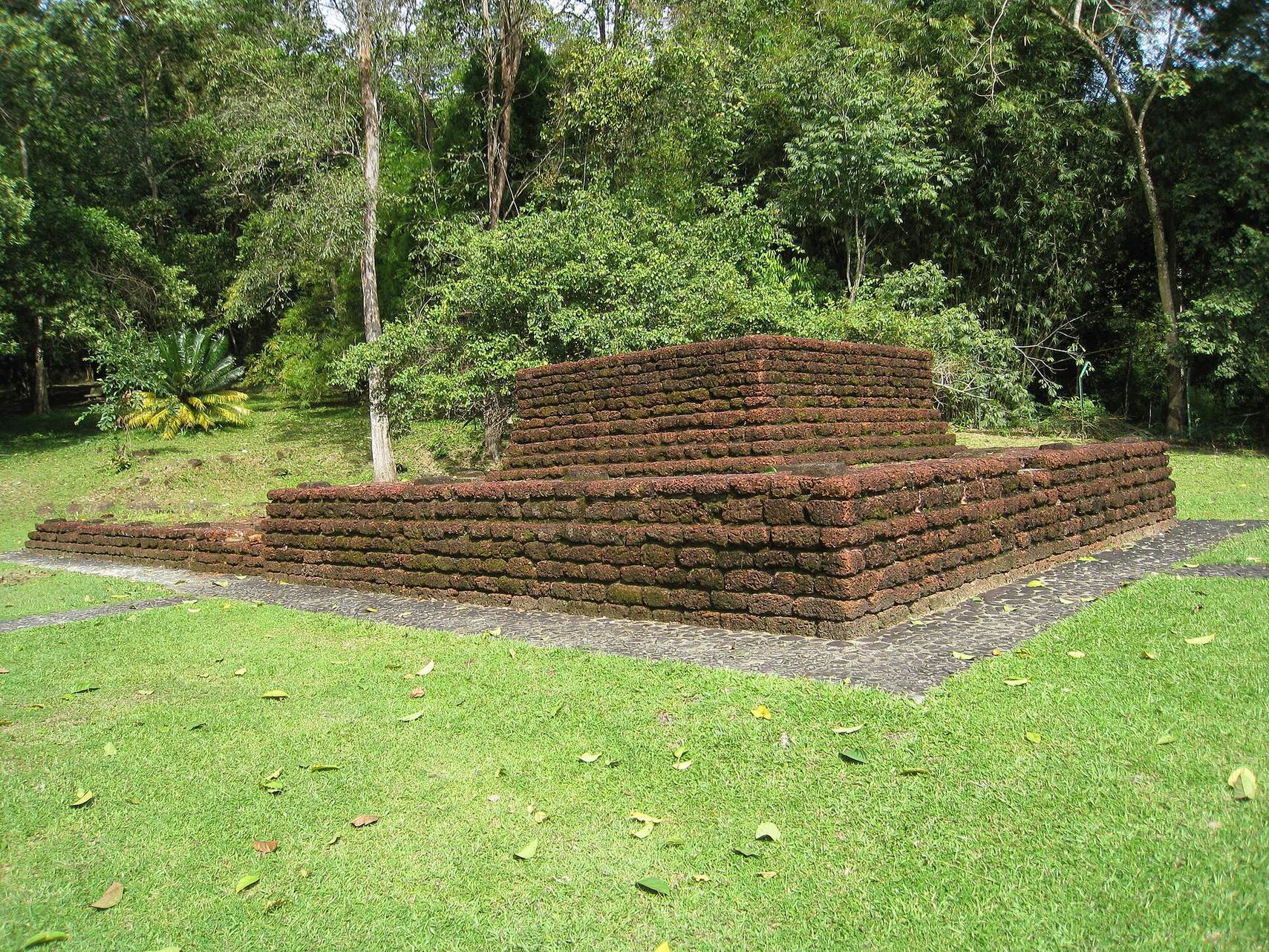
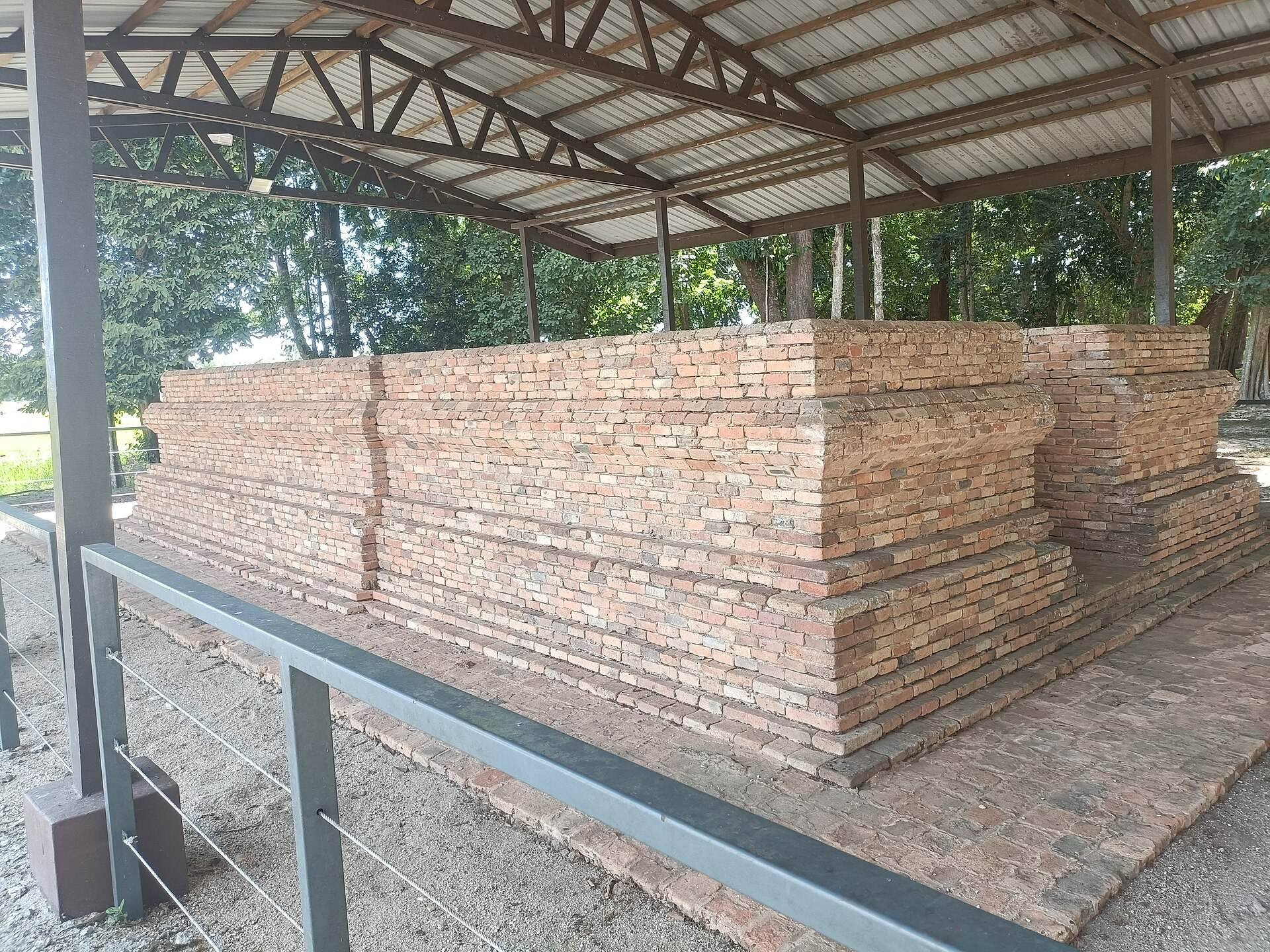
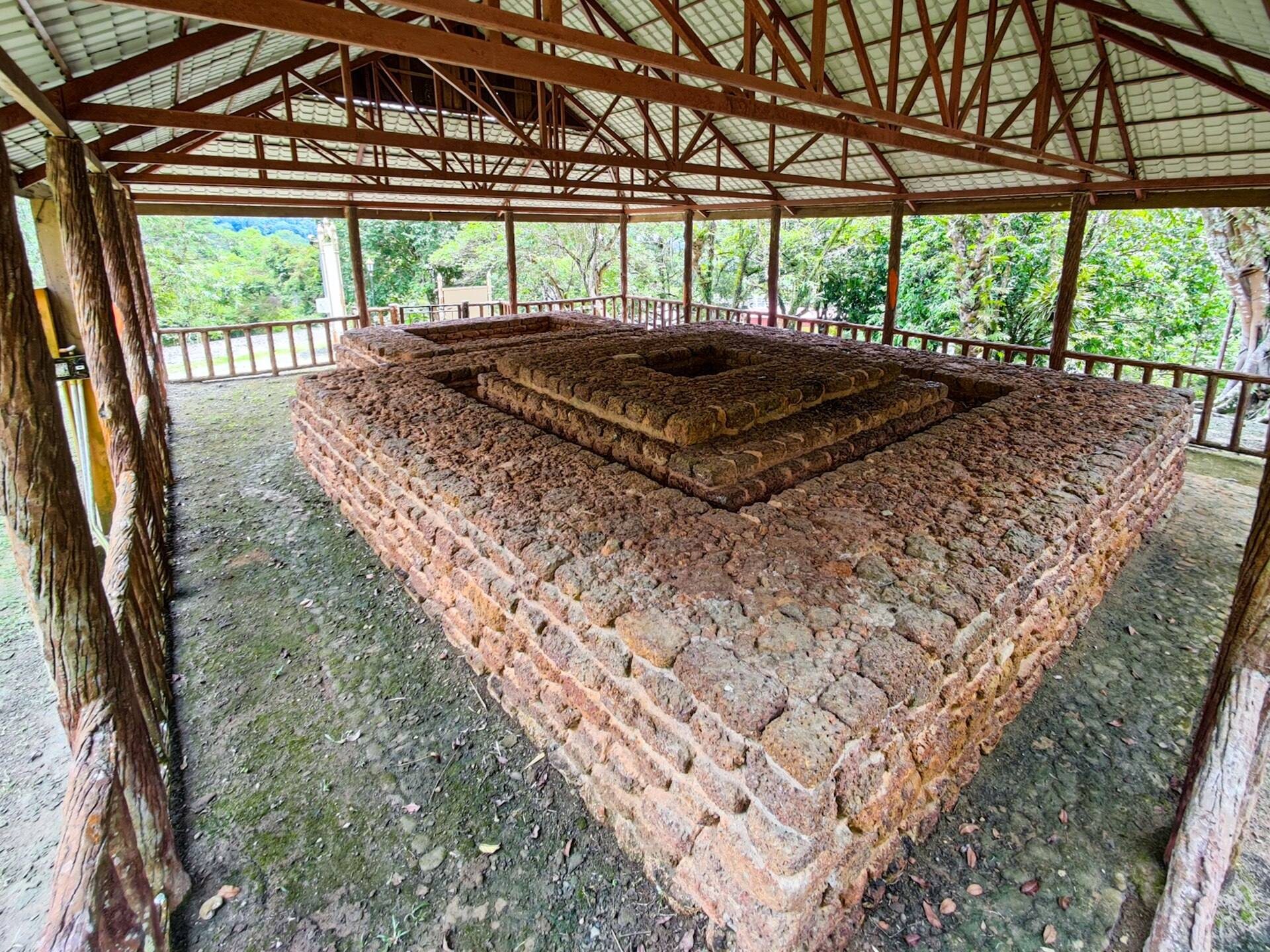
Bujang Valley lies in the Merbok river basin, between 1,217-metre Mount Jerai to the north and the Muda River to the south. Its archaeological landscape contains ruins more than 1,500 years old and includes over 50 religious monuments known as candi, a Southeast Asian term for Hindu or Buddhist shrines and temple complexes. The group includes Hindu and Buddhist monuments, among them chaitya, or Buddhist worship halls. The best-preserved and most impressive temple is at Pengkalan Bujang.
Sungai Batu industrial and waterfront remains
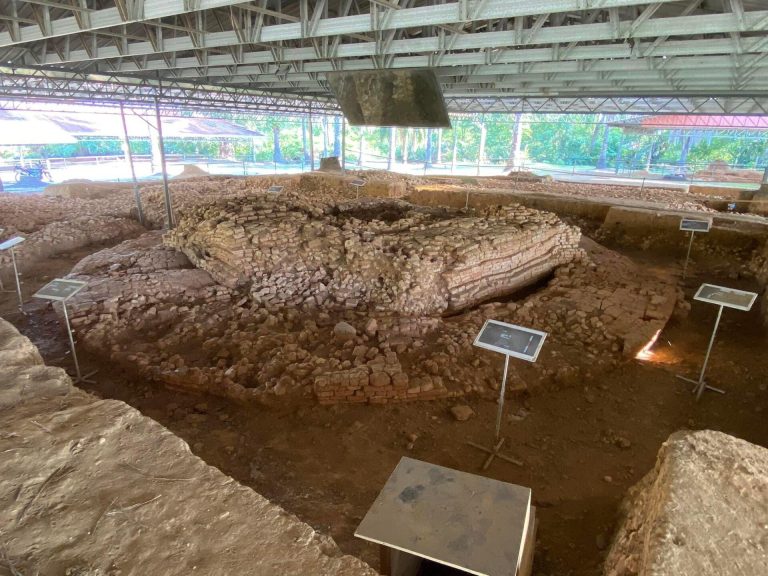
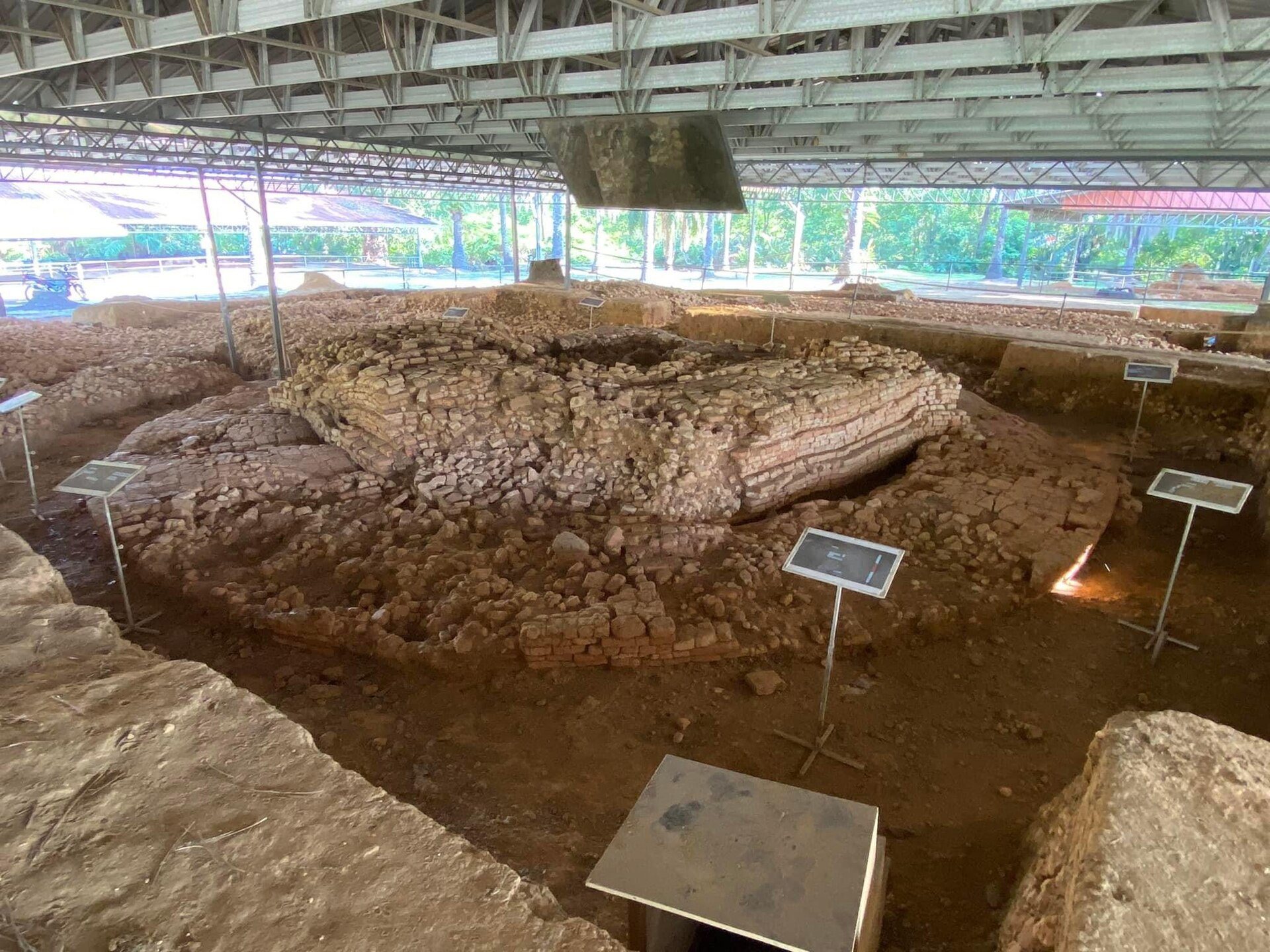
The Sungai Batu archaeological area contains several ancient jetties, iron-smelting installations, and a clay-brick monument dated to around AD 110. This monument is considered the oldest recorded human-made structure in Southeast Asia. Together, the waterfront and industrial remains illustrate the range of activity associated with the valley’s maritime and metalworking landscape.
Inscriptions and religious evidence
A rectangular inscribed stone bar from site I carries the Buddhist ye-dharma hetu formula in Pallava script, an early South Indian-derived writing system used in early Sanskrit and Buddhist inscriptions across South and Southeast Asia. The formula expresses the Buddhist principle that phenomena arise from causes and cease when their causes end. Assigned to the 7th century, the inscription identifies the Buddhist character of a shrine near its findspot, where only the basement survives. The stone is carved on three faces and may preserve lettering dating from the 6th century or earlier.
Except for the Cherok To’kun Inscription, engraved on a large boulder, the valley’s other inscriptions are comparatively small. Some may have been brought to the area by Buddhist pilgrims or traders. The wider archaeological material includes inscribed stone caskets and tablets, metal tools and ornaments, ceramics, pottery, glass objects, beads, sculptures, temple inscriptions, and numerous Hindu icons.
Survival and collections
The temples originally had wooden roofs, which have decayed over more than 1,200 years. Their structures consequently survive in altered and incomplete form. Some artefacts have been displayed in the Bujang Valley Archaeological Museum, while many discoveries are held in other institutions, including the National Museum of Malaysia and the National Museum of Singapore. Candi No. 11, once among the registered candi sites associated with Old Kedah, was demolished during the early 2010s.