Tenta: An Aceramic Neolithic Settlement in Cyprus
Site at a Glance
- Rating
- 4.3
- Popularity
- Low
- Country
- Cyprus
- Primary era
- Stone Age
- External website
- Open
- Eras represented
- Stone Age, Modern
- Civilizations
- Unclassified
- Site type
- Domestic
- Remains
- House
On this page9 sections
History
Tenta, also known as Kalavasos-Tenta or Tenda, is an Aceramic Neolithic settlement on a natural hill near Kalavasos in Cyprus’s Larnaca District. Built by early settled communities before the widespread use of pottery, it was first occupied around 8000 BC and remained in use into the sixth millennium BC. Its position overlooking the Vasilikos Valley, together with evidence for cultivation, animal management and hunting, makes it an important example of early village life on the island.
Early settlement and occupation
Tenta was broadly contemporary with Shillourokambos and Mylouthkia, and its earliest occupation predates Khirokitia by nearly a millennium. The settlement developed through an initial phase represented by postholes and pits, followed by four construction phases. The initial phase has been assigned to the second half of the seventh millennium BC, while the earliest radiocarbon result, 9240 ± 130 BP, came from the Lower South Slope and is not stratigraphically connected with the rest of the settlement. BP means “before present,” with the conventional reference point set at AD 1950.
Occupation continued during the sixth millennium BC, before the emergence of the Cypriot Ceramic Neolithic, the later Neolithic period associated partly with the appearance of pottery. Tenta was apparently used again during the Early Chalcolithic, a later period traditionally linked with stone and copper technologies. Several pits were dug in the lower part of the slope during this reoccupation.
Economy and community
Excavated buildings, artefacts, burials, plant remains and animal bones indicate considerable continuity in social organisation, technology and economic practice over approximately two thousand years. The community cultivated emmer and einkorn wheat, probably two-row barley, lentils and possibly peas. People also gathered figs, pistachios, grapes, olives, plums and possibly vetch, while deer, pigs and sheep or goats formed the main part of the animal remains.
Fourteen burial contexts contained eighteen individuals, including adults, children and infants. One pit held four infants together. The dead were placed in contracted positions beside house walls, beneath floors or outside buildings. Skeletal evidence gives average ages at death of approximately 30.5 years for males and 36.5 years for females, with average heights of about 162.9 centimetres and 153.8 centimetres respectively. The remains indicate generally good dental health, a diet containing protein and carbohydrates, possible haemolytic and iron-deficiency anaemia, and artificial cranial deformation in 11.1 percent of the individuals.
Discovery and archaeological investigation
Porphyrios Dikaios first reported Tenta in 1940, after artefacts were found during construction of a mining railway. Dikaios excavated at the site for two weeks in 1947. Later work formed part of the Vasilikos Valley project directed by Ian A. Todd, with the cooperation of Vassos Karageorghis and the Cyprus Department of Antiquities.
Five further excavation seasons took place between 1976 and 1984. The work was associated with Brandeis University and funded by the National Science Foundation, while detailed results continued to appear after the excavations had ended. The investigations established the sequence of settlement phases and recovered evidence for architecture, craft production, subsistence, burial customs and daily activity.
In 1994 and 1995, Vassos Karageorghis commissioned a protective shelter over the excavated remains. Funded by the Anastasios G. Leventis Foundation, the structure shields the site from the elements and has become a local landmark.
Remains
Settlement layout and buildings
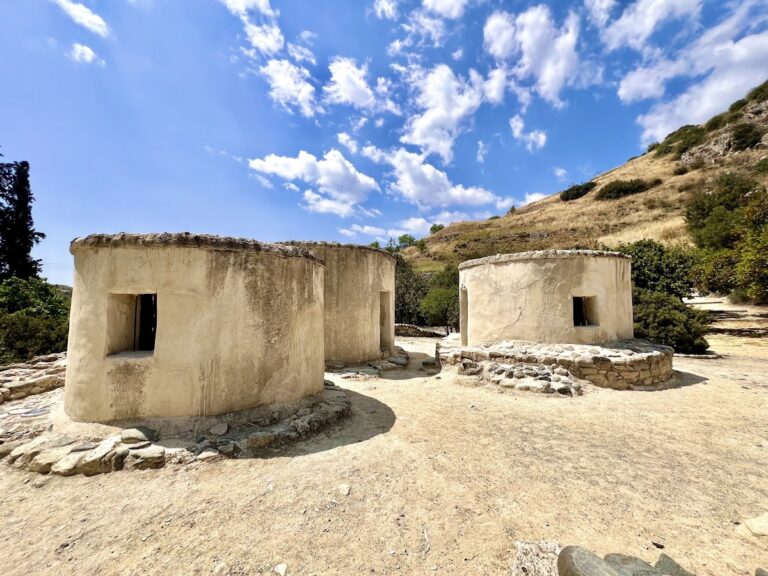
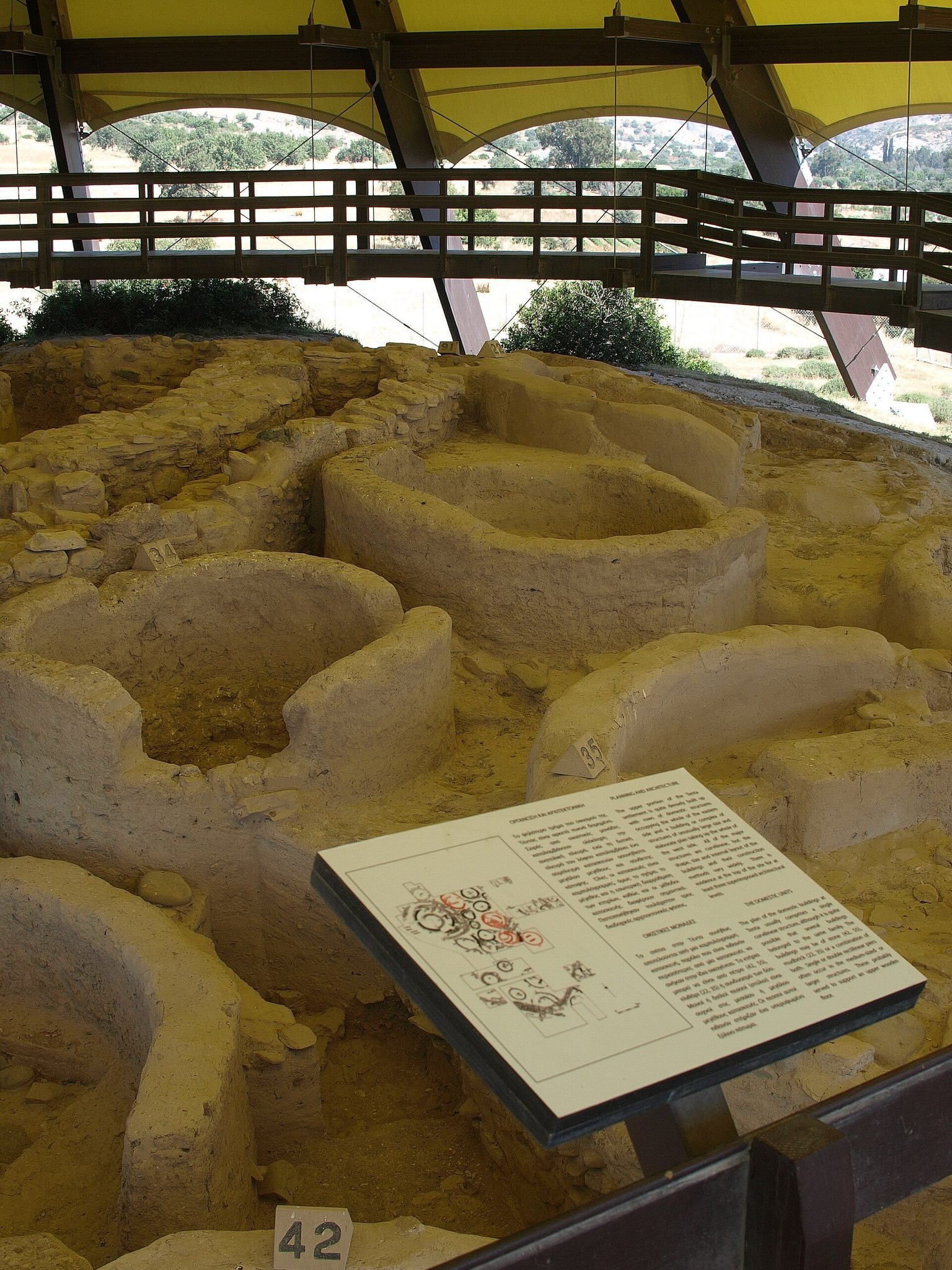
Tenta occupies a natural hill above the Vasilikos Valley. Approximately 40 to 45 structures have been excavated, and their size and form suggest that the population probably never exceeded about 150 people. The buildings have curving or circular plans rather than rectilinear rooms. The earliest activity consists of postholes and pits, while later phases contain roundhouses of different sizes, principally built from mudbrick. Some houses show indications of an upper storey, and parts of the settlement may have been protected by a wall.
At the summit, construction changed through successive combinations of stone and mudbrick. The earliest buildings used both materials, followed by buildings made entirely from mudbrick and then structures constructed entirely from stone. The stonework used limestone mixed with locally available diabase from the Vasilikos River. Walls generally survived to heights of one metre or more and measured approximately 25 to 60 centimetres in thickness. Their recorded colours include grey, reddish-brown, light brown and dark brown.
Floors and walls were often made with gypsum, lime or a mixture of both. A thin whitish plaster layer covered a friable mud-plaster base. Neatly parallel-laid stones formed platforms, benches and seats. Roofs were flat or domed, built with branches, reeds and rammed earth. Wall surfaces could also be decorated elaborately, including a painting of two human figures with raised hands.
Tools, ornaments and craft materials
About 1,000 artefacts made from stone, animal bone or shell came from buildings, exterior areas and soil deposits. The assemblage includes stone vessels, axes, hammerstones, blades, drills, notched blades, retouched flakes, grinding and rubbing stones, mortars and stone figurines. Some stone vessels have complex carved forms, indicating considerable technical skill. Pendants, beads, large arrowheads and ground-stone implements coated with ochre were found inside building walls.
Picrolite, a soft greenish stone used in prehistoric Cyprus for ornaments and worked objects, ranges in colour from dark green to grey and was probably obtained from the Kouris Dam area. Chert supplied tools for forceful breaking and for producing sparks to start fires. Two clay plugs associated with the walls belong to the Chalcolithic period rather than the main Aceramic Neolithic occupation.
Stone tools from the earliest settlement phase include unipolar microblades and small flake tools made mainly from translucent flint. The inhabitants used both unidirectional and bidirectional cores, worked pieces of stone from which blades or flakes were removed. A selection of objects from Tenta is now displayed in the Cyprus Museum and the Larnaca District Archaeological Museum.
Food remains and outdoor activity
Botanical remains were recovered through flotation, a water-based method that separates light plant material from sediment. The identified crops include emmer and einkorn wheat, probably two-row barley, lentils and possibly peas. Gathered plants include figs, pistachios, grapes, olives, plums and possibly vetch.
Hearths and fire pits occurred more often outside and between buildings than inside them, indicating that cooking often took place outdoors. Two hearths contained remains of gathered wild plants. The excavations recovered 2,817 animal bone fragments. Deer, pigs and caprines, meaning sheep and goats considered together, accounted for 99.7 percent of the identified remains, while cats, foxes and rodents accounted for the remaining 0.3 percent. Intact antlers found in three buildings may have been displayed as hunting achievements.
Burials and protective shelter
Burials were placed in contracted positions beside internal house walls, in oval pits beneath floors or outside buildings. Adults, children and infants were represented, and the skulls of some individuals had been artificially deformed. One burial context produced an ochre lump. These remains provide evidence for the community’s treatment of the dead alongside its domestic and economic activities.
The excavated settlement is covered by a tent-like conical or pyramidal shelter made from glulam beams, laminated structural timber formed by bonding layers of wood, and coated with a PVC membrane. The shelter protects the archaeological remains from the elements and gives Tenta its characteristic modern roof.