Cross Mound: An Enigmatic Earthwork in Ohio
Site at a Glance
- Rating
- 4.6
- Popularity
- Low
- Country
- United States
- Primary era
- Classical
- External website
- Open
- Eras represented
- Classical
- Civilizations
- Hopewell, Mississippian
- Site type
- Religious
- Remains
- Sanctuary
On this page6 sections
History
Cross Mound, also called Tarlton Cross Mound, is an enigmatic prehistoric earthwork near Tarlton, Ohio, in the United States. Its builders and date are uncertain, although its cross-shaped plan has prompted connections with several prehistoric traditions of the Ohio Valley and with solar imagery.
Possible prehistoric origins
Cross Mound has been associated at different times with the Hopewell, Fort Ancient, and Mississippian traditions. The Hopewell tradition describes Middle Woodland societies of eastern North America known for earthworks, ceremonial landscapes, and long-distance exchange. The Middle Woodland period broadly covers the centuries around the middle of the first millennium BC through the early centuries AD. Fort Ancient refers to later prehistoric communities of the Ohio Valley, generally after the Middle Woodland era, while the Mississippian tradition encompassed complex societies of the southeastern and central eastern United States during the first and second millennia AD.
Archaeologist Jarrod Burks of Ohio Valley Archaeology considers construction during the Middle Woodland period probable, while also allowing that Fort Ancient people may have built the earthwork. The nearby Alligator Effigy Mound and Serpent Mound date to after AD 1000, a chronology that forms part of the reasoning for considering a Fort Ancient connection. A further interpretation links the cross shape with the sun, since cross-like forms sometimes served as solar symbols in Mississippian religious imagery. These interpretations remain possibilities rather than established identifications.
Survey, preservation, and recognition
Ephraim George Squier and Edwin Hamilton Davis visited the site in the mid-1840s and published their survey in Ancient Monuments of the Mississippi Valley in 1848. They described a small circular rise of stone and earth near the rear of the cross as an altar and proposed a relationship with the Alligator Effigy Mound near Granville, Ohio.
Cross Mound is now owned and maintained by Fairfield County Parks. The site entered the U.S. National Register of Historic Places on November 10, 1970, under reference number 70000489. Its uncertain origin and unusual plan have kept it within wider discussions of Ohio’s prehistoric earthworks.
Remains
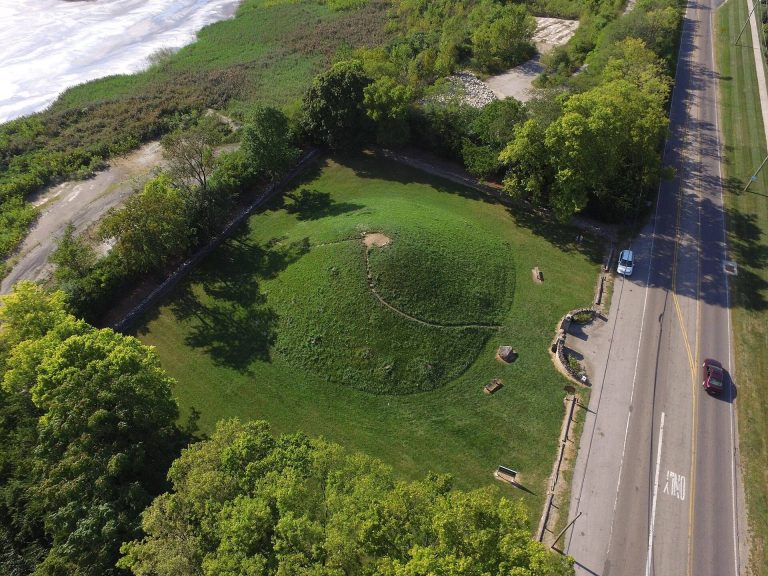
The earthwork lies in Cross Mound Park near a tributary of the Scioto River. The park covers 29 acres, while the National Register property occupies less than 1 acre. The main earthwork stands on what Squier and Davis called a narrow spur of land, with its arms aligned closely to the cardinal directions.
Cross-shaped earthwork
The central earthwork forms a Greek cross, with four arms extending toward the principal directions. Each arm was described as approximately 90 feet long. Squier and Davis measured the mound at about 3 feet high, while a later assessment by Dr. Greg Little estimated its height at approximately 4 feet.
A shallow ditch surrounds the earthwork and follows its cross-shaped outline. At the center is a circular depression measuring about 20 feet across. The nineteenth-century survey gave its depth as 20 feet, whereas a later report by the Ohio Historical Society described it as 12 inches deep. The differing measurements preserve a record of how the feature was described and assessed at different periods.
Associated mounds
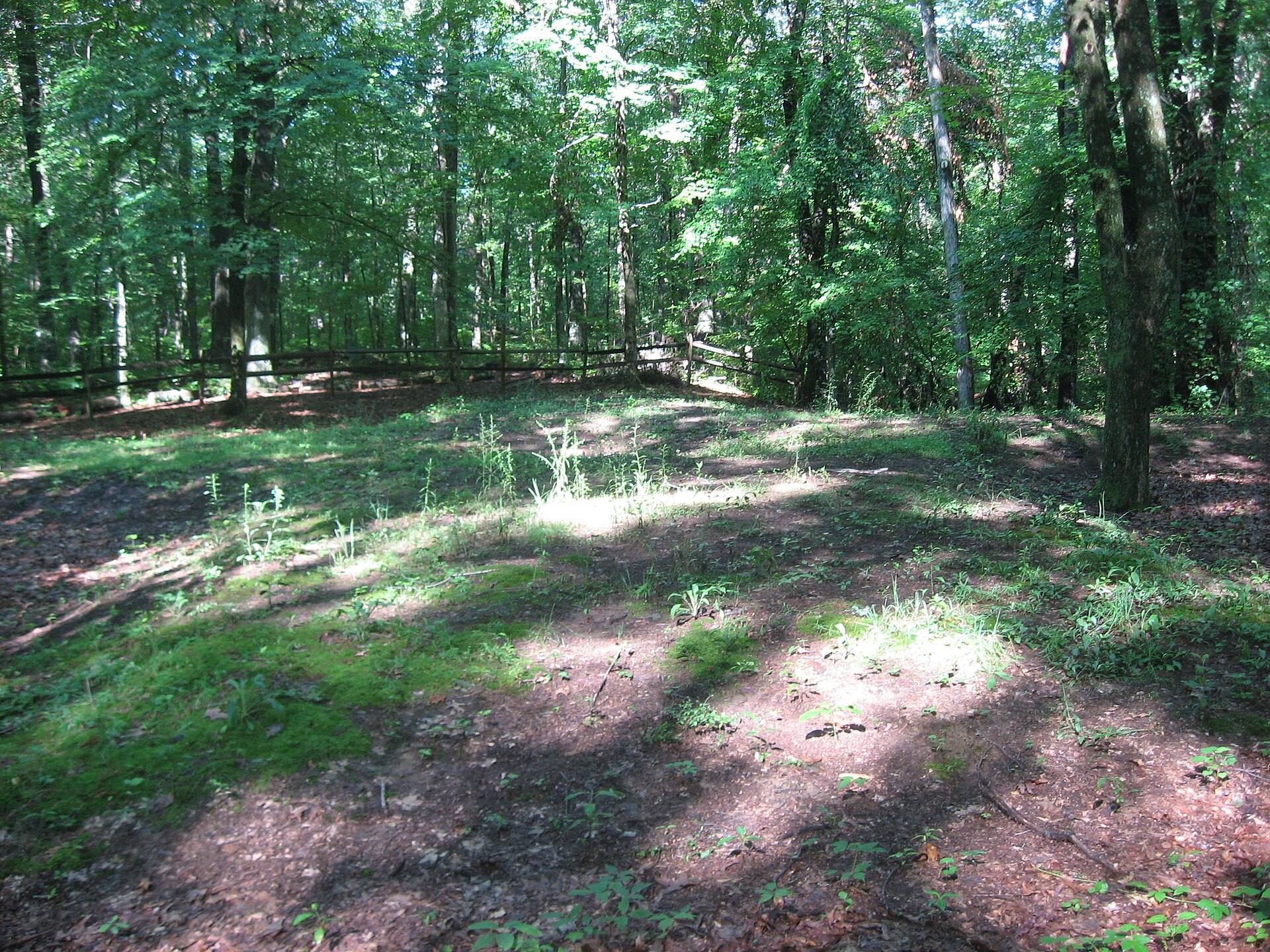
A small circular rise made of stone and earth lies toward the area that Squier and Davis identified as the rear of the cross. Later surveyors described this feature as a small stone mound, while the earlier investigators interpreted it as an altar.
Smaller mounds were also recorded near the main earthwork, and a larger nearby hill was described as containing several large mounds. Three small mounds remain at the site today, adding to the evidence that Cross Mound formed part of a broader group of prehistoric earthworks.