Sharada Peeth: A Ruined Hindu Temple and Centre of Learning in Kashmir
Site at a Glance
- Rating
- 4.6
- Popularity
- Low
- Country
- Pakistan
- Primary era
- Medieval
- Eras represented
- Classical, Medieval
- Civilizations
- Kushan, Mauryan
- Site type
- Religious
- Remains
- Temple
On this page12 sections
History
Sharada Peeth is a ruined Hindu temple and former centre of learning at Sharda in Pakistan-administered Azad Jammu and Kashmir, Pakistan. Its prominence belongs especially to the sixth through twelfth centuries CE, when it was regarded as a major temple institution and was associated with the study of Sanskrit, religious learning, and the Sharada script. The name Sharada Peeth means “seat of Sharada,” the goddess identified with Saraswati, who is associated with knowledge, speech, learning, and the arts.
Origins and medieval importance
The origins of Sharada Peeth remain uncertain. Traditions attribute its foundation or construction to the Mauryan emperor Ashoka around 237 BCE, to the Kushan period, or to Lalitaditya Muktapida, a Kashmiri ruler of the Karkota dynasty who reigned from 724 to 760 CE. Lalitaditya is considered a probable attribution, but no definitive evidence establishes that he was responsible for the site.
The institution may have served both as a temple and as a place of education. Some interpretations question whether it was ever a university in the strict sense. Another explanation is that earthquakes, collapse, abandonment, and the later reuse of building materials contributed to the loss of the wider educational complex.
Sharada Peeth was associated with the development and spread of the Sharada script, a historical script used principally in the northwestern Indian subcontinent for Sanskrit and related languages. The script took its name from the institution and the goddess, while Kashmir acquired the traditional epithet “Sharada Desh,” meaning “country of Sharada.” Its library or manuscript collection helped establish the site’s reputation as a centre of learning.
Pilgrimage and religious traditions
By the eighth century, the temple had become a pilgrimage destination for devotees from regions as distant as present-day Bengal. By the eleventh century, it was regarded as one of the most revered Hindu places of worship in South Asia. Al-Biruni, an eleventh-century Muslim scholar and historian, included it among the famous Hindu temples of the region. He described a wooden image of Sharada, although his information about Kashmir was based on hearsay because he did not personally enter the region.
Sharada Peeth is associated with Shaktism, a Hindu tradition centred on the worship of the Goddess, as well as with Shaivism, the tradition centred on Shiva, and religious traditions rooted in the Vedas. Hindu tradition identifies it as a Shakta pitha, a sacred place linked to a body part of the goddess Sati, traditionally regarded as Shiva’s consort. The traditions differ over whether the site belongs to lists of eighteen or fifty-one such places. Kashmiri Pandits regard it as one of their three principal pilgrimage sites, alongside the Martand Sun Temple and the Amarnath Temple.
Later accounts and uncertain associations
Jonaraja records that Zain-ul-Abidin, the fifteenth-century sultan of Kashmir, visited the temple in 1422 while seeking a vision of the goddess. According to the tradition, Sharada appeared to him in a dream after he slept in the temple court. In the sixteenth century, Abu’l-Fazl ibn Mubarak, a Mughal court historian under Emperor Akbar, described Sharada Peeth as a highly revered stone temple. He also recorded a belief that the shrine shook and produced extraordinary effects every eighth day of the bright half of the month.
A tradition places the temple’s destruction or severe deterioration in the fourteenth century. A nineteenth-century restoration is attributed to Gulab Singh, the Dogra ruler who became the first Maharaja of Jammu and Kashmir, but the sequence and extent of that work are not securely established.
Sharada Peeth is also linked by tradition with major centres of Sanskrit and religious learning. Adi Shankara and Ramanuja are associated with visits to Kashmir connected with commentaries on the Brahma Sutras, a foundational text of Vedanta. Another tradition claims that Xuanzang, the seventh-century Chinese Buddhist pilgrim and translator, visited in 632 and studied Buddhism there for two years. The historical strength of these associations remains uncertain.
Partition and recent religious interest
After the 1947 Partition, Hindu pilgrims from areas administered by India found access increasingly difficult, while the site came under Pakistani administration. In 2007, the Kashmiri Pandit scholar Ayaz Rasool Nazki visited the temple. Later campaigns sought permission for Kashmiri Pandits and other Indian devotees to visit and repair the shrine.
A reconstruction associated with Sharada worship was said to have begun in 2021 and opened in March 2023. It is unclear whether this referred to the historic ruin itself or to a separate reconstruction connected with the shrine.
Remains
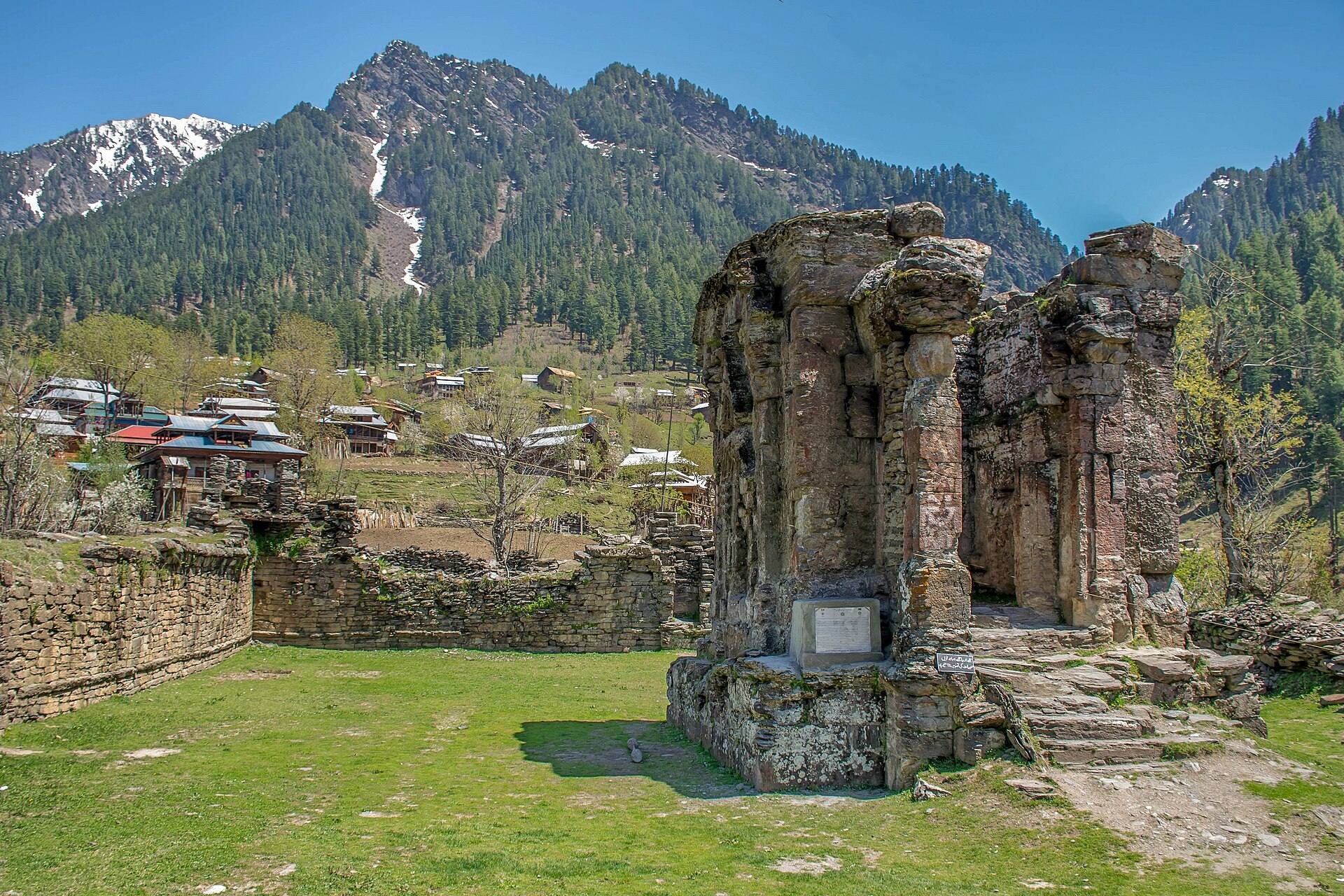
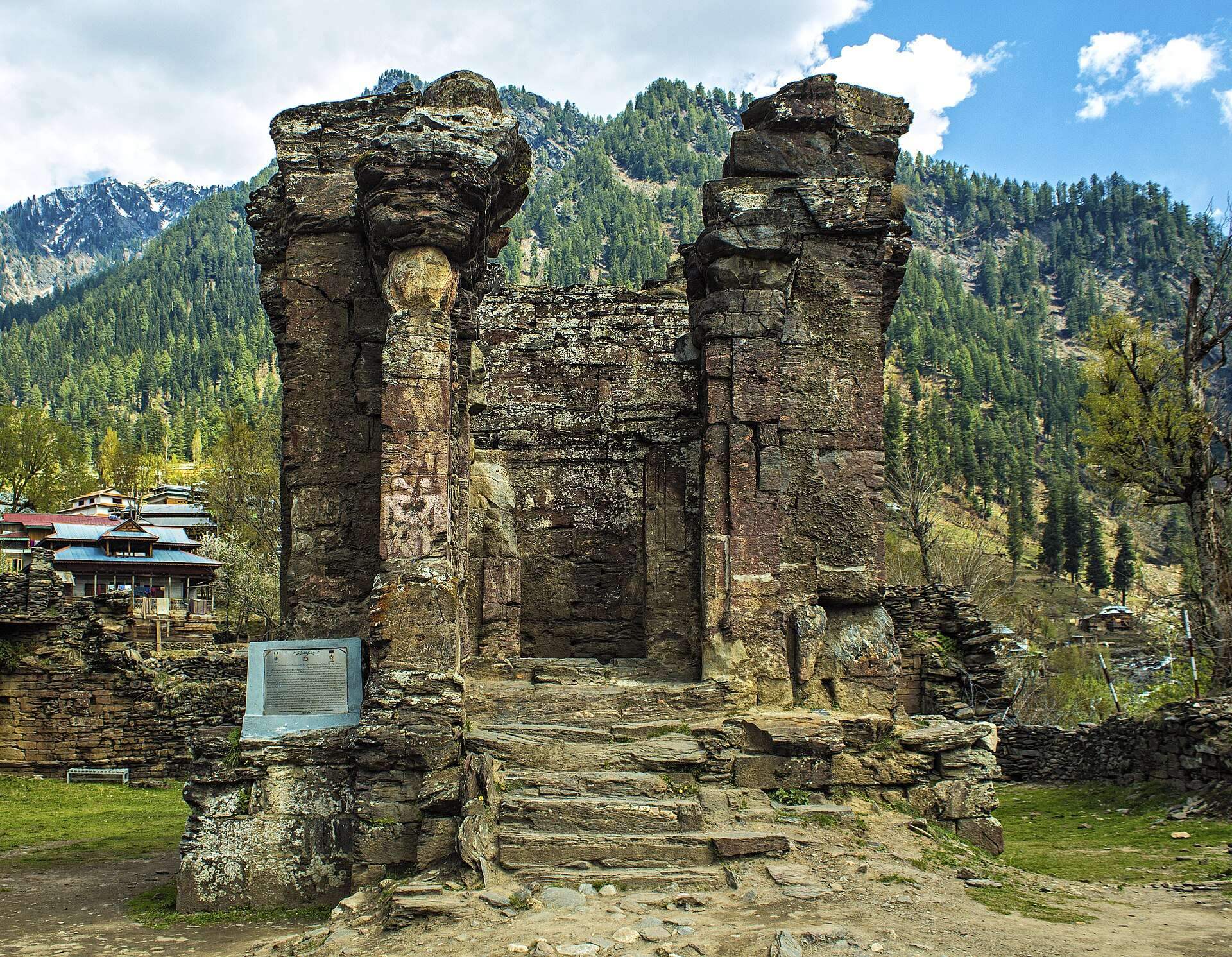
Sharada Peeth survives as a ruined Kashmiri-style stone temple complex on the bank of the Neelum River in the village of Sharda. The site lies in the valley of Mount Harmukh at approximately 1,981 metres above sea level. Kashmiri Pandit tradition regards Mount Harmukh as the abode of Shiva. The river and mountain valley form the principal natural setting associated with the remains.
Temple complex
Temple remains
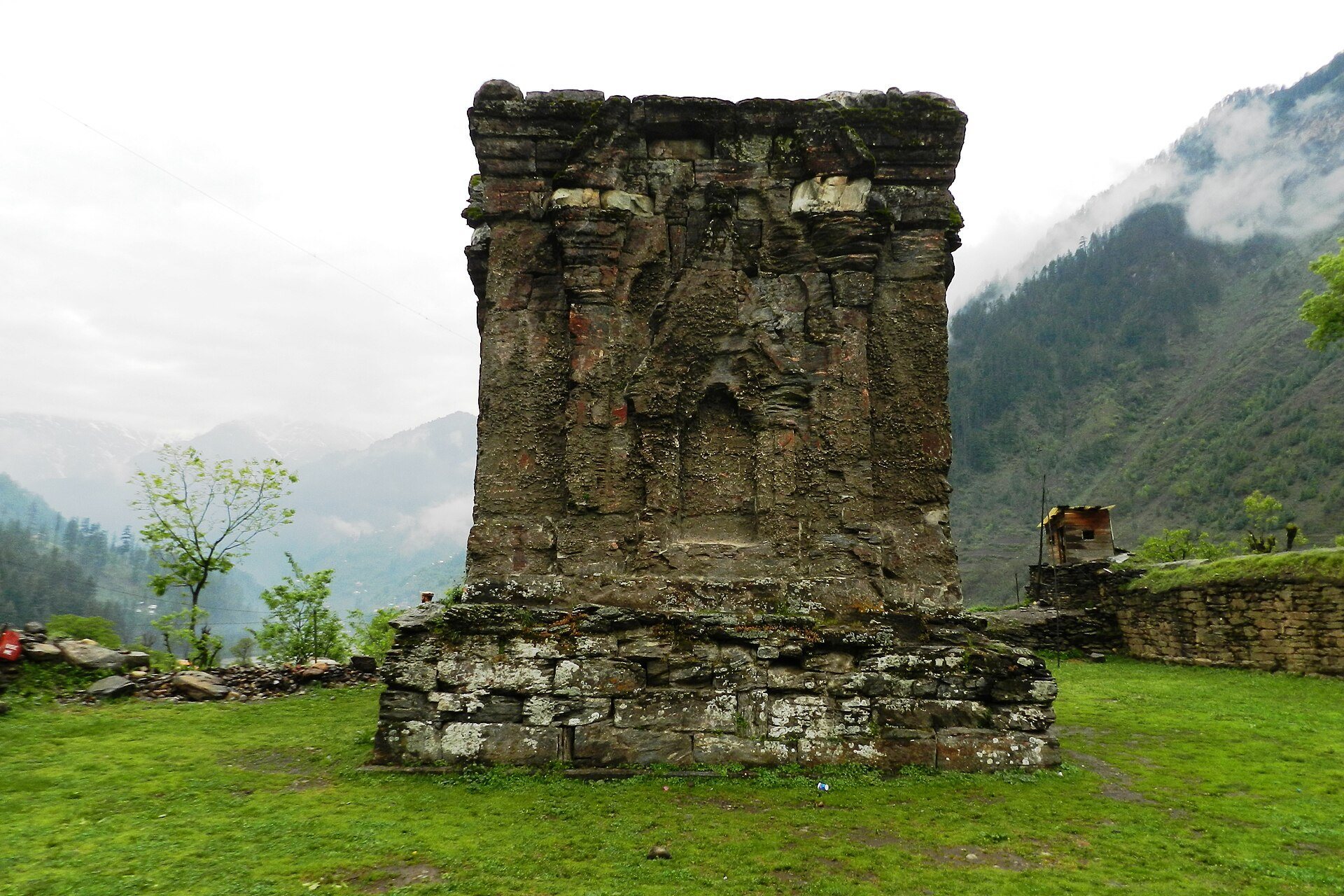
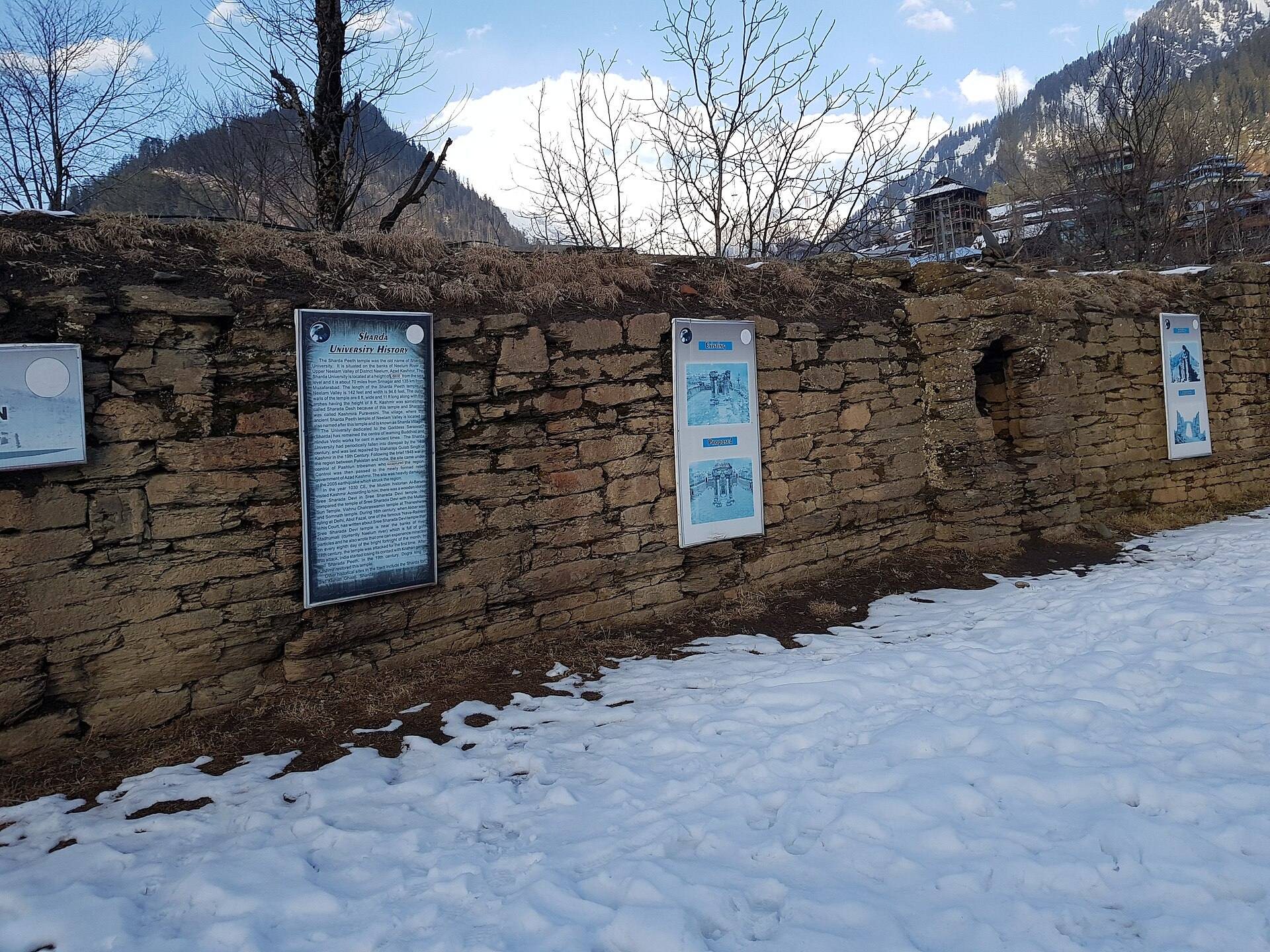
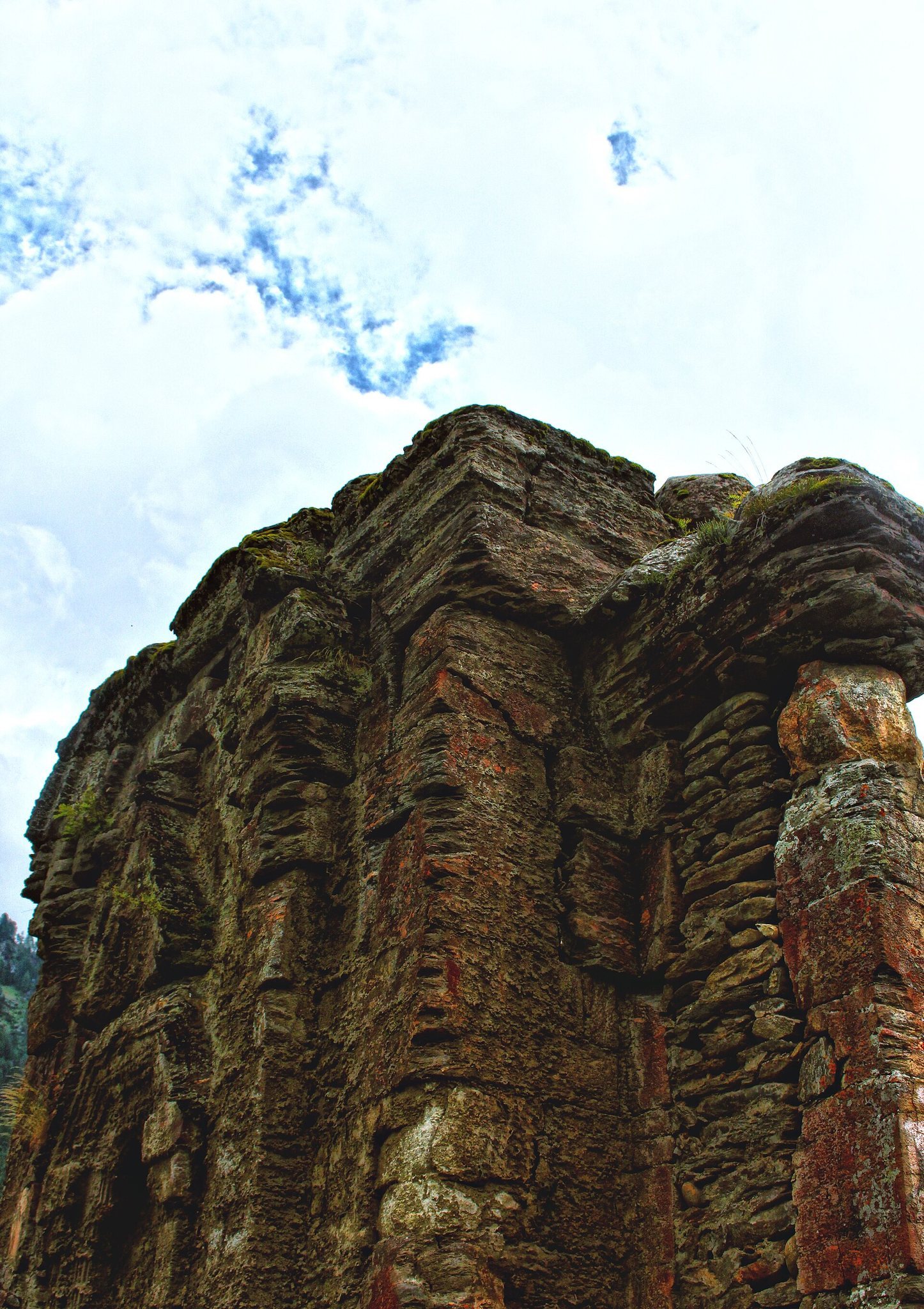
The temple was built of stone and included a court. Descriptions give the surviving site as approximately 22 feet wide and up to 16 feet high, with an area of four kanals, or about half an acre. Other measurements describe the temple as 142 feet long and 94.6 feet wide, with an 88-foot-high torana, a monumental gateway or entrance structure. The relationship between these larger measurements and the surviving ruin is uncertain.
The site is described as completely ruined, with temple remains surviving in the valley setting. Earthquakes, structural collapse, abandonment, and the reuse of masonry by local residents may have contributed to the loss of the former complex. The surviving stone fabric preserves the physical remains of a shrine whose earlier form also included a court.
Sanctum and image
Al-Biruni’s account places a wooden image of Sharada, or Saraswati, in the temple’s sanctum. This image connected the physical shrine with the institution’s religious identity and its association with learning.
Library and script tradition
Manuscript collection
The complex included a library or manuscript collection that contributed to Sharada Peeth’s role as a centre of learning. The institution’s reputation extended beyond the temple itself through its association with Sanskrit and religious study.
Sharada script
The Sharada script was extensively used at the institution and took its name from the shrine and its presiding goddess. Its connection with Sharada Peeth also supported the traditional identification of Kashmir as Sharada Desh, the country of Sharada.