A-Ma Temple: A Historic Mazu Shrine in Macao
Site at a Glance
- Rating
- 4.4
- Popularity
- Medium
- Country
- China
- Primary era
- Early Modern
- External website
- Open
- Eras represented
- Early Modern
- Civilizations
- Chinese
- Site type
- Religious
- Remains
- Temple
On this page15 sections
History
A-Ma Temple is a Chinese shrine dedicated primarily to Mazu, the sea goddess associated with sailors, fishermen, Fujianese communities, and maritime travel, on Barra Hill in Macao, People’s Republic of China. Its foundation is generally placed before the Portuguese settlement of Macao in the mid-sixteenth century, although a tradition dates construction to 1488. The complex follows the southern Fujian architectural tradition and is regarded as one of Macao’s three major ancient temples, alongside Lin Fong Temple and Pou Chai Buddhist Monastery.
Origins and Early History
The temple’s earliest history is surrounded by traditions of Mazu protecting Fujianese merchants and sailors from storms. In one account, she appeared as an elderly woman who vanished after guiding a voyage safely to Macao, leading the merchants to establish a shrine at the place where she disappeared. Another tradition says that a sea goddess calmed a storm and that her image was found after the vessel reached shelter. These stories explain the temple’s maritime association while leaving its precise foundation date uncertain.
Most scholars place an established Mazu shrine at the present site before Portuguese settlers arrived, probably before 1553 to 1557. A separate historical hypothesis connects the first temple with Yan Qisheng, a Fujianese smuggler and pirate who may have maintained a maritime trading base in Macao between 1452 and 1458. This remains a reconstruction rather than an established fact. Early Portuguese accounts encountered a Mazu temple already standing in Macao, and the Jesuit missionary Matteo Ricci recorded one after arriving there in 1582.
The temple has carried several names during its history, including Nương Ma Temple, Hoi Keong Temple, and Tin Hau Temple. Mazu is also known as Tin Hau, meaning the Heavenly Empress, and her worship is especially connected with coastal communities. The name of the temple is traditionally regarded as the source of “Macau.” One related tradition says that Portuguese sailors asked local people for the name of the place near the shrine and heard a form of “A-Ma Pavilion,” which was later adapted into Portuguese place-names.
Rebuilding and Modern History
The buildings were substantially improved in 1828. Typhoons damaged the complex in 1874 and 1875, after which a two-year rebuilding and expansion campaign created much of the appearance seen today. The temple’s historic fabric therefore combines earlier foundations and halls with nineteenth-century reconstruction.
Zhengjiao Chanlin, one of the principal halls, was nearly destroyed by fire on 8 February 1988. The government rebuilt it to its former appearance, completing the work in 1989. A second serious fire on 11 February 2016 caused extensive further damage to the same heritage-listed building. In 2006, a proposal to build a Portuguese-language school directly opposite the temple raised concerns that the relationship between the shrine, the sea, and its surrounding landscape would be obstructed. The relocation plan was cancelled later that year.
A-Ma Temple was classified as a protected immovable cultural property in Macao in 1992 and was selected that year as one of the city’s “Eight Views,” under the poetic title “A-Ma’s Purple Smoke.” It forms part of the Historic Centre of Macao, inscribed on the UNESCO World Heritage List in 2005 under criteria (ii), (iii), (iv), and (vi). The shrine and its setting have also been treated as cultural symbols of Macao and as witnesses to the city’s historical changes.
The temple’s presence entered both visual and literary records. Nineteenth-century Western paintings repeatedly represented the shrine and its surroundings, including works associated with George Chinnery and André Auguste Borget. On 13 August 1844, Jules Itier photographed Macao during a French mission using a daguerreotype, an early process that produced images on silver-coated metal plates. The resulting photographs are regarded as among the earliest surviving photographs made in China.
From 1738 onward, scholars, officials, and other visitors carved poems into the temple’s rocks. This tradition of A-Ma cliff poetry preserves evidence of Qing-period landscape, literary culture, social connections, and changing historical interpretations. The gateway also appeared on banknotes issued by the Banco Nacional Ultramarino and the Bank of China, including issues from 1945, 1981, 1990, 1996, 1999, 2003, and 2008.
Remains
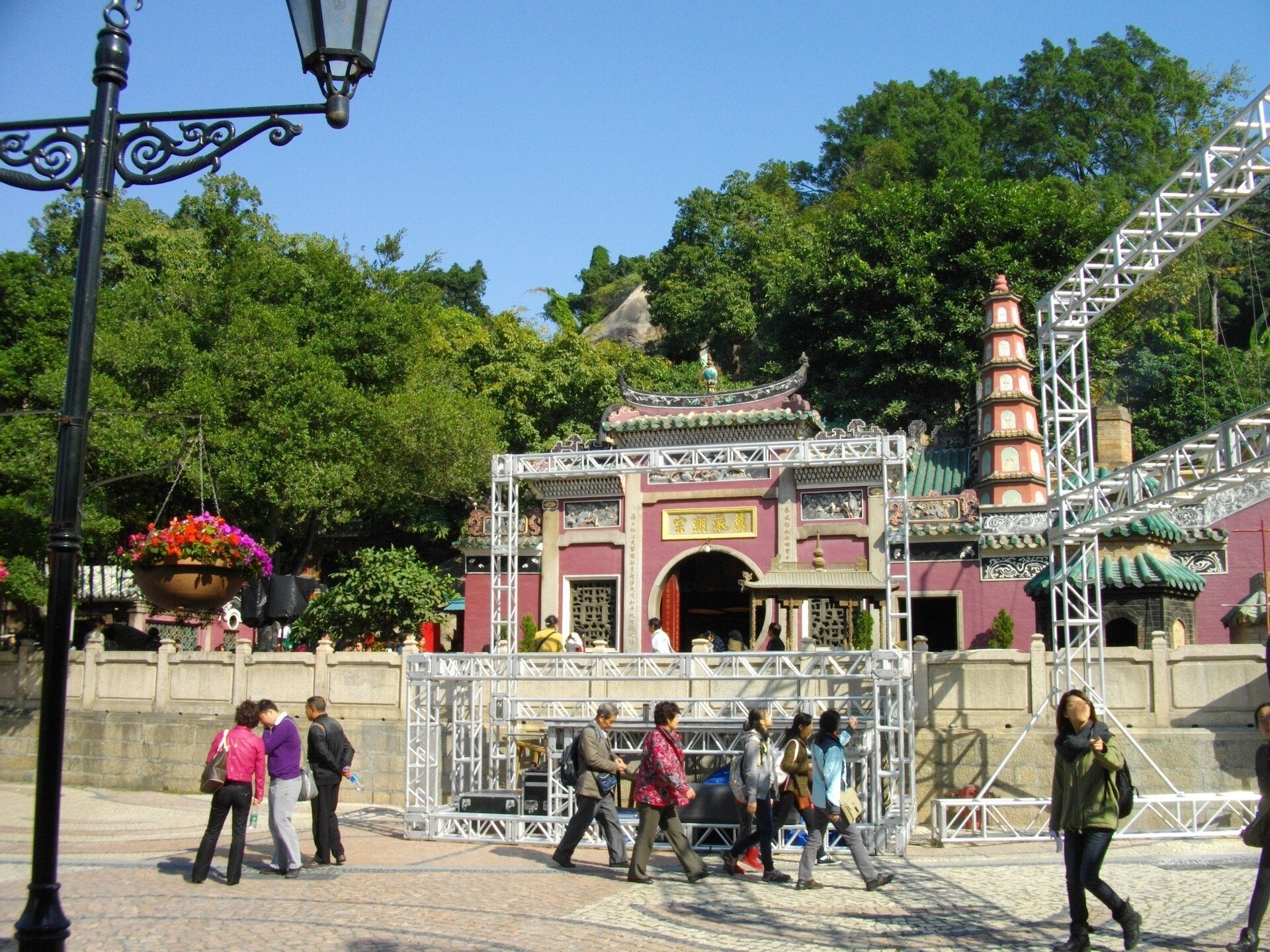
A-Ma Temple occupies a sea-facing hillside on Barra Hill. Rather than following the strict central axis common to many traditional Chinese temples, its buildings are arranged in staggered positions that follow the natural slope. The complex consists principally of an entrance gateway, a memorial arch, and four historic halls: the Main Hall, the Hall of Benevolence, the Hall of Guanyin, and Zhengjiao Chanlin. Granite, brick, glazed roof tiles, natural rock, hillside vegetation, and carved cliff faces together form the surviving architectural and landscape setting.
Entrance and Historic Halls
Gateway and Memorial Arch
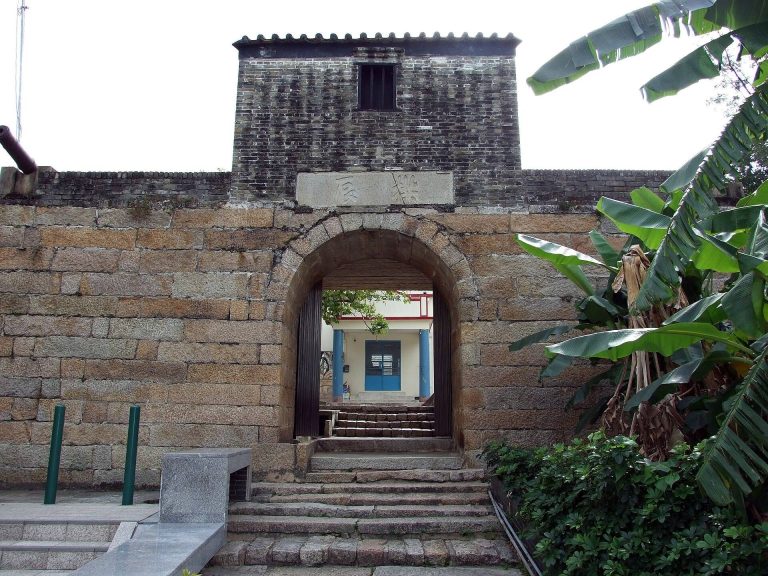
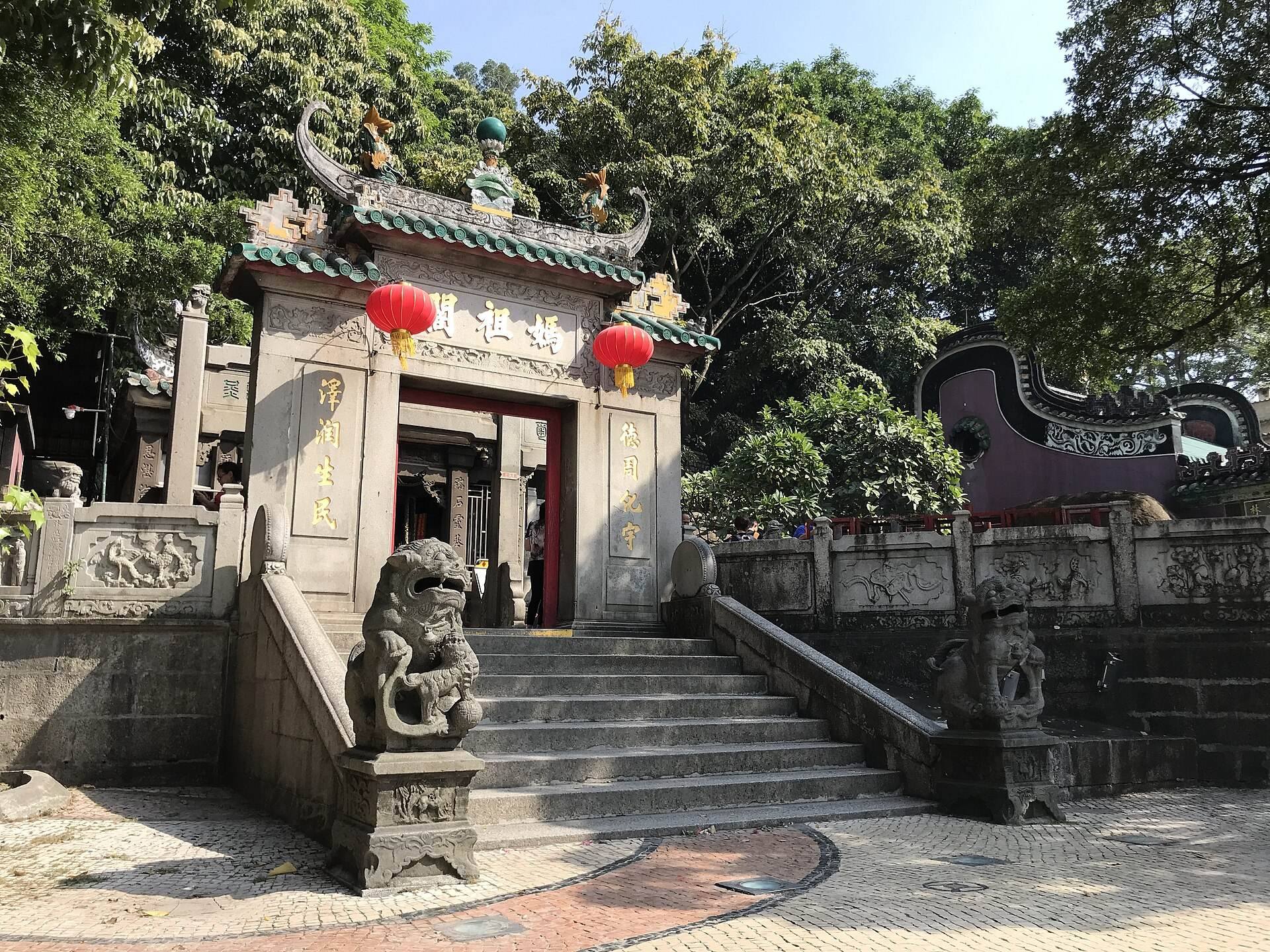
The granite entrance gateway stands before stone lions. Its lintel carries the inscription “A-Ma Pavilion,” with paired inscriptions expressing Mazu’s universal virtue and her nourishing beneficence. Glazed tiles cover the roof, whose ornamental ridge is supported by dragon-fish figures holding a pearl. Behind the gateway is a granite memorial arch, a ceremonial and commemorative structure, with three bays and four columns. Its inscriptions include “Calm Waves in the Southern Realm” and characters meaning “Pearl Light” and “Jewel Radiance.” The wording conveys a wish for the temple’s incense and religious activity to flourish.
Main Hall
The Main Hall, also called the Stone Hall or the “First Hall of the Sacred Mountain,” is aligned with the entrance and memorial arch. It was built in 1605 and rebuilt in 1629 and 1828. Granite and brick form the structure, while granite was also used for the columns, beams, parts of the walls, and sections of the roof framework. Glazed tiles cover a hip-and-roll roof over the worship area and a double-eaved hip roof over the shrine area. The hall enshrines Tin Hau, another title of Mazu, together with female attendants and demon generals.
Hall of Benevolence
The small Hall of Benevolence stands along a hillside path behind the Main Hall. Natural rock and several stone walls form its rear enclosure, making it the smallest of the four historic halls. A small pavilion is attached outside, with green glazed tiles and an upturned ridge. The hall enshrines Mazu with attendants and demon generals. It is traditionally dated to 1488, although its present doorway and interior stone shrine belong to the rebuilding of 1828, linking the building with an early foundation tradition while retaining later fabric.
Hall of Guanyin
The Hall of Guanyin existed before 1751, when it was originally a stone pavilion, and was rebuilt in 1828. Its principal materials are brick and stone, and its hard-gable roof has gable walls rising at the ends of the building. The hall enshrines Guanyin, a Buddhist bodhisattva associated with compassion, and represents the Buddhist element within the wider Mazu temple complex.
Zhengjiao Chanlin
Zhengjiao Chanlin existed before 1751 and was rebuilt in 1828. Dedicated to Mazu, it is more elaborate in scale and treatment than the other halls. The complex includes a principal shrine hall and side halls resembling brick-and-stone domestic buildings. The side buildings have hard-gable roofs, while the central hall uses a four-rafter structural system and a courtyard arrangement. Two side corridors flank the central courtyard beneath roll-shed roofs, a curved or gently rolled form commonly used over covered corridors and worship spaces.
Two rows of three columns divide the principal hall into three bays. Its roof is a glazed-tile slope roof, and the upper sections of the side walls have fire-preventive gables characteristic of southern Fujian architecture. The building was severely damaged by the fires of 1988 and 2016, followed by rebuilding and repair that preserved its role within the complex.
Cliff Inscriptions and Sacred Rocks
Cliff Poetry
Approximately 24 cliff inscriptions are distributed among the temple’s rocks. These carvings, made mostly by Qing-period writers and officials, include poems, names, and views connected with the landscape and literary history of the shrine. A cliff inscription is writing cut directly into exposed rock, and here the practice joined religious activity with poetry and commemoration.
The earliest known inscribed poem is “Water Blue, Sand Bright, Reflected Afar,” carved by Lin Guoyuan in 1738. It was first placed below the inscription “Sea Enlightenment” on Sea-Enlightenment Rock. A wall-building project in 1800 covered the original carving with masonry, so the poem was cut again elsewhere. The later version has suffered severe erosion and is difficult to read, while transmission has produced eight textual variants. Other contributors included Zhang Daoyuan, who carved a regulated verse in 1787, and Zhang Yutang, who traced characters with his finger during the Daoguang period. Huang Entong and Pan Shicheng added poems on 4 July 1844, one day after the signing of the Treaty of Wangxia in Macao.
Ocean Ship Rock
Ocean Ship Rock rises about 0.9 to 1.2 metres above the ground near the right side of the entrance. Its surface bears a carving of an ancient Chinese sailing vessel, popularly called a “big-eyed chicken.” The words “Favourable Crossing of a Great River” appear on the flag at the stern mast. The carving is described as more than 400 years old and connects the physical landscape directly with the temple’s maritime traditions.
Sea-Enlightenment Rock
Sea-Enlightenment Rock carries the large inscription “Sea Enlightenment,” attributed to Lin Guoyuan in 1738. It also bears the characters meaning “Supreme Unity,” carved by Li Qiantang in 1828. These latter characters are described as the largest at the temple and form part of the complex’s enduring association with inscribed stone, religious expression, and the sea-facing landscape.
Toad Rock
Toad Rock once stood near the seashore in front of the temple. A cavity through its centre produced a sound resembling a toad’s call when weather and tidal conditions changed. Fishermen reportedly treated the sound as a warning against putting to sea. The rock disappeared during Portuguese-administered reclamation works in 1868. Together, the surviving rocks and the cliff poetry preserve the interaction of natural features, maritime belief, religious practice, and literary culture that shaped A-Ma Temple.