Famen Temple: A Buddhist Relic Temple in Shaanxi, China
Site at a Glance
- Rating
- 4.4
- Popularity
- Very Low
- Country
- China
- Primary era
- Early Modern
- External website
- Open
- Eras represented
- Medieval, Early Modern, Modern
- Civilizations
- Chinese, Ming, Tang
- Site type
- Religious
- Remains
- Monastery
On this page22 sections
History
Famen Temple is a Buddhist temple in Fufeng County, Shaanxi, China. Its foundation date is uncertain, but excavated Eastern Han roof tiles and carved bricks place its origins in the reigns of Emperor Huan and Emperor Ling, while another tradition links its pagoda and relic cult to Ashoka, the Mauryan emperor associated with the spread of Buddhism and the distribution of Buddhist relics. The temple is traditionally regarded as the ancestor of pagoda temples in the Guanzhong region.
Early foundations and imperial rebuilding
Famen Temple already occupied a substantial site during the Northern Wei period. In 555, Tuoba Yu, a member of the Northern Wei imperial family, enlarged it. The temple was almost completely destroyed during the Northern Zhou suppression of Buddhism under Emperor Wu. After the Sui dynasty was established, it was rebuilt on a smaller scale. In 583, Emperor Wen renamed it the Chengshi Buddhist Practice Center, and in 602 Li Min opened the pagoda for a ceremony involving the Buddha relic. The temple was later merged with nearby Baochang Temple and became a temple-owned agricultural estate.
In 625, Emperor Gaozu of the Tang ordered the temple to be rebuilt and restored the name Famen Temple. The complex also sheltered people fleeing warfare at the end of the Sui dynasty, but fire later destroyed it. Monks rebuilt the temple, beginning a period in which imperial patronage repeatedly enlarged the site.
The Tang imperial temple
During the Tang dynasty, emperors Gaozong, Wu Zetian, Zhongzong, Suzong, Dezong, Xianzong, Yizong, and Xizong held six ceremonies to receive and two ceremonies to return the Buddha’s finger relic. These ceremonies, together with imperial gifts and donations, helped Famen Temple grow into a complex of twenty-four courtyards. The temple became an imperial Buddhist institution and an important pilgrimage destination.
The structure popularly known as the Sacred Tomb was replaced during the Tang period by a four-story wooden pagoda. In the fifth year of the Zhenguan era, Zhang Liang received authorization to dismantle Wangyun Palace for the construction of a pagoda. The building was reconstructed in the fifth year of the Xianqing era as a four-story pavilion-style tower. Emperor Zhongzong gave it the name True Relic Pagoda and later renamed it the Grand True Relic Pagoda. In 710, he also renamed the temple the Grand Imperial Carefree King Temple. The temple briefly took the name Fayun Temple in 838 before returning to Famen Temple.
Emperor Zhongzong and Empress Wei strongly supported Buddhism, and hair associated with them was placed beneath the pagoda. It was excavated in 1978. Famen Temple suffered during Emperor Wuzong’s persecution of Buddhism, a state campaign that restricted Buddhist institutions and confiscated their property, but it was rebuilt under Emperor Yizong. The underground palace was then sealed in the form later discovered by archaeologists.
In 874, Emperor Xizong returned the Buddha’s finger relic to Famen Temple and sealed it beneath the pagoda with thousands of valuable objects. The offering followed an esoteric Buddhist mandala, a ritual arrangement representing the sacred Buddhist cosmos. This ceremony confirmed the temple’s status as an imperial Buddhist center and strengthened its place in Buddhist pilgrimage.
Medieval renewal and later decline
During the Five Dynasties and Ten Kingdoms period, Li Maozhen, the Prince of Qin, spent more than thirty years renovating Famen Temple. Buddhism was restricted under Emperor Shizong of Later Zhou, but the temple continued to function. It revived under the Northern Song and again reached a scale comparable to its Tang prominence. One of its twenty-four courtyards, known as the Bathhouse Courtyard, was said to have served one thousand bathers each day. Emperor Huizong wrote the words “Buddha’s Realm of the Emperor” above the mountain gate.
During the Jin and Yuan periods, Famen Temple remained a major monastery in Guanzhong. Records state that its monks copied 5,000 volumes of the Buddhist canon. The temple declined during the Ming and Qing periods. The Tang wooden pagoda collapsed in 1569. From 1579, local donors including Yang Yuchen and Dang Wanliang financed its replacement, which was completed after thirty years as a thirteen-story, octagonal brick pagoda approximately 47 meters high. An earthquake caused the tower to lean and crack in 1654. Repairs followed in 1655, 1769, and 1884. The temple was damaged during the Shaanxi-Gansu Hui uprising in 1862 and was later rebuilt on a much smaller scale.
Modern destruction, excavation, and revival
After the establishment of the Republic of China, troops were repeatedly stationed at the temple, causing extensive damage. The North China Philanthropy Association led a reconstruction campaign beginning in 1938 as a relief project for impoverished residents. The work was completed in July 1940, and Buddhist activities resumed one month later under Zhu Ziqiao.
Famen Temple entered Shaanxi’s first provincial group of protected historical sites in 1956. During the Cultural Revolution, Red Guards destroyed Buddhist statues, the statues in the Mahavira Hall, Buddhist scriptures, and the Seven-Tone Stele, an ancient monument associated with the history of music. They began excavating the pagoda foundations and tried to open the pagoda. The abbot Liangqing set himself on fire in front of the True Relic Pagoda while attempting to protect the temple and its underground palace. Other monks were dispersed and persecuted, and the site became the temporary headquarters of Fufeng County’s revolutionary forces and a place of armed conflict. The underground palace remained unopened during this period.
After 1979, the Shaanxi provincial government funded restoration of the Mahavira Hall and Brass Buddha Pavilion. Heavy rain caused half of the True Relic Pagoda to collapse on 4 August 1981. The temple returned to Buddhist administration in 1984, and the remaining half of the pagoda was dismantled in 1985. Reconstruction began in February 1987. On 3 April that year, workers opened the underground palace and found the Buddha’s finger-bone relic together with thousands of Tang-period objects, including the Eightfold Treasure Casket, a bronze stupa, and a silver-gilt floral staff with twelve rings. Candy wrappers, peanut shells, and badges bearing Mao Zedong’s image were also found among the remains left by the Cultural Revolution. Most excavated objects were classified as first-grade cultural relics, the highest category.
The discovery expanded Famen Temple’s importance for Buddhist studies, scholarship, and archaeology. Ji Xianlin suggested that research on the objects could develop into an international academic field comparable to Dunhuang studies. The temple formally reopened in 1988 and held a ceremony for viewing the finger relic. Pagoda reconstruction and temple expansion were completed in October, and the Famen Temple Museum opened on 9 November.
Contemporary Buddhist institutions
The finger relic was taken abroad for Buddhist veneration in Thailand in 1994, Taiwan in 2002, Hong Kong in 2004, and South Korea in 2005. Xuecheng became abbot in 2004. A Buddhist studies class established that year developed into the Famen Temple Buddhist Academy, which began trial operation in 2007 and was formally established in 2010 as a provincial-level institution and the first higher Buddhist academy for Han Chinese Buddhism in northwestern China.
Famen Temple became a Major Nationally Protected Cultural Relic Site in 2006. The Namaste Dagoba was completed in 2009, and the finger relic was ceremonially enshrined there. On 16 October 2014, Famen Temple hosted the 27th General Conference of the World Fellowship of Buddhists, the organization’s first meeting in mainland China. A modern cultural scenic area developed beside the temple covers approximately 150 acres, or 0.61 square kilometers, and remains institutionally distinct from the Buddhist temple. Its management passed in 2013 from the Qujiang New Area administrative committee to a committee established by the Baoji municipal government, with representatives of the monastic community participating in its administration.
Remains
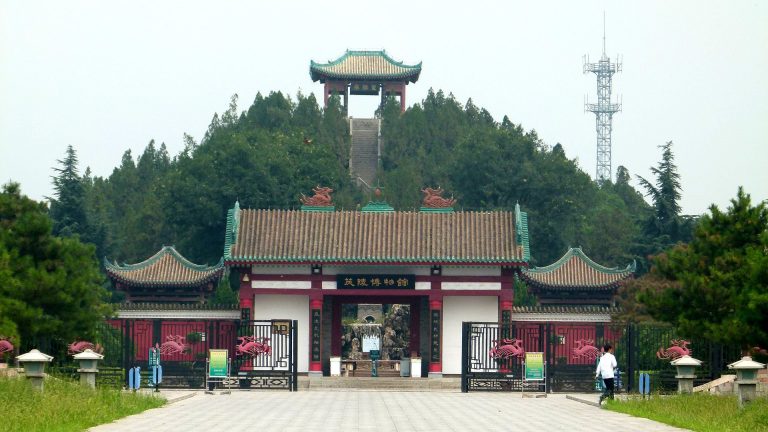
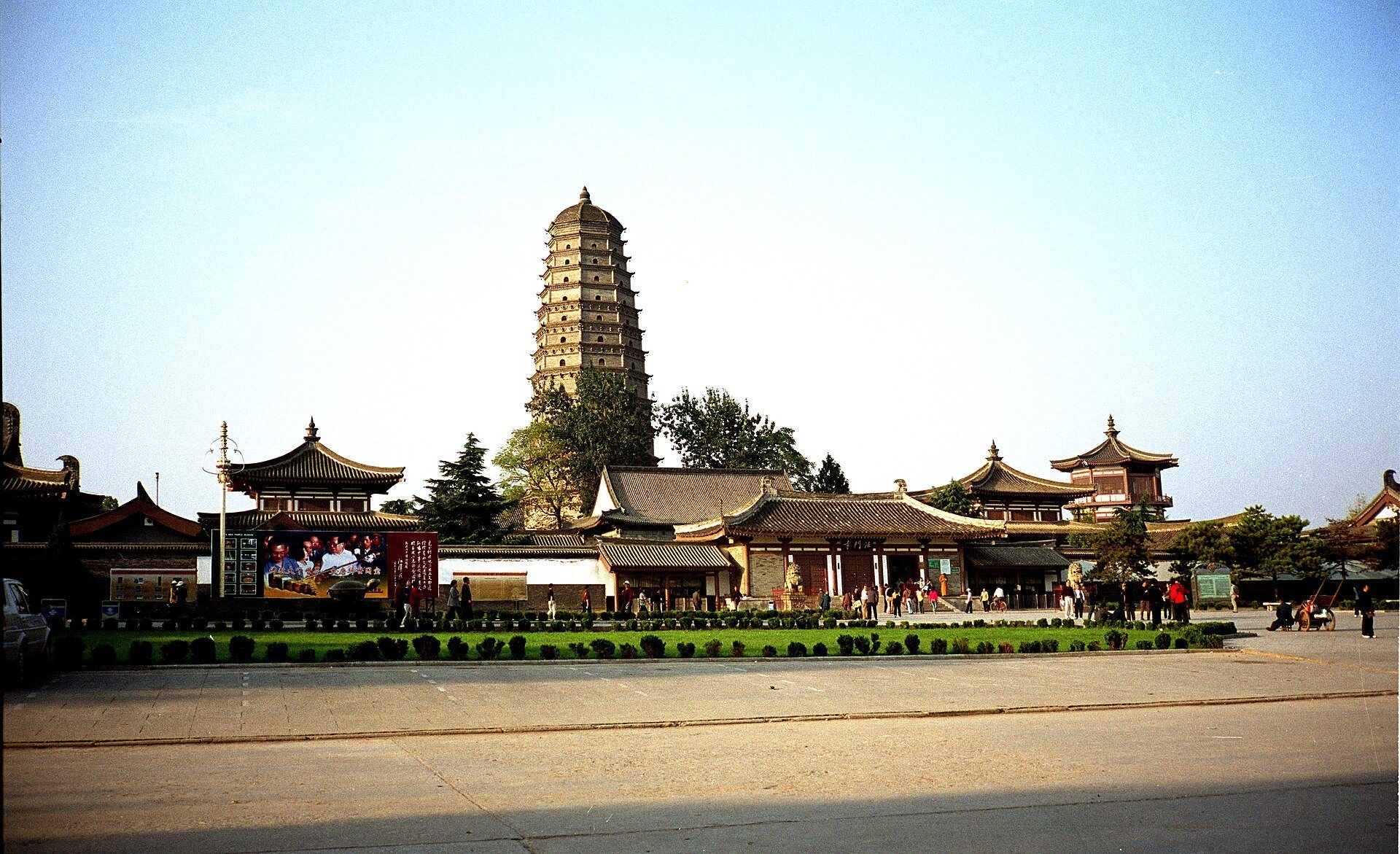
Famen Temple preserves a “pagoda before the hall” arrangement associated with early Chinese Buddhist temple planning. The True Relic Pagoda stands on the central axis, with the mountain gate and front hall before it and the Mahavira Hall behind it. The complex also includes the underground palace, museum buildings, later imitation-Tang structures, and the adjoining Namaste Dagoba.
Central axis and pagoda
True Relic Pagoda
The present True Relic Pagoda reproduces the Ming-period thirteen-story brick tower using measured drawings made before its collapse. Its reinforced-concrete structural skeleton is covered with gray bricks, and it contains platforms for viewing the surrounding area. The tower represents several stages in the site’s history. A four-story wooden pavilion-style pagoda stood here during the Tang period, followed by the thirteen-story Ming brick pagoda, which imitated timber construction. The present structure follows the pre-collapse Ming form.
Temple halls
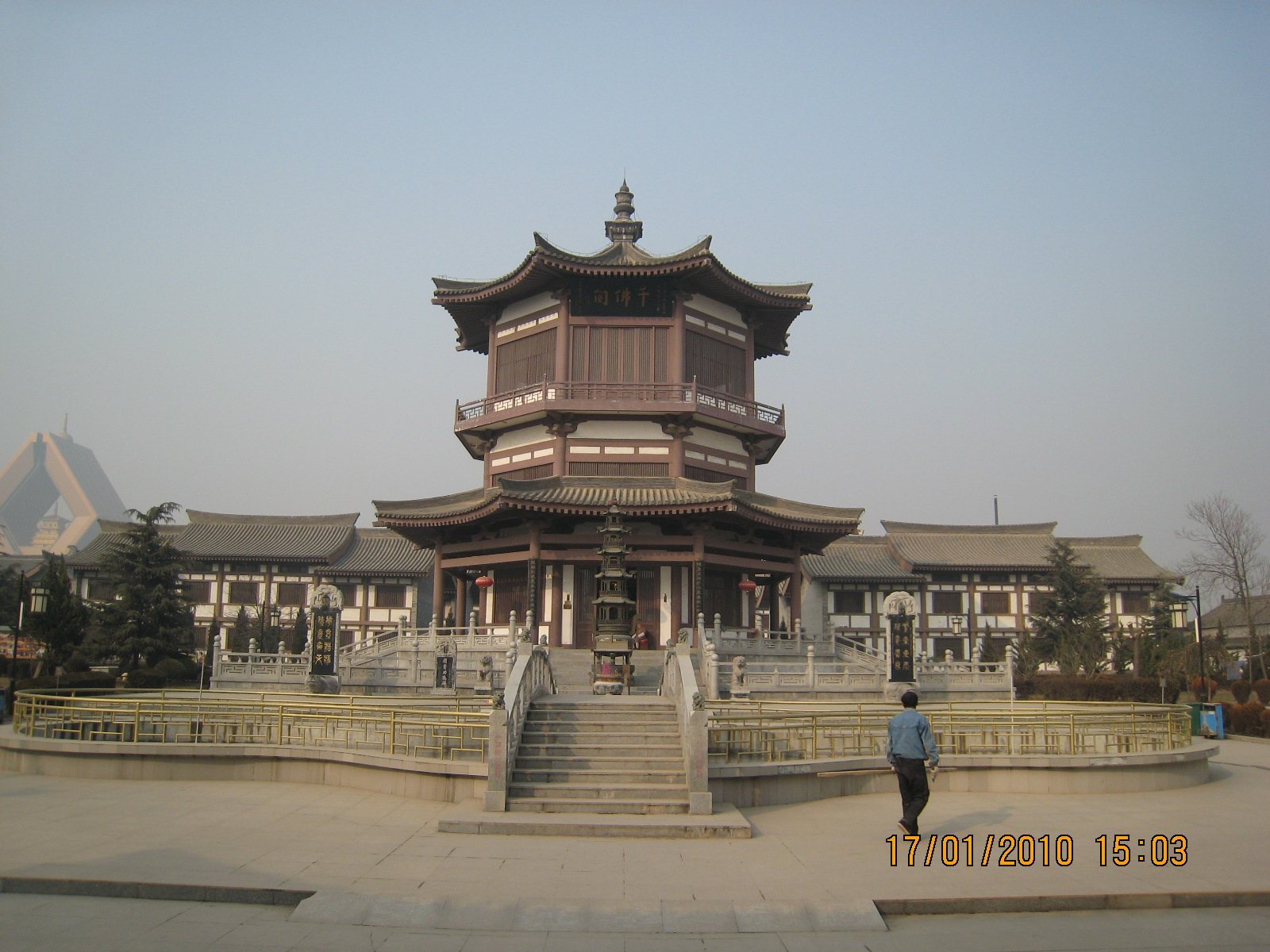
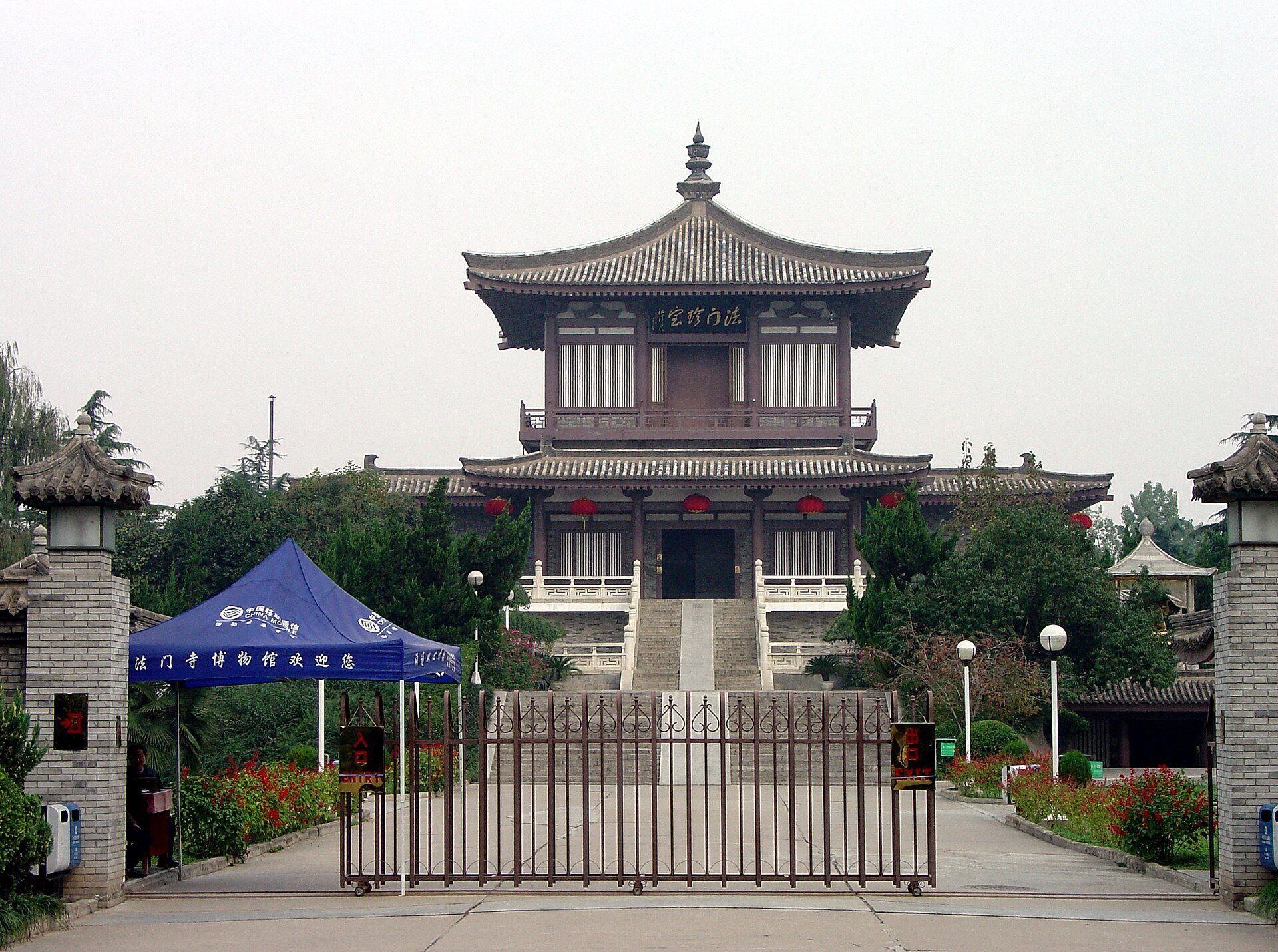
The mountain gate and front hall stand before the pagoda on the central axis, while the Mahavira Hall lies behind it. The Mahavira Hall is the principal Buddha hall of the temple. Since the 1980s, the complex has also gained imitation-Tang buildings including the Jade Buddha Hall, meditation hall, ancestral hall, dining hall, monks’ quarters, and Buddhist academy.
Underground palace and relic chamber
Tang underground palace
The underground palace was restored to its recorded Tang-period arrangement, with only a few severely damaged elements replaced. White marble and limestone slabs form the structure, while its inner walls and stone doors carry extensive carving. A circular underground chamber surrounds the palace and contains Buddhist niches. The Buddha’s finger relic was originally enshrined at the center of this chamber before being transferred to the Namaste Dagoba.
Finger relic and caskets
Four relics were found after the palace was opened between 5 and 12 May 1987. Two are made of white jade, and one is attributed to a distinguished monk. These three are described as duplicate relics placed with the true relic for protection. The yellow, bone-like relic with granular secretions is identified as the true relic and is believed to be a finger bone of Gautama Buddha, the historical Buddha whose bodily relics are venerated in Buddhist traditions.
The finger relic was enclosed within eight nested caskets. The outer sandalwood casket had decayed, while smaller caskets of gold, silver, and jade survived in good condition. Each had a silver lock and elaborate carving, and the innermost casket contained the relic.
Imperial offerings and archaeological collections
Metalwork and ritual objects
More than 120 sets of gold and silver objects came from the underground palace. Many were imperial ritual vessels associated with ceremonies for the Buddha’s relic, and many bear engraved inscriptions. The objects include a gilt-silver tea service with a metallic-thread tea container, a tortoise-shaped tea box, a tea roller-grinder, a silver stove, and a vessel for mixing and drinking tea.
The finds also include a silver-gilt incense burner and a gold-and-silver-decorated sandalwood incense burner. The latter has lotus-petal decoration, five lotus flowers with tortoises holding flowers in their mouths, and five animal-shaped feet whose fronts resemble unicorns. An inscription dates it to 869 and identifies its maker as an imperial workshop specializing in gold and silverware.
A gold-plated, silver-inlaid tortoise-shaped container has a carved turtle-shell and brocade-patterned cover. It measures 13 centimeters high, 28.3 centimeters long, and 15 centimeters wide. A set of five finely made gilt-silver plates is also attributed to the Tang period.
Textiles and miniature costume
A miniature bodhisattva costume includes a half-sleeved blouse 6.5 centimeters long, with sleeves measuring 4.1 centimeters. Its gold-couching embroidery uses thread averaging 0.1 millimeters in diameter, with the thinnest sections measuring 0.06 millimeters. One meter of thread required approximately 3,000 circles of gold foil.
More than 700 silk fabrics were recovered from the underground palace, including offerings attributed to former empresses. The collection contains an embroidered skirt associated with Wu Zetian, China’s only woman to rule as emperor in her own right and a major patron of Buddhism.
Glass, ceramics, and tea vessels
More than twenty glass vessels were recovered, chiefly hollow forms such as dishes, plates, and bowls. Their style reflects the long influence of western Asian and Islamic glassmaking traditions on Chinese production. Thirteen precious examples of secret-color ceramics were also excavated. These refined celadon wares were associated with elite and court production. An accounting tablet found in the underground palace, considered together with the vessels, helped establish that “secret-color” referred to a particular type of ceramic ware rather than only to an undisclosed glazing technique.
Museum and written remains
Famen Temple Museum
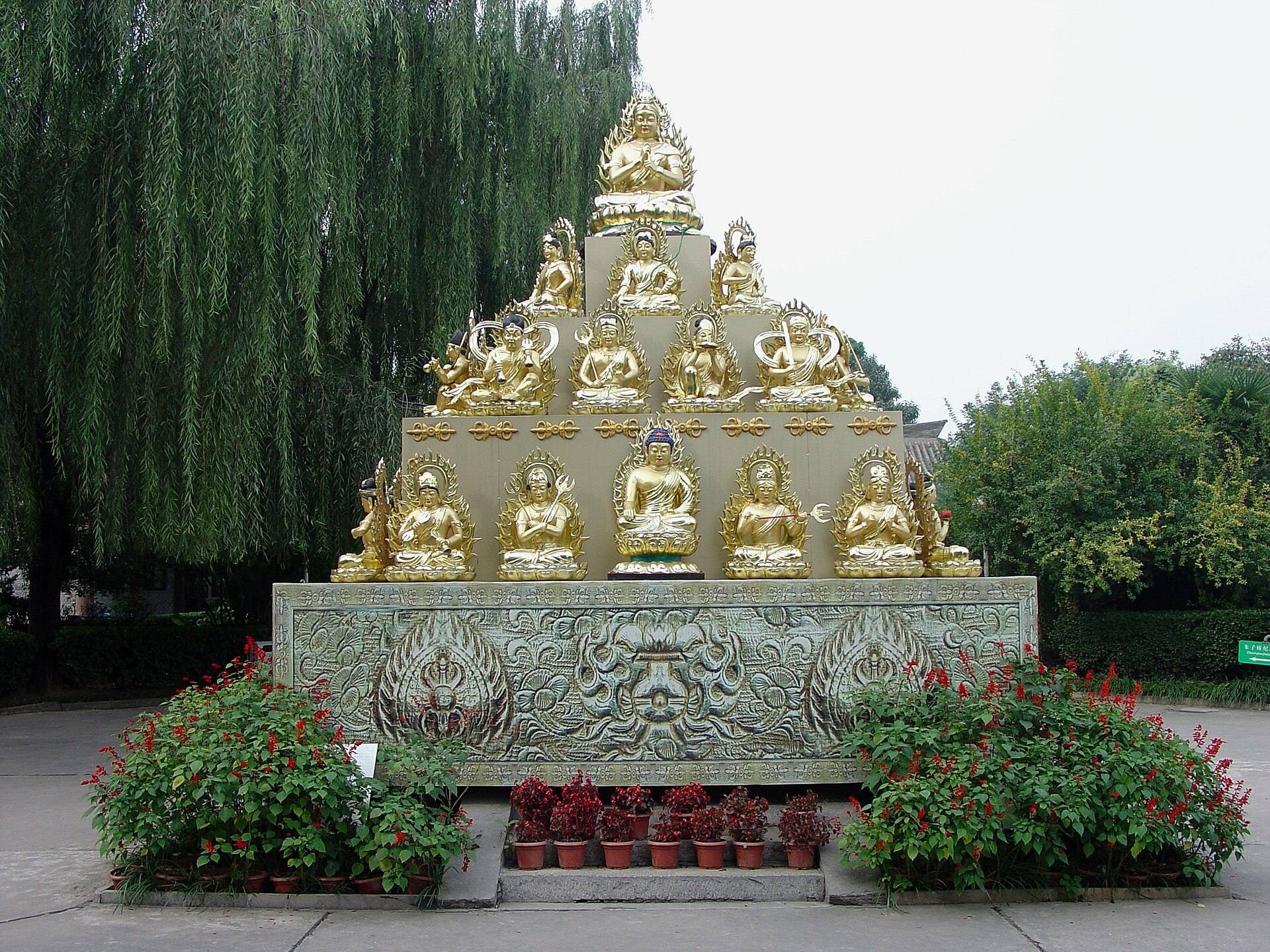
The western section of the temple contains the Famen Temple Museum, including a multifunction reception hall and a treasure hall. The museum collections include 104 Buddhist figures, 16 olive-green ceramic objects, 17 glass objects, and hundreds of volumes of Buddhist scripture associated with the underground palace and temple collections.
Scriptures and inscriptions
The earliest Buddhist scripture associated with the temple was the Great Parinirvana Sutra, formerly carved on Wu Zetian’s Thousand Buddhas Stele. The stele no longer survives, but the library preserves materials connected with the complete Vilu Canon, the colophons of the Puning Canon, and the catalogue of the Secret Scriptures.
Ming pagoda figures
The Ming thirteen-story pagoda originally contained 88 Buddha niches, each intended for one figure. By the 1939 restoration, 68 figures remained. Later clearing revealed 98 Buddha figures, many containing scriptures and sealed deposits from the Ming and Republican periods.
Namaste Dagoba
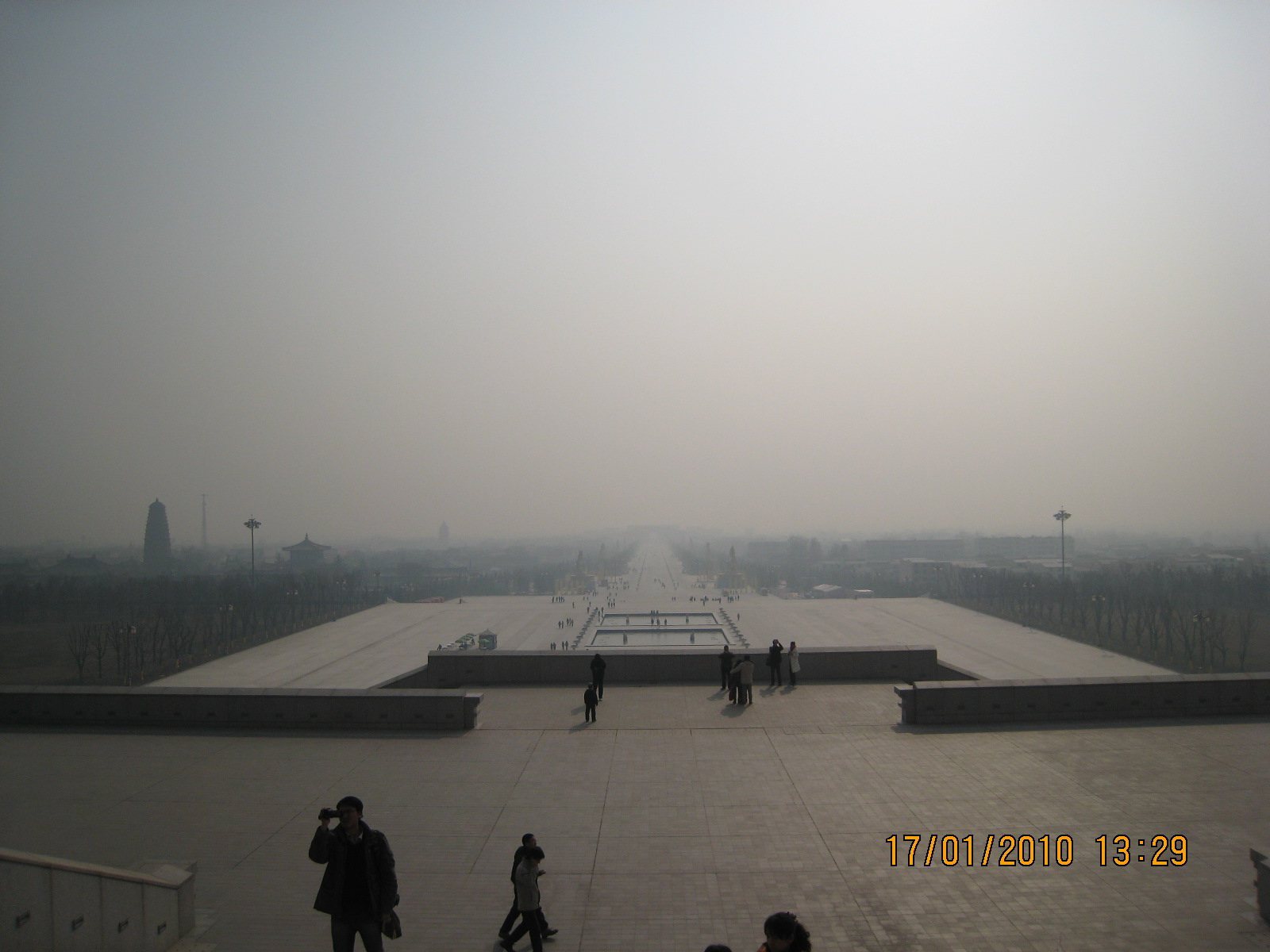
The Namaste Dagoba stands in the adjoining cultural scenic area. It is 148 meters high, approximately the height of a thirty-five-story building, and was designed by C. Y. Lee, the architect of Taipei 101. It serves as a place of worship and a repository for relics from the Famen pagoda. Its claim to be the world’s tallest Buddhist stupa remains unverified. After its completion in 2009, the Buddha’s finger relic was ceremonially enshrined there.