Pancha Rathas: Pallava Monolithic Temple Models at Mahabalipuram
Site at a Glance
- Rating
- 4.7
- Popularity
- High
- Country
- India
- Primary era
- Medieval
- Eras represented
- Medieval
- Civilizations
- Pallava
- Site type
- Civic
- Remains
- Monument
On this page11 sections
History
Pallava carving and uncertain attribution
Pancha Rathas is a complex of five unfinished monolithic granite monuments at Mahabalipuram, India, carved in the seventh century in the Dravidian architectural tradition of the Pallavas, a South Indian ruling dynasty. The site stands on the Coromandel Coast of the Bay of Bengal and forms part of the Group of Monuments at Mahabalipuram.
The monuments are commonly associated with the reigns of Mahendravarman I and his son Narasimhavarman I. Under this interpretation, work ended after Narasimhavarman I died in AD 668. A different attribution, linked to newly discovered inscriptions and to historians including Nagaswamy, places the carving during the reign of Narasimhavarman II, approximately from AD 690 to 725. The precise chronology and royal patronage therefore remain uncertain.
The Pallavas planned the structures as stone versions of ancient wooden chariots, according to an Archaeological Survey of India plaque. Construction stopped before the complex was completed, leaving its exact purpose unresolved. The monuments were never consecrated for worship, and their unfinished condition prevents a certain identification of their intended use.
Names, interpretation, and preservation
The names now used for the five monuments come from the Pandavas and Draupadi, figures from the Mahabharata, a major Sanskrit epic. The labels are conventional and do not demonstrate a connection between the monuments and those characters. The Archaeological Survey of India has instead suggested that the structures should be understood as vimanas, or shrine superstructures, although they remained incomplete rather than functioning as finished temples.
The complex is part of a group of nine monolithic rock-cut structures at Mahabalipuram. It was included in the UNESCO World Heritage Site known as the Group of Monuments at Mahabalipuram in 1984. The granite carvings have remained well preserved despite the salty winds of the Bay of Bengal and tsunamis in the thirteenth century and in 2004.
Remains
Layout and architectural forms
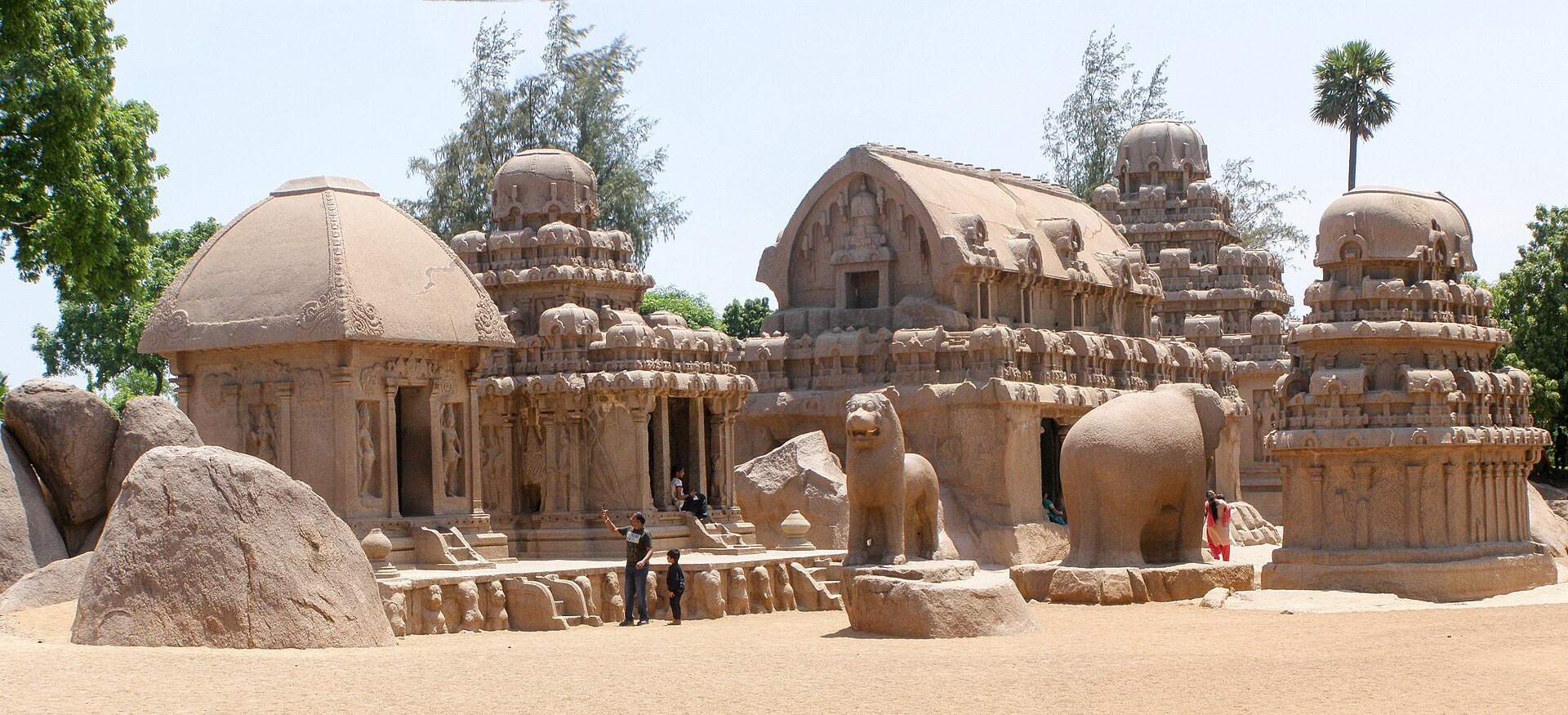
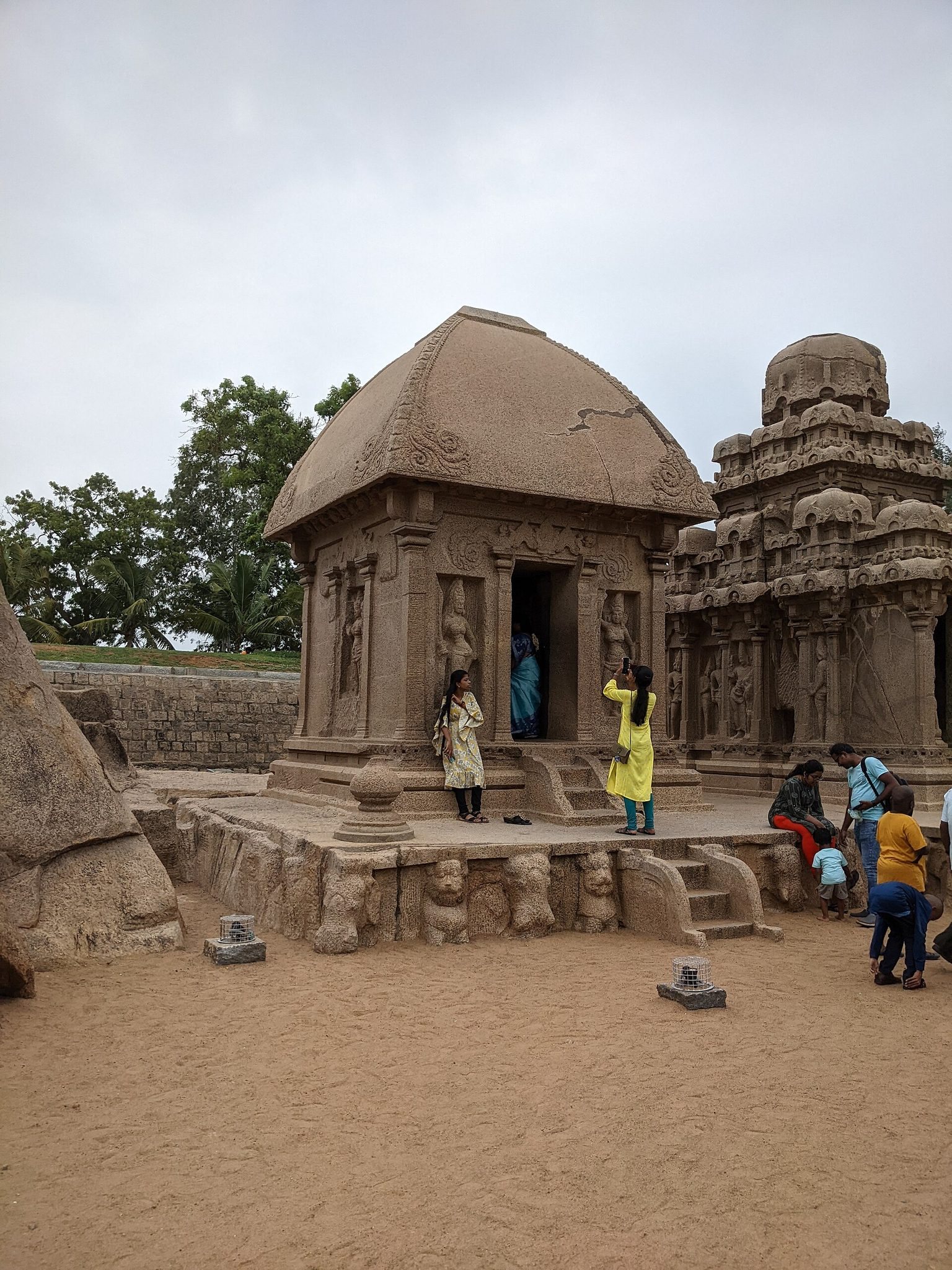
Each ratha is carved from a single mass of granite, rather than assembled from separate blocks. The five structures stand on a shared, slightly sloping plinth oriented from north to south. Their plans vary between square, rectangular, and apsidal forms. Arranged by size, they are the Dharmaraja Ratha, Bhima Ratha, Arjuna Ratha, Nakula Sahadeva Ratha, and Draupadi Ratha. The largest measures about 42 by 35 feet, or 13 by 11 metres, while the tallest rises approximately 40 feet, or 12 metres.
The group presents several forms of Dravidian design, including single-tiered and three-tiered towers or domes. Its shapes probably imitate wooden temple chariots and may have provided models for larger temples later built in Tamil Nadu. Several of the rathas also resemble Buddhist viharas, or monastic residences, and chaityas, or prayer halls and shrines.
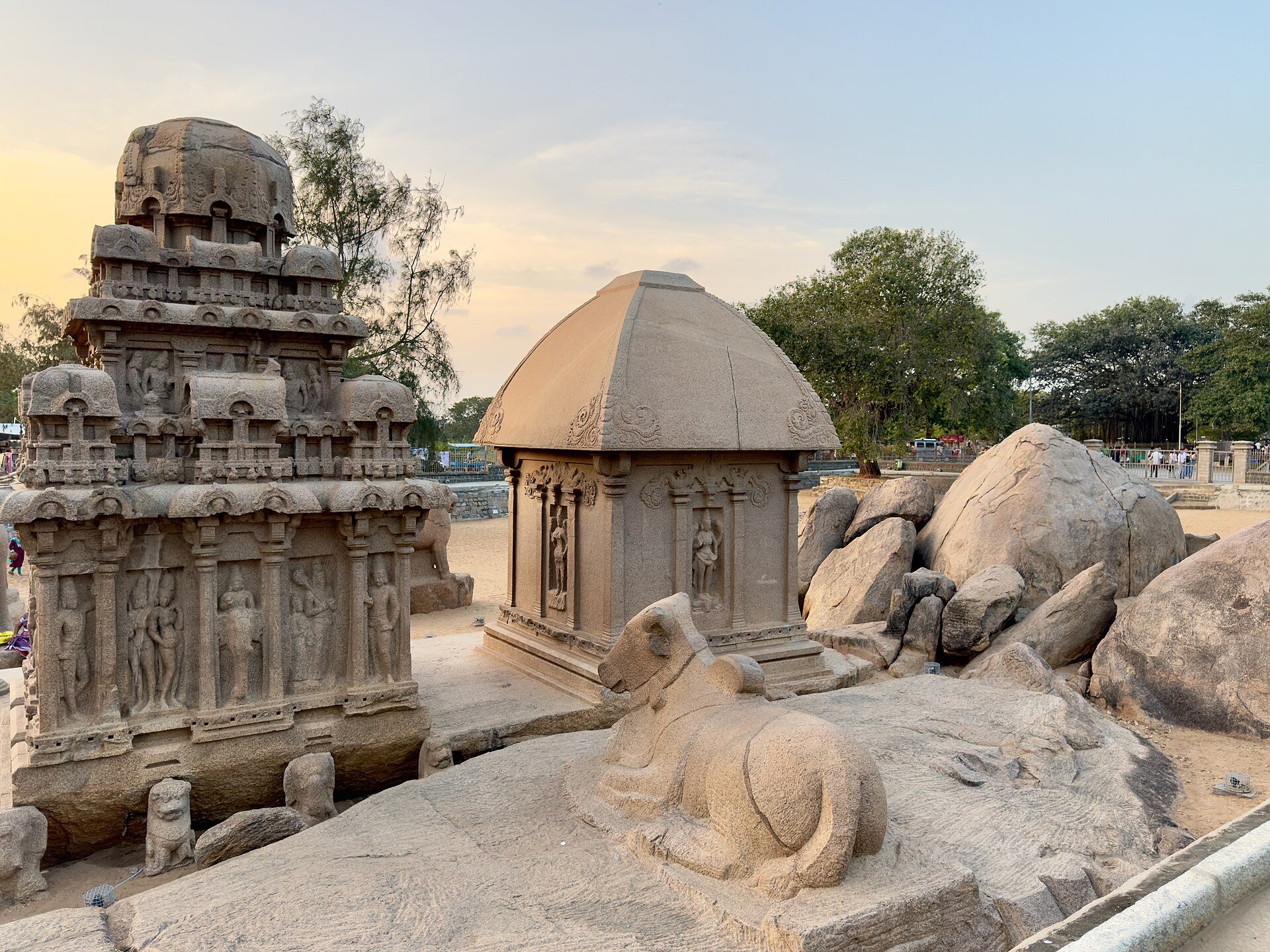
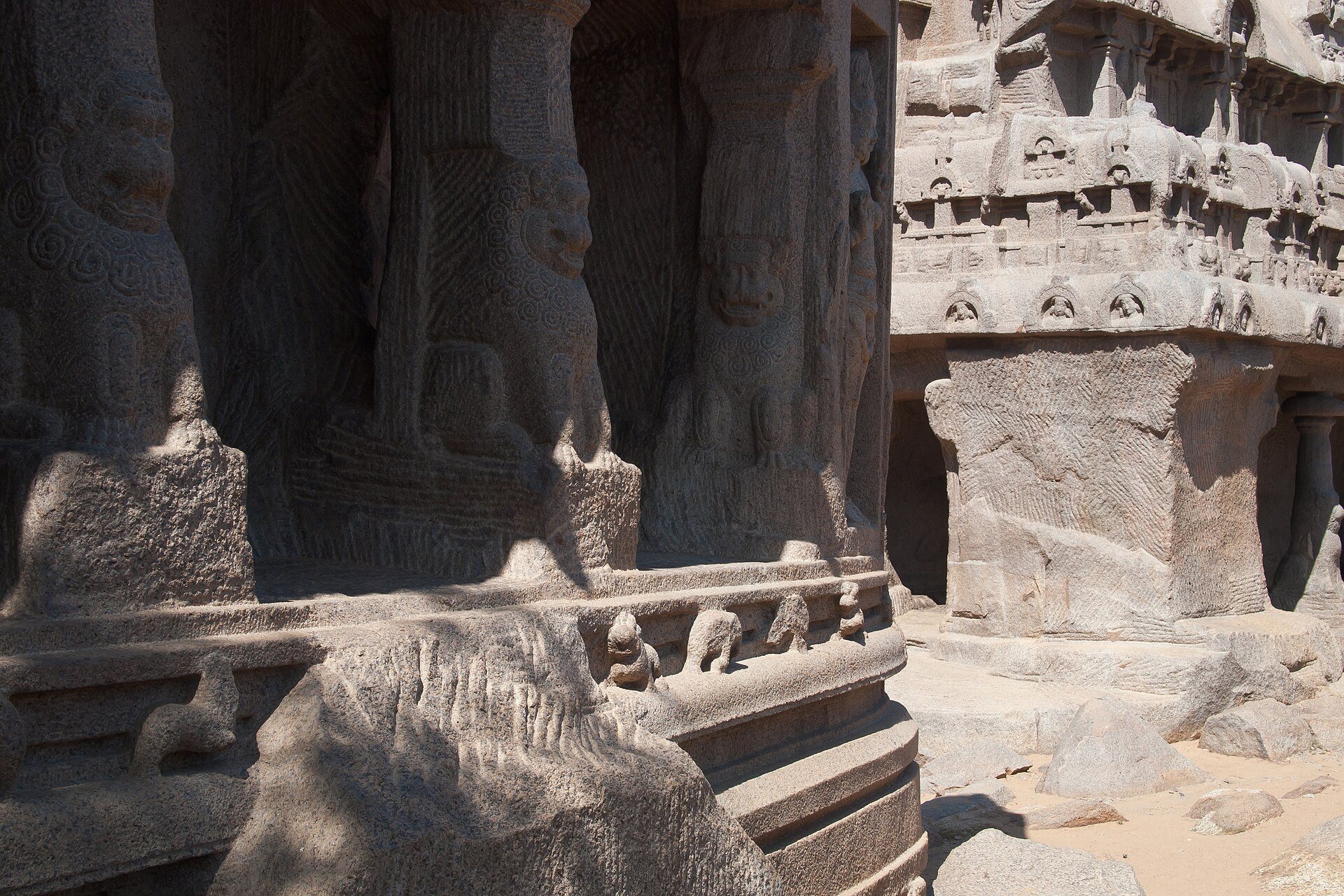
The walls are divided into successive sections, with projections and recesses creating shallow pilasters. Rectangular niches hold carvings of gods, demi-gods, and kings. Other decoration includes aquatic animals with leafy tails and open jaws, curved brackets, porch columns, overhanging eaves, and arch-shaped windows that sometimes contain carved figures. Mouldings end in parapets, while rows of miniature roof forms rise above the eaves. Uncut stone remains visible at the bases and tops, and some carving follows apparent joints in the granite, both indicating that the work was left unfinished.
Individual rathas and sculptures
Dharmaraja Ratha
The Dharmaraja Ratha has a square plan and a pyramidal elevation arranged in three stages. Its sculptural programme includes Harihara, the combined form of Shiva and Vishnu, along with Brahma, Skanda, Ardhanarishvara, and King Narasimhavarman I. Ardhanarishvara represents a unified form of Shiva and the goddess Parvati. On the eastern face, Indra is shown seated on Airavata, his white elephant mount. A separate monolithic sculpture of Nandi, Shiva’s bull and attendant, stands in the open space beside the ratha.
Arjuna Ratha
The Arjuna Ratha follows the Dharmaraja Ratha in the arrangement of the complex. It has a richly decorated facade whose general composition resembles that of the Dharmaraja Ratha.
Bhima Ratha
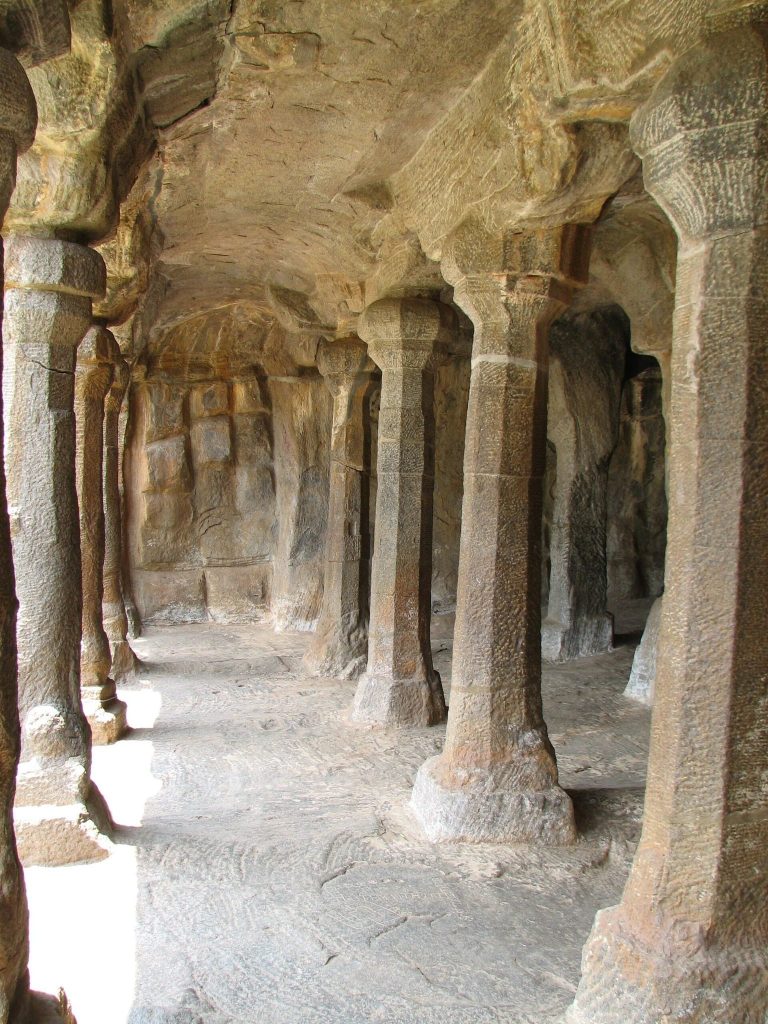
The Bhima Ratha has a rectangular plan. Galleries extend along its two long sides, each supported by four columns associated with lion imagery.
Nakula Sahadeva Ratha
The Nakula Sahadeva Ratha has a simple plan with apsidal ends. A large monolithic stone elephant occupies the adjacent open space.
Draupadi Ratha
The Draupadi Ratha is a square structure shaped like a village hut with a thatched roof. Inside, a fresco or wall painting depicts the mother goddess Durga.