Valdediós Monastery: A Cistercian Abbey in Asturias, Spain
Site at a Glance
- Rating
- 4.6
- Popularity
- Low
- Country
- Spain
- Primary era
- Medieval
- External website
- Open
- Eras represented
- Medieval, Early Modern
- Civilizations
- Crown of Castile, Kingdom of Asturias, Kingdom of León, Spanish
- Site type
- Religious
- Remains
- Monastery
On this page12 sections
History
Valdediós Monastery is a Cistercian monastery in Spain, near Villaviciosa in Asturias, founded in 1200 by Alfonso IX of León and Berengaria of Castile. The royal founders donated the Boiges valley to the Cistercian Order, a Catholic monastic community shaped by the Benedictine tradition and known for disciplined communal life and relatively austere architecture. The new house became a daughter monastery of Santa María de Sobrado.
Foundation and medieval development
The valley already contained the small church of San Salvador, built by Alfonso III of Asturias in the late ninth century. The first monks named the valley Valdediós, meaning “Valley of God.” After a proposed relocation to Boñar was abandoned, work on the monastery church began in 1218 under the direction of Gualterius, probably a master of Frankish origin. The church was completed around 1225.
Ferdinand III of Castile later favoured Valdediós after inheriting Galicia and León. The monastery became a well-endowed and important abbey, receiving further gifts from local nobles. Among its benefactors was Pedro Peláez Quexal, holder of Maliayo, the former name of the territory around Villaviciosa. After Ferdinand III’s death, the monastery declined during the fourteenth and fifteenth centuries.
Reform, destruction, and rebuilding
On 14 April 1515, Valdediós was reformed by the Cistercian Congregation of the Regular Observance, also known as the Congregation of San Bernardo of Castile. This was a Cistercian reform congregation based in Castile. The following decade brought a major physical disaster. In 1522, the Valdediós River overflowed and destroyed the cloister and the surrounding monastic buildings, although the church survived. The complex was rebuilt during the middle of the sixteenth century.
Suppression and changing uses
The French invasion, the Spanish War of Independence, and nineteenth-century confiscations disrupted the monastery’s religious life. The house was suppressed on 11 October 1835 under the confiscation measures of the liberal minister Juan Álvarez Mendizábal. Three monks remained afterward, and the last died in 1862. During the War of Independence, the monks had also left Valdediós between 1808 and 1812.
In 1862, the Archdiocese of Oviedo acquired the complex and established a minor seminary there, later reorganized as a secondary school. From 1923 to 1951, the buildings served as a diocesan seminary, apart from an interruption between July 1936 and October 1937.
The Spanish Civil War brought another severe disruption. Clergy and seminarians fled because of religious persecution in the Republican-held area, and the monastery housed the La Cadellada psychiatric hospital for approximately fifteen months. On 26 October 1937, the Valdediós events took place there, when war crimes were committed by the Arapiles No. 7 Mountain Battalion of the insurgent army. The minor seminary closed in 1951, after which the monastery was again abandoned.
Restoration and modern religious communities
Restoration began in 1986 through an agreement between the Government of the Principality of Asturias and the Archdiocese of Oviedo. On 29 July 1992, the Holy See approved the conversion of Valdediós into a Cistercian conventual priory, a monastic house governed by a prior rather than an abbot. The plan aimed to return a small Cistercian community to the site and revive the Congregation of San Bernardo of Castile.
The planned revival did not take place. The priory was suspended in 2008, and in February 2009 its three remaining monks, Jorge Gibert Tarruell, Lawrence Curran, and Massimo Marianella, left for assignments at other monasteries. The Community of Saint John later occupied Valdediós but departed on 30 June 2012 because its limited resources could not maintain the extensive complex. Responsibility then returned to the Bishopric of Oviedo. The Carmelite Samaritan Sisters of the Heart of Jesus occupied the monastery from 2016 until 2020.
Valdediós has been protected as a Site of Cultural Interest, the highest category of heritage protection under Spanish legislation, since 3 June 1931.
Remains
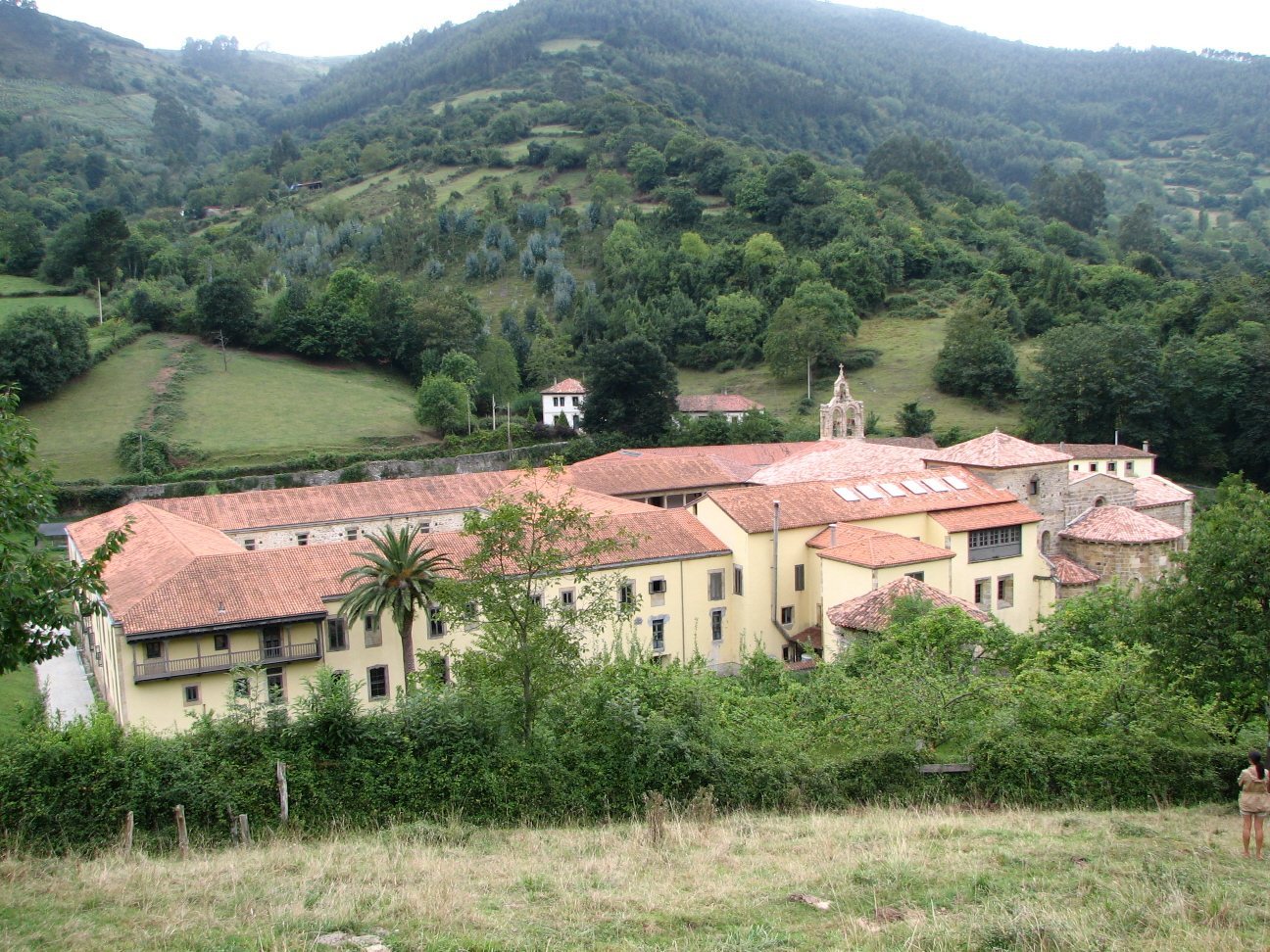
The complex stands in the Valdediós valley, in the parish of Puelles within the municipality of Villaviciosa. Its principal remains are the stone monastery church of Santa María de Valdediós, the monastic buildings and cloisters adjoining it, and the separate church of San Salvador de Valdediós, popularly known as “El Conventín.” Together they preserve medieval, Renaissance, and later architectural phases.
Churches of Valdediós
Monastery church of Santa María
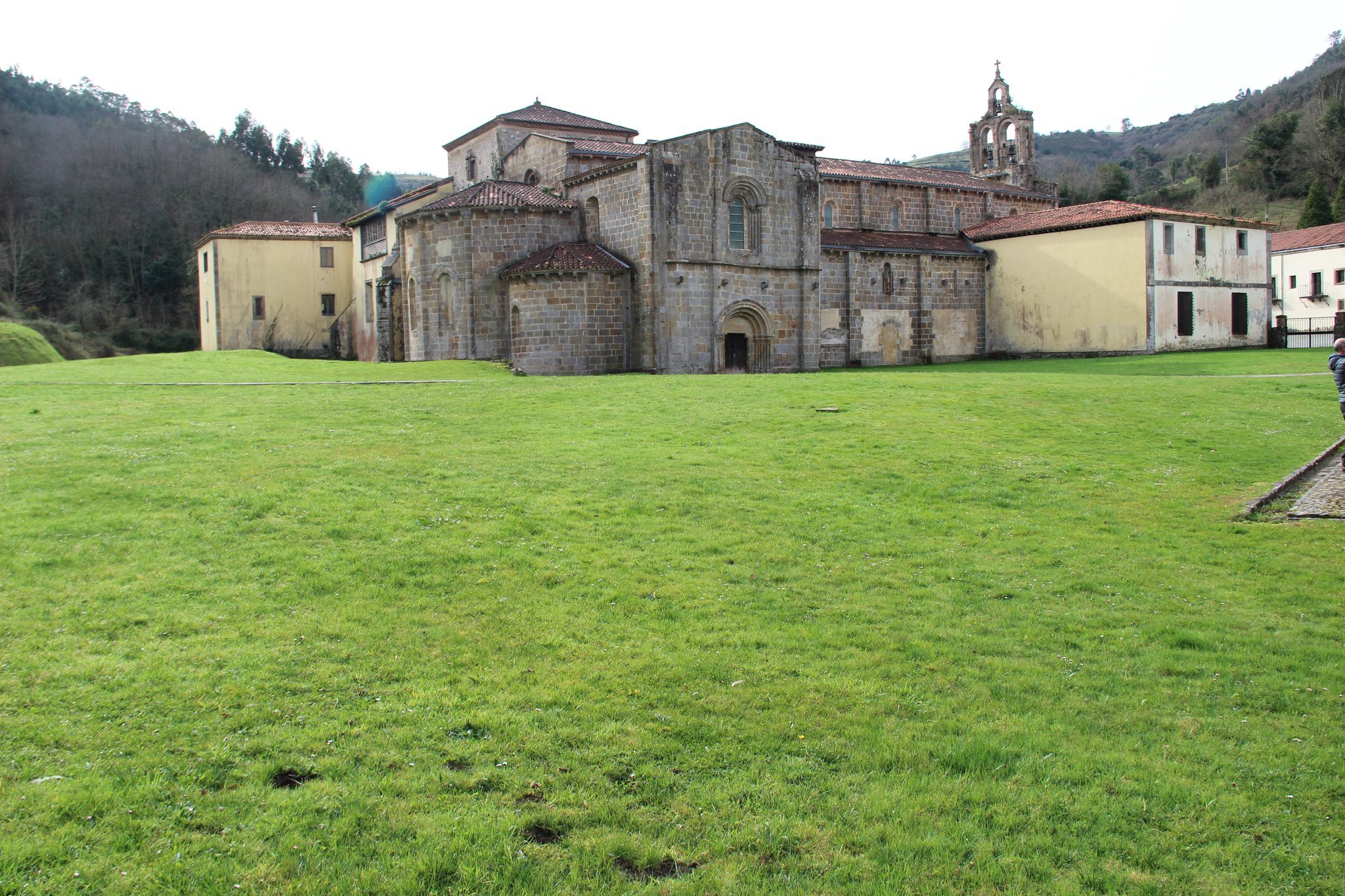
The monastery church is a stone building in the Spanish Gothic tradition, with a thirteenth-century design shaped by Cistercian practice. Begun in 1218 and completed around 1225, it has a cruciform plan, meaning that its layout forms a cross. The interior contains one main nave and two side aisles, while semicircular apses form the rounded ends of the eastern parts. A cross-ribbed vault, supported by intersecting ribs, covers the church, and a narthex, or entrance vestibule, stands at one end.
The church survived the flood of 1522 that destroyed the medieval cloister and surrounding buildings. Its furnishings include eighteenth-century elements, among them a Baroque organ. The church therefore combines its medieval Cistercian structure with later additions and furnishings.
San Salvador de Valdediós
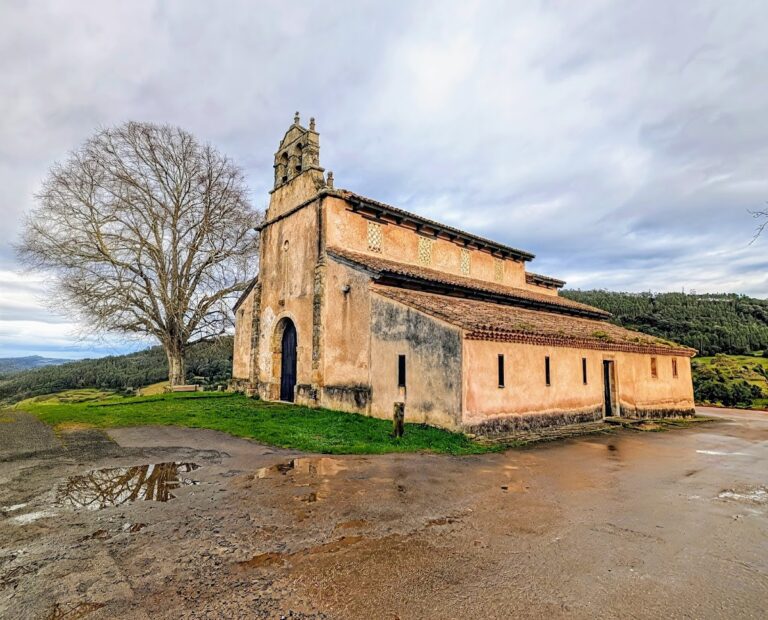
Adjacent to the monastery is San Salvador de Valdediós, a small pre-Romanesque church built by Alfonso III in the late ninth century. It is regarded as an important example of Asturian pre-Romanesque architecture and is described as exceptionally well preserved. Its presence preserves the earlier religious foundation that occupied the valley before the Cistercian monastery was established.
Cloister and monastic buildings
Renaissance cloister
The medieval cloister, a covered walkway surrounding an open courtyard and connecting the main parts of a monastery, was destroyed by the overflowing Valdediós River in 1522. It was replaced during the sixteenth-century rebuilding by a two-storey Renaissance cloister. An additional third storey was added in the eighteenth century.
Sacristy
The sacristy was built in the sixteenth century and has a net vault, a later vault pattern formed by a network of ribs. It belongs to the phase of reconstruction that followed the flood and forms part of the extensive group of associated monastic buildings.
The monastery and its associated structures underwent further restoration from 1986 onward. Their surviving fabric brings together the thirteenth-century church, the rebuilt Renaissance cloister, eighteenth-century additions, and the nearby ninth-century San Salvador church.