Santa Maria della Salute: Venice’s Baroque Votive Basilica
Site at a Glance
- Rating
- 4.7
- Popularity
- High
- Country
- Italy
- Primary era
- Early Modern
- External website
- Open
- Eras represented
- Early Modern
- Civilizations
- Venetian
- Site type
- Religious
- Remains
- Basilica
On this page23 sections
History
Santa Maria della Salute is a Roman Catholic votive church and minor basilica in Venice, Italy, built by the Venetian Republic in the Baroque period after the plague epidemic of 1630–31. Dedicated to the Virgin Mary, it was conceived as a thanksgiving offering for the city’s deliverance and became one of Venice’s most prominent religious landmarks.
The vow and foundation
On 22 October 1630, Patriarch Giovanni Tiepolo vowed to build a church to the Virgin of Health and to establish an annual thanksgiving visit by the doge, the elected head of the Venetian Republic, and the Senate, one of the republic’s principal governing bodies. The epidemic killed approximately 80,000 people in Venice and 600,000 across Venetian territories, including the doge and the patriarch. The Senate decreed the new church on the same day.
The site selected was Punta della Dogana, at the end of the Dorsoduro district, between the Grand Canal and the Giudecca Canal and opposite the Bacino di San Marco. Its position allowed processional access and created a visual and symbolic relationship with San Giorgio Maggiore, San Marco, and Il Redentore. The church was also intended to form a monumental termination for the palaces along the Grand Canal.
To clear the building site, the Church of the Holy Trinity, its convent, and its school were demolished. Eleven designs were submitted in a competition, and the Senate selected Baldassare Longhena, then thirty-four years old. Longhena was a Venetian Baroque architect who combined centralized plans with the classical vocabulary associated with Palladio. His project conceived the church as a crown dedicated to the Virgin Mary.
Construction and completion
Construction began in April 1631, and the church itself was formally begun on 9 November. The ground had to be reclaimed and strengthened before the building could rise. Tradition claimed that more than one million piles were driven into the soil, while documentary evidence records 110,700 piles.
The structure was nearly complete by 1653. The larger dome was built between 1654 and 1656, and the smaller dome followed after 1660. Interior, exterior, and decorative work continued through the seventeenth century. The church was completed in 1687 and solemnly blessed on 9 November by Patriarch Alvise Sagredo.
The altars and decoration developed over several decades. The Venetian council ordered paintings from the suppressed Santo Spirito monastery to be transferred to the church in 1656. The six side altars were completed between 1667 and 1674, while the main altar was made to Longhena’s design between 1670 and 1674. Further interior work continued from 1679 to 1681, and exterior decoration was still in progress in 1683.
Religious life and the plague tradition
The Somascan Fathers, members of a Catholic order founded by Saint Jerome Emiliani to assist orphans and the poor, administered the church. The adjoining seminary housed members of the order from 1670 to 1810.
On 21 November 1670, after the War of Candia, the Senate ordered the transfer of a Marian icon from Candia, the Venetian name for Heraklion. The war had been fought between Venice and the Ottoman Empire over Crete, which Venice ceded to the Ottoman Empire in the peace settlement. Francesco Morosini brought the icon to Venice as war booty, and it became associated with the city’s deliverance from plague.
The annual thanksgiving observance takes place on 21 November, the Feast of the Presentation of the Virgin. Venetians traditionally cross a temporary bridge from the area of San Marco to the basilica for prayer and thanksgiving. The ceremony remains one of Venice’s major religious festivals, and its traditional dish is castradina, prepared from mutton. The church’s dedication also led to the Virgin Mary being added to Venice’s list of patron saints, while many of its artworks refer to plague and deliverance.
Later status and conservation
Santa Maria della Salute became part of the parish of the Gesuati and is administered within the Patriarchate of Venice, the principal Roman Catholic ecclesiastical jurisdiction governing Venice. In May 1921, Pope Benedict XV raised the church to the rank of minor basilica.
Since its completion, interventions have principally involved maintenance and conservation, allowing the unified Baroque character of the building to remain largely intact. A fire in the adjacent seminary on 30 August 2010 damaged Titian’s David and Goliath in the sacristy. The low wrought-iron screen at the high altar commemorates the plague epidemic of 1831. The original arrangement of the altar area was completely open. The principal Marian icon occupies its present position from 21 November; its crown dates from 1922, and the painting was most recently restored in 1959.
Remains
Setting and exterior
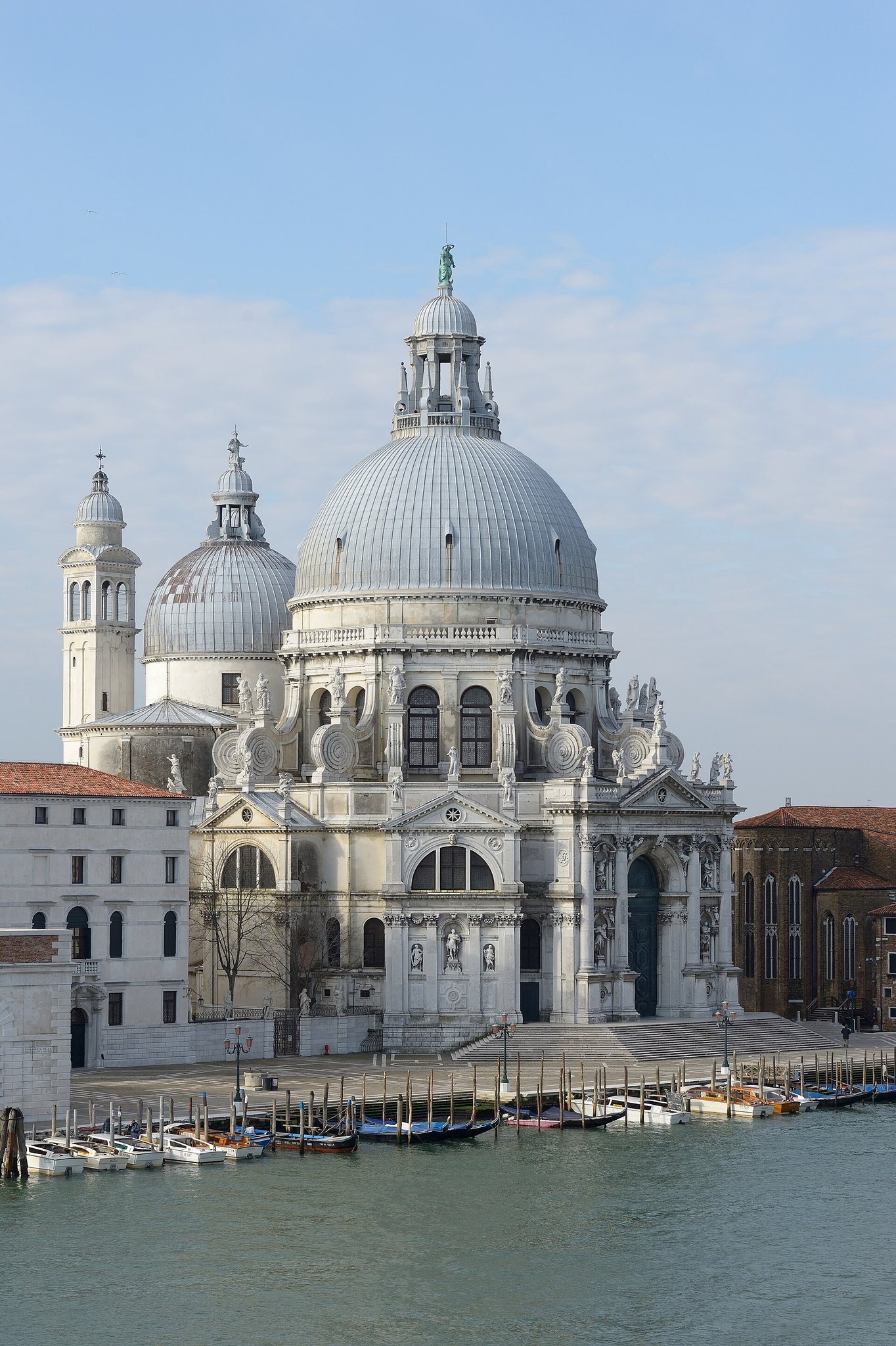
The basilica stands on a platform at Punta della Dogana, between the Grand Canal and the Giudecca Canal. Its position is visible from the Bacino di San Marco, the Grand Canal, the Giudecca Canal, the Campo della Salute, and the former land approach along the Rio Terà dei Catecumeni. A monumental fifteen-step stair rises from the surrounding ground to the elevated platform, while a second fifteen-step stair descends toward the Grand Canal, creating the visual impression that the church rises directly from the water.
Longhena’s Baroque design has clear references to Palladian architecture. The building consists of a central octagonal body, a smaller southern presbytery, two domes, six surrounding chapels, and two bell towers. It measures approximately 70 metres in length and 47 metres in width, or 76 metres by 54.5 metres when the monumental entrance stair is included. Its highest point is approximately 60 metres.
Main dome
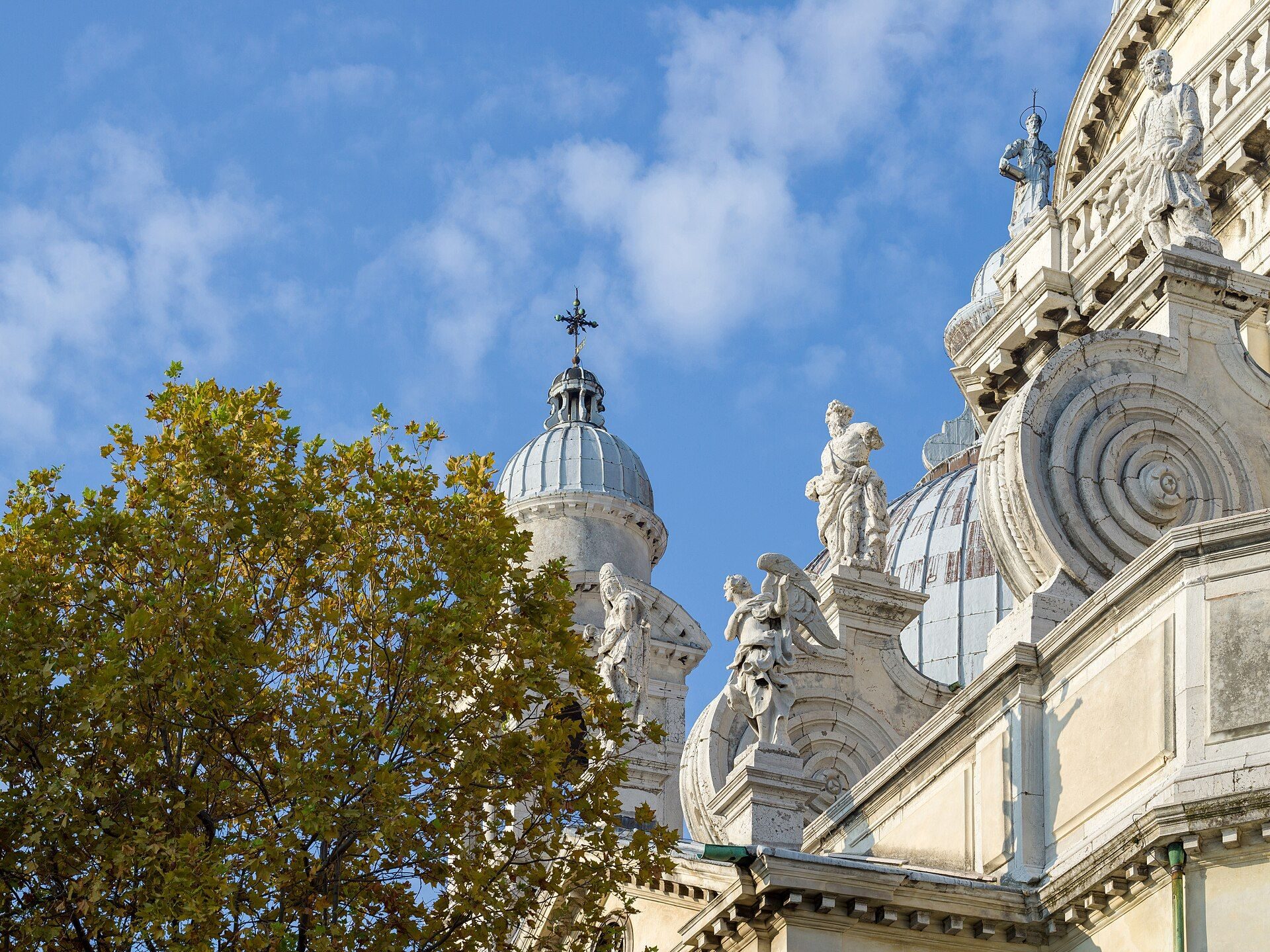
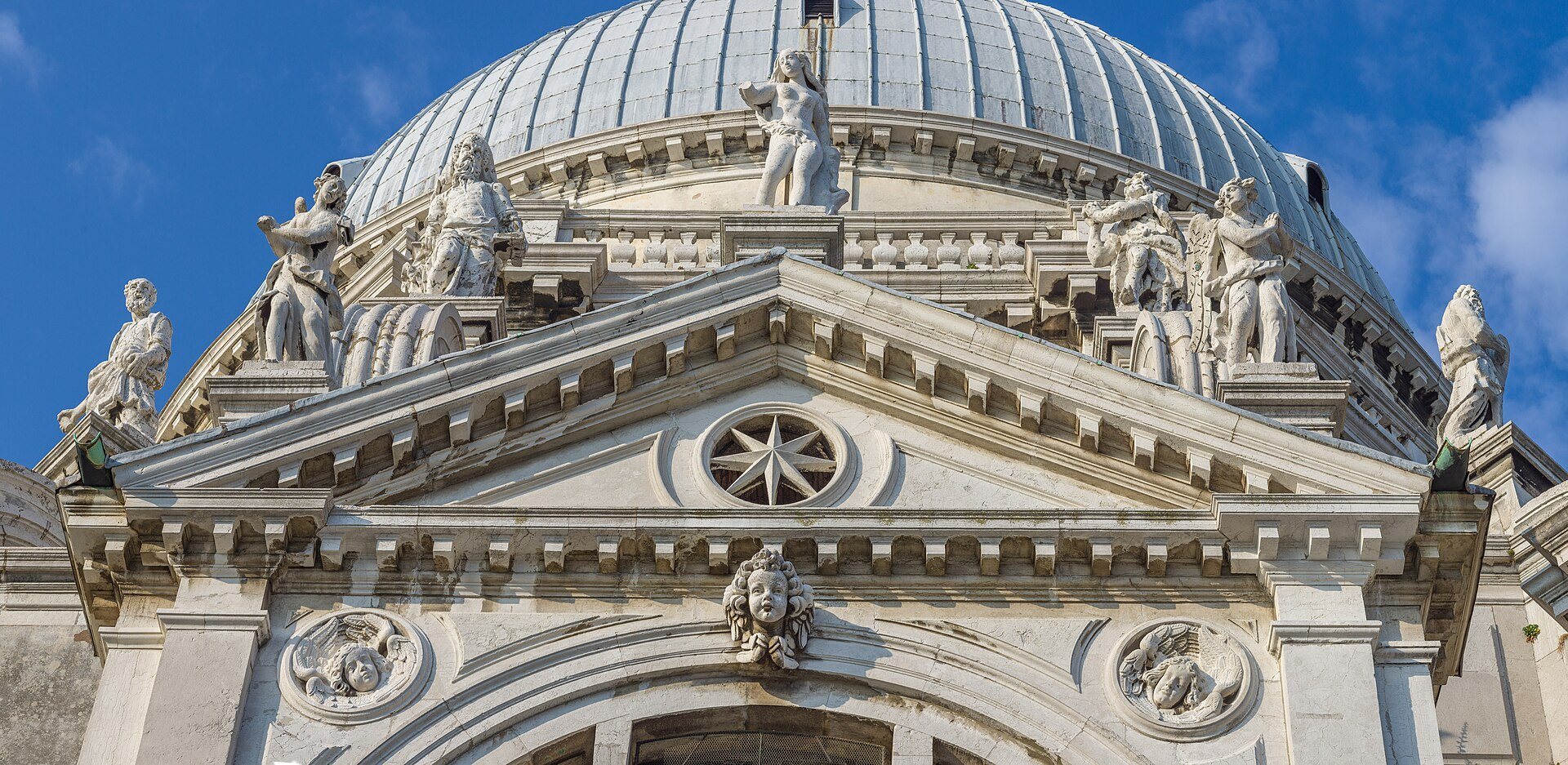
The larger central dome rises above a tall octagonal drum and has two shells. Its inner shell is made of brick and is almost pyramidal, while the outer shell is wooden and covered with lead sheets. An eight-obelisk lantern closes the dome and carries a statue of the Virgin Mary. Fifteen spiral-decorated, disk-shaped elements at the base of the drum function as buttresses, while the seven external fronts around the central octagon also help stabilize it. The eighth, southern side is occupied by the smaller presbytery.
Presbytery dome and bell towers
The smaller southern dome covers the presbytery and rises above its own tall drum and lantern. A statue of Saint Mark stands on the lantern facing the Basilica of San Marco, which traditionally preserves the saint’s remains. Two massive square bell towers, each approximately 46 metres high, flank the southern end of the church. Their arrangement recalls the bell towers of Palladio’s Il Redentore in Venice.
Façades and sculpture
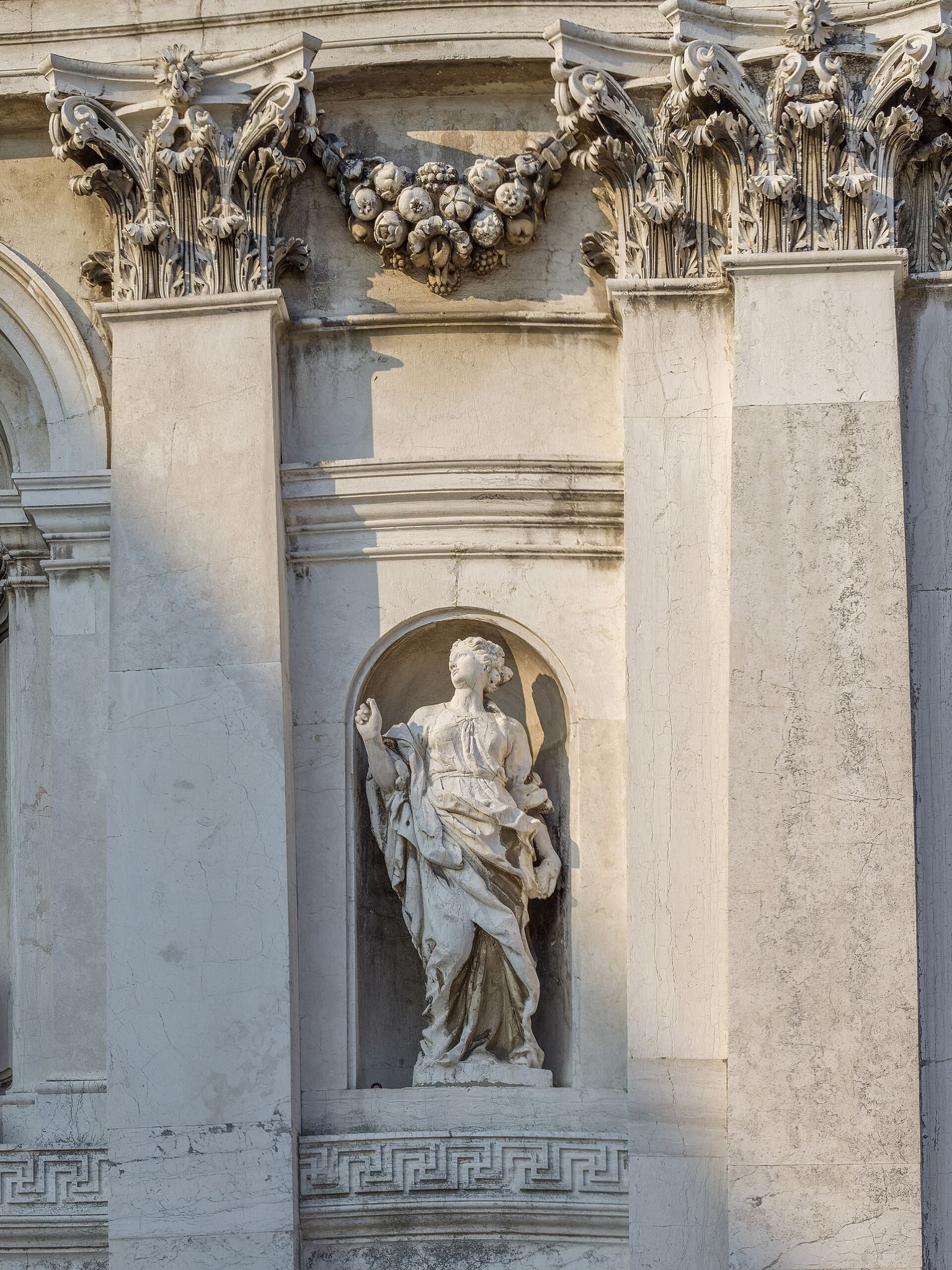
The exterior uses Istrian stone and brick surfaces finished with marmorino, a polished coating of lime and marble powder that gives masonry the appearance of marble. The exterior and interior together contain 148 marble sculptures, including 93 freestanding statues and 55 reliefs.
The main façade has four niches containing statues of the Evangelists made before 1660 by Tommaso Rues. Two sibyls holding open books stand above the entrance, with a Virgin and Child and four accompanying angels above them. The outer angels are probably by Michele Fabris, known as Ongaro, and the central angels by Bernardino Falcone. The entrance has a large double-leaf oak door covered with gilded bronze panels. A winged lion of Saint Mark formerly stood above it, but French occupying forces destroyed the statue in 1797.
Each side of the church has three façades corresponding to the interior side chapels. The façades nearest the main entrance are faced with Istrian marble, and all six carry pairs of angels and figures from the Old Testament. The right side includes Judith, Saint Theodore, Rebekah, and Ruth, while the left includes Eve, Saint George and the dragon, Esther, and Jael. The sculptures are associated principally with Francesco Cavrioli, Tommaso Rues, Michele Fabris, and Giovanni Bonazza. The present Eve is a 1967 copy. The original fell during the windstorm of 4 November 1966 and is now in the Ca’ d’Oro museum.
Spiral buttresses
Fourteen statues, each approximately 2.75 metres high and made around 1660, decorate the spiral buttresses. They represent Isaiah, David, Jeremiah, Daniel with a lion, Elisha, Micah, Zechariah, Moses with the tablets, Jael, Amos, Jonah, Ezekiel, and two unidentified prophets. Their individual attributions remain uncertain and rely principally on stylistic comparisons and fragmentary evidence.
Central interior and dome
The central interior is octagonal and surrounded by a ring of chapels and a processional ambulatory. The repeated octagonal forms have been interpreted in connection with Marian symbolism, including the eight-pointed star associated with Mary as Stella Maris, or Star of the Sea. The floor is covered with a carpet-like mosaic of polychrome marble. Concentric circles occupy the centre, while smaller circles and quadrilateral forms in the outer areas create an illusion of depth.
The main dome rises approximately 60 metres and has an interior diameter of about 21 to 21.55 metres. Its weight rests on eight structural columns. Beside them are slender Corinthian columns approximately 9.9 metres high on 4.4-metre bases. These are decorative and do not continue into the dome drum. Eight wooden statues of prophets stand around the base of the drum, holding inscribed parchment scrolls. They represent Hosea, Jeremiah, Daniel, Haggai, Isaiah, Simon, Ezekiel, and King David. Their makers are unidentified, although an association with Tommaso Rues’s workshop has been proposed.
Two Baroque holy-water stoups from the 1680s stand beside the entrance. One carries a small bronze figure of John the Baptist and the other a figure of Saint Mark. Four entrance niches contain statues of Saint Gerard, Blessed Giacomo Salomoni, Blessed Paolo Giustinian, and Saint Leone Bembo. The latter three were regarded as protectors of Venice against epidemics.
High altar and Marian icon
High altar
The high altar stands at the centre of the southern presbytery and is reached by three steps. It is octagonal, with angels at its corners serving as caryatids, sculpted figures used in place of columns or other supports. Reliefs of musical and singing putti decorate its base.
Above the altar is Venice Delivered from the Plague, made between 1670 and 1674 by the Flemish sculptor Juste Le Court. The group shows the Madonna and Child above a cloud with putti, a putto driving away the emaciated female personification of plague, and a kneeling female figure representing Venice. Saint Mark and Saint Lorenzo Giustiniani flank the altar.
Madonna of Health
The altar shelters a Byzantine Marian icon known as the Madonna of Health or Panagia Mesopantitissa, a name meaning “mediator of peace” or “mediator.” The image probably dates from the twelfth century, although parts were overpainted in the fifteenth century. It came from Candia, now Heraklion, and was placed in its present position on 21 November. Its crown dates from 1922.
Side altars and paintings
Six side altars were installed between 1667 and 1674. Each has an altarpiece between pairs of Corinthian columns, with reliefs of symbolic virtues on the column bases. Some of these reliefs have been attributed to Michele Fabris, though the attribution is uncertain.
Presentation and Assumption altars
The altar of the Presentation of Mary contains Luca Giordano’s 1674 painting of the Presentation of the Virgin in the Temple. Its base reliefs represent Temperance, Mystery, Wisdom, and Charity. The Assumption altar contains Giordano’s Assumption of the Virgin, produced in Naples and sent to Venice for approval. A 1767 statue of Saint Jerome Emiliani by Giovanni Maria Morlaiter stands before it. The reliefs at the base represent Charity, Justice, Hope, and Health.
Nativity and Annunciation altars
The altar of the Nativity of Mary contains Giordano’s 1674 painting of the Nativity. A small seven-part reliquary covered with gilded reliefs stands before it, while small bronze figures formerly placed above it are kept in a museum. The reliefs represent Providence, Abundance, Meditation, and Health.
The Annunciation altar has an altarpiece by Pietro Liberi, made before 1674. Its reliquary preserves relics of the martyrs Saint Justin and Saint Fabian. Reliefs on the base represent Glory, Innocence, Goodness, and probably Victory over the Plague.
Saint Anthony and Descent of the Holy Spirit altars
The altar of Saint Anthony of Padua contains Liberi’s 1665 painting, which shows Venice pleading and includes a distinctly Venetian palace detail in the background. Its base reliefs represent Charity, Faith, and Modesty.
The altar of the Descent of the Holy Spirit contains Titian’s painting from around 1546, made with the participation of his son Orazio. The Senate transferred it from the Santo Spirito monastery in 1656 together with twelve other paintings by Titian, now kept in the sacristy. Its reliquary is held by two angels, probably made by Michele Fabris or his workshop. The base reliefs represent Science, Intellect, Good Counsel, and Fortitude.
Choir and sacristy
Choir
The choir occupies the square-ended area behind the high altar. Its wall niches contain statues made between 1679 and 1681 depicting protectors against epidemics. Saint Roch and Saint Sebastian stand beneath the organ on the rear wall, and the statue of Saint Sebastian is probably by Orazio Marinai or his workshop.
The wooden choir stalls were made to Longhena’s design between 1679 and 1681. The upper row has 25 sections and the lower row 15. Some panels depict symbols associated with the arts and scenes from the Morean War. The choir ceiling once held eight paintings by Titian, which remained there until 1940 and are now kept in the sacristy. Statues of Saint Charles Borromeo and a blessed member of the Giustinian family stand beside the door leading from the choir to the sacristy.
Sacristy
The sacristy connects the church with the former seminary and preserves twelve paintings by Titian and one by Tintoretto, along with works by other artists. Titian’s early Saint Mark Enthroned with Saints Cosmas and Damian, Sebastian, and Roch dates from 1510 or 1512. The ceiling contains David and Goliath, Cain and Abel, and The Sacrifice of Isaac, made for the Santo Spirito monastery between 1542 and 1544. Eight circular paintings, or tondi, depict the four Evangelists and four Doctors of the Church.
Tintoretto’s Marriage at Cana, dated 1561, hangs on the right wall. It includes a self-portrait of the artist and portraits of contemporary men among the figures. The sacristy also contains Titian’s David and Goliath, which was damaged in the 2010 fire in the adjacent seminary.
Organ and bells
The basilica contains an organ built by Francesco Antonio Dacci in 1782–83 and modified by Giacomo Bazzani in 1819, 1825, and 1845. Its façade has 51 pipes in three groups of 17, together with two original keyboards, a 20-key pedalboard, and registers arranged on consoles beside the keyboards.
The right bell tower contains six bells cast by De Poli of Vittorio Veneto. Four large bells were cast in 1938 and two smaller bells in 1991.