Church of Saint Anthony of the Germans: A Baroque Church in Madrid
Site at a Glance
- Rating
- 4.6
- Popularity
- Medium
- Country
- Spain
- Primary era
- Early Modern
- External website
- Open
- Eras represented
- Early Modern
- Civilizations
- Spanish
- Site type
- Religious
- Remains
- Church
On this page17 sections
History
The Church of Saint Anthony of the Germans is a Baroque church in Madrid, Spain, founded in 1624 as the Church of Saint Anthony of the Portuguese. Designed by the Jesuit Pedro Sánchez during the reign of Philip IV, with a facade by Juan Gómez de Mora and contributions from Francisco Seseña, it was completed in 1633. The church formed part of an institution created to support Portuguese residents of Madrid and later became associated with German Catholics and the Brotherhood of the Refuge.
The Portuguese foundation
The institution behind the church began with the Brotherhood of Saint Anthony, created by royal order in 1604. It established its headquarters in Madrid in 1606 under the Council of Portugal, during the period when Portugal was governed by the Spanish Crown. The brotherhood provided religious support, mutual assistance, and charitable aid for Portuguese residents, while its activities also reached beyond that community.
The brotherhood was linked to the Hospital of Saint Anthony of the Portuguese, founded by Philip III in 1606. Hospital care associated with the institution was in operation by 1611. Internal problems, the construction of the church and a larger hospital, and the Portuguese revolt of 1640 disrupted the project and delayed the hospital’s full operation. When royal donations from Portuguese revenues were lost, the institution increasingly depended on charitable contributions from the Portuguese community in Madrid. The hospital consequently went through successive closures and reopenings.
The church was intended as the religious center of Madrid’s Portuguese community, although its priests and congregation were not exclusively Portuguese. Its connection with senior officials, followed by hostility toward Portuguese residents after the revolt of 1640, contributed to accusations of Judaism against members of the brotherhood. In hostile descriptions, the church was even called a synagogue.
From Portuguese to German associations
After Portugal became definitively independent in 1668, the brotherhood came under the Chamber of Castile. From 1689 it was associated with the German Catholic household guard of Queen Mariana of Neuburg, the second wife of Charles II. The church and hospital then acquired their present name, Saint Anthony of the Germans, while retaining their dedication to Saint Anthony of Padua.
Saint Anthony of Padua was a Portuguese Franciscan preacher and saint associated with miracles, charitable aid, and devotion to the poor. He was born in Lisbon, worked in France and Italy, and died in Padua in 1231. His continued presence as the church’s patron connected its later German and charitable associations with its original Portuguese identity.
In 1702, Philip V transferred the church and hospital to the Brotherhood of the Refuge, a Catholic charitable institution devoted to assisting people in poverty. The brotherhood became known for its bread-and-egg round, in which a priest and two lay brothers searched Madrid’s streets for people sleeping outdoors and offered them water, white bread, and a boiled egg. The institution’s charitable identity continues through dining rooms, schools, and residences.
The creation of the interior decoration
The church’s elaborate interior developed after the building itself. Several chapel paintings and the first high altarpiece were made during the first third of the seventeenth century, but the comprehensive fresco decoration began only in the second half of the century, after the building had stood for almost three decades with little interior decoration beyond its moldings.
Agostino Mitelli and Angelo Michele Colonna prepared the initial decorative designs after Velázquez recommended them to Philip IV. Mitelli died in 1660, and Colonna returned to Italy in 1662. Francisco Rizi, Juan Carreño de Miranda, and Luca Giordano then carried out the main program. The fresco cycle was completed approximately sixty-eight years after the church was built, bringing together painted architecture, sculpture, religious narrative, allegory, and royal imagery in a unified Baroque scheme.
Later history and continuing identity
The church and its associated buildings underwent interventions in the late nineteenth century and further restoration during the twentieth century. In 1973 the church was declared a Property of Cultural Interest under the official reference RI-51-0003915. The remains of the Castilian infantas Berenguela of Castile and Constance of Castile were transferred to the church’s crypt in 1869, after the demolition of the convent of Santo Domingo el Real in Madrid.
The church has retained its Catholic dedication to Saint Anthony of Padua through its successive Portuguese, German, and Brotherhood of the Refuge associations. The Brotherhood of the Refuge remains connected with the church, preserving the institution’s charitable identity alongside its religious and artistic heritage.
Remains
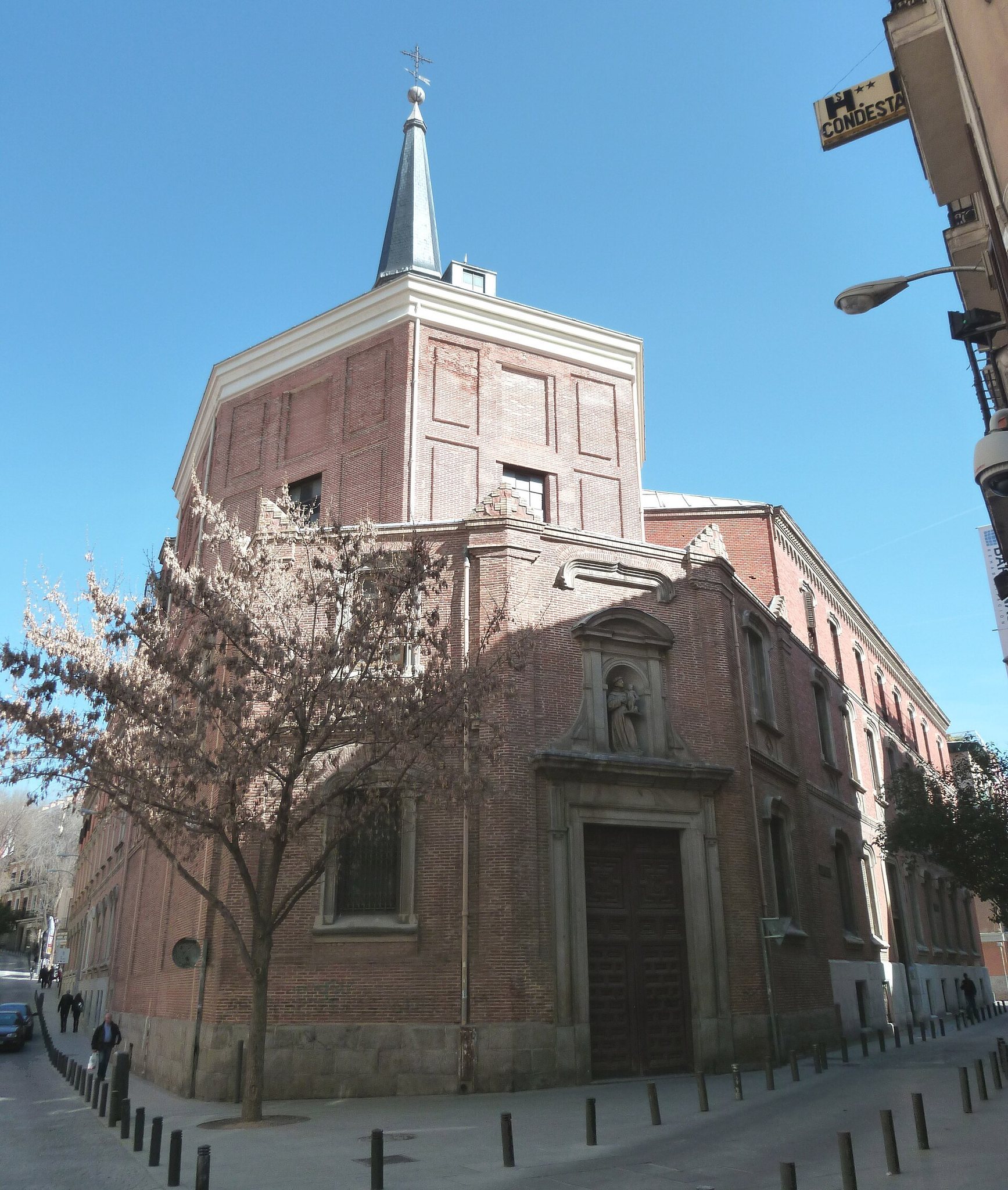
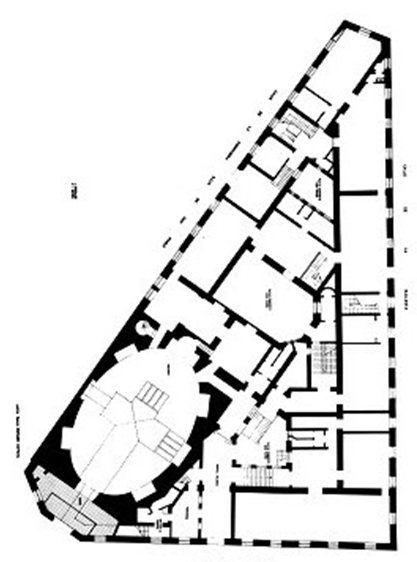
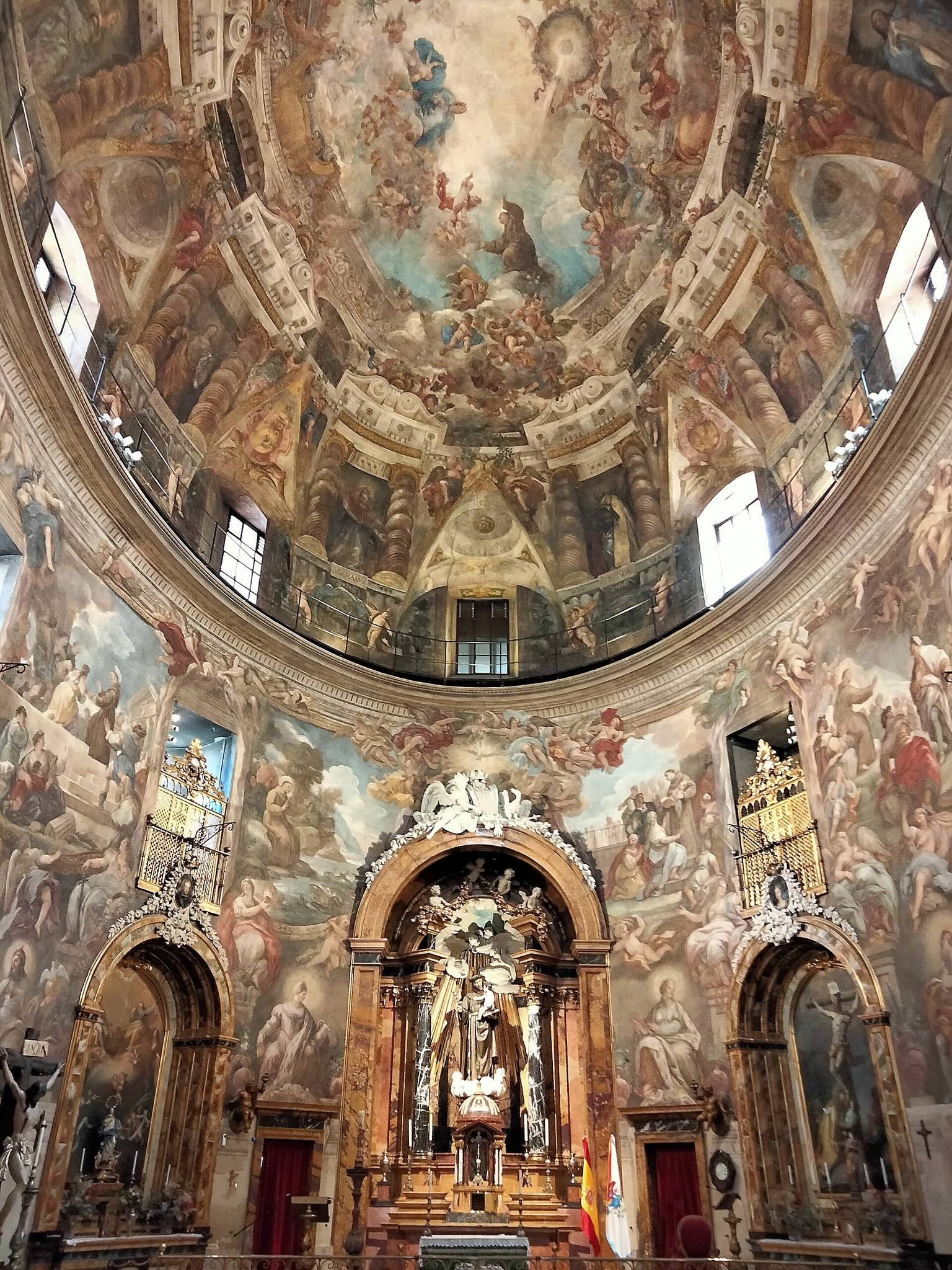
The church stands at the junction of Calle de la Puebla and Corredera Baja de San Pablo, with the former hospital extending toward Calle de la Ballesta. It is a small Baroque building organized around an elliptical plan, an unusual arrangement represented by only a few churches in Spain. A single nave follows the ellipse, while six side altars occupy semicircular arched niches around the unified interior.
Exterior and associated buildings
The exterior has a restrained appearance with post-Herrerian characteristics, including clear proportions, linear design, structural calm, and strongly marked horizontal lines. Exposed pinkish brick forms the outer walls. Granite and limestone from the Madrid mountains appear in the plinths, lintels, doors, and windows. The principal facade is crowned by a stone statue of Saint Anthony of Padua holding the Christ Child, made by Manuel Pereira.
The dome has an octagonal exterior form, a black slate covering, and an octagonal spire. Its structure is a lightweight framed dome, known as an encamonada dome, made with materials such as wood, brick, and plaster and concealed externally by the slate-covered spire. This economical construction permitted the interior to carry an extensive decorative program.
The former Hospital of the Brotherhood adjoins the church. It has a triangular plan and two floors, with walls extending from the church toward the triangle formed by Calle de la Puebla, Calle de la Ballesta, and Corredera Baja de San Pablo.
Painted dome and upper walls
The Apotheosis of Saint Anthony
The center of the dome contains the Apotheosis of Saint Anthony, in which the Portuguese saint rises toward heaven among angels. Carreño de Miranda painted the central scene, while Rizi created the illusionistic architectural base, or drum, with Solomonic columns and shell-shaped pediments. Rizi also painted Portuguese saints in the first ring of the dome.
Clouds, cherubs, and seraphim surround the central scene, while a painted Portuguese coat of arms appears above the entrance. Eight saints occupy illusionistic niches formed by twisted columns and triangular pediments with volutes. They are Saint Fructuosus, Saint Julia, Beatrice of Silva and Meneses, Blessed Amadeus of Portugal, Blessed Gonzalo of Amarante, Saint Sabina, Saint Irenaeus, and Pope Saint Damasus I. The first five figures are Portuguese ecclesiastical or religious figures, while the others represent saints of Late Antiquity.
Scenes and allegories
Giordano painted the curved walls in fresco with scenes from the life and miracles of Saint Anthony of Padua. The cycle includes the saint preaching to the fish at Rimini, restoring a severed foot, witnessing a mule kneel before the consecrated host, and revealing a dead man in a cart. Other scenes show a falsely blind man, the healing of a crippled boy, a storm that did not wet people attending a sermon, and a newborn child naming his father.
The wall paintings also include allegorical figures linked with Saint Anthony’s virtues or with meanings that remain uncertain. They include Christian Charity; figures interpreted as Peace and Penitence; Truth and Experience; Gentleness; Imitation; Catholic Faith and Charity; a woman trampling a seven-headed monster with a possibly related figure of Desire; and an unidentified woman trampling a man’s head.
Painted tapestries held by angels appear above the lower line of windows. A painted cornice beneath the scenes from Saint Anthony’s life divides the walls visually while preserving the continuous pictorial effect. In the lower wall areas, eight royal or saintly figures appear in richly emphasized clothing and with crowns, swords, and other attributes. They are Saint Edith of England, Saint Henry II, Saint Louis IX of France, Saint Stephen of Hungary, Saint Emeric of Hungary, Saint Hermenegild, Saint Ferdinand III of Castile, and Saint Cunegunda. Together, these figures represent rulers associated with the expansion of Christianity in Europe.
Chapels and altars
Side chapels
The six chapels each contain a painting and a small sculpture. Their paintings represent the Trinity, Saint Charles Borromeo, Saint Elizabeth of Portugal, Saint Engratia, Saint Anne with Saint Joachim and the Virgin as a child, and the Calvary. Eugenio Cajés painted Saint Elizabeth of Portugal in 1629, while Giordano painted Saint Anne, Saint Joachim, and the Virgin in 1694. The painter of the Trinity is unknown. Other associated works include Giordano’s Calvary and paintings of Saint Charles Borromeo, including a scene of the saint healing the sick attributed to Van Kessel or Giordano.
The small sculptures date from the eighteenth century and represent the Immaculate Conception, the Archangel Raphael with the fish, Saint Andrew with his cross, Saint Joseph with the Child, Our Lady of Mount Carmel, and Our Lady of Solitude dressed as a widow.
Royal portraits
Six royal portraits painted in 1702 hang above the chapel arches. They represent Philip V, Charles II, Philip III, Philip IV, Mariana of Neuburg, and Maria Luisa Gabriela of Savoy. The series was formerly attributed to Francisco Ignacio Ruiz de la Iglesia, while Nicolás de la Cuadra is identified as its painter. The portrait of Mariana of Austria may be by Ruiz de la Iglesia.
High altar
The original high altarpiece was commissioned from Juan Bautista Garrido in 1631 and included work by Vicente Carducho, Manuel Pereira, and Francisco de Pineda. Carducho’s paintings are now in the sacristy, and the original structure was later removed. The present high altar was made in 1765 by Miguel Fernández and Francisco Gutiérrez.
The present altar uses two dark-marble columns to support three levels of gilded lintels crowned by four cherubs. A white relief of angels and clouds with gilded rays forms the background for a sculpture of Saint Anthony with the Christ Child by Manuel Pereira. The altar replaced a Baroque retable removed during the Neoclassical period. Gray and white marble cover the floor, while green and brown marble appear in the chapel arches and entrance.
Crypt and interior furnishings
Burial crypt
A small brick crypt lies beneath the church. It has a flattened barrel vault, a small altar at the head, and niches on the opposite side. Patients who wished to be buried there were interred in the crypt. It contains the remains of Berenguela of Castile, daughter of Alfonso X and Violante of Aragon, and Constance of Castile, daughter of Ferdinand IV of Castile and Constance of Portugal. Since 2006, it has also contained a bronze statue of Saint Pedro Poveda by Pedro Requejo Novoa.
Woodwork and surviving paintings
The pulpit, confessionals, and wooden decoration of the entrance arch were made by the carpenter Francisco Javier Ugena and gilded by Manuel de Blas for the Marquis of Alcañices in 1780. The church preserves frescoes by Rizi, Carreño de Miranda, and Giordano, together with earlier works by Carducho and Cajés. These paintings, sculptures, and architectural elements form a continuous Baroque ensemble centered on Saint Anthony of Padua and the miracles associated with his life.