Church of Saint Nicholas in Klyoniki: An Orthodox Church in Moscow
Site at a Glance
- Rating
- 4.9
- Popularity
- Low
- Country
- Russia
- Primary era
- Early Modern
- External website
- Open
- Eras represented
- Early Modern, Modern
- Civilizations
- Russian
- Site type
- Religious
- Remains
- Church
On this page12 sections
History
The Church of Saint Nicholas in Klyoniki is an Orthodox church in Moscow, Russia, standing in the historic White City in the Basmanny District. Its documented history includes rebuilding from the seventeenth century onward, while a tradition attributes an earlier church on the site to Grand Prince Ivan III in 1468. The White City was Moscow’s central district within a fortified wall that no longer survives.
Early churches and seventeenth-century rebuilding
According to a tradition associated with Pyotr Sytin, Ivan III, also known as Ivan the Great, founded a votive Church of Saint Simeon the Stylite of the Wonderful Mountain after a major fire in 1468. The fire began in the White City but did not reach the Kremlin. Chronicles mention both the fire and the construction of such a church, but they do not identify its location, so the connection with the present site remains traditional.
The church does not appear on the Petrov Plan of 1597–1599 or the Godunov Plan of the early seventeenth century. It is shown on the Sigismund Plan of 1610. Documents from 1620 and an account book from 1625 refer to a Church of the Kazan Icon of the Mother of God at the site. A new stone church was built beside the older wooden church in 1657. After a new altar was established in the 1690s, the building was known as the Church of the Kazan Icon of the Mother of God and Saint Nicholas the Wonderworker.
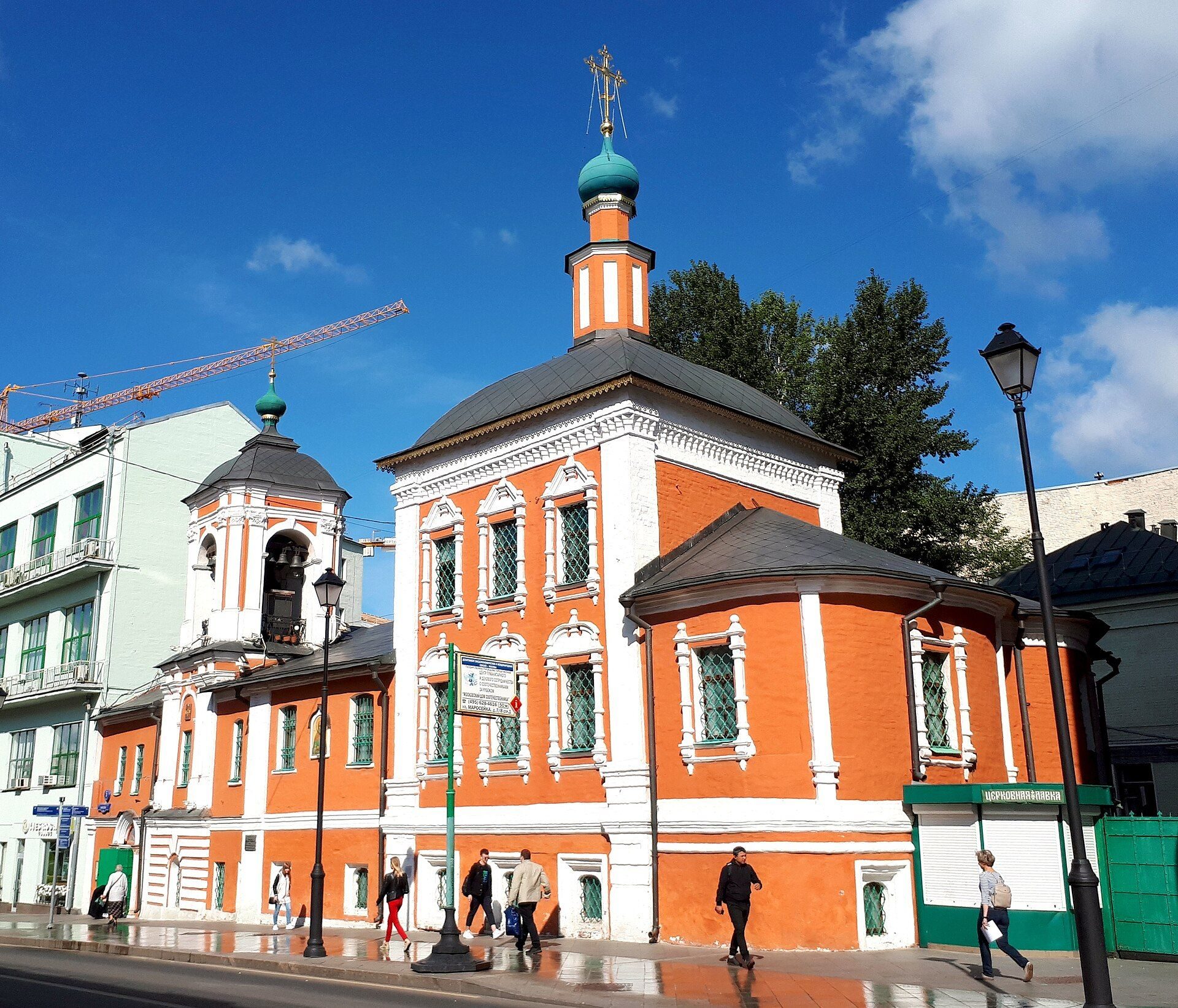
A major fire in 1701 led to a substantial reconstruction. The upper part of the principal structure was dismantled, while its lower portion became a basement level and was extended westward. This lower structure was incorporated into a taller two-light church, meaning a high interior lit by two tiers of windows, with an apse and vestibule. A new Kazan side chapel was added on the south, and a second storey was later built above it.
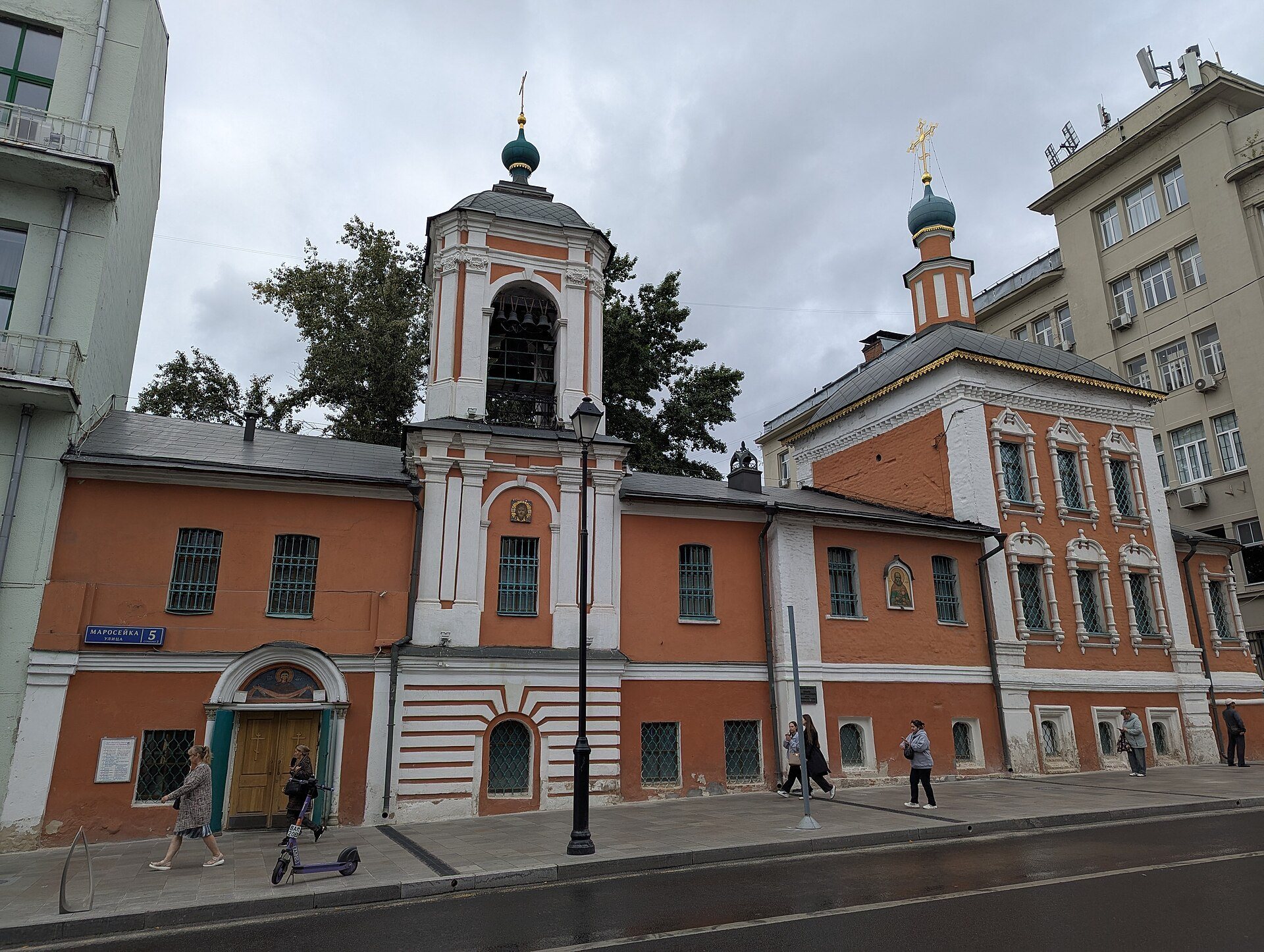
Another fire, in 1749, was followed by the construction of the existing bell tower and partial remodelling of the facades. The church was renewed again during the nineteenth century, with works recorded in 1868 and 1894. Rebuilding in the 1820s is also associated with the stage at which the church acquired its present form.
The name and the nineteenth-century parish
The church’s name changed through several forms. In 1657 it was described as being “at the grating,” while documents from 1689 and 1698 used “in Blinniki,” with the latter also referring to the Kazan church. The form “in Klinniki” appeared in 1701, and “in Klyoniki” became common during the eighteenth and nineteenth centuries. Some researchers reject the explanation that the name came from a maple grove. Other proposals connect it with pancake sellers, weapons workshops, or an apparition of Saint Nicholas’s icon in a village called Klyoniki.
From 1893 to 1923, the priest Alexei Mechev served as rector. He was a Russian Orthodox spiritual elder associated with parish-based religious renewal in Moscow and was canonized by the Russian Orthodox Church in 2000. His congregation included a lay community that sought to follow a monastic rule, and the church became a place where pilgrims sought guidance and prayer. A parish school operated there in the 1910s.
In 1914–1915, a small two-storey clergy house was built in the church courtyard with funds from the publisher Ivan Sytin. Its construction followed permission granted by Alexei Mechev for windows from Sytin’s adjacent apartment building to face the church courtyard.
Closure, restoration, and present religious status
After Alexei Mechev’s death in 1923, his son Sergius Mechev became rector. During the 1920s, icon painters worked at the church under the spiritual direction of Alexei and Sergius. The church was also associated with believers who did not commemorate Metropolitan Peter. In 1927, the architect and restorer Dmitry Sukhov reconstructed the window surrounds on the south side and on the lower church’s north side.
The church closed in the early 1930s, after the Feast of the Annunciation. Sergius Mechev had been arrested on 24 November 1929 and was later executed. The church and bell tower were stripped of their domes or heads. The building first served as a warehouse and later as the accounting office of the Central Committee of the Komsomol. Its sacred furnishings were destroyed during this period.
Icon painting resumed at the church in December 1989. Two icon-painting schools that worked in its workshop later provided the principal foundation for the icon-painting department opened in 1992 at Saint Tikhon’s Orthodox University. The church was returned to the Russian Orthodox Church on 18 July 1990 and consecrated on 17 December of that year. Domes, crosses, and the interior were restored, allowing regular services to resume.
The church was registered as a cultural monument in 1960 and is protected as a cultural-heritage monument of federal significance in the Russian Federation. It remains an active Orthodox church. Its rectors have included Alexei Mechev, Sergius Mechev, Alexander Kulikov, Nikolai Chernyshev, and Nikolai Vazhnov, who has served since 2011.
Remains
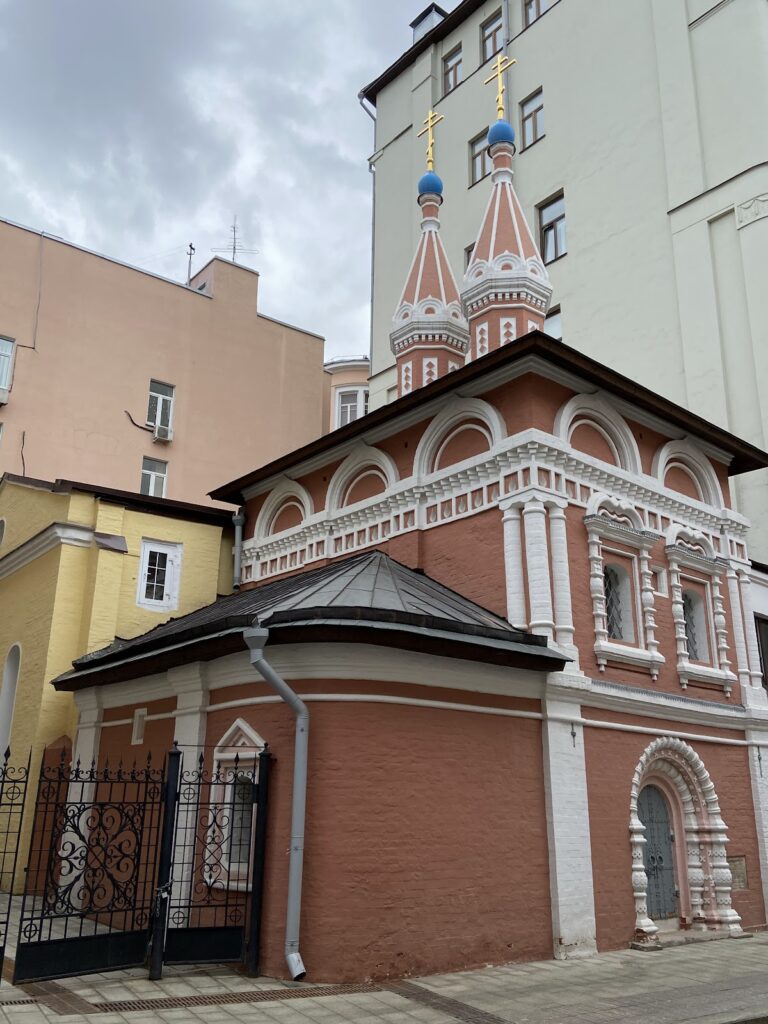
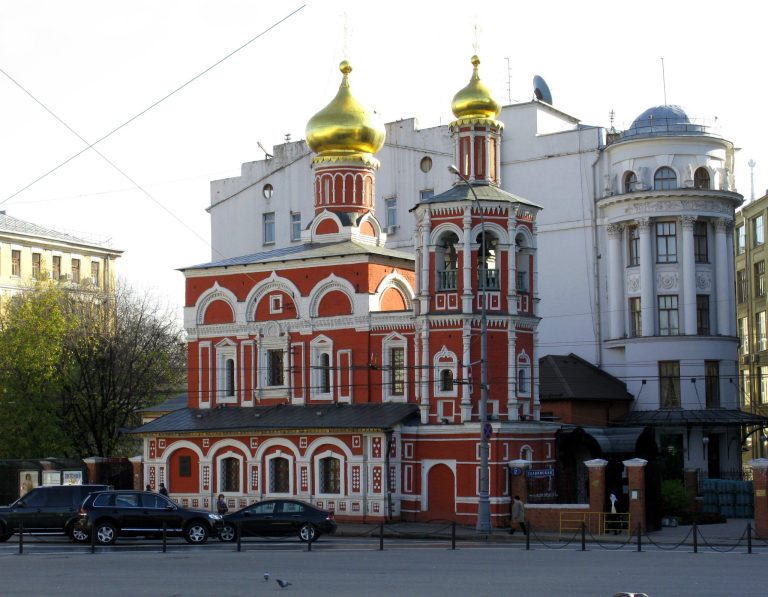
The surviving complex is a brick church with an upper church and a lower church, one bell tower, and a small two-storey clergy house in the courtyard. The main composition is an elongated two-light quadrangular body aligned along a north–south axis, with a two-part altar. A single-storey refectory connects the principal body with the bell tower, while a single-storey Saint Nicholas chapel adjoins the quadrangular body on the north.
Main church
Upper and lower churches
The rebuilding of 1701 created the high two-light volume above the enlarged lower portion of the earlier structure. The upper church contains chapels dedicated to Saint Nicholas of Myra and the Kazan Icon of the Mother of God. The lower church contains chapels dedicated to All Saints Who Shone Forth in the Russian Land and Righteous Alexei of Moscow. An architectural inventory describes the building as having a single nave and one iconostasis.
Western chamber
The western adjoining chamber retains wall painting from around 1701. Its decoration includes secular ornament and depictions of trees, preserving part of the artistic treatment associated with the rebuilding after the 1701 fire.
Bell tower and side chapel
The bell tower was built after the fire of 1749 and forms part of the later composition. The southern Kazan chapel belongs to the rebuilding that followed the 1701 fire, while its second storey was added subsequently. The church’s heads and crosses were restored after the building returned to Orthodox use.
Religious furnishings and associated building
Relics and icons
The lower church includes a designated space for the relics of Righteous Alexei Mechev. The church venerates a copy of the Feodorovskaya Icon of the Mother of God and an icon of All Saints of the Russian Land. It also preserves icons containing particles of the relics of Saints Sergius of Radonezh and Theodosius of Totma. Before the twentieth-century closure, the interior retained some old icons and books.
Clergy house
The small two-storey clergy house built in 1914–1915 stands within the church courtyard and forms part of the surviving church complex. Its construction was financed by Ivan Sytin after an agreement concerning windows from his neighbouring apartment building.