Epiphany Monastery: A Medieval Orthodox Monastery in Moscow
Site at a Glance
- Popularity
- High
- Country
- Russia
- Primary era
- Early Modern
- Eras represented
- Early Modern, Modern
- Civilizations
- Russian
- Site type
- Religious
- Remains
- Monastery
On this page15 sections
History
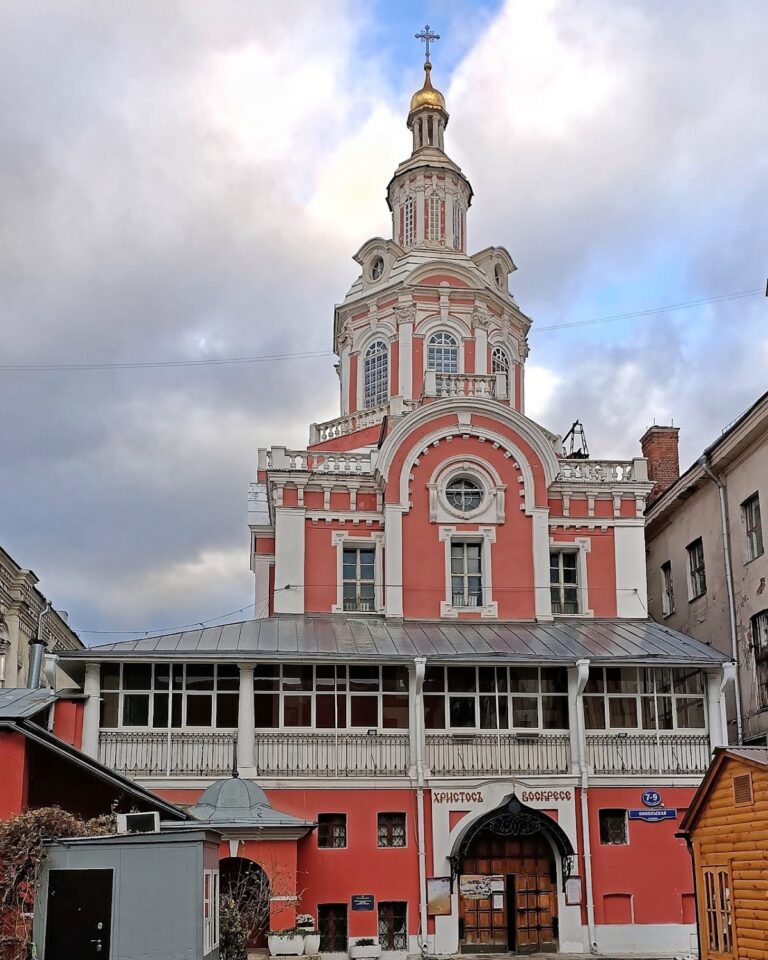
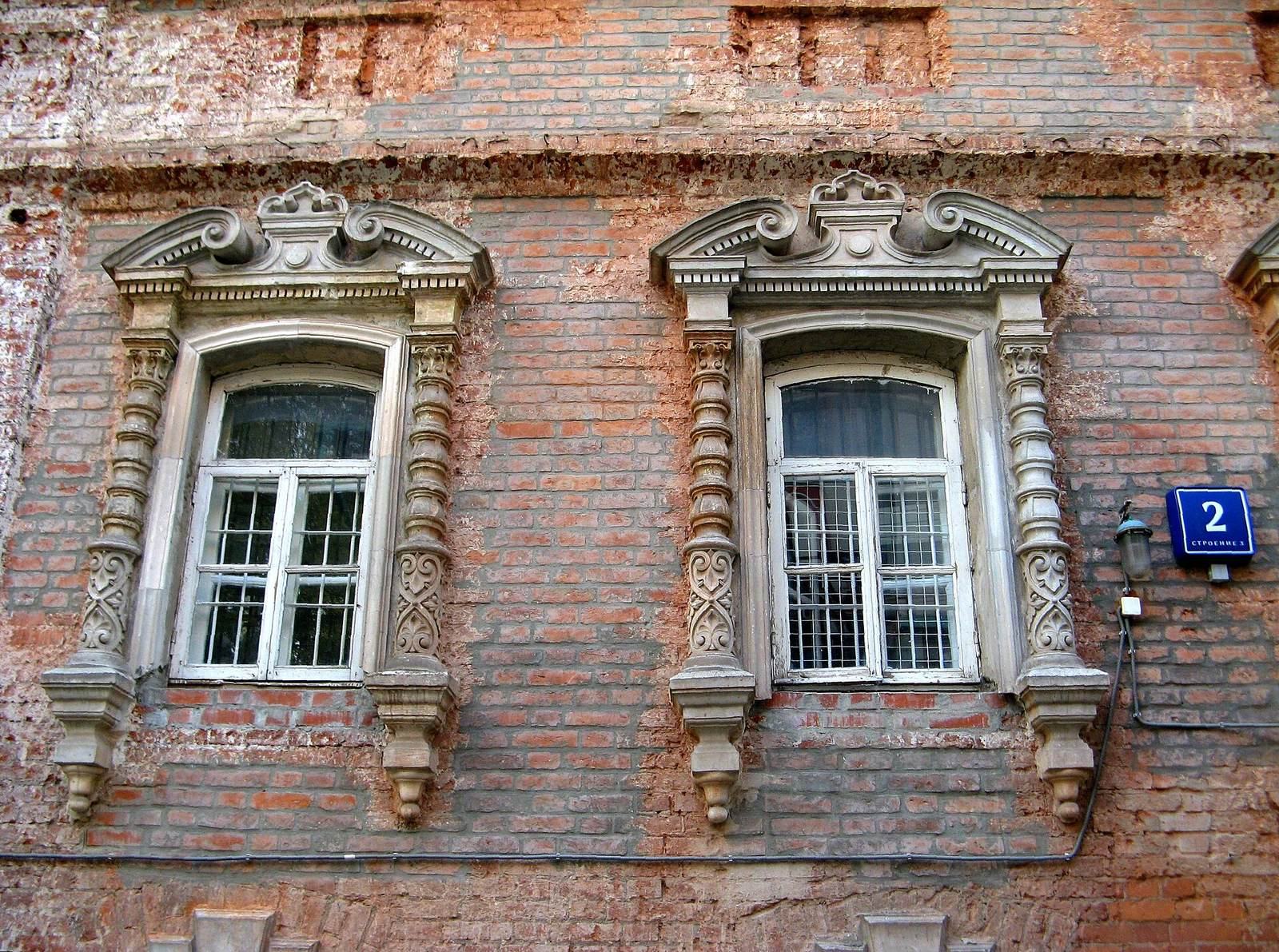
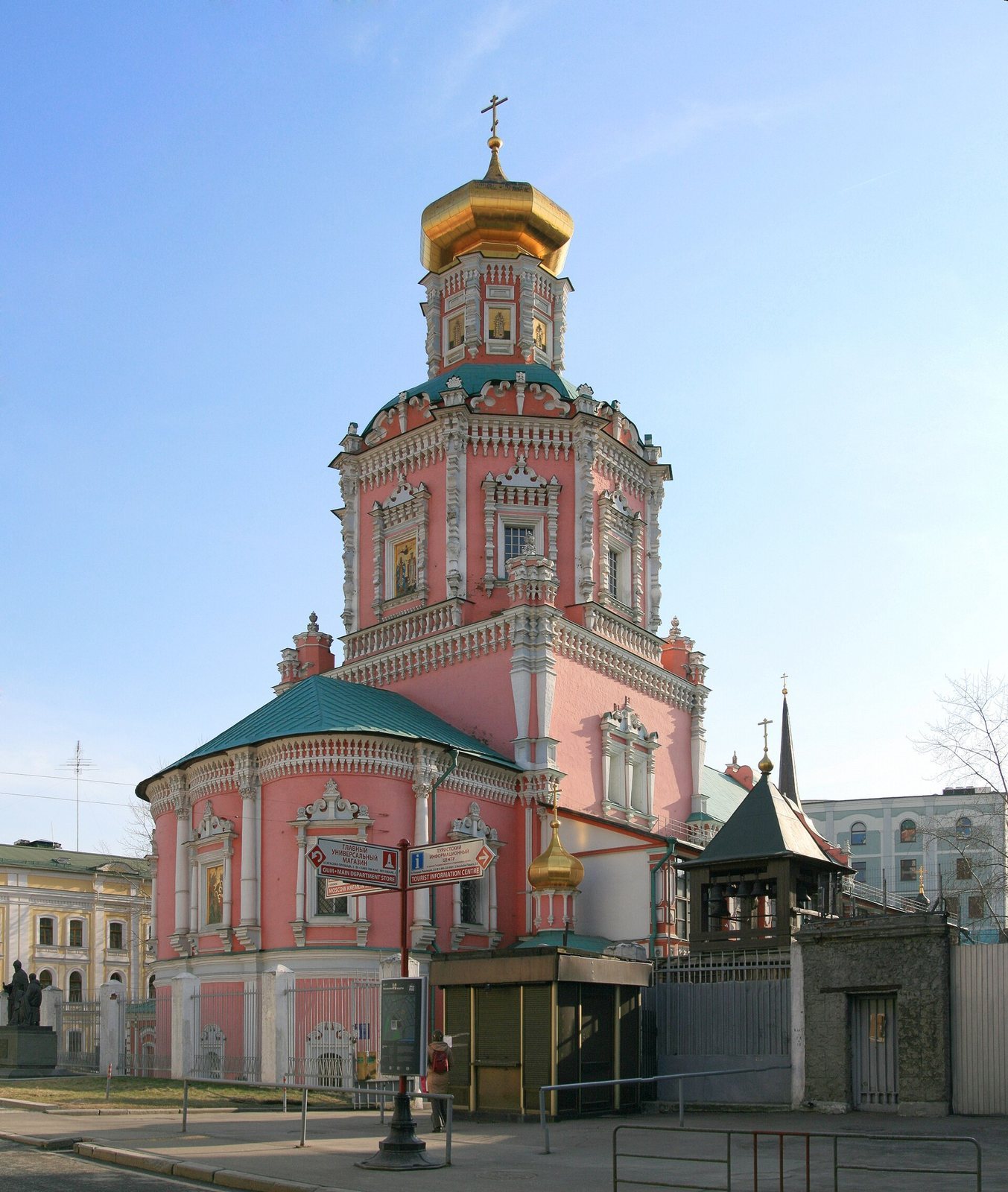
The Epiphany Monastery was a men’s Orthodox monastery in the Kitai-gorod district of Moscow, Russia. Tradition attributes its foundation in the late thirteenth century to Prince Daniel of Moscow, and it was regarded as one of the city’s oldest monasteries. Its surviving cathedral reflects the late-seventeenth-century Naryshkin Baroque, a Russian architectural style known for elaborate decoration.
Foundation and medieval history
Church tradition names Stefan, the elder brother of Sergius of Radonezh, among the monastery’s abbots. Alexis, a leading Orthodox church figure who later became a metropolitan, took monastic vows there in 1313 and is also associated with an extended stay at the monastery. Its head was among the earliest in Moscow to receive the title of archimandrite, a senior monastic rank.
The first cathedral was made of wood and was replaced by a stone building in 1342, with funding from a boyar. Tokhtamysh, a khan of the Golden Horde, a Mongol-Turkic state, sacked the monastery in 1382. An outbreak of pestilence followed in 1427. In 1451, an invasion led by the Horde prince Mazovsha caused a fire and extensive damage. Vasily II supported the monastery’s restoration, and a refectory was added under Ivan III.
Royal patronage, conflict, and rebuilding
The monastery received land and other support from rulers and noble families. Vasily III, Ivan the Terrible, Boris Godunov, and the Romodanovsky boyars donated estates, while Xenia Repnina gave it a courtyard. By the late sixteenth century it had also acquired several courtyards at Kolomenskoye. Ivan the Terrible used the monastery as a collection point for rents, dues, and fodder. A 1584 gift paid for commemorations for people who had fallen from favor, and in 1632 the monastery received an exemption from taxes on specified quantities of building materials and firewood carried by water.
Fires damaged the monastery in 1547 and 1551. It was repaired in 1571, after the Crimean Khanate ruler Devlet Giray led a campaign against Moscow. During the Time of Troubles, a period of political crisis and dynastic instability in Russia around the turn of the seventeenth century, fighting for Kitai-gorod in 1611–12 left the monastery looted and burned. A new stone cathedral was built in 1624 under Tsar Mikhail Fedorovich, the first ruler of the Romanov dynasty.
The school and the late-seventeenth-century monastery
A school opened at the monastery in 1685 under the direction of the Greek Orthodox educators known as the Likhud brothers. Its pupils came from both ordinary households and the aristocracy, and their studies lasted about fifteen years. Enrollment exceeded 180 within two years. In 1687 the school joined the institution established by the monk and educator Simeon Polotsky and moved to neighboring Zaikonospassky Monastery. It developed into the Slavic-Greek-Latin Academy, an important Moscow institution of higher learning, and later became the Moscow Theological Academy.
After a fire in 1686, the monastery underwent rebuilding. New monastic cells were completed in 1692, and construction of a cathedral followed with the blessing of Patriarch Adrian. Tsaritsa Natalia Naryshkina, the mother of Peter I, and the princely families of Golitsyn and Dolgorukov provided funds. The lower church was consecrated to the Kazan icon of the Mother of God in 1693, and the upper church to the Theophany in 1696. The Theophany is the Christian feast commemorating Jesus’s baptism. The monastery’s revered Kazan icon had been carried by the militia led by Minin and Pozharsky during the Time of Troubles before it was transferred to the cathedral.
Eighteenth- and nineteenth-century changes
A fire in 1737 damaged the monastery, whose buildings were subsequently restored. Monastery lands were secularized in 1764, meaning that they passed from church ownership to state control. In 1744 the community had 216 peasant households and 1,014 peasants; after the transfer of its lands, the number of monks rarely exceeded 17. In 1788 the monastery became the residence of a vicar bishop, a bishop serving under the authority of the diocesan bishop. From 1865, vicar bishops administered it. In the late eighteenth century, rooms in the buildings around the monastery were rented to haberdashers.
Before French forces entered Moscow during Napoleon’s 1812 invasion, the archimandrite evacuated the monastery’s sacristy, a room for church vestments and sacred objects. Other valuables were concealed in a church wall. During the French retreat, an explosion in an attempt to destroy the Kremlin damaged the cathedral: fragments pierced its brick roof, its windows broke, and the bell-tower cross bent. Repairs were followed by reconsecration in 1813.
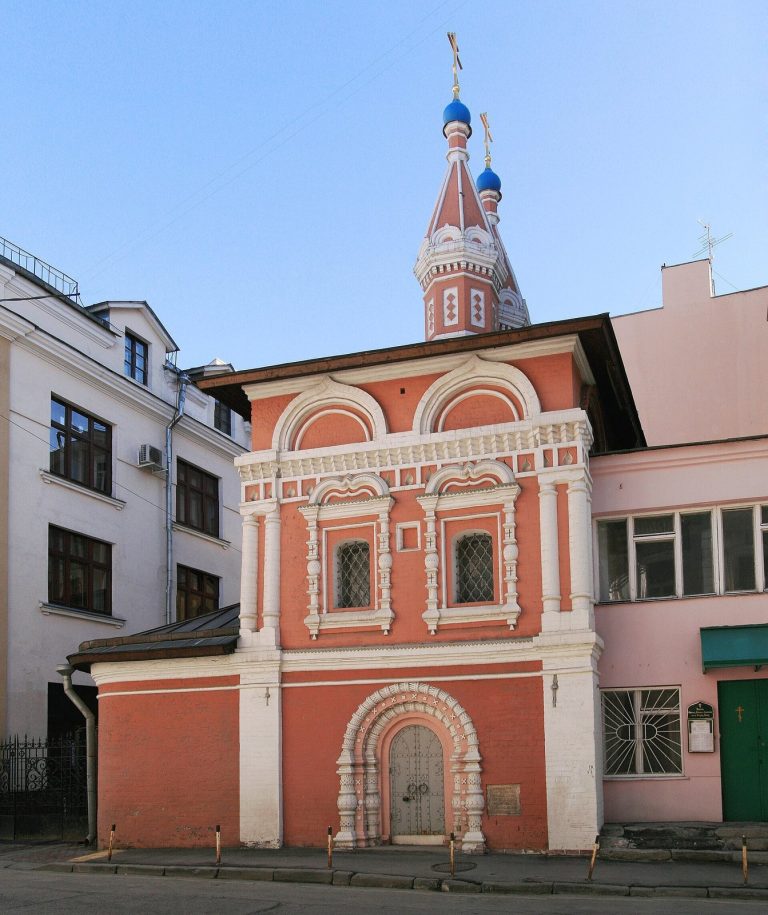
In 1867, sacred objects brought from the Russian Panteleimon Monastery on Mount Athos were displayed for veneration in the cathedral. They included the icon of the Mother of God known as “Quick to Hear,” relics of Saints Panteleimon and Tryphon and other martyrs, a cross holding a fragment of the Life-giving Cross, and a stone fragment from the Holy Sepulchre. In 1905, the seventeenth-century gate church of the Nativity of John the Baptist was demolished despite protests from the Moscow Archaeological Society. A revenue-earning building took its place in 1905–09, and a chapel with the same dedication was established in the cathedral.
Revolution, closure, and return of the cathedral
After the February Revolution of 1917, a bishop appointed to administer the Moscow Diocese lived at the monastery. It was formally closed in 1919, although its parish community continued to worship there. Church valuables were confiscated in 1922 for famine relief, and the residents were expelled before the monastery was dissolved in 1929.
Following the expulsion, the bell tower, a seventeenth-century tower in the enclosure, the Alexius chapel, and other structures were dismantled. Monastery rooms served at different times as a flour warehouse, a dormitory for Mining Academy students, accommodation for subway-construction workers, and an industrial works. After the Second World War, an administrative building for the People’s Commissariat for Internal Affairs was erected on the grounds. In 1941, a shot-down German aircraft crashed beside the monastery. Buildings at the crash site were destroyed, and the blast damaged the cathedral’s upper part and dome.
The cathedral was transferred to the State Academic Russian Choir named after Sveshnikov in 1982, and a scientific restoration project was prepared. It returned to the Russian Orthodox Church in 1991, when services resumed, but the monastery itself was not re-established. The cathedral was affiliated with two other churches in 1993 and a chapel in 1994. A teachers’ seminary opened at the monastery in 1995 and later became a regent-choral seminary, which operated until 2012. The former monastery holds federal-level cultural heritage status in Russia.
Remains
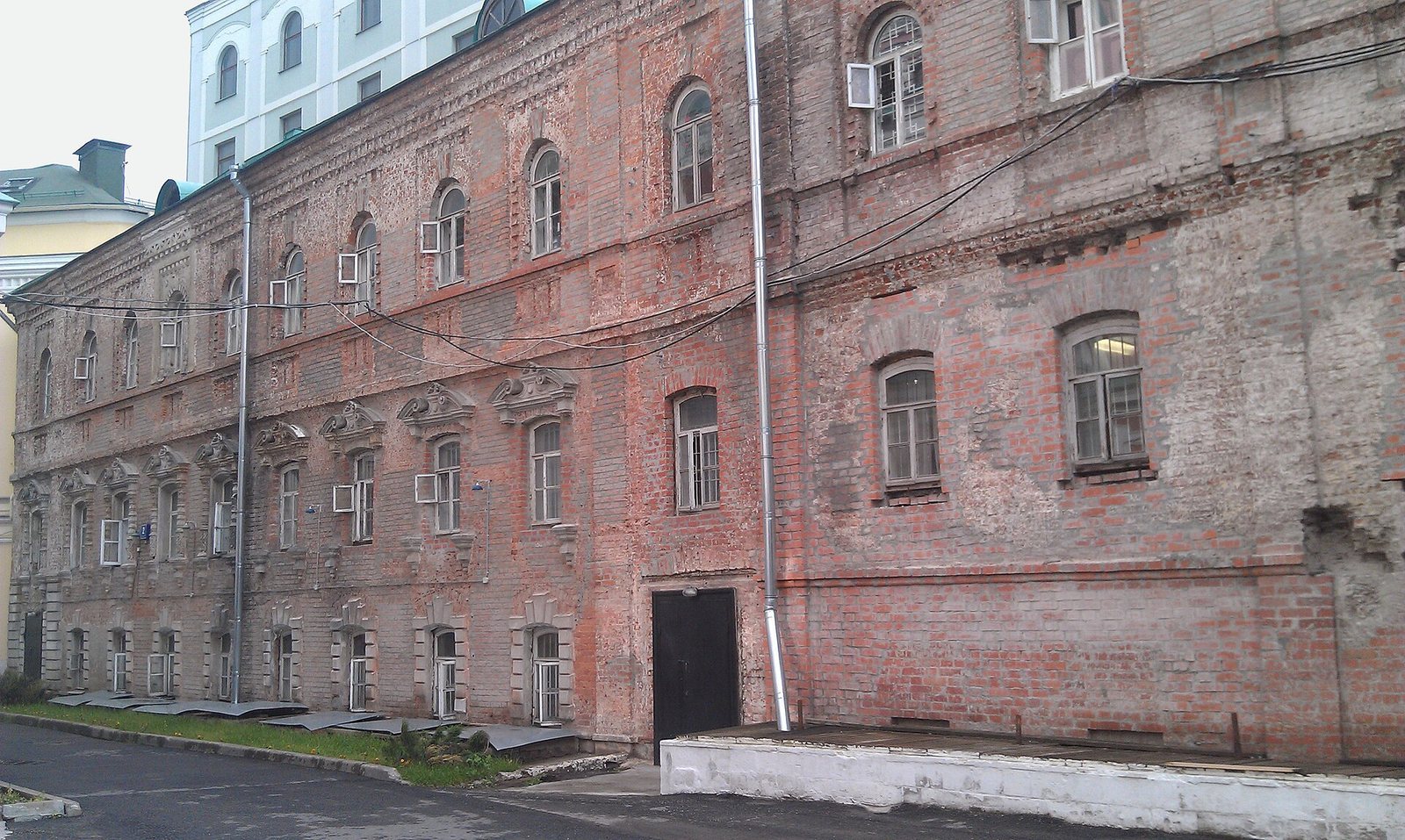
The monastery grounds were divided into a southern area with the cathedral, the abbot’s chambers, and monks’ cells, and a northern area for service buildings. Stables, a forge, and spaces for rent also formed part of the complex. By 2018, the surviving monastic buildings included the cathedral, the brotherhood building, and the abbot’s chambers. The grounds had contracted by about three-quarters from their eighteenth-century extent.
Buildings and chapels
Theophany Cathedral
The cathedral is a two-storey building. Part of the 1624 structure survives in its lower church, where arches on the lower level were later blocked. The Kazan icon of the Mother of God gives the lower church its dedication, while the upper church is dedicated to the Theophany.
Side chapels
The cathedral’s side chapels were dedicated to Saint George, the Apostle James son of Alphaeus, Saint Panteleimon, and, later, Theodosius of Chernigov. The Saint George chapel was established in 1747, and the chapel to James in 1754. The latter was subsequently used as a sacristy and, around 1900, consecrated to Theodosius. A chapel to Saint Panteleimon was established in 1873. The Alexius chapel underwent substantial alteration in the nineteenth century and was later demolished; during restoration, it was reconstructed according to a hypothesis about its original appearance.
Gate churches and towers
A gate church dedicated to Boris and Gleb, with a bell tower, had been built by 1742. A chapel in the bell-tower building was dedicated to Boris and Gleb in 1739, then rededicated to the Savior Not Made by Hands. Early memorial liturgies were held there in summer. The bell tower and the seventeenth-century enclosure tower were later dismantled. On Nikolskaya Street, the gate church of the Nativity of John the Baptist stood on a courtyard donated in 1672. Following its demolition, a revenue-earning building was constructed on the same site in 1905–09. The associated Athonite chapel was dedicated to Saint Panteleimon the Healer and was also on Nikolskaya Street.
Burials and memorial sculpture
Burial ground
The lower church contained a burial ground with about 150 interments, including members of the Golitsyn, Sheremetev, Dolgorukov, Saltykov, Romodanovsky, and Repnin families. Memorials honored Mikhail Golitsyn, the general-in-chief Grigory Yusupov and general-in-chief Alexander Menshikov, and Senator Alexei Golitsyn. French sculptor Jean-Antoine Houdon made the tomb of Field Marshal Mikhail Golitsyn in 1765.
Tombs and transferred monuments
Many eighteenth-century wall tombs used shallow, decorative carving with ribbons, garlands, bouquets, drapery, and personified figures. A grave monument from the fourteenth century for the boyar Fyodor Byakont was installed in the early nineteenth century in place of a worn monument. Burials at the monastery were plundered in the 1930s. Selected monuments, including Houdon’s tomb for Mikhail Golitsyn and the monument to Byakont, were moved to Donskoy Monastery, and some removals resulted in losses.
Memorial to the Likhud brothers
A bronze monument to the Likhud brothers was installed beside the cathedral in 2007.