Pirunlinna: A Viking-Age Hillfort in Finland
Site at a Glance
- Rating
- 4.5
- Popularity
- Very Low
- Country
- Finland
- Primary era
- Medieval
- Eras represented
- Medieval
- Civilizations
- Unclassified
- Site type
- Military
- Remains
- Fort
On this page7 sections
History
Pirunlinna is a hillfort in Lempäälä, Finland, apparently used during the Viking Age and later prehistoric period, broadly between AD 700 and 1300. Its elevated position and stone defenses made it a suitable fortified place, although the original purpose of the site was eventually forgotten. Some interpretations connect Pirunlinna with an ancient chain of hillforts centered on Rapola Castle at Sääksmäki. The proposed network also included Siuro Hillfort, Valkkinen in Vesilahti, Tenhola in Hattula, Aulanko, Linnanpää in Vanaja, Mantereenlinna, Hakoisten Hillfort, and Unikkolinna in Janakkala.
Traditions and Later Use
Once the hillfort’s earlier function had faded from local memory, tradition attributed its construction and occupation to devils. This belief gave both the hillfort and its cave their names. The cave is known as Pirunpesä, meaning “Devil’s Nest,” and also as Pirunkirkko, or “Devil’s Church.”
The site appears to have remained useful as a position in modern times. A hearth and other traces of fire use were found on the summit. A description published by the parish pastor Edner in the 1750s also states that a well still existed at the eastern end of the hillfort. Before the water level of Linnajärvi was lowered, the lake reached the foot of the hill, placing the fortified height beside a larger body of water than is present today.
Archaeological Investigations
Nils Cleve carried out Pirunlinna’s only archaeological excavation in 1929 after learning that a Stone Age flint arrowhead had been found in the cave. He recovered seven more arrowheads made from flint, a hard stone shaped into projectile points. Cleve did not regard the cave as a settlement and apparently understood it as a shelter for travelers. The cave has also been interpreted more generally as a place used for longer-term shelter. Ville Luho examined the site more superficially in 1940, followed by Marja Sipilä in 1994. In that same year, the hill was cleared under the direction of Olli Soininen to improve visibility.
Remains
Hilltop Defenses
Ramparts and Gates
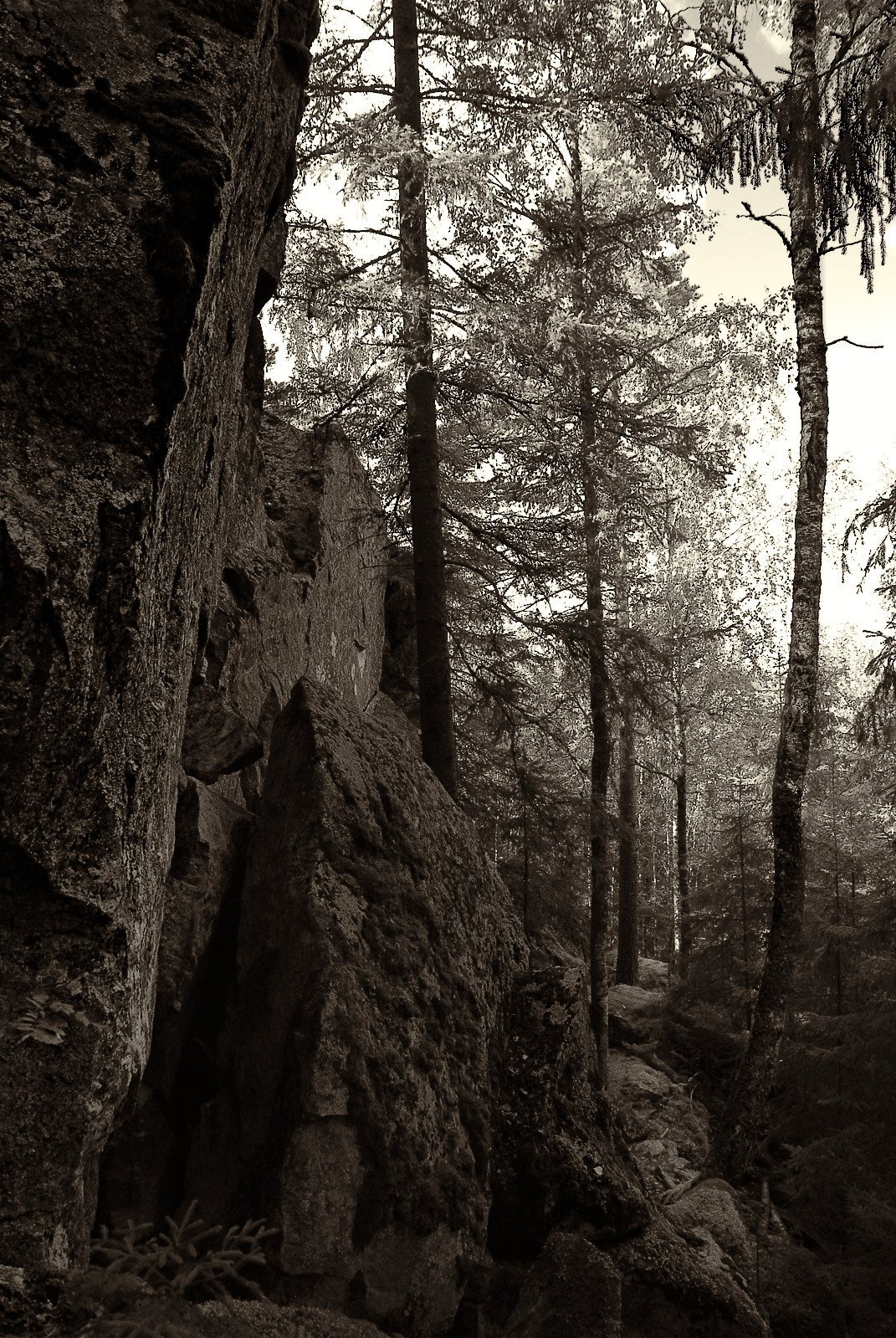
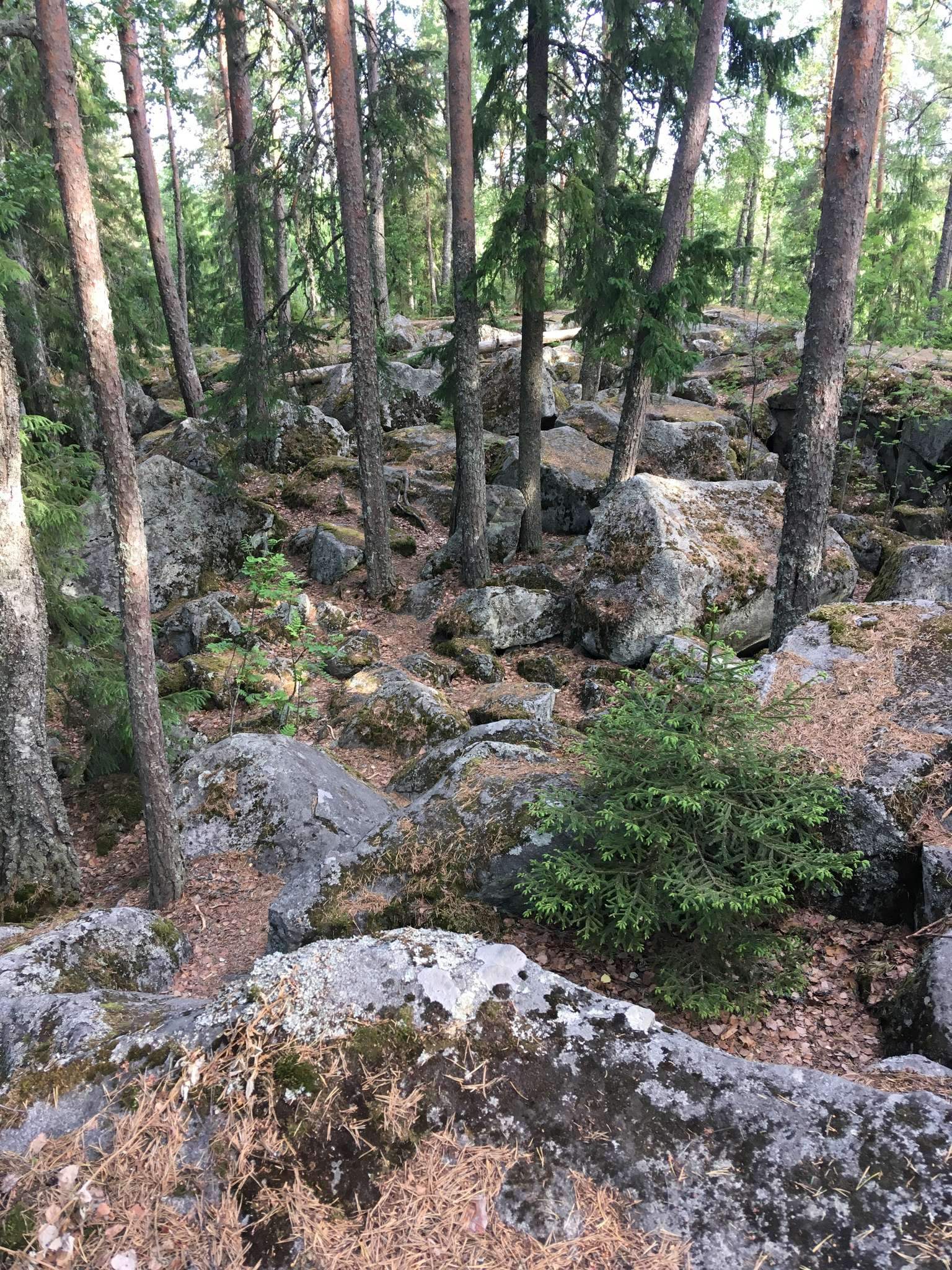
Pirunlinna occupies an oval, rocky summit measuring about 100 by 70 meters. The hill lies on low-lying marshland, about 600 meters southwest of Linnajärvi and 8.5 kilometers northeast of Lempäälä Church. Its northern and northeastern slopes are the steepest and include cliffs, while rocky and boulder-covered ground surrounds the hill.
Stone ramparts run along the southeastern and northeastern edges of the summit. They were formed from stones gathered nearby, and a drawing made by Isak Inberg in 1872 also shows ramparts extending across the southern slope for about 100 meters. The defenses had gates on the southern, eastern, and western sides. The southern entrance was a simple opening, while the ends of the ramparts turned outward at the eastern gate. At the western gate, a passage originally ran on both sides of the rampart.
The rampart was approximately man-high as recently as about a century ago. Stones have since been rolled or removed, leaving the structure lower than it once was.
Pirunpesä Cave
On the northern side of the hill, large glacial boulders form a cave-like recess known as Pirunpesä or Pirunkirkko. The sheltered space measures approximately 5 by 5 meters. An adjoining level area to the east measures about 5 by 8 meters and is protected by a rock wall that curves above it.
The cave produced the seven flint arrowheads recovered during the 1929 excavation, in addition to the Stone Age arrowhead found there earlier. These finds relate to the cave’s interpretation as a shelter rather than a settlement. The historical description from the 1750s places a well at the eastern end of the hillfort, although its present condition is not stated.