Segovia Cathedral: A Late Gothic Cathedral in Spain
Site at a Glance
- Rating
- 4.7
- Popularity
- Very High
- Country
- Spain
- Primary era
- Early Modern
- External website
- Open
- Eras represented
- Medieval, Early Modern, Modern
- Civilizations
- Crown of Castile, Spanish
- Site type
- Religious
- Remains
- Cathedral
On this page22 sections
History
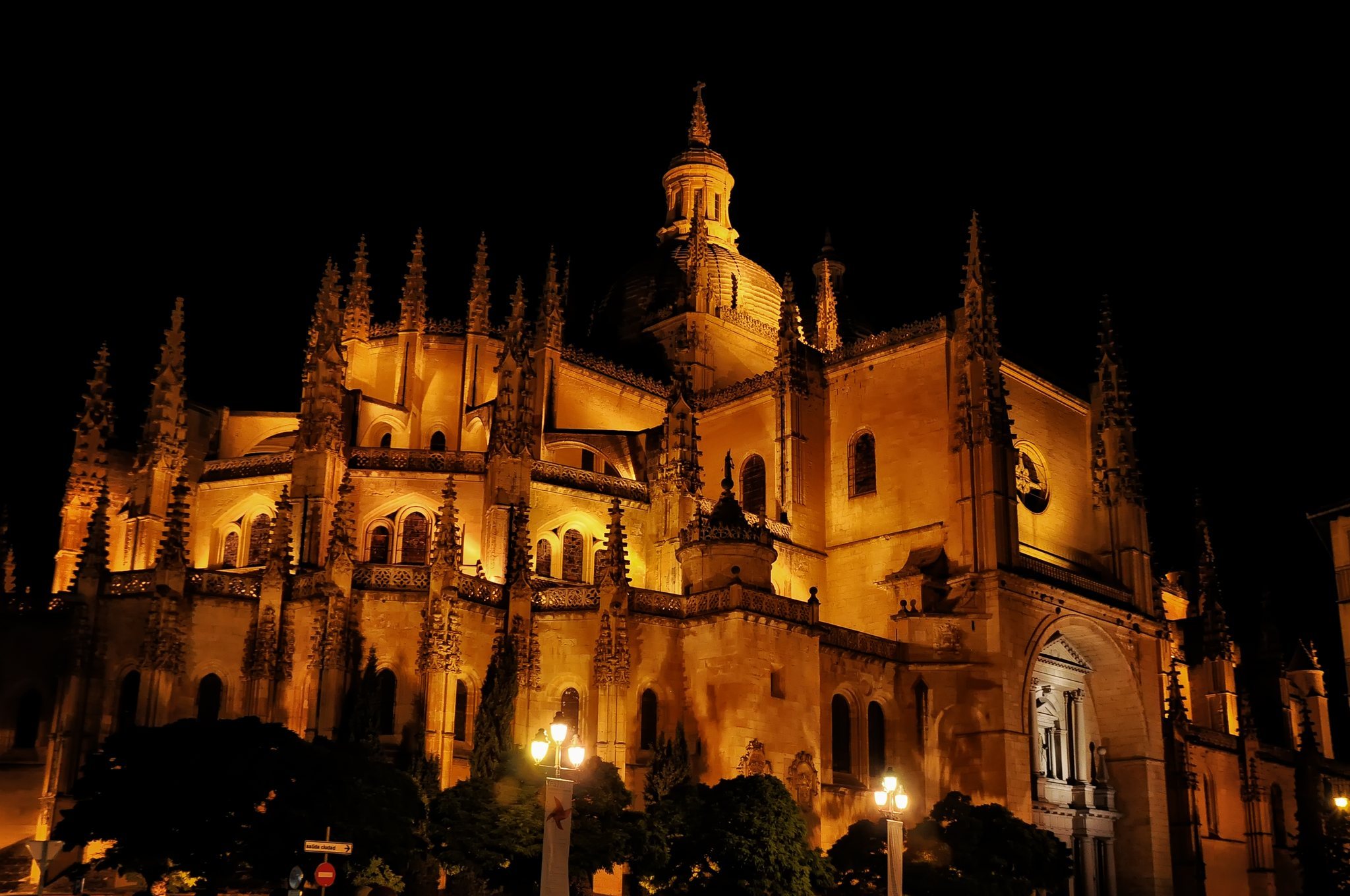
Segovia Cathedral is a Roman Catholic cathedral in Segovia, Spain, begun in 1525 as a late Gothic, or Flamboyant Gothic, replacement for a medieval church destroyed during the Revolt of the Comuneros. The cathedral is formally dedicated to Our Lady of the Assumption and Saint Fructus and serves as the seat of the Diocese of Segovia. Its principal function remains worship, under the administration of the cathedral chapter, the body responsible for the cathedral’s liturgical and administrative governance.
Destruction of the former cathedral
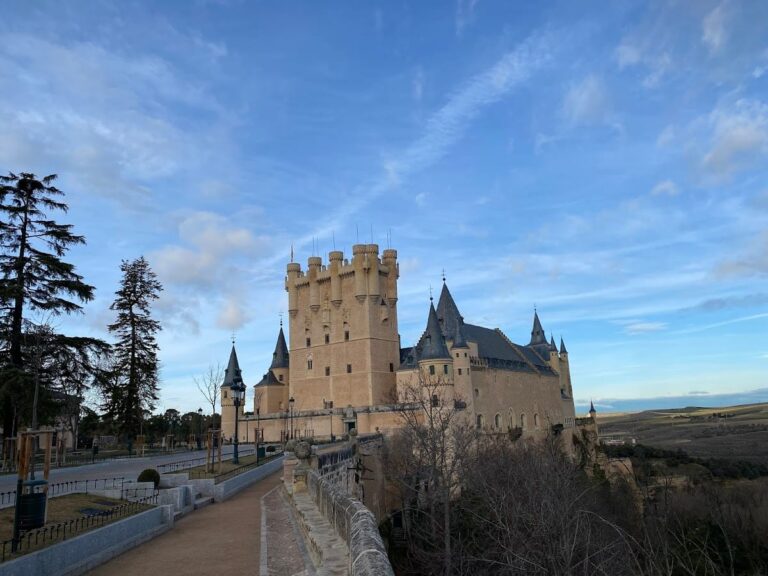
The former Cathedral of Santa Maria stood beside the Alcazar. It was destroyed in 1521 during the Revolt of the Comuneros, a major Castilian uprising against the government of Charles V between 1520 and 1521. During the siege of Segovia, supporters of Charles V held the Alcazar, while the Comuneros attempted to occupy the cathedral as a strategic position from which to challenge it.
Charles V, also known as Charles I of Spain, ordered a replacement cathedral on a higher site. The decision reduced the danger that the church could again be used as a military position during a siege. The new building occupied the former convent of Santa Clara and part of the former Jewish quarter. Medieval houses and at least two surviving synagogues remain in the surrounding area, with the synagogues preserved to varying degrees.
Construction under Charles V
Construction began during the reign of Charles V and the episcopate of Diego Ribera de Toledo, when Segovia was a major centre of the wool and cloth trade. The city may then have had as many as 27,000 inhabitants, before entering a period of decline. Juan Gil de Hontañón received the commission on 7 May 1524, and the first stone was laid on 8 June 1525.
The building sequence was unusual because work began at the western end rather than at the eastern apse. The first phase lasted from 1525 to 1557 and involved Juan Gil de Hontañón, his son Rodrigo Gil de Hontañón, and García de Cubillas. Juan Gil was absent from Segovia from 1529, while the elevations of the nave were completed by 1542. He later returned and continued work, including at the eastern end, until his death in 1577.
The cathedral is one of the latest major Gothic cathedrals in Spain and Europe. Its construction began when Renaissance architecture was already spreading through Europe, yet the main design continued the late medieval Gothic tradition. Elements from the former cathedral were reused to reduce costs, including the entire cloister, choir stalls, grilles, doors, and other architectural and decorative components. The old cathedral’s organs were temporarily moved to the convent of Santa Clara and installed in the new choir in 1559.
Completion and later history
A second construction phase lasted from 1578 to 1607 and involved Rodrigo de Solar, Juan Pescador, Diego de Sisniega, and others. The final major campaign ran from 1607 to 1685 under Pedro de Brizuela or Francisco de Viadero. Because work had begun at the west end, the apse was not closed until 1685. The original mahogany spire of the tower was destroyed by lightning and fire in 1614 and replaced by the present stone spire.
Construction of the Chapel of the Ayala family began in 1686. The cathedral was consecrated on 16 July 1789 by Bishop José Martínez Escalzo. Its later appearance incorporated Baroque and Neoclassical work within the late Gothic fabric, including a high altar designed by Francisco Sabatini for Charles III.
The former Chapel of Saint Catherine became a cathedral museum by order of Bishop Manuel Castro Alonso on 24 July 1924. Restoration of the room began in 2019, was interrupted by the Covid-19 health crisis, and was completed in 2022. Work beneath the tomb of the Infante Pedro revealed three bones and a garment, which research associated with the infant and placed his age at death between six and twelve months.
The cathedral received Spanish cultural-heritage protection as a monument on 3 June 1931. It forms part of the UNESCO World Heritage Site Old Town of Segovia and its Aqueduct, inscribed in 1985. The tapestry and liturgical-ornaments room opened after renovation in 2017, and the painting room was inaugurated in 2018. Restoration of the stained-glass ensemble was commissioned from the Segovian glassmaker Carlos Muñoz de Pablos from 2010 onward. Restoration of the altarpiece and crypt beneath the Chapel of Santiago began on 1 February 2024 and was completed at the end of that year. The chapel reopened on 29 January 2025. A September novena dedicated to the Virgin of Fuencisla is celebrated in the cathedral.
Remains
Plan, structure, and principal spaces
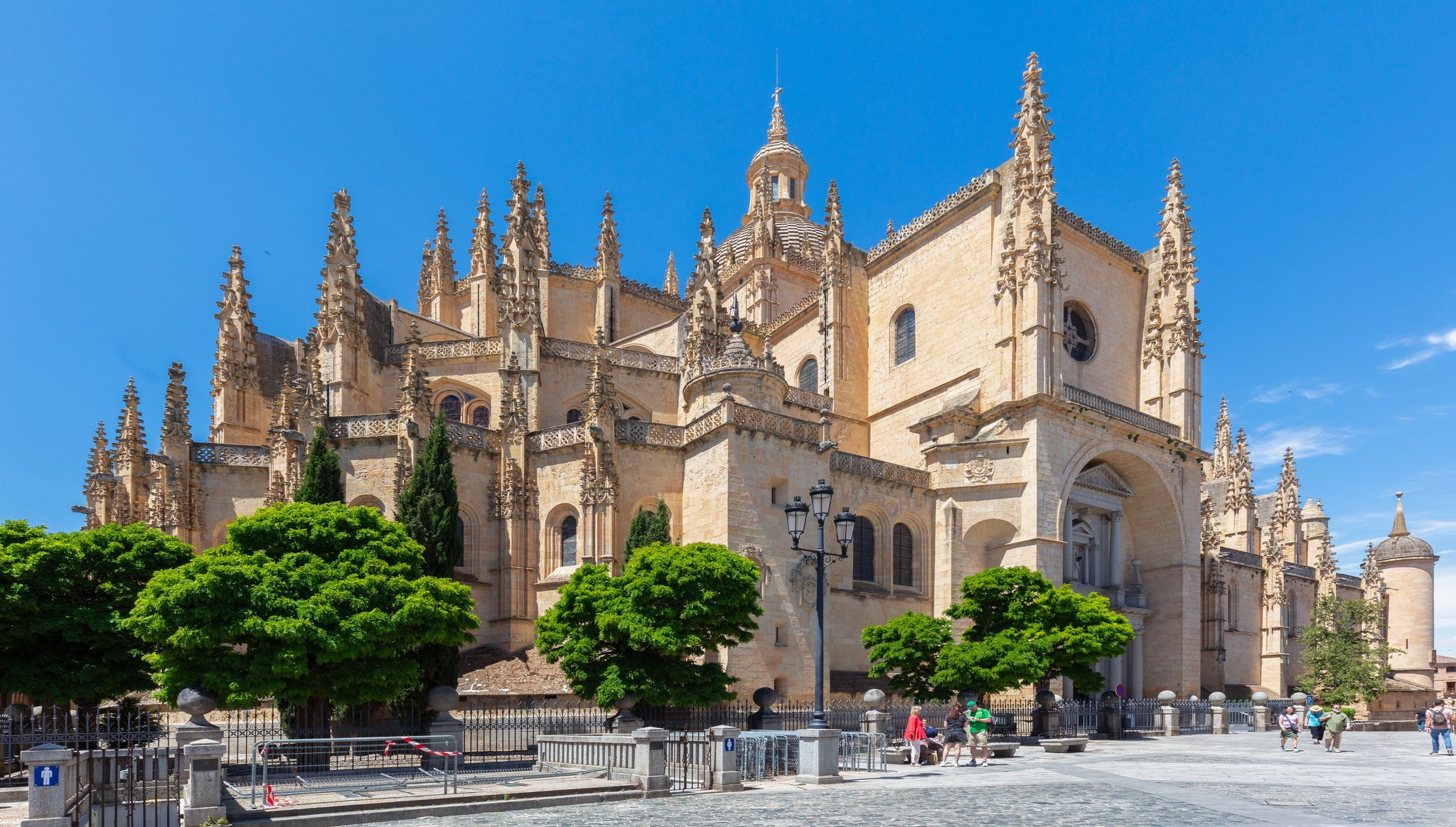
Segovia Cathedral has a Latin-cross plan and a late Gothic structure with selected Renaissance features. Its five-bay central nave is flanked by two aisles, each with five lateral chapels. The building also contains a choir, transept, semicircular apse, ambulatory, and seven radiating chapels. An ambulatory is a passage around the choir or apse, while radiating chapels open from it around the curved eastern end.
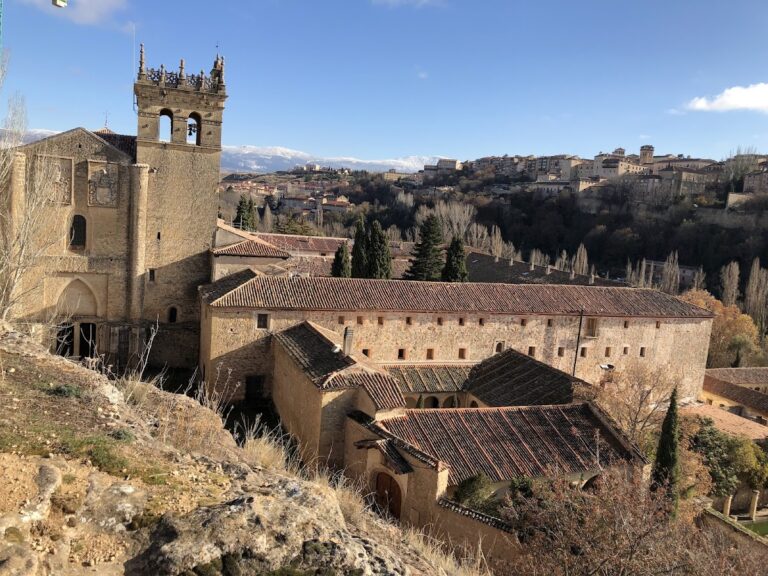
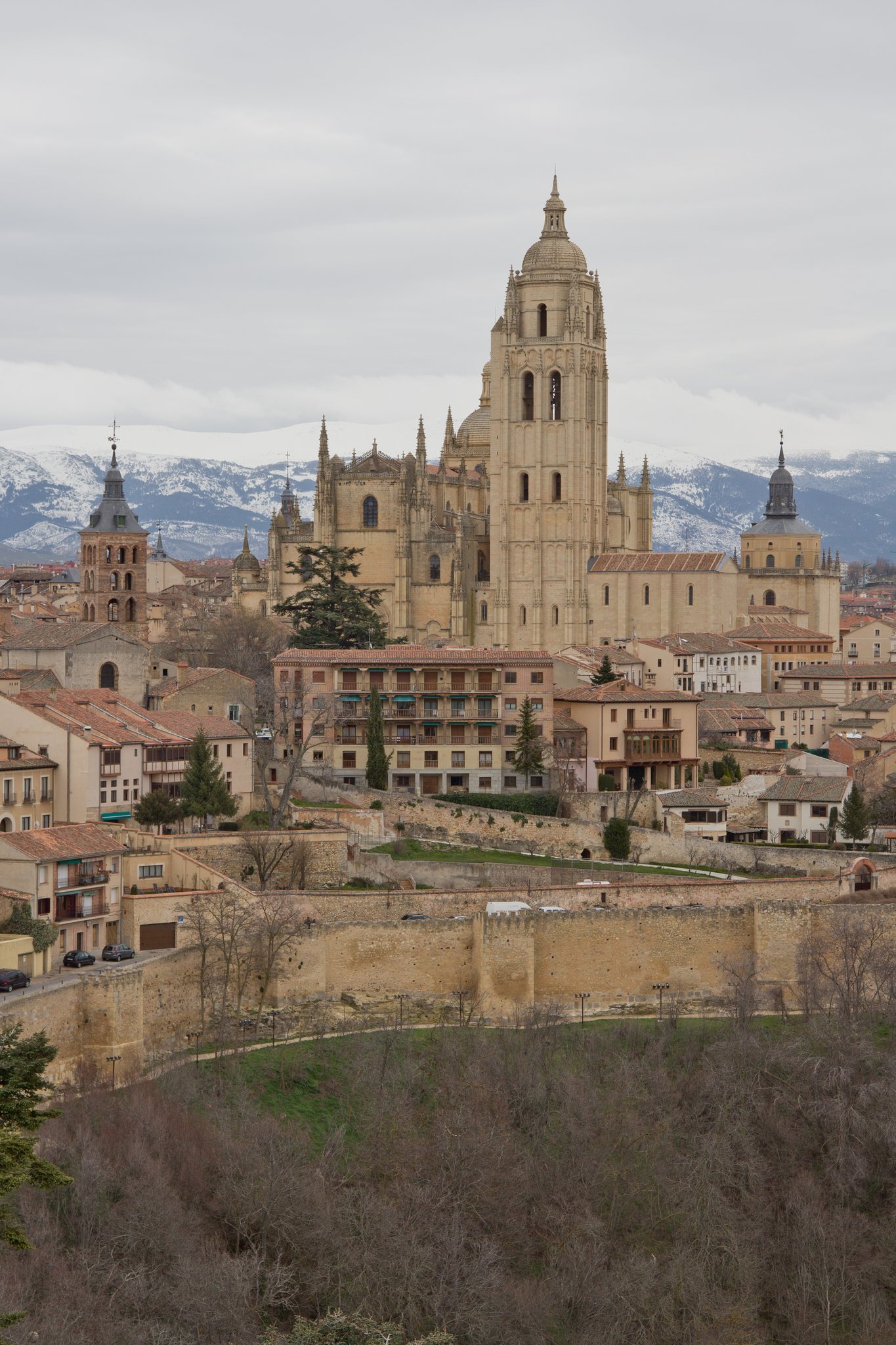
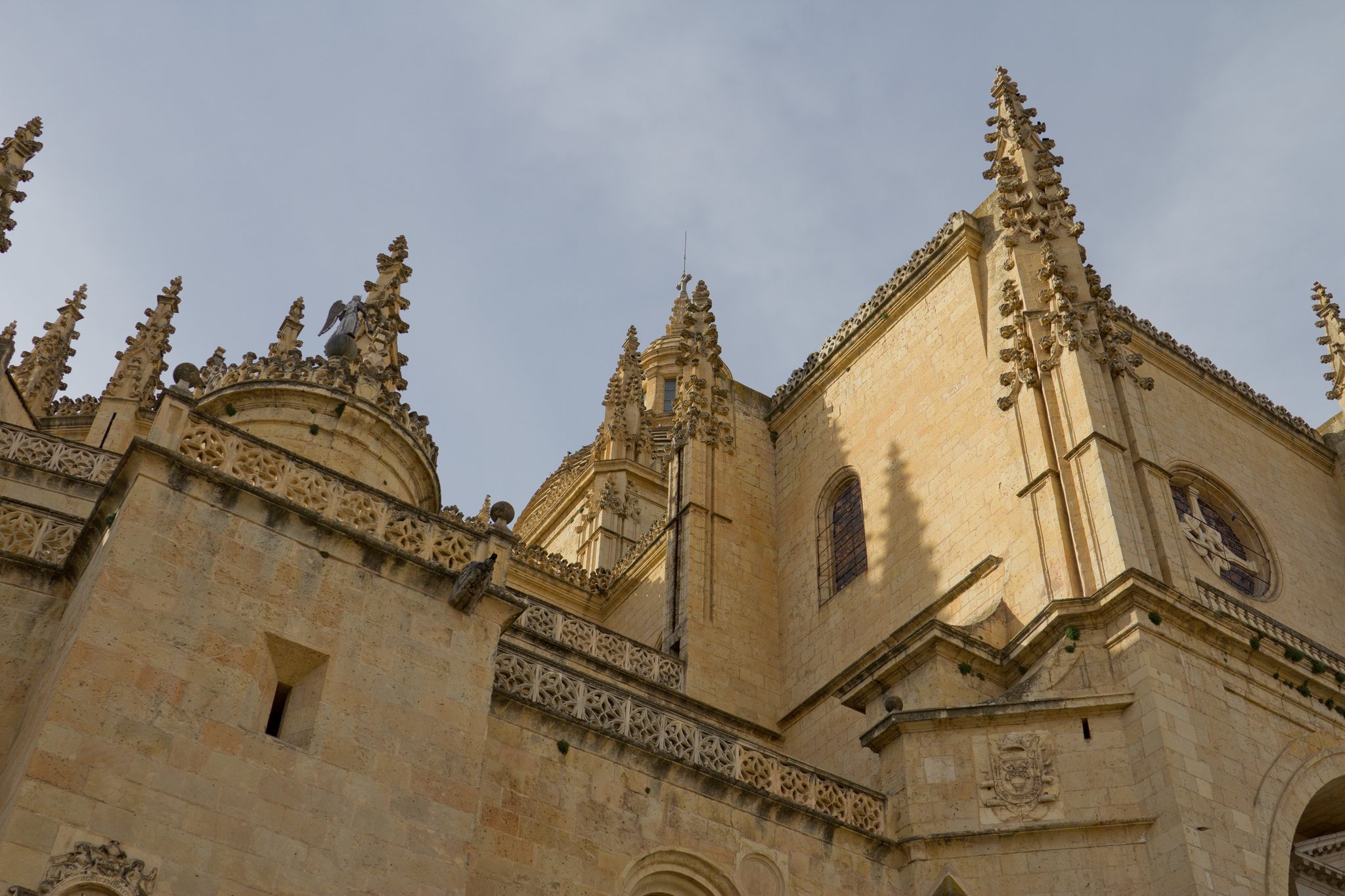
The three high naves and the ambulatory are covered by Gothic vaults rising approximately 30 to 33 metres. The cathedral is approximately 105 to 109 metres long and 50 metres wide, while the tower reaches approximately 88 to 90 metres. High walls are supported by flying buttresses, each surmounted by elaborate pinnacles. The principal entrances are the western Puerta del Perdón, the Puerta de San Frutos at the northern end of the transept, and the Puerta de San Geroteo at the southern end.
The tower and dome
The tower stands on the south-west side, to the right of the principal facade. Access is through the Chapel of Saint Blaise, and the tower contains both the bell chamber and the bell-ringer’s house. Its wooden mahogany spire was replaced by the present stone spire after the fire of 1614.
The crossing is covered by a dome completed by Pedro de Brizuela in the seventeenth century. It forms the principal interruption to the building’s otherwise notably unified late Gothic interior.
Choir, altars, and central furnishings
High altar and choir
The high altar has a Neoclassical altarpiece of multicoloured marble and bronze, designed by Francisco Sabatini for Charles III and made in the workshops of the Royal Palace of Madrid between 1768 and 1775. Its two-tiered composition stands on black marble veined with white. It includes large white images of Saint Fructus and Saint Hierotheos by Manuel Adeba Pacheco, a seated thirteenth-century Virgin of Peace, and images of Saints Valentine and Engratia, the Virgin’s monogram, and a cross.
Henry IV donated the Virgin of Peace to the cathedral, although Ferdinand III is also regarded as a possible earlier owner. Antonio Vendetti covered the image and its seat with silver in 1775. The altar is enclosed by Antonio de Elorza’s Baroque grille of 1736, gilded by Miguel and José Borbúa of Segovia and decorated with lilies, coats of arms, and medallions. A second grille by Elorza, dated 1729, encloses the choir area.
The choir stalls came from the former cathedral. Juan Gil and Jerónimo de Amberes installed them in 1558, and Fermín Huici completed them in 1790. The late-fifteenth-century stalls are Flamboyant Gothic, with ogee arches, lowered arches, long columns, openwork tracery, and royal seats beneath small Gothic domes. The coat of arms of Bishop Juan Arias Dávila appears above the episcopal seat.
Via Sacra and retrochoir
The Via Sacra is the ceremonial passage between the choir and the main chapel. It contains episcopal burials and a marble pulpit decorated with reliefs of the Evangelists and the Immaculate Conception. The retrochoir altarpiece was transferred from the Palace of Riofrío in 1782. Ventura Rodríguez and Juan de la Torre y López enlarged its original central body with two wings so that it filled the space between the piers.
Hubert Dumandre made the altarpiece in 1758, chiefly from Spanish marble. Its central body contains a silver urn made by Sebastián de Paredes in 1633 for the relics of Saint Fructus. Above it are sculptures of Saints Peter and Paul and the Trinity. The wings contain images of Saint Elizabeth and Saint Philip, commemorating the parents of Charles III and their donation of the altarpiece. Niches on the Gospel and Epistle sides contain sculptures of the four Evangelists by Manuel Adeba Pacheco.
Organs
The former cathedral’s organs were made in 1473 during the reign of Henry IV by Johan Cortexo. The present organs were commissioned by the cathedral chapter. The Epistle organ was commissioned in 1700 and delivered in 1702 under Pedro de Liborna Echevarría. The Gospel organ was begun in 1769 by Pedro Manuel de Echevarría with a donation from Bishop Juan José Martínez y Descalzo and was largely completed by his son José.
Chapels and devotional furnishings
Western and southern chapels
The Chapel of the Immaculate Conception, beside the Puerta del Perdón, was built in 1531. Its tercelete vault, a ribbed vault with additional subsidiary ribs forming a complex pattern, was decorated by Juan del Río in 1622 with symbols of the Immaculate Conception. The cathedral chapter granted the chapel as a family pantheon in 1645 to Pedro Fernández de Miñano y Contreras, governor of Cadiz, Knight of the Order of Santiago, and captain of the Silver Fleet under Philip IV.
The chapel contains six paintings made by Ignacio de Ries in 1653, including The Tree of Life, The Adoration of the Shepherds, The Conversion of Saint Paul, The Baptism of Christ, The Coronation of the Virgin, and King David. Its polychrome wooden altarpiece includes an image of the Immaculate Conception commissioned from Antonio de Herrera Barnuevo in 1621. Francisco Jiménez made the mahogany grille in Jerez de la Frontera during the first half of the seventeenth century.
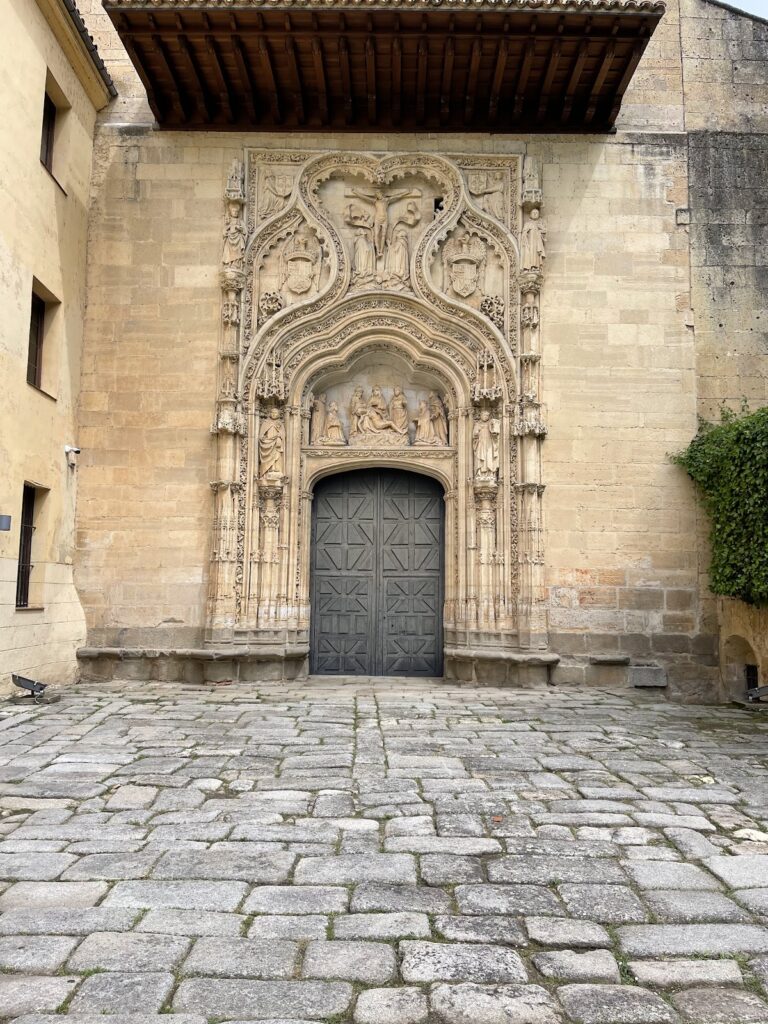
The Chapel of the Cristo del Consuelo provides access to the cloister. Its seventeenth-century Baroque altarpiece contains a crucifix on the lower section and the seventeenth-century Cristo del Consuelo, transferred from the former Jesuit College. The doorway to the cloister came from the former cathedral. Isabella the Catholic paid for it, and Juan Guas made it in 1483. Its tympanum by Sebastián Almonacid depicts the Pietà surrounded by angels bearing the instruments of the Passion, with traces of colour still surviving. The grille, made by Fray Francisco de Salamanca in 1508, formerly closed the old cathedral’s choir.
Two recumbent episcopal tombs stand opposite the altarpiece, those of Raimundo de Losana and Diego de Covarrubias, dating respectively from the early seventeenth and late sixteenth centuries. The Chapel of Saint Anthony contains a Baroque altarpiece made by José Vallejo Vivanco in 1696 and 1697. Its furnishings include a Saint Anthony by Pedro Valle, a praying image of Bishop Antonio Idiáquez Manrique by José Galbán, and paintings by Francisco Herranz.
Chapel of the Pietà and related foundations
The Chapel of the Pietà, also called the Chapel of the Holy Burial, was founded by Juan Rodríguez de Noreña, the canon responsible for building works. Juan de Juni made its altarpiece in 1571, and the chapel contains a canvas of Saint Thomas’s Doubt attributed to Alonso Sánchez Coello. Its grille belonged to the former cathedral’s main chapel and was made by Francisco de Salamanca in 1515.
A chapel founded by Andrés de Madrigal, treasurer and canon of the cathedral, contains two chaplaincies, a grille begun by Francisco Hernández in 1618, and an altarpiece designed by Pedro de Brizuela in 1621 and executed by Juan de Alcelegui, Juan Imberto, and Felipe de Aragón. The Chapel of Saints Cosmas and Damian has an altarpiece commissioned in 1629 from Domingo Fernández by Pero Suárez de la Concha and Juan Antonio Berrocal Bezilla. Its sculptures of the two saints and its image of the Immaculate Conception came from the workshop of Gregorio Fernández.
A chapel founded in 1623 by Alonso Nieto and his wife contains a late-seventeenth-century altarpiece attributed to José Vallejo Vivanco. Three divisions separated by Solomonic columns frame a central painting of the Mass of Saint Gregory. Antonio de Elorza installed its Baroque grille in 1716.
Chapel of Santiago and the crypt
The Chapel of Santiago was the first cathedral chapel granted to a civilian. In 1577 the chapter granted it to Francisco Gutiérrez de Cuéllar, chief accountant to Philip II, commander of the Order of Santiago, and the chapel’s founder. Pedro de Bolduque made the principal Baroque altarpiece in 1595, and Alonso de Herrera polychromed it. It includes a founder’s portrait attributed to Alonso Sánchez Coello. Two additional altarpieces are dedicated to the Virgin of Fuencisla and Saints Joachim and Anne.
A granite doorway beside the chapel leads down fifteen granite steps to the cathedral’s only excavated subterranean space, a crypt designed by Rodrigo del Solar and probably completed by 1604. A vestibule leads to two rooms. One is long, narrow, and brick-paved, with grisaille angels carrying the instruments of the Passion. The other is a family pantheon lit by two skylights opening toward the cloister garden. It contains a granite slab used as an altarpiece, bearing a nearly erased image of Our Lady of Antigua, with the figure of the Child remaining comparatively clear.
The chapel has a painted vault and ribs, a Baroque grille dated 1594 made by Juan de Salamanca and decorated by Juan del Río, and a stone altarpiece made by Pedro de Brizuela in the early seventeenth century. The altarpiece was stuccoed to imitate marble in 1788 and contains an eighteenth-century polychrome wooden image of Saint Barbara.
Chapels of the Christ and the Blessed Sacrament
The Chapel of the Recumbent Christ contains a seventeenth-century altarpiece with a painting of the Descent from the Cross and an urn designed for viewing the image from the side. Gregorio Fernández made the Baroque sculpture of the Recumbent Christ, which was donated by Bishop Melchor de Moscoso y Sandoval. The chapel’s Baroque grille was made by Lorenzo Hernández de Medina and gilded by Pedro de Prádena.
The Chapel of Saint Blaise contains a late-seventeenth-century Baroque altarpiece with a sculpture of Saint Blaise as a bishop and an oil painting of Saint Cecilia attributed to Francisco Llamas. The chapel also provides access to the tower. The Chapel of the Blessed Sacrament is symmetrical with the Chapel of Saint Anthony and is divided into the Chapel of the Cristo de la Agonía and the Chapel of the Ayala family. A Romanesque Crucifixion group with the Virgin and Saint John stands at its entrance.
The Chapel of the Cristo de la Agonía has two ribbed vaults, paintings of Segovian bishops, and access to the sacristy. Daniel Zuloaga made its ceramic altarpiece in 1897 at the La Segoviana pottery factory. The crucifix is attributed to Manuel Pereira and was donated by Ramona López de Ayala y del Hierro. A grille, candelabra, and wrought-iron lamps by Ángel Pulido complete the ensemble.
The Ayala family chapel contains a Baroque altarpiece designed by José Churriguera, whose construction began in 1686. Two Solomonic columns flank a central tabernacle, an architectural compartment for the reserved Eucharist, while side recesses contain relics. An image of Saint Ferdinand beneath a canopy occupies the upper section. Added in 1718, the tabernacle rotates on its base and presents the Annunciation, Pentecost, a casket for Holy Thursday, and an exposition structure for Corpus Christi. Four attached tombs belong to Juan, Diego, Gaspar, and Antonio Ayala Berganza.
Ambulatory chapels
One ambulatory chapel contains an altarpiece commissioned from Pedro de Bolduque in 1585. Originally divided into three vertical sections and an attic, it lost its side divisions when it was moved. Its central images are Christ Bound to the Column and Saint Peter, above a relief of Quo Vadis. The attic contains Cristóbal de Velasco’s painting of the Martyrdom of Saint Peter.
Another ambulatory chapel contains an eighteenth-century Classicist Baroque altarpiece by Manuel Adeba Pacheco in stuccoed wood. Its central relief shows the Virgin placing a chasuble on Saint Ildefonsus with the help of an angel. A further chapel has two display cases, one holding an Ecce Homo brought to Segovia in 1907 as a processional image, and the other containing an anonymous eighteenth-century Ecce Homo, a seventeenth-century sorrowful Virgin, and two processional crosses. One cross is seventeenth-century wood with mother-of-pearl inlay, while Antonio Oquendo made the other in 1519.
An eighteenth-century ambulatory altarpiece was made by Juan Maurat and gilded by Santiago Casado in 1772. Its tabernacle has an anonymous painting of the Virgin and Child, and Gregorio Aguirre made the enclosing grille in 1774. Three wooden altarpieces commissioned in 1747 are dedicated to Saint Fructus and his siblings, Saint Valentine and Saint Engratia. The central altarpiece of Saint Fructus is taller and has a Virgin on its lower section, while the side altarpieces show Saint Valentine with a book and Saint Engratia with a martyr’s palm.
Another ambulatory chapel has an anonymous Classicist altarpiece donated in 1782 and stuccoed to imitate marble. Its three divisions contain Saint Teresa of Jesus, an unidentified Jesuit saint, and Saint Anthony. A further chapel contains a simple altarpiece and a painting by Ramón Bayeu, with murals by the same artist on the walls and vault. Nineteenth-century wooden images of the Sacred Heart of Jesus and the Immaculate Heart of Mary stand beside the altarpiece. The Chapel of Saint Joseph has an eighteenth-century altarpiece with a central image of Saint Joseph holding the Child and attic sculptures of Saint Teresa and Saint John of the Cross.
Cloister, rooms, and collections
Cloister and chapter room
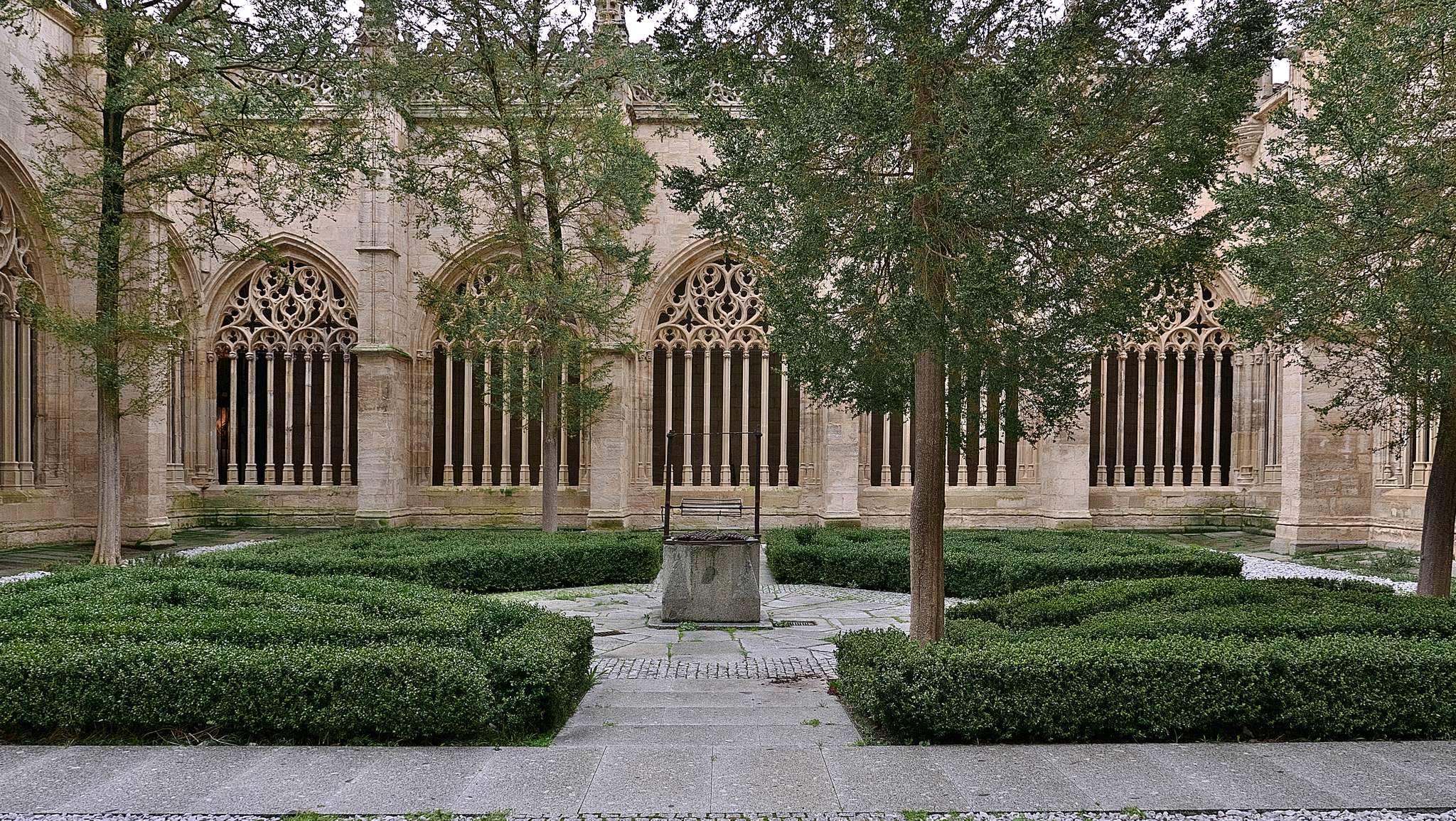
The Flamboyant Gothic cloister was dismantled and transferred stone by stone from the former cathedral. It is the surviving part of the old temple specifically retained within the new complex. The cloister contains tools used in the cathedral’s construction and provides access to the chapter room, Saint Catherine’s room, the tapestry and liturgical-ornaments room, and the painting room.
The chapter room, formerly the meeting room of the cathedral chapter, was built under García de Cubillas in the mid-sixteenth century. It contains eleven Brussels tapestries woven by Geeraert Peemans, depicting Queen Zenobia and Emperor Aurelian. Its late-sixteenth-century coffered ceilings were white-stuccoed and gilded in the seventeenth century by Francisco López. The room also contains a bishop’s seat, a seventeenth-century Christ formerly in the Chapel of the Immaculate Conception, and a Classicist Baroque altarpiece with a Virgin of the Conception by José Esteve.
Museum rooms
The tapestry and liturgical-ornaments room occupied the cathedral bookshop until 1975. It contains the sixteenth-century Brussels tapestry series The Planets and liturgical vestments associated with Bishops Arias Dávila and Fadrique of Portugal.
The painting room contains 42 Castilian and Flemish works, including paintings in oil on copper and oil under glass. Identified works include The Virgin and Child by Luis de Morales, Saint Thomas’s Doubt by Alonso Sánchez Coello, The Fountain of Grace from the workshop of Jan van Eyck, Saint Gregory’s Mass by Pedro Berruguete, and the Descent from the Cross Triptych by Ambrosius Benson, formerly in the church of Saint Michael.
Saint Catherine’s room
The former Chapel of Saint Catherine occupies the first level of the tower and was among the earliest parts of the cathedral to be built. García de Cubillas directed its construction under Juan Gil de Hontañón’s supervision. Alberto de Holanda installed its windows in 1528, and its vault was completed in 1530.
Saint Catherine’s room now contains liturgical vestments, relics, tapestries, the tomb of the Infante Pedro, and the bones and garment associated with him. It also displays a facsimile of the Synodal of Aguilafuente and seventeenth-century Flemish tapestries woven at Oudenaarde from the Verdure series, depicting palace scenes.
Stained glass
The stained-glass ensemble contains 65 panels or pieces belonging to three chronological phases. The sixteenth-century phase includes a major Mannerist series associated with the Pierres workshop and artists including Nicolás de Vergara, Nicolás de Holanda, and Gualter de Ronch. Francisco Herranz executed the seventeenth-century phase, comprising 33 panels, and his program survives in a manuscript in the cathedral archive. Seven further windows were installed in the main chapel in 1916 by the Maumejean workshop of Madrid.