Bury St Edmunds Abbey: A Benedictine Monastery and Pilgrimage Centre
Site at a Glance
- Rating
- 4.8
- Popularity
- Medium
- Country
- United Kingdom
- Primary era
- Medieval
- External website
- Open
- Eras represented
- Medieval
- Civilizations
- English
- Site type
- Religious
- Remains
- Monastery
On this page19 sections
History
Bury St Edmunds Abbey in the United Kingdom was a Benedictine monastery established around 1020 around the shrine of Edmund the Martyr, an Anglo-Saxon king killed by the Great Heathen Army in 869. The abbey grew into a major pilgrimage centre and one of England’s richest monasteries before its dissolution in 1539.
Early religious foundation
The site was already a religious centre roughly three centuries before Edmund’s remains were moved to Beodricsworth in the early tenth century. The settlement later became known as St Edmundsbury. Tradition connected the earlier foundation with St Sigeberht. In 945, the abbey received a banleuca, an area under its own jurisdiction rather than ordinary external administration.
Around 1020, during the reign of Cnut, monks from St Benet’s Abbey replaced the secular priests who guarded Edmund’s shrine. Cnut was an eleventh-century king who ruled England and several other northern European territories. With episcopal authority, the monks established a Benedictine abbey, a monastery governed by an abbot under the Rule of Saint Benedict, and received surrounding lands for the community.
Ufi, prior of Holme, became the first abbot and remained in office until his death in 1044. The Bishop of London consecrated him. Leofstan then served as abbot from 1044 to 1065, followed by Baldwin, a royal physician appointed by the king. Baldwin held the office from 1065 to 1097.
Growth and regional power
Baldwin rebuilt the abbey church and ceremonially reinterred Edmund’s body there in 1095. Edmund was venerated as a Christian martyr, and his shrine attracted pilgrims whose visits helped increase the abbey’s influence. Extensive endowments also made the monastery a powerful regional institution.
The abbey’s charters granted it broad lands and rights in Suffolk. It controlled the gates of Bury St Edmunds, held authority over orphan wardships and compulsory labour, charged tariffs on economic activities, and operated a royal mint. By the fourteenth century, its territory extended across a particularly large area of West Suffolk. The monks planned Bury St Edmunds on a grid pattern, while the town developed around the abbey.
Prosperity during the thirteenth century reduced resistance from townspeople and peasants, but opposition grew during the following century. The abbey’s authority and financial demands became increasingly unpopular, contributing to violent conflict in 1327.
The Great Riot and later medieval troubles
The Great Riot of 1327 brought repeated attacks against the abbey in January, February, and May, after townspeople demanded greater liberties. Several monks were killed, many buildings were damaged or destroyed, and the townspeople seized and destroyed the abbey’s charters, statutes, and debtors’ accounts.
On 29 September 1327, Queen Isabella arrived at the abbey with an army from Hainaut after returning from the Continent to depose her husband, Edward II. She stayed for several days with her son, the future Edward III.
On 18 October, monks entered a local parish church wearing armour beneath their habits and took hostages. During the confrontation, several people were killed. Townspeople, including a parson and twenty-eight chaplains, then burned the abbey gates and captured the monastery. The abbey was rebuilt afterward.
A special commission in 1345 found that the monks neither wore their habits nor lived in the monastery. Financial strain increased during the first half of the fifteenth century and contributed to the abbey’s decline. The west tower of the abbey church collapsed in 1431. Henry VI spent Christmas at the abbey in 1433 and remained there for several months. In 1447, Humphrey, Duke of Gloucester, died at Bury St Edmunds in suspicious or unexplained circumstances after his arrest.
Fire, dissolution, and later investigation
An accidental fire burned out the entire abbey church in 1465. The church was largely rebuilt by 1506, after which the monastery entered a quieter period until its suppression.
In 1539, Henry VIII’s government dissolved the abbey during the Dissolution of the Monasteries, the sixteenth-century suppression of England’s monasteries and transfer of their property to the Crown. The abbey’s possessions passed to the Crown, while valuable materials and artefacts were stripped from the buildings. Local builders later used the ruins as a quarry.
Several notable burials were associated with the abbey. Jurmin and Edmund the Martyr were buried there. Alan Rufus, who died in 1093, was first buried outside the south door and later reinterred inside the abbey church. Thomas of Brotherton, Earl of Norfolk and Lord Marshal of England, died in 1338 and was buried in the choir. Mary Tudor, Queen of France and daughter of Henry VII, died in 1533. Her remains were moved to nearby St Mary’s Church five years later, after the abbey’s dissolution.
A manuscript found in Douai in the late nineteenth century recorded the burial places of eighteen abbots. The antiquary Montague R. James used this Douai Register in his history of the abbey and supervised an excavation of the chapter house. On New Year’s Day 1903, the coffins and remains of five abbots were displayed to the public. The ruins are now owned by English Heritage and managed by the local council.
Remains
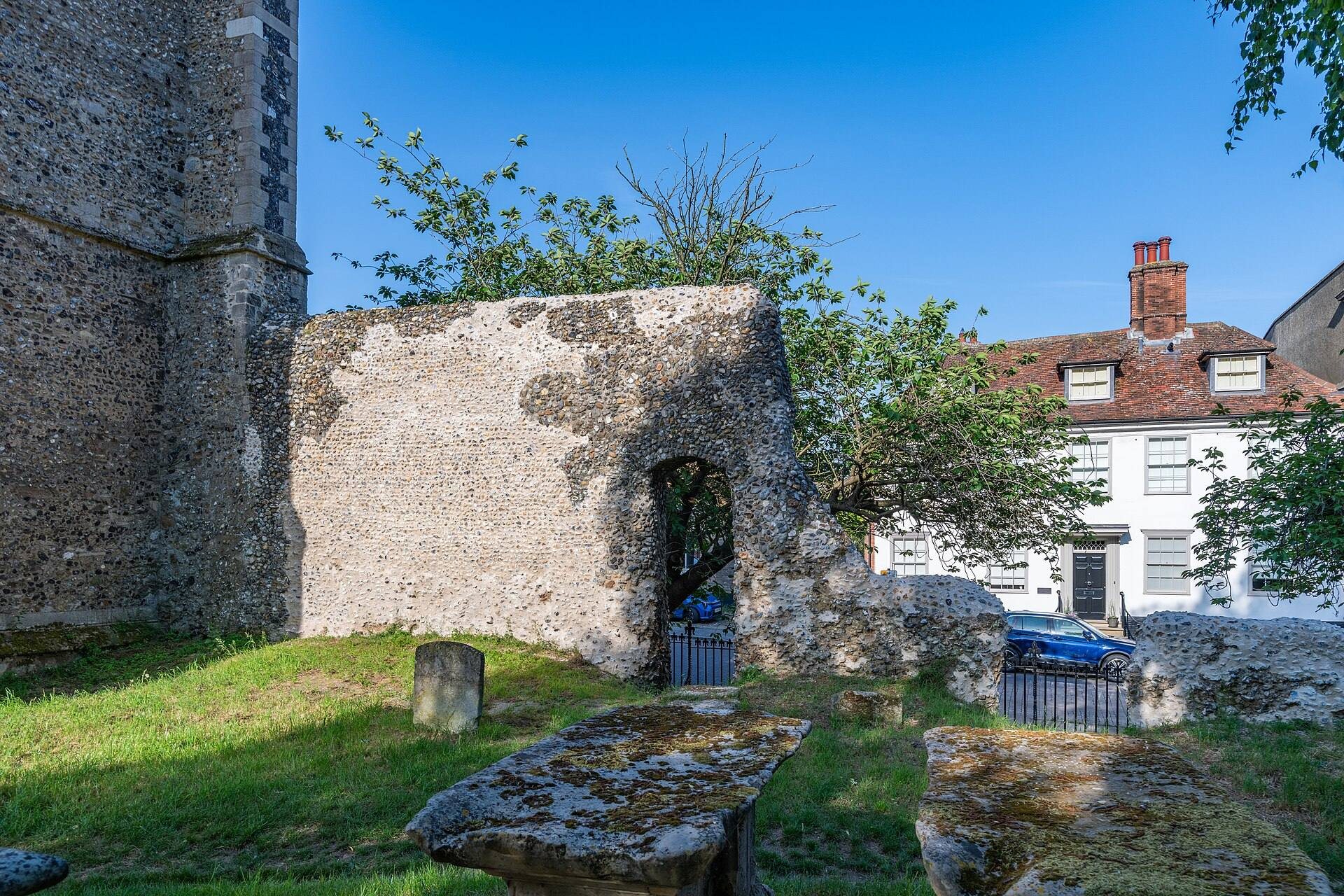
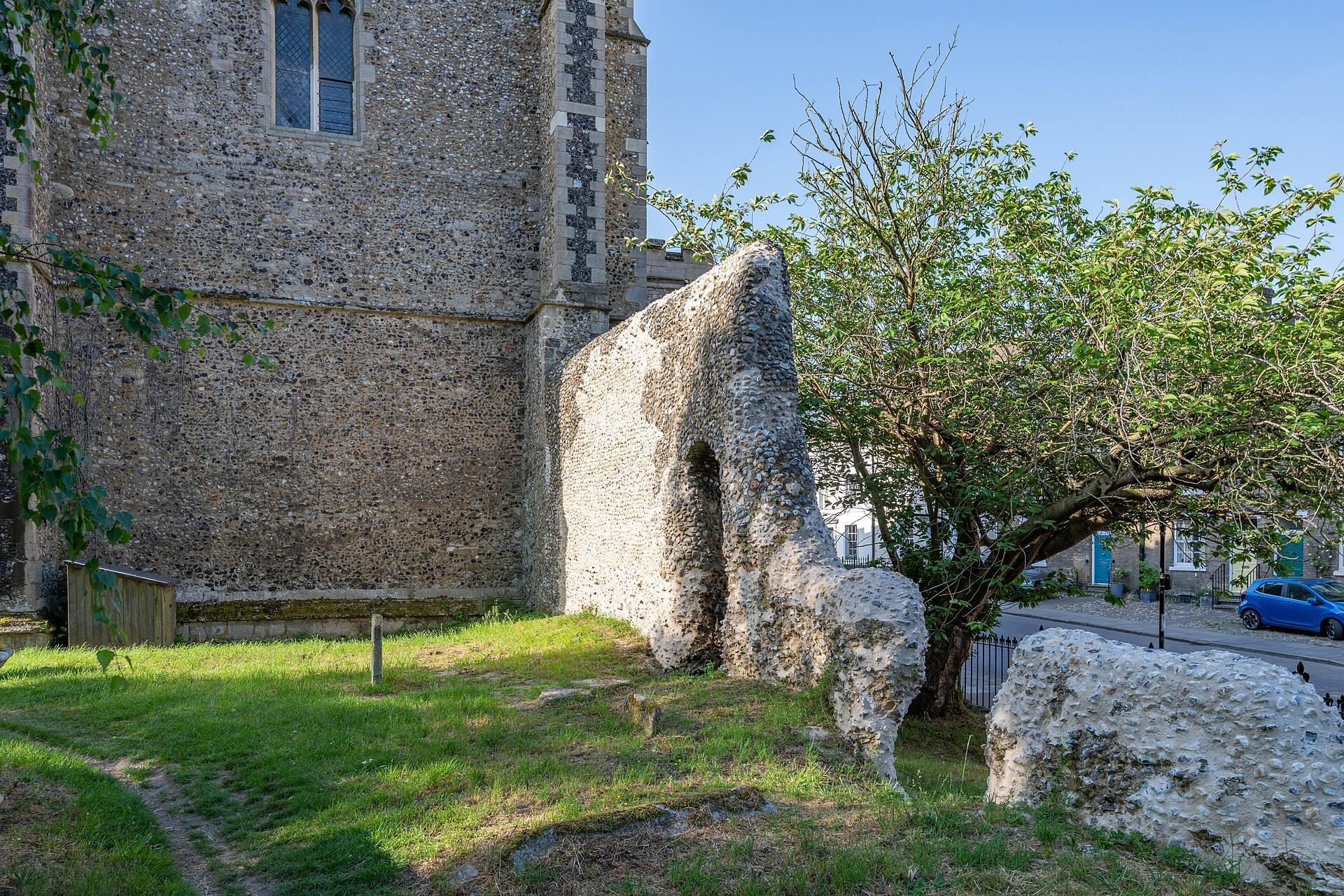
The surviving complex combines the rubble cores of a vast medieval church with gates, parish churches, archaeological remains, and the landscaped Abbey Gardens. The main abbey church followed a cruciform plan, meaning that its long central space crossed a projecting transept, and ended in an apsidal east end, a curved termination. Its construction and enlargement took place during the eleventh and twelfth centuries.
Abbey church and precinct
Abbey church
The abbey church measured approximately 505 feet, or 154 metres, in length and 246 feet, or 75 metres, across its western transept. Edmund’s shrine stood behind the high altar. Most of the surviving church fabric consists of rubble cores rather than intact wall elevations, preserving the scale and plan of the medieval building while also reflecting the damage and material stripping that followed the Dissolution.
Monastic precinct
The chapter house formed part of the abbey complex and was the setting for the excavation supervised by Montague R. James in 1903. Coffins and remains associated with five abbots were recovered or identified there. The precinct also contained the Crankles, a fishpond near the River Lark, and a vineyard established during the thirteenth century. Three breweries served the abbey, whose rules entitled each monk to eight pints of beer per day.
Medieval gatehouses
Norman Gate
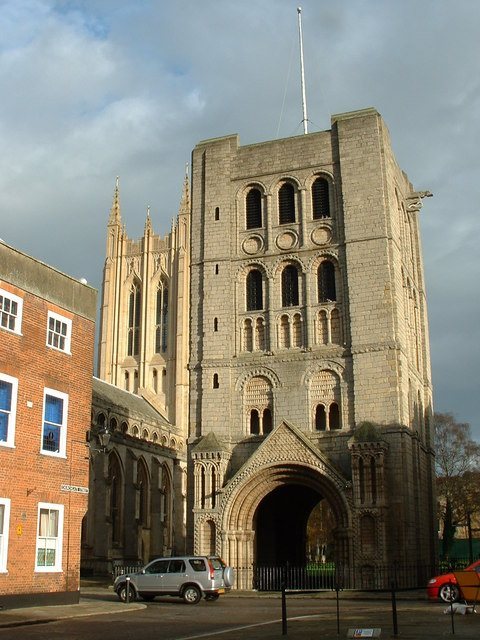
The Norman Gate was built approximately between 1120 and 1148 to provide access to the abbey church. Its four-storey gate hall is entered through a single archway and survives in an almost unchanged form. It remains the belfry of St James’s Church, now St Edmundsbury Cathedral.
Abbey Gate
Abbey Gate formed the secular entrance to the Great Courtyard and was used by the abbey’s servants. This substantial fourteenth-century stone gatehouse has a two-storey gate hall and a single archway retaining its portcullis, a heavy grated gate that moves vertically within grooves. It is one of the best surviving examples of its type.
Parish churches
St James’s Church
St James’s Church was completed around 1135 within the abbey precinct and continued to serve as a parish church. It is now St Edmundsbury Cathedral, and the Norman Gate survives as its belfry.
St Mary’s Church
St Mary’s Church was first built around 1125 and continued as a parish church within the former abbey complex. It was rebuilt between 1425 and 1435 in the Perpendicular style, a late medieval English form known for strong vertical lines, large window openings, and elaborate stone tracery.
Objects and archaeological discoveries
Cloisters Cross
The Cloisters Cross, also called the Bury St Edmunds Cross, is an unusually complex twelfth-century Romanesque altar cross carved from walrus ivory. Romanesque art belongs to the medieval style that preceded Gothic architecture and commonly uses rounded arches, solid forms, and geometric decoration. The sculptor is unknown. The cross is now in the Metropolitan Museum of Art in New York. Its attribution to Master Hugo of the abbey has been proposed, although its English origin is not certain and Germany has also been suggested.
Other discoveries
A collection of wolf skulls was found at the site in 1848. The abbey’s burials and the excavation of the chapter house provide archaeological evidence for the community’s religious and institutional history.
Abbey Gardens
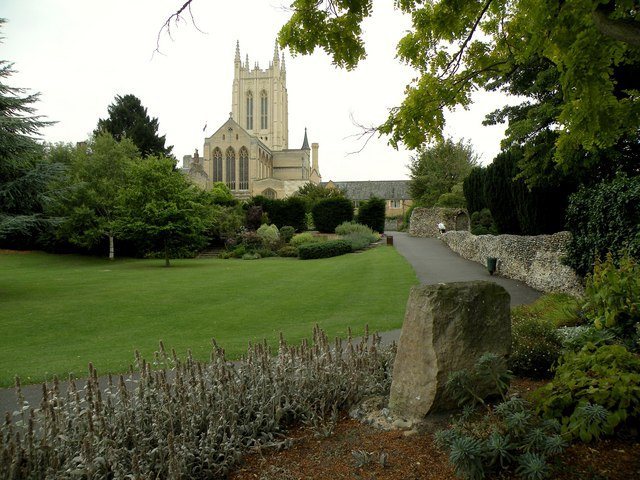
The Abbey Gardens surround the ruins and include a sensory garden for visually impaired visitors. An internet bench installed there in 2001 was described as the first of its kind. West Suffolk Council manages the gardens with English Heritage, with maintenance and improvements supported by volunteers.