Croxden Abbey: A Cistercian Monastery in England
Site at a Glance
- Rating
- 4.6
- Popularity
- Low
- Country
- United Kingdom
- Primary era
- Medieval
- External website
- Open
- Eras represented
- Medieval
- Civilizations
- English
- Site type
- Religious
- Remains
- Monastery
On this page10 sections
History
Croxden Abbey is a Cistercian monastery in the United Kingdom, founded in the late twelfth century for the worship of the Virgin Mary. The Cistercians were a monastic order that sought a stricter and more austere form of Benedictine religious life. The abbey belonged to the institutional lineage of Clairvaux and was founded from Aunay Abbey in Normandy, making it a daughter house of that monastery. It stood within the medieval Diocese of Lincoln and became an important religious and landed institution in the region.
Foundation and early development
Bertram III de Verdun established the community for the spiritual welfare of his family and successors. Its foundation is dated either to 1176 or to 28 May 1178. Twelve Cistercian monks from Aunay first settled near Alton, but moved to Croxden in 1179 because the original site was unsuitable. Their first abbot was Thomas, an Englishman.
Bertram de Verdun endowed the new monastery with lands in Staffordshire, Cheshire, Derbyshire, and Leicestershire. He also granted the churches of Alton and Tugby, together with chapels at Keythorpe and East Norton. In 1200, King John assigned the monks an annual payment of £5 from the Exchequer of Ireland. This arrangement was exchanged in 1206 for land at Adeney in Shropshire.
Prosperity and patronage
Croxden expanded during the thirteenth century and developed a substantial economy based especially on sheep farming, wool exports, and charcoal sales. Sheep farming provided much of its income from about 1230. By 1315, the abbey was supplying more wool to the Continent than any other religious house in the county, and its dealings with Florentine merchants continued into the 1420s.
The size of the community reflected this period of prosperity. During Walter London’s twenty-six years as abbot, eighty people entered the community, followed by twenty-five during William of Houton’s five-year abbacy. Later admissions were more limited. Henry of Measham received fourteen entrants in ten years, John of Billisdon received fourteen in nine years, Richard of Twyford received two in three years, and William of Over received nine in eleven years. Building work on the abbey church continued for roughly fifty years, and the church was consecrated in 1253.
The Verdun family continued to protect the abbey, and patronage later passed to the Furnivall family. Members of both families chose burial at Croxden, including Bertram III de Verdun and his wife Rohese. Other recorded burials included Theobald de Verdun, Matilda Mortimer, Elizabeth de Clare, and Elizabeth de Segrave.
Conflict and financial decline
After Theobald II de Verdun died in 1316, patronage passed through his heiress Joan de Verdun to her second husband, Thomas de Furnivall. Disputes followed over the use of abbey lands and property. In 1319, the monks barricaded themselves inside the abbey for sixteen weeks. Legal proceedings supported by other local landowners restored their use of the property, and the conflict was settled in 1321.
From the early fourteenth century, the monastery faced mounting financial pressure. Royal taxation, repeated loans, a corrodian, poor harvests, major repairs, storms, and plague all affected its resources. A corrodian was a financial obligation or pension granted in exchange for maintenance, food, or related support. Abbot Alexander de Colbeley was deposed for mismanagement in 1368. His successor, William Gunston, faced further crop failure, a storm in 1372, and renewed plague. By 1377 and 1381, the community comprised only six monks as well as the abbot.
Recovery and dissolution
The abbey recovered to some extent during the fifteenth century, especially under Abbots John Walton and John Shipton, although it did not regain its earlier prosperity. Thirteen monks were recorded in 1538.
In 1535, the abbey’s annual income was estimated at £103 and stated to be below £200. This placed it within the scope of the Suppression of Religious Houses Act, part of the programme by which Henry VIII, the Tudor king whose break with the Roman Catholic Church led to the dissolution of England’s monasteries, closed smaller religious houses. The monks paid £100 for a royal licence to continue, but Croxden was surrendered and dissolved in 1538. Its land and property were sold, while the monks received pensions. The last abbot, Thomas Chalner, was granted an annual pension of £26 13s. 4d.
After the Dissolution, the surviving mid-thirteenth-century chapel served as Croxden’s parish church until 1886, when a new church was built to the north. The site entered state care in 1936. Excavations in 1968 exposed foundations belonging to demolished buildings, adding to the understanding of the monastery’s layout. The ruins are managed by English Heritage and are protected as a Grade I listed monument, a status assigned in 1966.
Remains
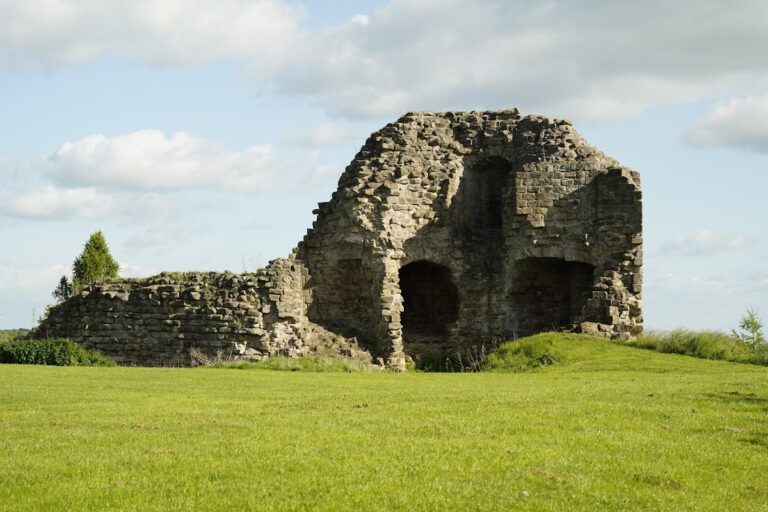
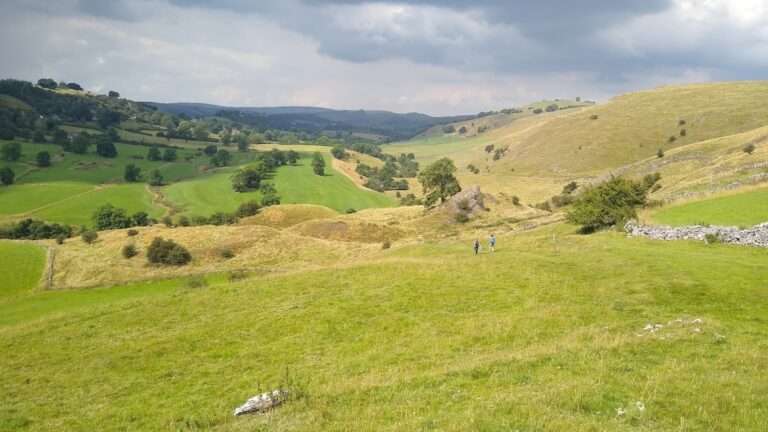
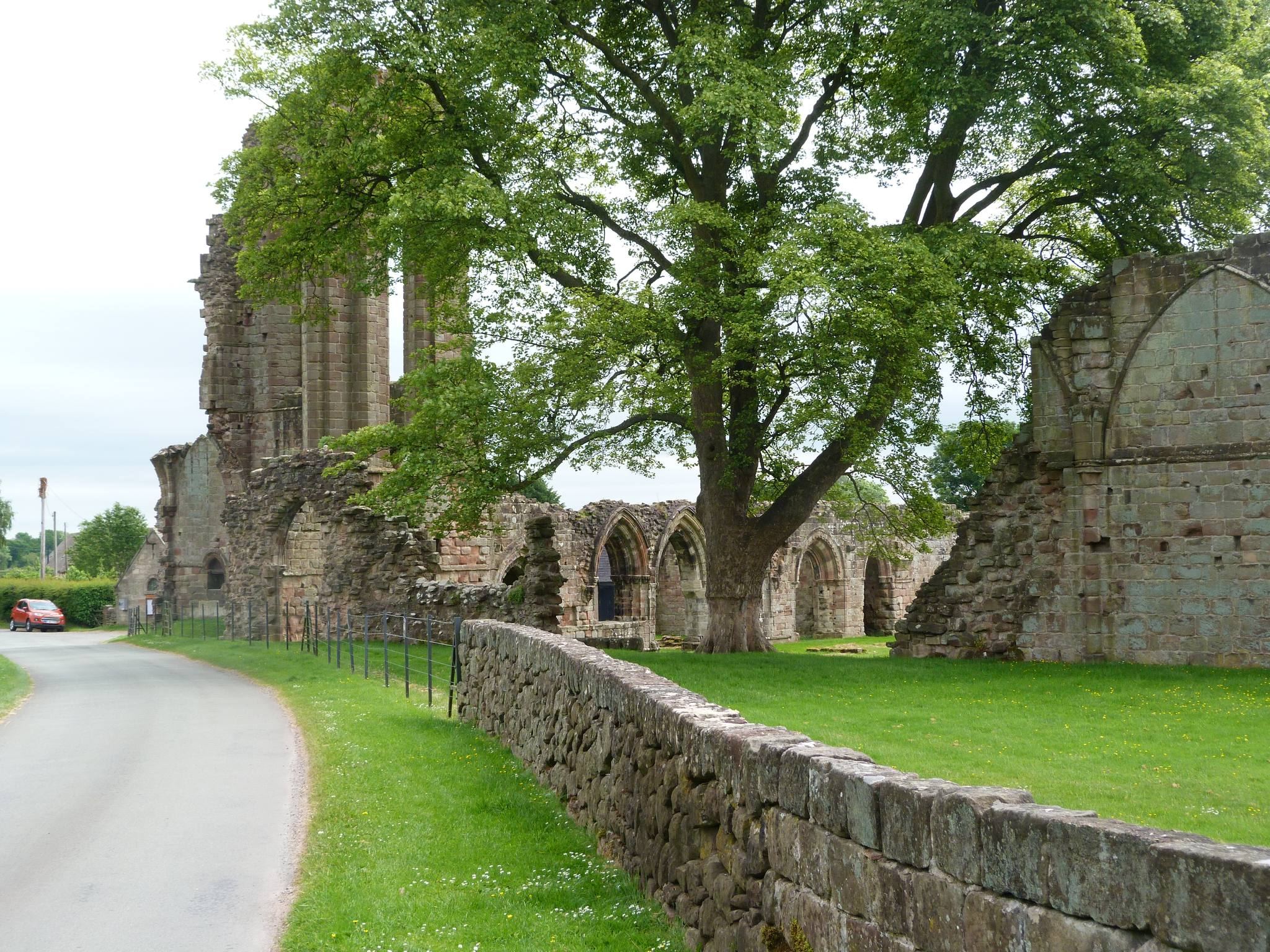
Croxden Abbey stands about six to seven kilometres north-west of Uttoxeter beside a small stream that feeds the River Dove. Modern agricultural buildings surround the remains. The plan followed the arrangement of the mother church at Aunay and was more elaborate than that of many Cistercian houses. The church occupied the northern part of the complex, while the conventual and service buildings lay to its south. A modern road now runs diagonally through the church ruins, cloister, and monks’ buildings. Archaeological excavation has revealed foundations belonging to structures whose standing fabric was later demolished.
Abbey church
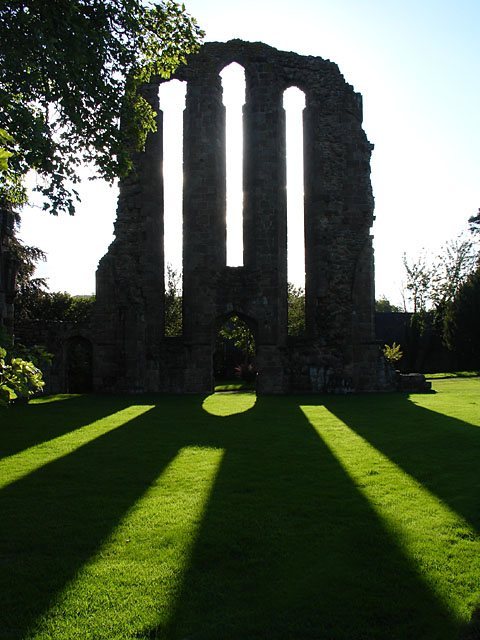
The red-sandstone abbey church measured about 240 feet, or 73 metres, in length. Its nave had eight bays and three aisles. At the eastern end, the plan departed from the usual Cistercian arrangement with a semicircular apse and five semicircular chapels opening from an ambulatory, the passage around the sanctuary. The substantially surviving west front contains two doorways, three slender lancet windows, and a Gothic entrance framed by five archivolts. An archivolt is a moulded band that follows the curve of an arch, while a lancet is a tall, narrow pointed-arch window. Parts of the crossing also survive, particularly the south transept.
Cloister and monastic buildings
Fragments of the cloister and a three-aisled chapterhouse remain. The chapterhouse was the room where the monastic community met for administrative business and heard a daily reading from its rule. The wider group of conventual and service buildings included the sacristy, kitchen, and dormitory. Their excavated foundations help define the arrangement of the monastic complex.
Abbot’s house
An independent abbot’s house dating from the fourteenth century survives to the south-east of the main monastic buildings. Its separate position reflects the distinct accommodation and administrative arrangements that developed within the later abbey complex.
Uttoxeter Casket
The Uttoxeter Casket, also known as Dr Nelson’s Casket, is a wooden Anglo-Saxon reliquary probably originating from Croxden Abbey. It probably held a religious relic and was displayed on an altar. The casket is now held by the Cleveland Museum of Art in Ohio.