Tutbury Castle: A Medieval Castle and Place of Royal Custody


Site at a Glance
- Rating
- 4.4
- Popularity
- Low
- Country
- United Kingdom
- Primary era
- Medieval
- Eras represented
- Medieval, Modern
- Civilizations
- English
- Site type
- Military
- Remains
- Castle
On this page13 sections
History
Tutbury Castle is a medieval castle in Tutbury, United Kingdom, whose early history belongs to the Norman period. It became the headquarters of Henry de Ferrers and the administrative centre of the Appletree wapentake, a historical district broadly comparable to a hundred, which included Duffield Frith. Its later history combined aristocratic residence, royal custody, and military conflict, leaving the castle closely associated with the Duchy of Lancaster and Mary, Queen of Scots.
Norman foundations and destruction
Around 1080, Henry de Ferrers and his wife, Bertha, endowed Tutbury Priory with two manors. At this time, the priory appears to have depended on the Norman abbey of Saint-Pierre-sur-Dives. The castle and priory formed part of the Ferrers family’s authority in the area, while Tutbury’s administrative role connected it with the wider management of their lands.
William de Ferrers, 3rd Earl of Derby, joined the rebellion against Henry II in 1173 and 1174. The rising challenged the king’s authority, and Tutbury was among at least 20 rebel castles that were slighted, meaning that they were damaged or partly demolished so they could not readily serve as strongholds. The castle suffered further destruction in 1264 after the rebellion of Robert de Ferrers, 6th Earl of Derby. Following another rebellion, its lands were granted to Edmund Crouchback in 1269 and thereafter remained part of the Duchy of Lancaster, the hereditary estate associated with the English sovereign.
Lancastrian residence
By the fourteenth century, Tutbury had been largely repaired and was used mainly as a residence rather than a military stronghold. John of Gaunt, the son of Edward III and a major English prince and landowner, substantially rebuilt the castle sometime before 1370.
From 1372 until her death in 1394, John of Gaunt’s second wife, Constance of Castile, lived permanently at Tutbury. Her court generously supported music and the arts and was said to have ambitions resembling those later associated with Windsor. Eleanor of Aquitaine, the powerful queen who was successively queen consort of France and England, was also among the castle’s notable occupants.
Mary, Queen of Scots at Tutbury
Tutbury became a place of royal custody after Mary, Queen of Scots, was forced to abdicate in 1567 and entered prolonged English custody. Following her defeat at Langside in 1568, the English Privy Council considered Tutbury, Nottingham, and Fotheringhay as possible places of detention because they lay farther from the Scottish border and Yorkshire. Mary reached Tutbury on 4 February 1569 after being transferred from Bolton Castle through Ripon, Wetherby, Pontefract, Rotherham, Chesterfield, and Wingfield Manor.
The Royal Wardrobe in the Tower of London sent tapestries, furniture, and bedding to prepare the castle for her. Bad weather delayed the supplies, so Bess of Hardwick sent additional furnishings from Sheffield. Mary regarded Tutbury as damp and poorly maintained, complaining about wet plaster and draughts caused by old carpentry that fitted badly. She moved to Wingfield Manor in April 1569, returned to Tutbury in September under heavier guard and with a smaller household, and was taken to Coventry in November after the Catholic Rising of the North, a rebellion against Elizabeth I’s Protestant government. Elizabeth ordered her return on Christmas Eve, and Mary was back at Tutbury on 2 January 1570 before being sent to Chatsworth in May.
Mary returned to Tutbury in January 1585 through Wingfield Manor. Her keepers, Ralph Sadler and John Somers, arranged hangings for her bedchamber, while hangings brought from Lord Paget’s houses at Burton and Beaudesert were judged unsatisfactory. Mary had a billiard table and was sometimes taken by Sadler hawking on the River Dove, within three miles of the castle, under the guard of 40 or 50 mounted men. Elizabeth I later prohibited this freedom.
On 19 April 1585, Sir Amyas Paulet assumed responsibility for Mary. He removed her cloth of estate, restricted her servants’ use of the wall walk near the gate, curtailed her charitable activities in Tutbury, and disarmed many of her Scottish servants, who carried pistols. Mary was allowed to hunt deer with her greyhound at Stockley Park near Anslow in July, but she left Tutbury for Chartley Castle on Christmas Eve 1585.
Decay, Civil War, and demolition
The castle fabric began to decay by the late sixteenth century. James I nevertheless stayed there several times between 1619 and 1624, and in August 1624 he knighted Sir Henry Rainsford and Sir Edward Vernon at Tutbury.
During the English Civil War, the conflict of the 1640s between supporters of Charles I and Parliamentary forces, Royalist troops held Tutbury for the Crown and strengthened its defences. Parliamentary forces failed to dislodge the garrison in 1643, but the castle surrendered after a three-week siege in April 1646. Sir Andrew Kniveton, the governor, drew up the surrender treaty, which was signed on 20 April.
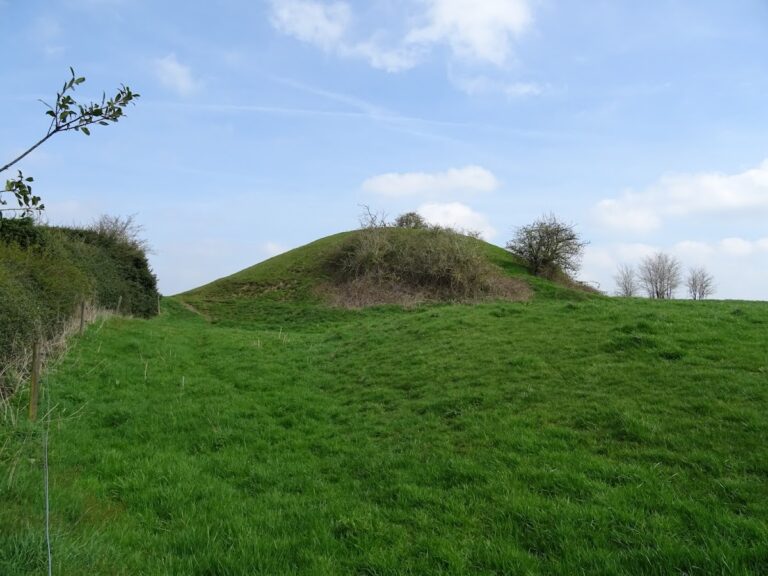
In 1647 Parliament declared the castle untenable because of the siege and the damage it had caused. Its fortifications were ordered to be demolished, and demolition took place from 1647 to 1648. A folly was later built on the motte in 1780. Tutbury remains owned by the Duchy of Lancaster and is both a scheduled monument, a legally protected archaeological or historic site in England, and a Grade I listed building of exceptional national architectural or historic interest. Lesley Smith became curator and leased the castle from the Duchy in 1999.
Remains
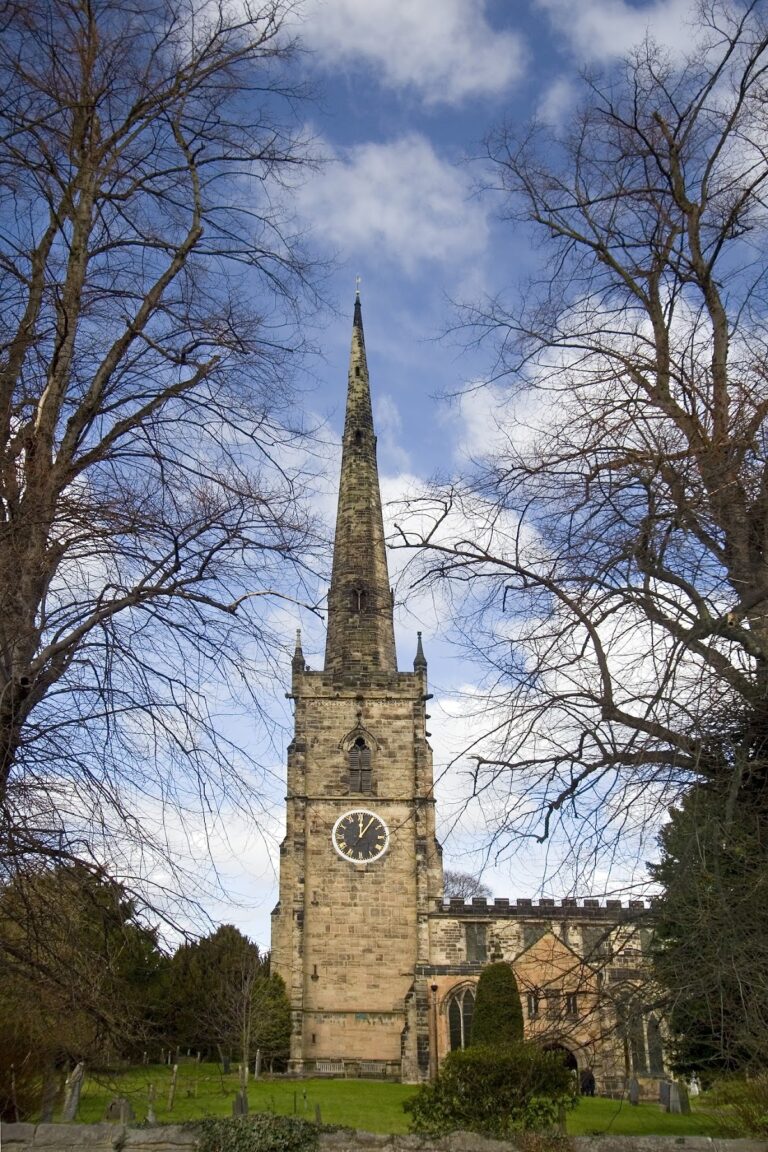
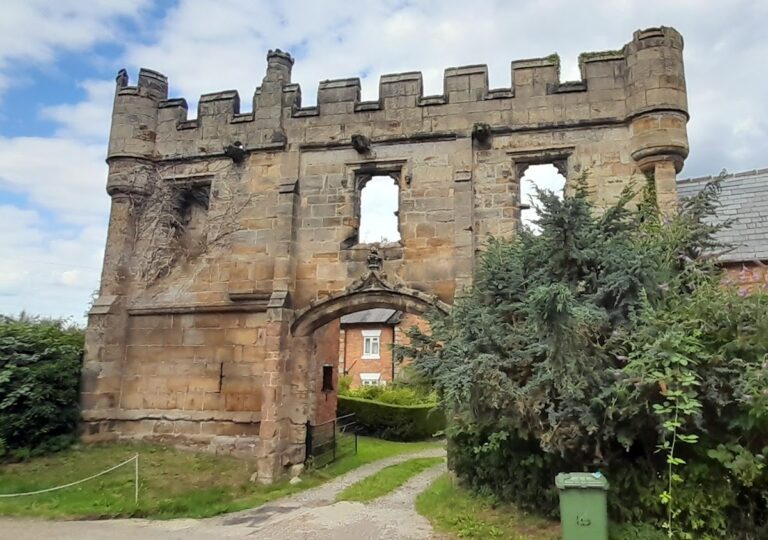
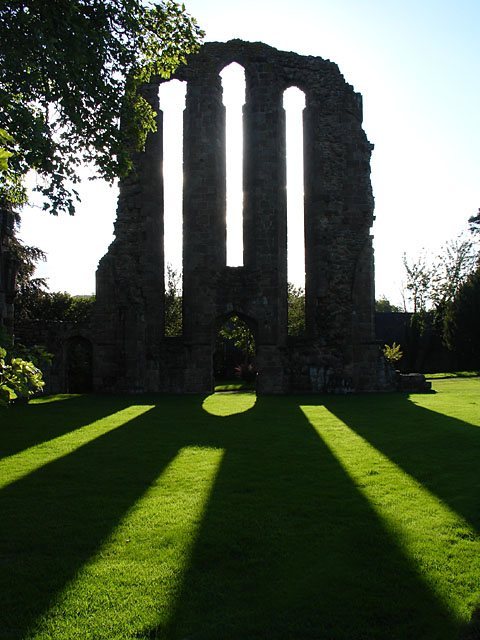
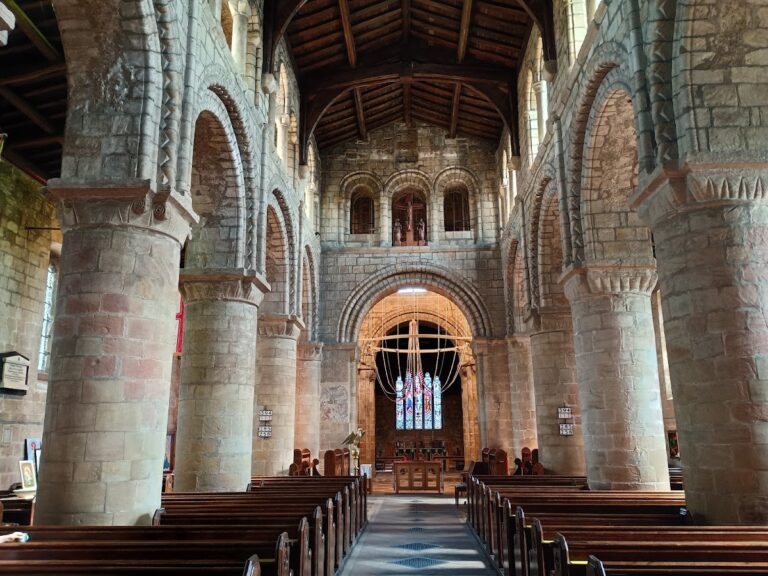
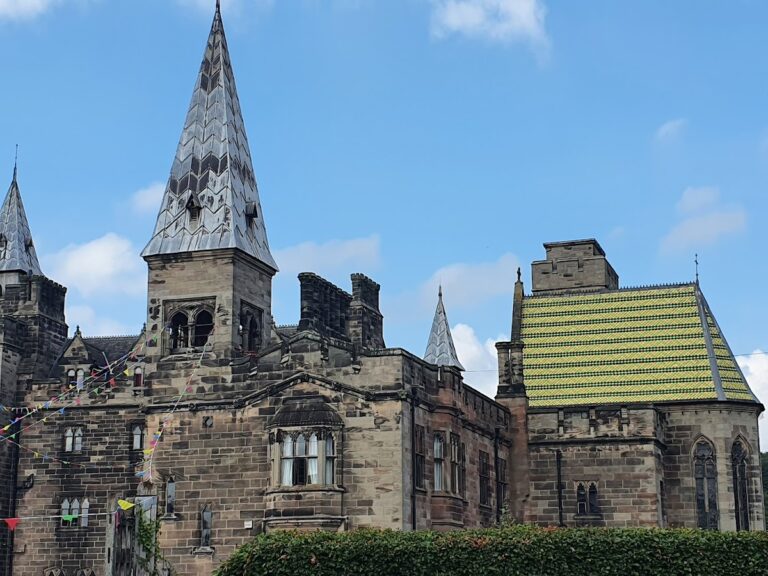
Tutbury Castle survives as a largely ruined medieval complex on a slight hill. Its physical arrangement includes inner and outer bailey walls, a great tower, a motte, and a castle court. The surviving ruins mainly belong to rebuilding in the fourteenth and fifteenth centuries, while the castle also contained a chapel dating from the twelfth century.
Earthworks and principal ruins
Motte and baileys
The motte is a raised earthwork mound incorporated into the fortified castle site. The 1780 folly stands on its summit. Around it, the surviving inner and outer bailey walls define the principal enclosed areas of the castle. The enclosure and castle court formed part of the accommodation used by Mary, Queen of Scots, who compared the setting with a hunting lodge and recalled the Bois de Vincennes.
Great tower and chapel
The great tower is one of the principal surviving elements of the ruined castle. The enclosure also included a twelfth-century chapel, while much of the other surviving masonry belongs to the fourteenth- and fifteenth-century rebuilding. A gate, a wall walk near the gate, and dykes around or near the accommodation formed additional parts of the complex.
Mary, Queen of Scots’ lodgings
1585 bedchamber
Mary’s 1585 bedchamber occupied the top of a timber-built lodging placed against the castle wall immediately beneath the roof. Its two windows looked into the castle court. Mary arranged a tapestry tent over her bed to improve its warmth, and the room was affected by the dampness, wet plaster, draughts, and ill-fitting carpentry that troubled her during her custody.
Earlier lodging
Another lodging, used by Mary in 1569 and considered as an alternative in 1585, contained two chambers approximately 24 feet, or 8 metres, above the ground. Their windows looked across the dykes towards Tutbury town. The windows and a latrine, then called a house of office, were regarded as possible escape routes, making the lodging difficult to secure. A sketch plan of Mary’s rooms at Tutbury is held by the British Library.
Mary’s accommodation was furnished, or intended to be furnished, with tapestries, furniture, and bedding. The castle’s surviving associations with her imprisonment also extend to the billiard table she possessed there. A wooden enclosure built by John Somers as a garden was criticised by Mary for resembling a pig run.
Traditions of the ruined castle
Local tradition associates the ruins with apparitions, including a soldier on the walls, a White Lady in a tower window, and Mary, Queen of Scots. The royal bedchamber is also linked to reports of visitors experiencing faintness.