Nostra Signora della Consolazione e San Vincenzo martire: An Augustinian Parish Church in Genoa
Site at a Glance
- Rating
- 4.6
- Popularity
- Low
- Country
- Italy
- Primary era
- Early Modern
- External website
- Open
- Eras represented
- Early Modern, Modern
- Civilizations
- Genoese, Italian
- Site type
- Religious
- Remains
- Church
On this page18 sections
History
Nostra Signora della Consolazione e San Vincenzo martire is a Roman Catholic parish church in Genoa, Italy, built between 1681 and 1706 in the Baroque period. It belongs to the Carignano-Foce vicariate of the Archdiocese of Genoa and is also known as Santa Maria della Consolazione or, because of the twentieth-century devotion to Saint Rita, the Church of Santa Rita.
The Augustinian foundation at Artoria
A church dedicated to Our Lady of Consolation was documented in Genoa from 1475. It belonged to the Congregation of the Consolation, a reformed community within the Order of Saint Augustine. Founded in Genoa in 1473 and later approved by Pope Leo X, the congregation eventually possessed 34 monasteries. Augustinian communities followed the rule associated with Saint Augustine of Hippo and combined religious life with pastoral work, study, and preaching.
Blessed Giovan Battista Poggi, the congregation’s prior, established his residence at the earlier church. Under the Augustinians, the complex became a center of spirituality and culture. Artists from Florence, including Perino del Vaga, contributed to its decoration. The church and convent stood at Artoria, outside Genoa’s walls on the slopes of Mount Zerbino.
Genoa’s new defensive walls, built in 1632, passed over or close to the complex. Because the area was considered unsafe during a military attack, the church and convent were demolished in December 1681 despite opposition from the Augustinians. The community temporarily worshipped at the nearby parish church of San Vincenzo and lived in Francesco Pinelli’s palace.
Construction of the present complex
Between 1683 and 1684, the Augustinians acquired the palace, together with a villa and garden belonging to the church official Giulio Vincenzo Gentile. Gentile laid the foundation stone of the new church in 1684. Construction of the present complex continued until 1706, while the church opened for worship in 1693 under the patronage of the Genoese families Durazzo, Della Torre, Canevari, and Lercari-Castiglione. The architect is uncertain, although the design has been attributed to Piero Antonio Corradi.
The Augustinians devoted much of their available funding to adapting the Pinelli palace as a monastery and cultural center rather than to extensive decoration of the church. Work on the adaptation began in 1699, and the monks moved into the monastery in 1708. The whole palace was never converted. Some rooms were used, and continue to be used, by secular institutions.
The former monastery covered about 10,000 square metres and rose over four floors, with the upper floor largely occupied by a library. An eighteenth-century cloister was begun but not completed. Toward the end of the nineteenth century, it became part of the Mercato Orientale. The market retains the original colonnades on the sides facing the church and Via XX Settembre, together with the closed portal on Via Galata. Its other two sides were completed later.
Parish transfer and nineteenth-century completion
The parish of San Vincenzo had existed since 1163, but urban development left its church too small for parish use. Its functions and dedication were transferred to the church of Our Lady of Consolation, which thereby acquired the additional dedication to Saint Vincent the Martyr. The former San Vincenzo church was first used as barracks and later as a garrison club.
Napoleonic suppression of religious orders brought another change. The Augustinians were expelled in 1810, and the church passed to the diocesan clergy. It became a parish in 1813. The Augustinians returned in 1816 and continued to administer the parish.
Decoration continued throughout the nineteenth century, with contributions from Giuseppe Paganelli, Michele Canzio, Giovanni Quinzio, Francesco Semino, and Giuseppe Isola. Paolo Micallef, Archbishop of Pisa, formally consecrated the church in 1875, after which additional fresco cycles were produced. On 13 December 1890, Archbishop Salvatore Magnasco granted the church the title of provost church.
Devotion, conservation, and collections
During the twentieth century, devotion to Saint Rita of Cascia expanded considerably. Saint Rita was a late-medieval Italian Augustinian nun traditionally associated with difficult and seemingly impossible causes, and her veneration commonly includes the blessing of roses. In the church, her altar replaced one formerly dedicated to Saint Roch. The blessing of roses on 22 May attracted large numbers of worshippers.
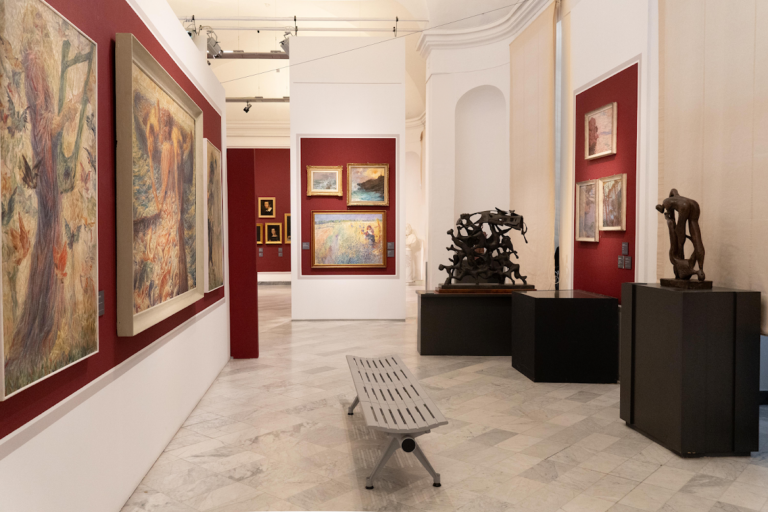
On 12 February 1961, Cardinal Giuseppe Siri blessed the new bronze entrance doors. A museum of sacred art was established in connection with the 2008 celebration of the Augustinian jubilee and the associated Torch of Friendship among Nations initiative. It preserves liturgical vestments, chant books, silver objects, devotional paintings, and other historic works connected with the church and the former Augustinian complex.
The church’s furnishings also include works transferred from the earlier complex at Artoria and from suppressed Genoese churches. These include Sant’Agostino, San Vincenzo, San Sebastiano, San Camillo, Santa Maria della Pace, and the oratories of the Rosary and the Belt. Conservation under the Ligurian heritage authorities restored the large medieval crucifix after more than a century of neglect caused by an unsuccessful repainting.
Remains
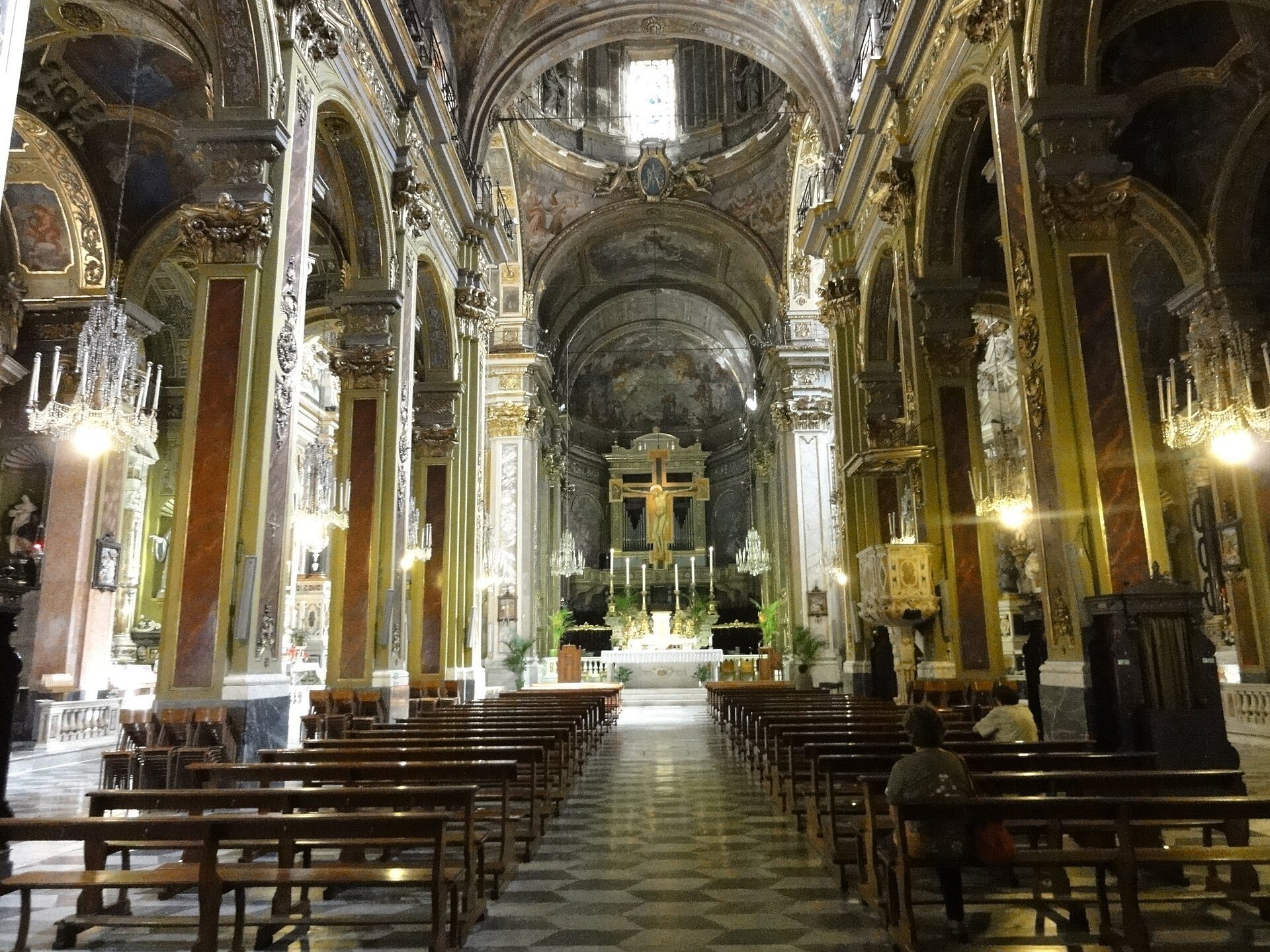
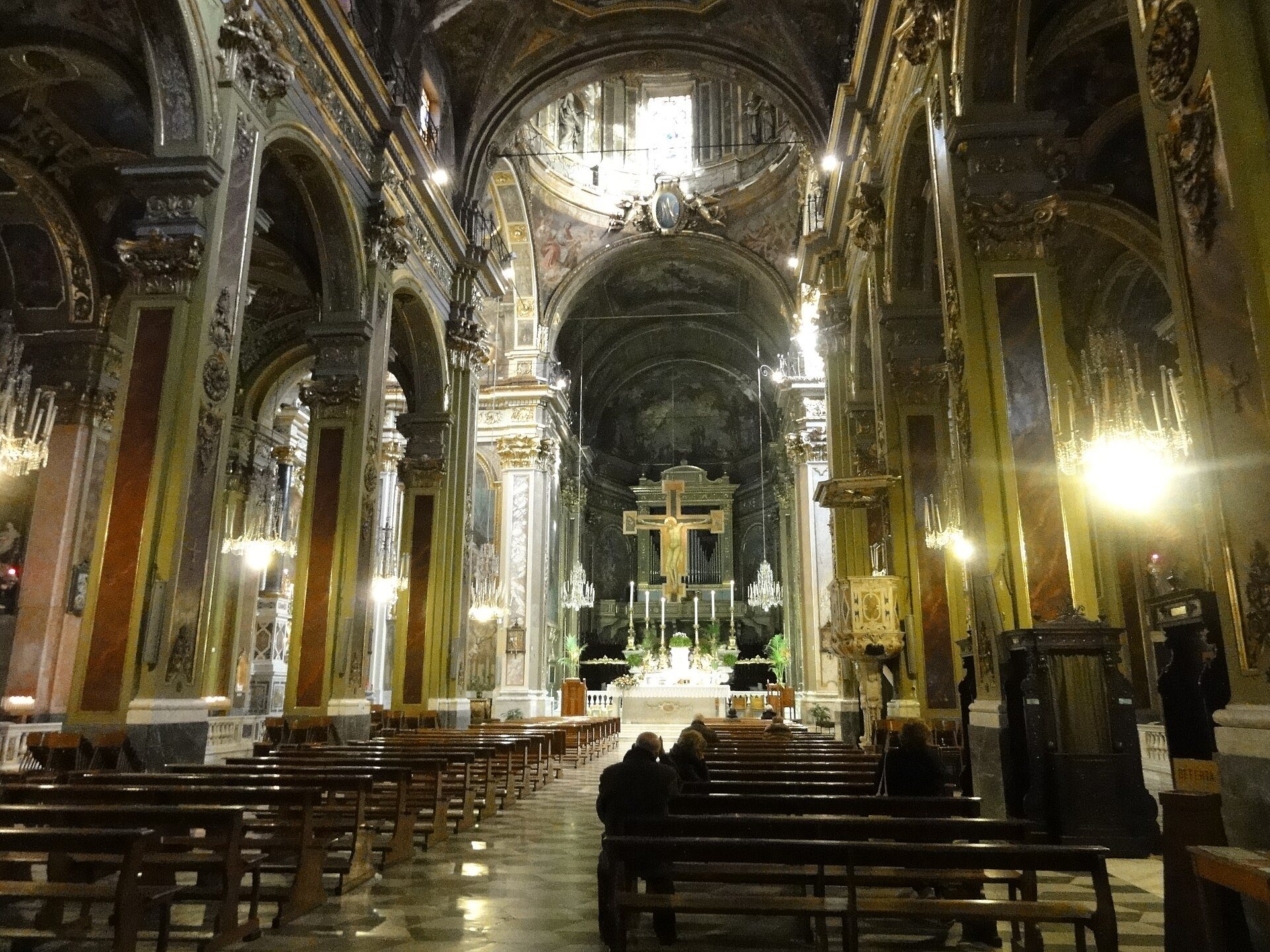
The surviving church is a Baroque building with later neoclassical elements. Its plan has three aisles divided by square piers, a transept, a dome over the crossing, and an elongated presbytery. Ten side chapels, five on each side, contain the secondary altars. The church and associated former monastery preserve a concentration of paintings, sculpture, furnishings, architectural fragments, and liturgical objects from the Augustinian complex and other Genoese churches.
Exterior and main interior
Facade and entrance
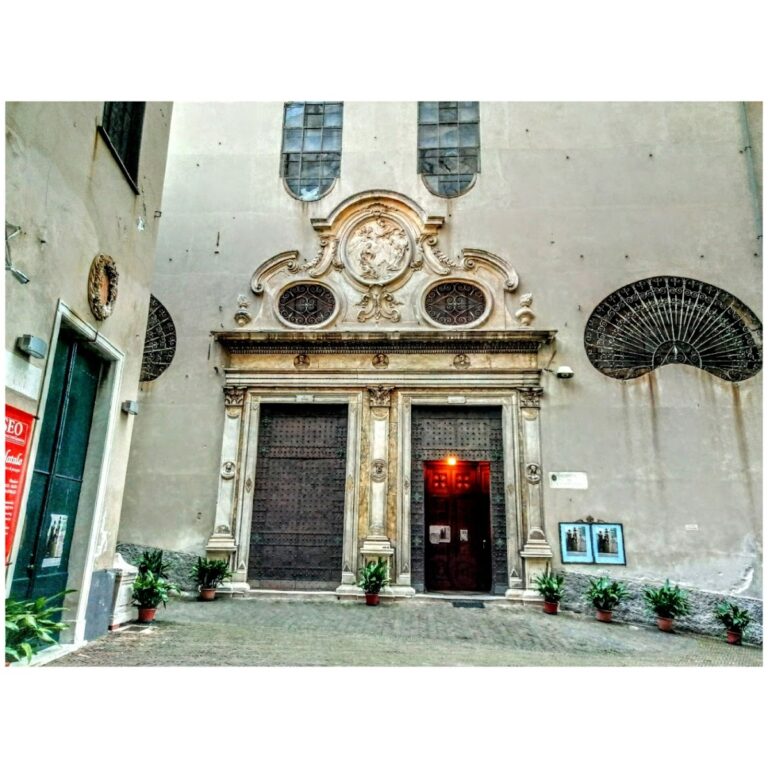
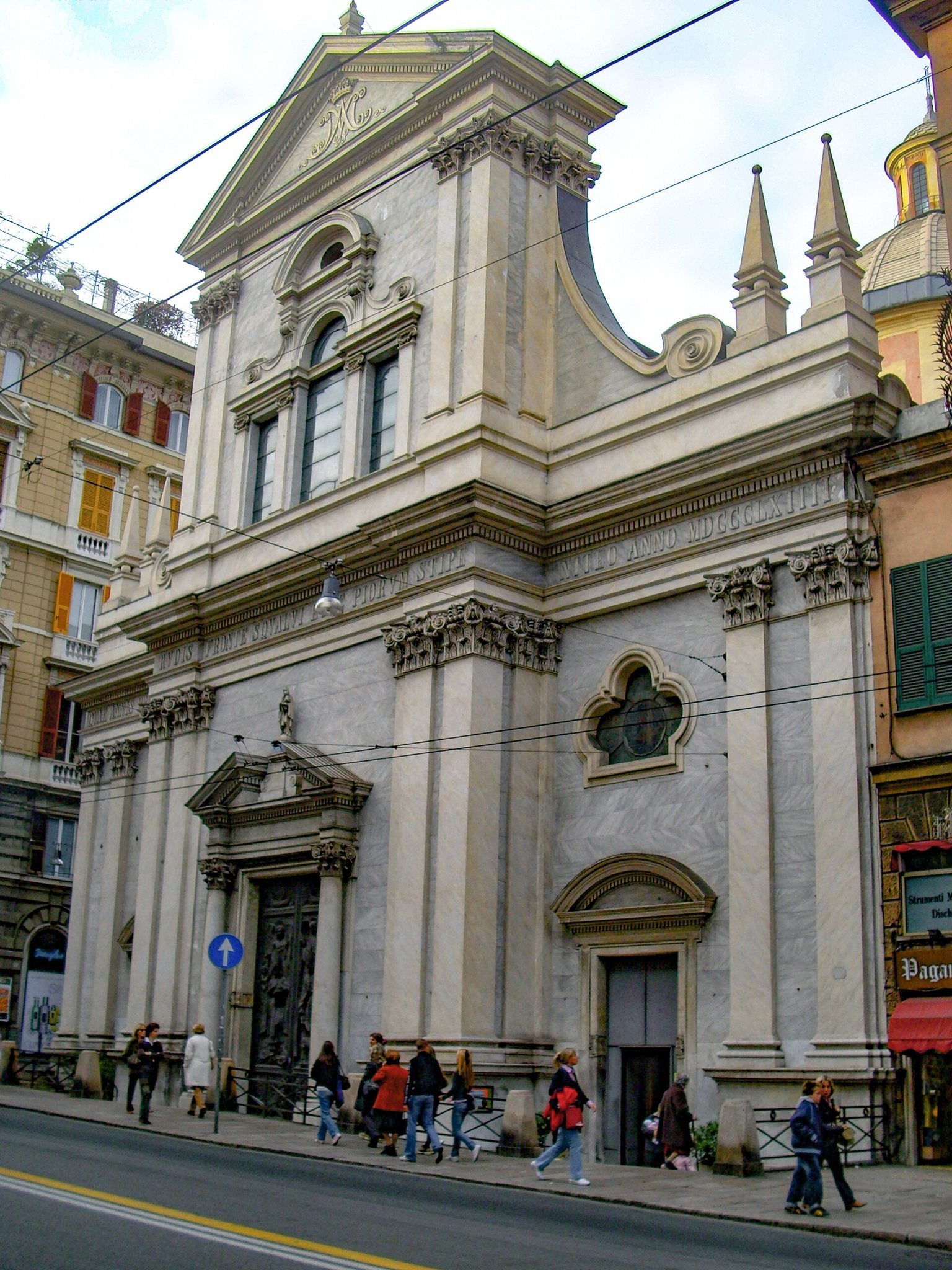
Carlo Biale completed the two-colour Baroque facade in 1864, freely interpreting designs published by Peter Paul Rubens during his stay in Genoa. The main portal contains a copy of a sixteenth-century marble Madonna and Child. The original came from the church at Artoria and was badly damaged by wartime events; it is preserved inside the present church.
The entrance doors carry two bronze reliefs made by Mistruzzi in 1961. Saint Augustine appears on the left and Saint Thomas of Villanova on the right. The entrances now lie below street level because Via XX Settembre, opened in the late nineteenth century, was built higher than the earlier Via della Consolazione.
Nave, dome, and vaults
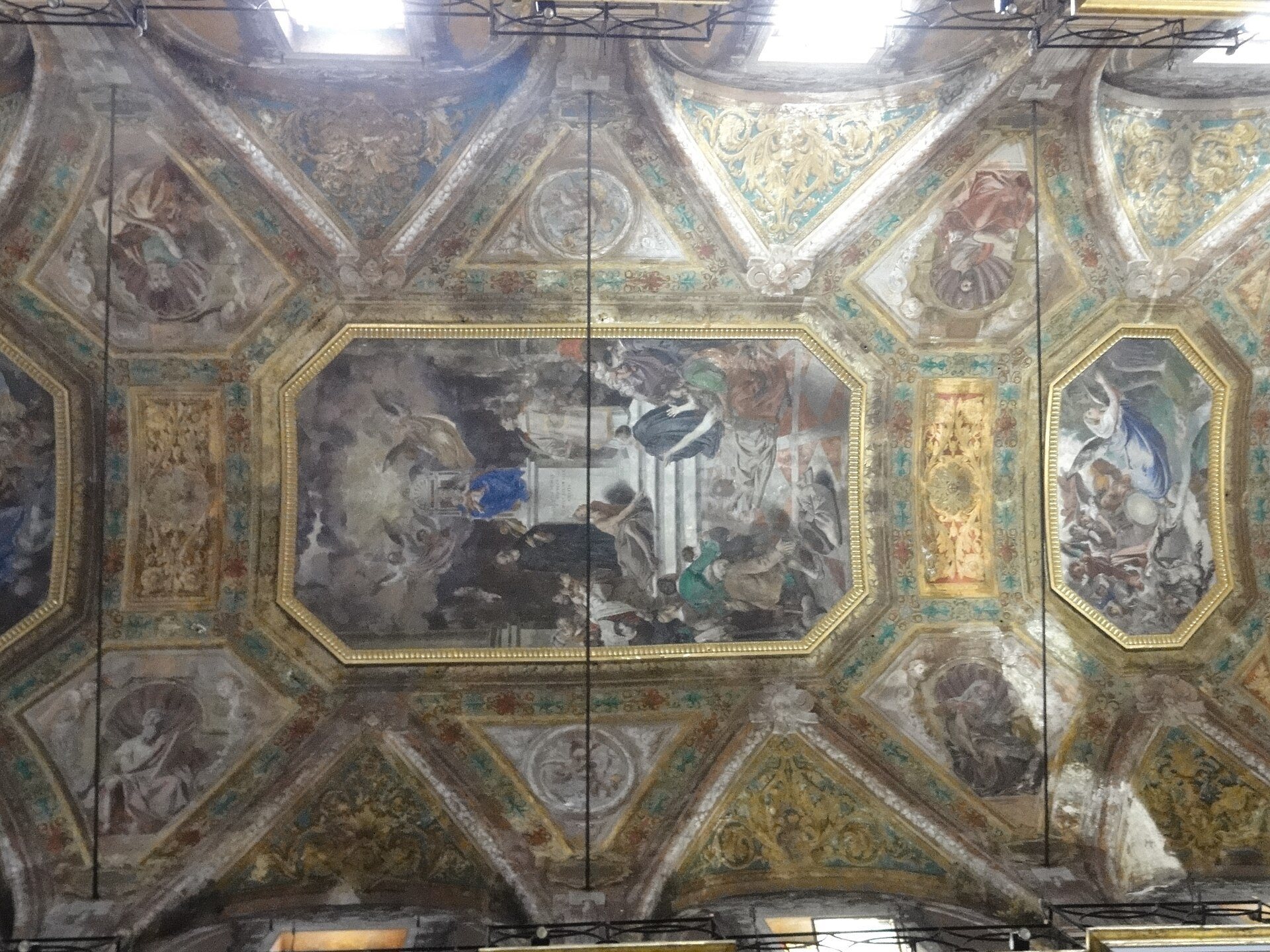
The dome was added in 1769 to designs by Simone Cantoni. Its vault contains Francesco Semino’s 1878 fresco of the Fall of Lucifer, while stucco statues of the Doctors of the Church decorate the drum. Giuseppe Isola painted the central vault and inner facade in 1874. His central cycle includes two Apocalyptic Visions and the Madonna of Consolation enthroned between Saints Augustine and Vincent. The inner facade bears Judith Triumphant in Bethulia.
The large window contains stained glass made by R. Arbertelli in 1948, depicting Saint Monica, Our Lady of Consolation, and Saint Augustine. Giovanni Quinzio painted the frescoes of the side aisles. A glazed terracotta Nativity, dated 1475 and associated with the school of Andrea della Robbia, is fixed to the pier between the Chapel of Saint Vincent and the adjacent chapel.
Presbytery and apse
The presbytery rises several steps above the nave. On its right, behind glass, is a fragment of wall from the sacristy of the earlier Artoria church. It bears a monochrome chiaroscuro fresco of the Entombment, attributed to Perino del Vaga. Chiaroscuro models forms through strong contrasts of light and dark. Cesare Maccari painted the Baptism of Saint Augustine and the Ordination of Saint Augustine as Bishop on the presbytery walls in 1889.
A nineteenth-century marble balustrade separates the presbytery from the apse. The apse contains a late-seventeenth-century Genoese former high altar and an Augustinian choir with elaborate eighteenth-century wooden stalls. A large rotating lectern, or badalone, held the choir manuscripts and could be turned toward different singers. Filippo Alessio painted Saint Vincent in Glory on the presbytery vault and the Madonna of Consolation Adoring the Son on the apse vault in 1825.
Above the high altar hangs a double-sided painted crucifix measuring approximately 5.18 by 4.18 metres. Painted around 1350 by the anonymous artist known as the Master of Santa Maria di Castello, probably a follower of Pietro Lorenzetti, it shows the crucified Christ against a gilded ground. It probably came from the Gothic church of Sant’Agostino in Sarzano and entered the present church after the Napoleonic suppressions. Gold stars on a blue ground on its reverse indicate that it was designed to hang above an altar. Cesare Fera designed its present altar slab and wooden choir stalls in 1993.
Sacristy
Wooden doors on the right side of the presbytery lead to the sacristy, which is connected by a passage to the monastery. It contains eighteenth-century furniture and an eighteenth-century altar with a painting of the Giving of the Girdle to Saint Thomas the Apostle. Relics of the Augustinian friar Blessed Vaseraria were placed in a seventeenth-century wooden sarcophagus within the altar slab.
The vestibule contains a large processional crucifix attributed to Bernardo Schiaffino. Giovanni Battista Merano painted the Glory of Saint Augustine on the sacristy vault.
Side chapels and devotional works
Augustinian and Saint Vincent chapels
The right transept contains the Chapel of Saint Augustine and Our Lady of the Belt, built in 1718 by Domenico Torre. Bernardo Schiaffino made the marble group of the Madonna with Saints Augustine and Monica, with angels giving the belt to Augustine. The group stands in a niche between pairs of spiral columns in black Portovenere marble, and Schiaffino also made the putti beneath the altar slab. Paolo Gerolamo Piola painted the vault frescoes in 1722, including the Baptism of Saint Augustine and the Angel Appearing to Saint Monica. Related paintings show Saint John the Baptist, a Prophet, and Saint Peter Receiving the Keys from Christ.
The chapel also contains Giuseppe Capecci’s tomb with a marble bust and a glazed maiolica relief of the Madonna Adoring the Child. The relief came from the original church and was made by the workshop of Luca della Robbia.
The Chapel of Saint Vincent the Martyr contains the Martyrdom of Saint Vincent, dated 1605 and attributed to Lazzaro Tavarone or his school. The painting came from the former parish church of San Vincenzo. The chapel also holds a reliquary of Saint Pius the Martyr, nineteenth-century stucco statues of Saints Peter and Paul, and Giovanni Quinzio’s fresco of the Preaching of Saint Vincent.
Other Augustinian chapels
The Chapel of Saint Nicholas of Tolentino contains a wooden statue made by Agostino Storace, a pupil of Anton Maria Maragliano, around 1760 to 1770. The statue was heavily repainted in the nineteenth century. Nineteenth-century stucco statues of Saints William and Helena accompany Giovanni Quinzio’s fresco of the Dormition of Saint Nicholas.
The Chapel of the Immaculate Conception contains a polychrome wooden statue made by Stefano Valle around 1875, nineteenth-century stucco statues of Saints Catherine and Agnes, and Giovanni Quinzio’s vault fresco of the Flight into Egypt. The first right-hand altar is dedicated to Saint Joseph and Blessed Maria Teresa Fasce. It displays Domenico Fiasella’s Saint Thomas Distributing Alms, transferred from the original church, while the vault bears Quinzio’s Saint Augustine in Glory.
The Chapel of Saint John of Sahagún contains an eighteenth-century painting by Francesco Narice showing the saint miraculously saving a child who has fallen into a well. Its vault bears Quinzio’s Saint Peter among the Pagans. The Chapel of Saint Lawrence contains Domenico Piola’s Martyrdom of Saint Lawrence, commissioned for the corresponding chapel in the earlier church by Lorenzo Canevaro. Quinzio painted the Imprisonment of Saint Lawrence on its vault.
Rosary, Saint Rita, and Our Lady of Health
The Chapel of Our Lady of the Rosary contains a large seventeenth-century altarpiece or sculptural apparatus by Giovanni Battista Santacroce, dated between 1625 and 1650 and transferred from San Vincenzo. The niche statues of Saint Dominic and Saint Catherine of Siena are attributed to the workshop of Anton Maria Maragliano. Quinzio painted the Annunciation on the vault.
The Chapel of Saint Rita contains Tito Troja’s nineteenth-century oval painting of the saint. It also includes the burial of the Augustinian friar Michele Agostino Delfino, nineteenth-century stucco statues of Blessed Simon of Cascia and Blessed Clare of Montefalco, and Quinzio’s Death and Glory of Saint Aloysius Gonzaga on the outer vault.
The Chapel of Our Lady of Health has an altar transferred from San Camillo in 1813. Its altarpiece is an eighteenth-century copy of a painting by Sassoferrato from the demolished church of Santa Maria della Pace, which formerly stood opposite the church. Giuseppe Paganelli’s paintings include Esther and Ahasuerus, the Brazen Serpent, and images of Saints Joachim and Anne.
Organs, monastery, and sacred-art collection
Pipe organs
The apse contains two pipe organs made by Giacomo Locatelli. The larger Opus 48 was built in 1880 and restored by Mascioni in 1975. It has entirely mechanical action, three 61-note keyboards, and a concave 27-note pedalboard. Opus 47, built in 1879, has mechanical action, one 58-note keyboard, and a concave 24-note pedalboard.
Former monastery and refectory
The former monastery’s refectory, once the ceremonial salon of the Pinelli palace, contains a collection of paintings. These include Orazio De Ferrari’s Holy Family of 1648, Luca Cambiaso’s large Last Supper, Antonio Semino’s signed and dated Entombment of 1547, Domenico Bocciardo’s Saint Roch Adoring the Madonna dated between 1746 and 1770, Michele Agostino Delfino’s Assumption of the Virgin, Antonio Giolfi’s Baptism of Saint Augustine and Translation of the Image of Our Lady of Good Counsel, and Antonio da Como’s Madonna with Saints Augustine, Roch, and Sebastian, dated 1529.
The Last Supper reflects the customary use of such scenes in monastic refectories, where they evoked the brotherhood of the religious community. The sacred-art collection also includes liturgical vestments, chant books, silver objects, devotional images, ceramics, a marble statue, a small fresco, eighteenth-century chalices, and objects associated with the monks who lived in the monastery. Some of these works came from the first Augustinian complex at Artoria.