Tikhvinskaya Church in Alekseyevskoe: A Russian Orthodox Church in Moscow
Site at a Glance
- Rating
- 4.7
- Popularity
- Low
- Country
- Russia
- Primary era
- Early Modern
- External website
- Open
- Eras represented
- Early Modern, Modern
- Civilizations
- Russian
- Site type
- Religious
- Remains
- Church
On this page13 sections
History
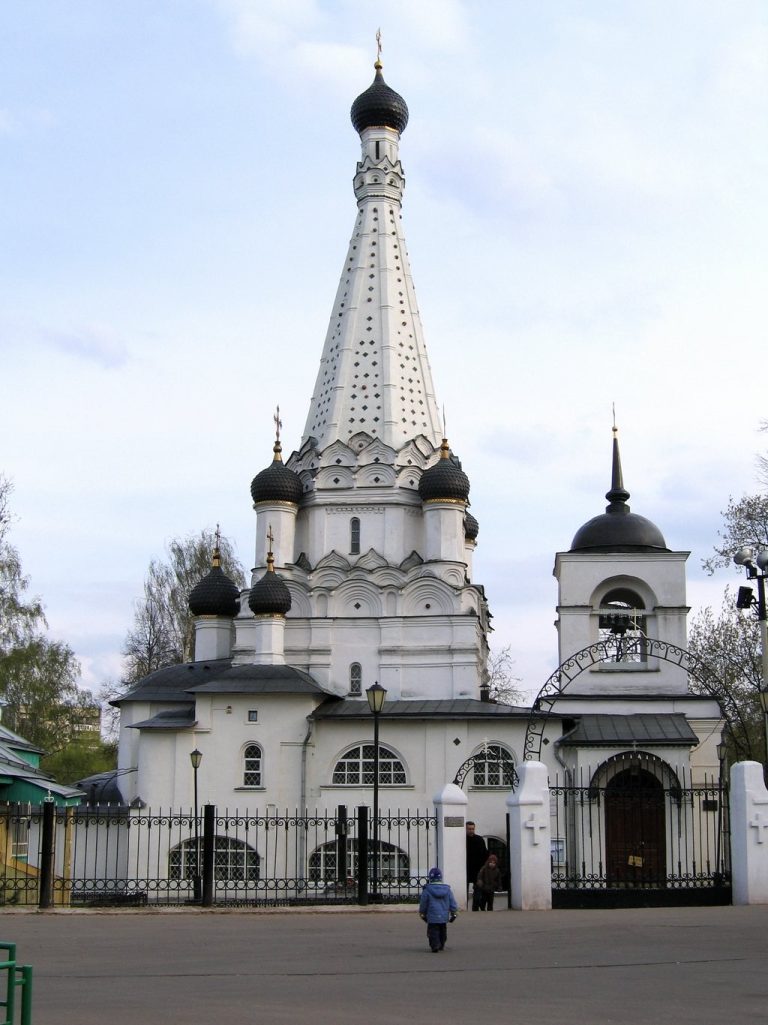
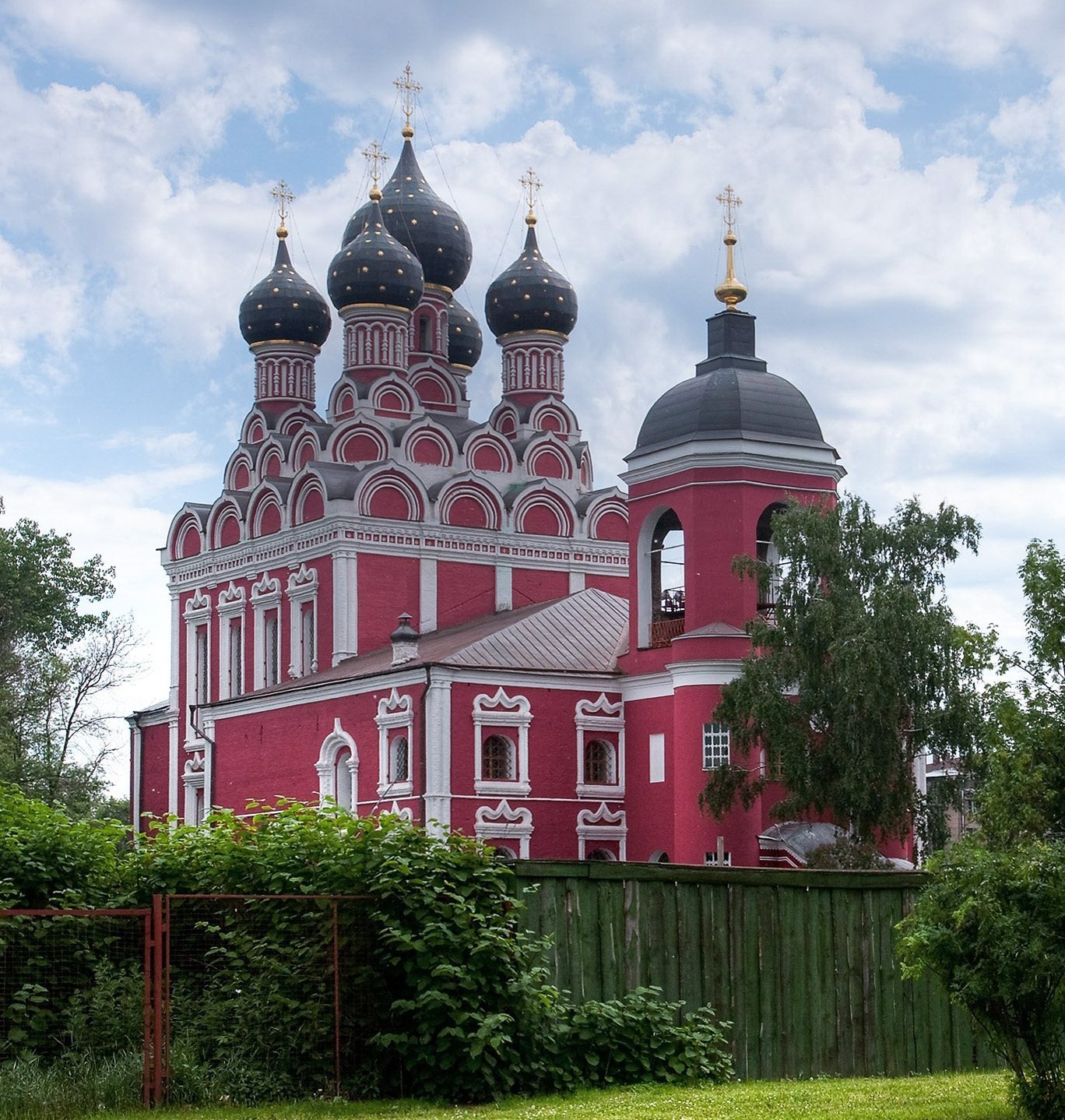
Tikhvinskaya Church in Alekseyevskoe is an active Russian Orthodox church in Moscow, Russia, built in the seventeenth-century Russian uzorochye style and consecrated in 1680. Dedicated to the Tikhvin Icon of the Mother of God, traditionally associated with the town of Tikhvin and venerated as miraculous, it belongs to the Moscow Diocese and the Trinity deanery. The church has remained open throughout its history.
The Alekseyevskoe estate
The settlement was known in the sixteenth century as Kopytovka and stood near the Retonka River. In 1621, it was granted to Prince Dmitry Trubetskoy for his military service during the liberation of Moscow from Polish intervention. After the death of his widow, Anna Trubetskaya, the estate passed to the Palace Department.
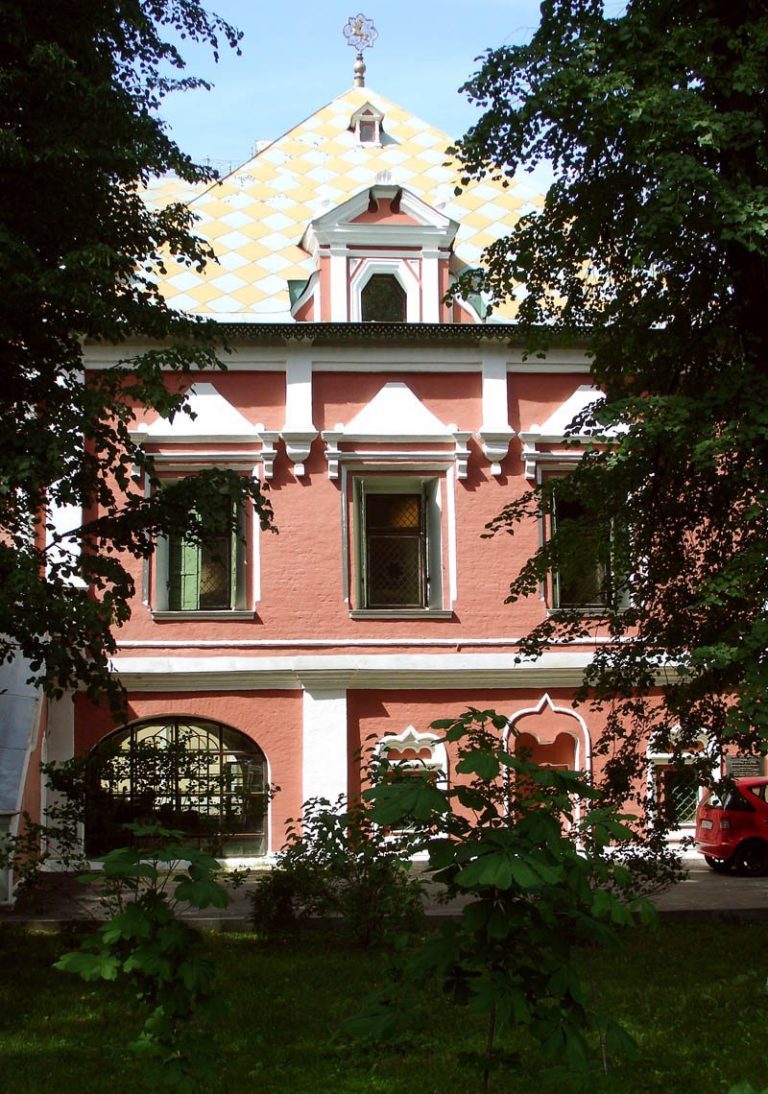
Anna Trubetskaya built the stone Church of Alexis, Man of God, in 1646 to 1648. The settlement later took the name Alekseyevskoe from this church. A royal way palace was probably constructed beside it for Tsar Alexei Mikhailovich, the seventeenth-century Russian ruler who used the estate as a royal way-station during hunting trips and journeys to the Trinity Monastery. The palace and the church were joined by a passage.
Foundation and consecration
At Alexei Mikhailovich’s direction, construction of the Tikhvin church began either in 1673 or in 1676 and was completed in 1680. The church was consecrated on 31 October 1680, after the tsar’s death. Patriarch Joachim presided, and Tsar Fyodor Alekseyevich, Alexei Mikhailovich’s son and successor, attended the ceremony. Fyodor presented the church with a Byzantine-style copy of the Tikhvin Icon.
The Tikhvin church and the older Alexis church originally stood about two sazhen apart, joined by a covered arcade. Together with the royal way palace, they formed a single architectural ensemble. The palace was dismantled because of decay before 1817, although it has also been suggested that it suffered severe damage in the 1812 fire.
War, rebuilding, and nineteenth-century additions
During the French occupation of Moscow in 1812, the church was plundered. The refectory, a church assembly building connecting the main sanctuary with subsidiary spaces, was converted into a stable, while the principal church space became a warehouse. After Moscow was liberated, Emperor Alexander I allocated funds for repairs.
The older Alexis church was dismantled in 1824, and its bricks were reused in the construction of the Tikhvin church’s bell tower. A later Alexis chapel preserves the dedication of the earlier village church. An Alekseyevskoe cemetery was established nearby during the same period, with its earliest recorded burials dating from 1844.
In the middle of the nineteenth century, the Konstantinov merchant family financed two chapels in the refectory, dedicated to Sergius of Radonezh and Nicholas the Wonderworker. They were consecrated on 23 May 1848, with iconostases designed by the architect Mikhail Bykovsky. A chapel dedicated to Alexis, Man of God, was added thirty-six years later, and the chapel of the Martyr Tryphon was established in 1917.
The Soviet period and later conservation
In April 1922, Soviet authorities confiscated 58 diamonds and precious church utensils weighing six poods in total. A pood was a traditional Russian unit of weight. The bells remained in place, although the ringing tier was no longer used. Many local icons were preserved, together with icons transferred from churches that were being closed.
A lower church dedicated to the Renewal of the Church of the Resurrection in Jerusalem was established in the basement in 1922. It used an iconostasis, the screen of icons separating the sanctuary from the main body of an Orthodox church, transferred from an unidentified house church. The lower church was later abolished and converted first into a fruit-and-vegetable depot and then into workshops belonging to the church enterprise Sofrino. The workshops occupied the space from 1961 until their relocation was completed by 1998.
The church remained open during the Soviet period. A tradition connects it with the bombing of Moscow in 1941 and claims that the Tikhvin Icon was carried by airplane in a procession around the city. This tradition is regarded as unsupported by historical evidence.
Repairs followed the Second World War, including a full-scale campaign in 1954. The interiors were restored during work in the 1970s and 1980s, when wall paintings from the first half of the nineteenth century were uncovered. Tikhvinskaya Church in Alekseyevskoe is protected as a cultural-heritage monument of federal significance in Russia. It is also associated with the Orthodox Culture Faculty of the Peter the Great Strategic Missile Forces Military Academy and with the Chapel of Saint Basil the Great at the All-Russian Exhibition Centre.
Remains
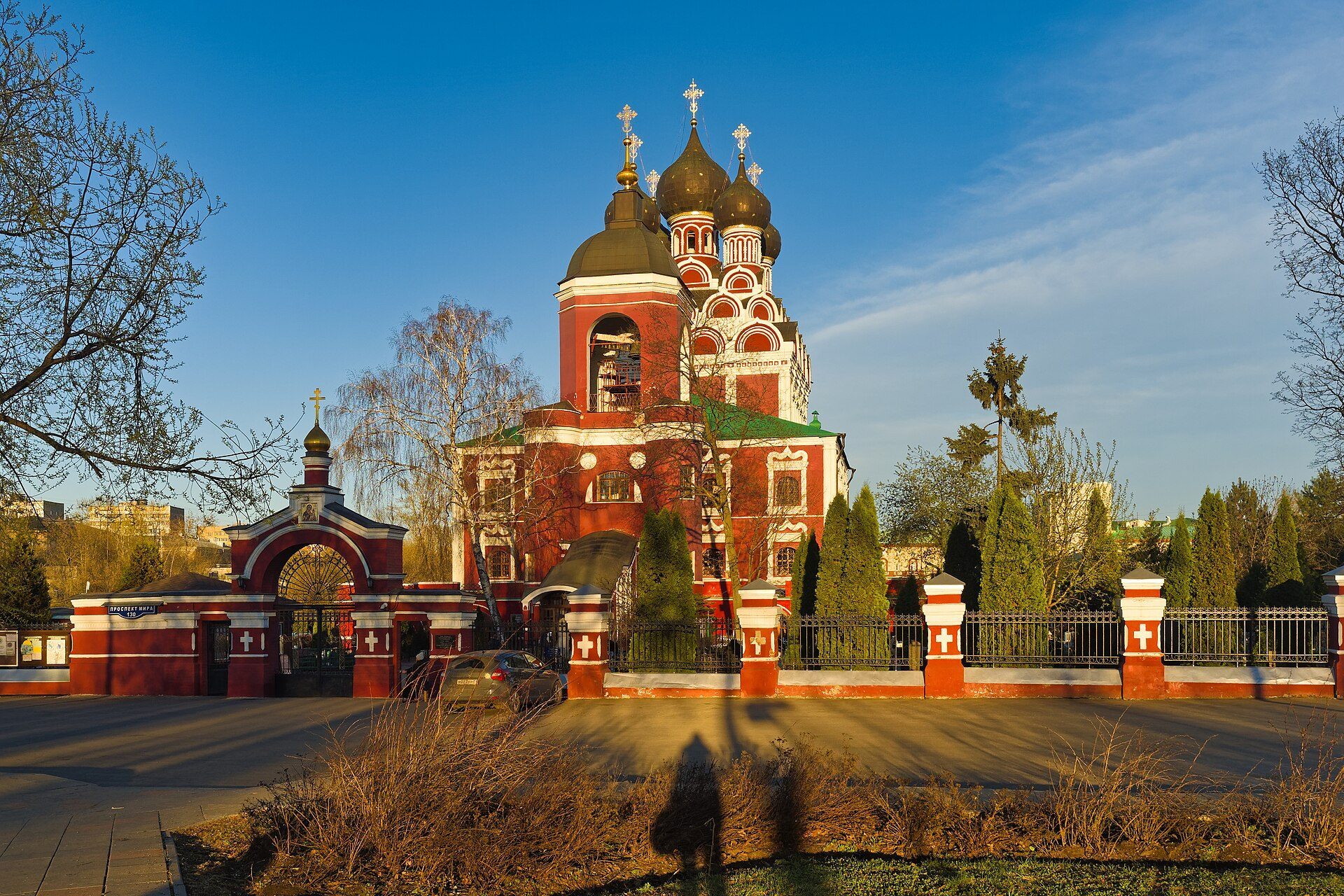
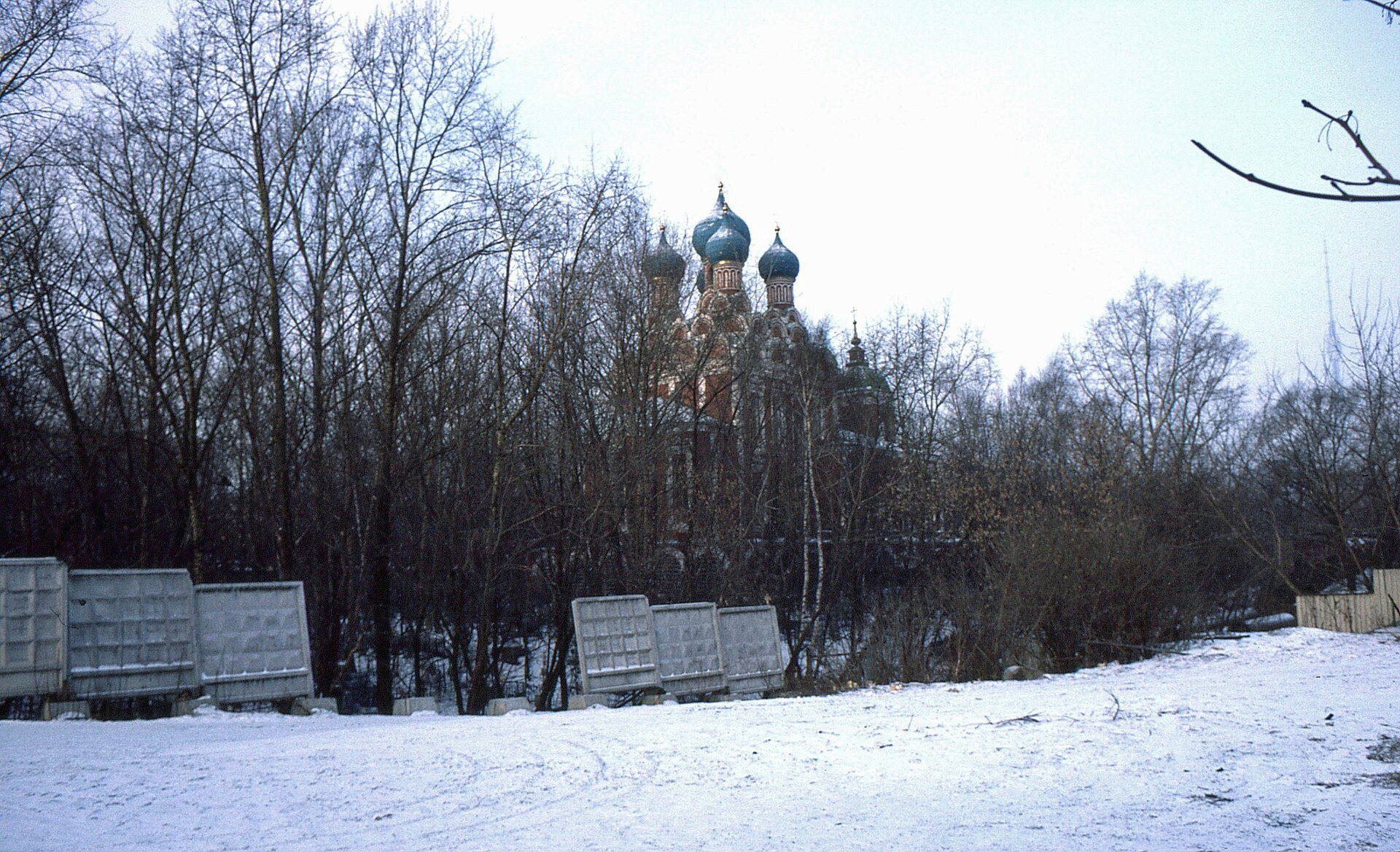
The surviving church is a large brick, five-domed building raised on a high basement. Its enlarged proportions allow it to accommodate approximately 3,000 people. The principal quadrangular volume is crowned by three continuous tiers of kokoshniks, ornamental gable-like forms characteristic of the building’s Russian uzorochye style, and supports five domes. A gallery surrounds the lower part of the main volume. On the western side, the church joins the refectory and a two-tier bell tower.
Church structure and former palace connections
Refectory and royal prayer rooms
The refectory retains evidence of its former connection with the royal way palace. A passage once led from it to the palace but was later blocked. Another passage in the north wall opened into separate enclosed prayer rooms for the tsar and tsarina. These rooms preserve tiled stoves and carved wooden candleholders.
Bell tower and covered arcade
The present bell tower incorporates bricks taken from the Alexis church when that older building was demolished in 1824. The two churches had originally been linked by a covered arcade with arches, forming part of the larger estate ensemble.
Interior decoration and sacred objects
Wall paintings and chapels
An artists’ workshop produced the main church’s wall paintings in 1836, possibly under the direction of Giovanni Scotti. Later restoration revealed traces of older paintings beneath or alongside the nineteenth-century work. The principal altar is dedicated to the Tikhvin Icon of the Mother of God. The interior also contains chapels dedicated to Sergius of Radonezh, Nicholas the Wonderworker, Alexis, Man of God, and the Martyr Tryphon.
Iconostasis and revered objects
The Tikhvin Icon stands beneath a special canopy in the local tier of a mid-seventeenth-century iconostasis. Other sacred objects include an icon of the Mother of God known as “Addition of Mind,” a cross containing particles of the relics of Nicholas the Wonderworker, and a reliquary, a container for preserving sacred remains, holding relics of saints. The church also contains an exact copy of the cave of the Holy Sepulchre.
Cemetery grounds
The church grounds include the Alekseyevskoe cemetery, whose earliest recorded burials date from 1844. Behind the apse is a particularly venerated grave identified as that of the hieromonk Innokenty Oreshkin. A hieromonk is an Orthodox monk who has been ordained as a priest.