Beauvale Priory: A Carthusian Monastery in England
Site at a Glance
- Rating
- 4.6
- Popularity
- Low
- Country
- United Kingdom
- Primary era
- Medieval
- External website
- Open
- Eras represented
- Medieval, Early Modern, Modern
- Civilizations
- British, English
- Site type
- Religious
- Remains
- Monastery
On this page11 sections
History
Beauvale Priory is a former Roman Catholic Carthusian monastery in the United Kingdom, founded in 1343 by Nicholas de Cantelupe, Lord of Ilkeston, in honour of the Holy Trinity. Also known as Beauvale Charterhouse or the Priory Church of the Holy Trinity, it was established during the late Middle Ages for a prior and twelve monks. Beauvale was the third of nine Carthusian houses founded in England.
Foundation and religious life
The Carthusians were a Catholic monastic order known for strict observance, enclosure, solitude, and an austere way of life. Beauvale followed this demanding tradition, and its monks were regarded as maintaining their standards until the Dissolution of the Monasteries. The English Carthusian houses founded after Beauvale included establishments in London, near Coventry, Kingston upon Hull, Mount Grace, Epworth, and Shene, while Witham Friary and Hinton had been founded earlier.
Beauvale has been associated with late-medieval English spirituality, although the extent of that role remains uncertain. John P. H. Clark proposed that the author of The Cloud of Unknowing may have been a Carthusian of Beauvale. Jonathan Hughes suggested that the priory may also have been an important centre for studying the English mystic Richard Rolle.
The priory held valuable ecclesiastical rights and property. In 1534, the Valor Ecclesiasticus, a survey of the income and property of England’s religious institutions ordered under Henry VIII, assessed Beauvale’s annual income at £227 8s., with £196 6s. remaining after expenses. The priory controlled the advowsons of the churches of Greasley and Selston in Nottinghamshire, Bonby in Lincolnshire, and Farnham in Yorkshire. An advowson was the legal right to present a cleric to a church benefice, giving Beauvale a role in appointing parish clergy.
Resistance and dissolution
Beauvale’s final years were shaped by the religious changes introduced by Henry VIII, the Tudor king whose rejection of papal authority established royal supremacy over the Church of England and led to the dissolution of England’s monasteries. The Carthusians refused to accept the king’s supremacy. In 1535, Robert Lawrence, then prior of Beauvale, travelled to London to appeal to Thomas Cromwell, Henry’s chief minister and a leading administrator of the royal programme of ecclesiastical reform. Lawrence was imprisoned in the Tower of London without being allowed to see Cromwell.
On 28 April 1535, Lawrence was tried with two other Carthusian priors and a Brigittine from Syon Abbey for denying the king’s supremacy. When the jury initially refused to convict them, Cromwell threatened the jurors until they returned guilty verdicts. Lawrence was executed at Tyburn on 4 May 1535 by hanging, drawing, and quartering. John Houghton, Lawrence’s predecessor as prior of Beauvale, had also been executed as a Carthusian martyr. In 1970, Pope Paul VI canonized Lawrence and Houghton among the Forty Martyrs of England and Wales.
Although Beauvale’s annual value was just below the threshold for dissolution, the monks paid a fine of £166 13s. 4d. to postpone suppression. The agreement was concluded on 2 January 1537/38. The priory finally surrendered on 18 July 1539. The document was signed by Prior Thomas Woodcock and seven monks: John Langdale, William Welles, Alexander Lowthe, Edmund Garner, Robert Gowton, Thomas Leyghton, and Thomas Wallis. Woodcock received an annual pension of £26 13s. 4d.
After the priory
In 1541, the priory and most of its possessions were granted to Sir William Huse of London. The manor of Etwall, which had previously belonged to Beauvale, was granted to Sir John Porte in 1540. The recorded priors include William in 1404, Richard de Burton in 1422 and 1426, Thomas Metheley in 1468, John Swift in 1478, Thomas Wydder in 1482, Nicholas Wartre in 1486, John Houghton in 1531, Robert Lawrence in 1535, and Thomas Woodcock from December 1537 until the surrender.
Beauvale was among the first sites to receive scheduled-monument protection, on 10 April 1915. Its individual buildings received listed-building protection in 1952. The ruin later provided the setting for D. H. Lawrence’s historical short story A Fragment of Stained Glass.
Remains
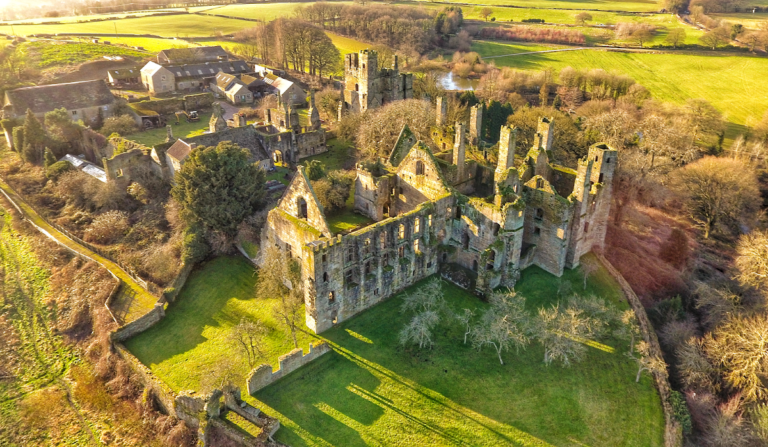
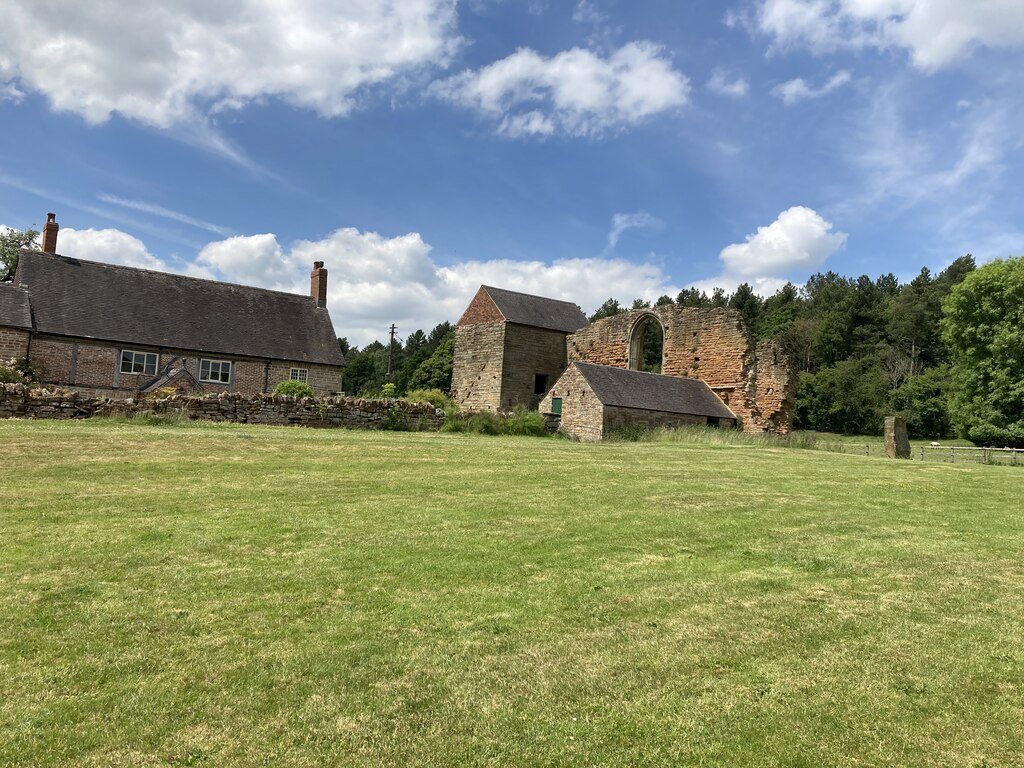
Substantial remains survive at Beauvale, including parts of the priory church, a gatehouse, and sections of the boundary wall. These structures form the principal visible architectural evidence of the Carthusian foundation, while later buildings and displaced materials preserve further connections with the former monastery.
Priory buildings and boundary
Priory church
The surviving remains of the priory church are Grade II* listed. They represent the principal ecclesiastical building of the Carthusian community founded in 1343 and form part of the substantial remains of the former priory.
Gatehouse and boundary wall
The gatehouse and parts of the boundary wall also survive and are separately listed at Grade II. Together with the church remains, they preserve elements of the priory’s enclosed architectural setting, which reflected the Carthusian emphasis on separation and regulated communal life.
Later building and surviving materials
Abbey Farmhouse
Abbey Farmhouse occupies part of the later history of the site. Built in the sixteenth century, it was extended during the eighteenth and nineteenth centuries. Much of its material was quarried from the former priory, linking the farmhouse physically with the post-Dissolution reuse of Beauvale’s buildings.
Tiles, glass, and manuscripts
Some tiles and stained-glass fragments from Beauvale are now preserved in St Mary’s Church at Greasley. Two manuscripts associated with the priory’s library also survive elsewhere. Cambridge MS Mm 5.37 contains a copy of Richard Rolle’s Incendium Amoris, while Bodleian Library MS Douce 114 contains Middle English translations of saints’ lives, a letter concerning Catherine of Siena, and Henry Suso’s Horologium Sapientiae.
The surviving range of buildings and associated materials reflects Beauvale’s place among the nine Carthusian houses established in England. Its church remains, gatehouse, boundary fragments, later farmhouse, and dispersed library materials together preserve evidence of the priory’s religious life and its transformation after the Dissolution.