House of the Virgin Mary: A Marian Shrine in Türkiye
Site at a Glance
- Rating
- 4.5
- Popularity
- Medium
- Country
- Turkey
- Primary era
- Medieval
- External website
- Open
- Eras represented
- Classical, Medieval
- Civilizations
- Byzantine, Roman
- Site type
- Religious
- Remains
- Sanctuary
On this page14 sections
History
Origins of the Ephesus tradition
The House of the Virgin Mary is a Catholic Marian shrine in Türkiye, near Selçuk and ancient Ephesus, associated with a tradition that Mary, the mother of Jesus, lived and possibly died there. Its surviving chapel has been interpreted as a late Byzantine building, although the date and purpose of the earliest structure remain disputed. Christians regard the site as a possible temporary residence and burial place for Mary, while the Roman Catholic Church has recognized it as a pilgrimage sanctuary without authenticating the house or definitively rejecting the tradition.
The modern search for the shrine grew from reports of visions experienced by Anne Catherine Emmerich, a German Augustinian nun and visionary. The writer Clemens Brentano recorded accounts based on those visions and published them after her death. His 1852 account described John the Apostle taking Mary to a house near Ephesus overlooking the sea, where she was said to have lived and been buried. This narrative helped establish the connection between the Ephesus landscape and the later shrine.
The French priest Julien Gouyet reported finding the ruin on 18 October 1881, but the discovery attracted little immediate attention. In 1891, the Lazarist priests Henri Jung and Benjamin Vervault, encouraged by Adèle Marie de Mandat-Grancey and supported by Eugène Poulin, found the ruin again. A commission sent by Poulin later confirmed their identification. The building was then a roofless, four-walled ruin, and its connection with Mary remained part of a developing religious tradition rather than an established historical conclusion.
Establishment of the shrine
After negotiations with the Ottoman authorities, Adèle Marie de Mandat-Grancey purchased the property in November 1892. She arranged its restoration by Lazarist priests and local workers under Henri Jung’s direction. The Catholic Church regards her as the foundress of the shrine. She supervised its improvement, cultivation, and hospitality until her death in 1915.
Annual pilgrimages began in 1896. Clearing, restoration, and excavation followed, including searches for Mary’s tomb and for a supposed Way of the Cross connected with Emmerich’s visions. The provisional rebuilding of the church was completed between 1898 and 1902, and a guest and sisters’ residence was added in 1903. These works transformed the ruin into a functioning pilgrimage site.
Pope Leo XIII was informed of the discovery in 1895. In 1896, he withdrew the plenary indulgence previously associated with the traditional Marian grave in Jerusalem, while also considering whether to send a papal commission to investigate the Ephesus site. Pope Pius XII declared the house a Catholic pilgrimage site, or sanctuary, in August 1951. Pope John XXIII made the associated privileges permanent in 1961.
War, ownership, and renewal
The property was transferred to Eugène Poulin in 1910. During the First World War, the area became a military exclusion zone, and Turkish authorities confiscated the abandoned property in 1917. When the Lazarists returned in 1920 during the Greco-Turkish War, they found the site overgrown and damaged. Religious activity resumed on a limited basis in 1926 but ceased again after 1936.
Turkey recognized the ownership arrangements in 1947, and regular pilgrimages resumed from 1949. The shrine was renewed during the rebuilding of the complex after 1950. Ownership passed to co-owners led by the local Catholic bishop in 1952 and, from 1955, to the American Society of Ephesus. George B. Quatman established this private foundation to maintain the House of Mary and other memorial sites associated with ancient Ephesus.
The shrine also developed as a place of interreligious pilgrimage. Muslim visitors venerate Maryam, the name used for Mary in Islam, as the mother of Isa, or Jesus. In the early years of the official pilgrimage, Muslim visitors outnumbered Christian pilgrims. Some Turkish traditions have treated a visit to the House of Mary as a substitute for the pilgrimage obligation for poor people and women unable to travel to Mecca. The spring below the house is also associated with drinking water, taking it home, and reports of healing within local devotional belief.
Papal visits and historical debate
Pope Paul VI visited the shrine on 26 July 1967, Pope John Paul II on 30 November 1979, and Pope Benedict XVI on 29 November 2006. Each celebrated Mass there. A liturgical service is held annually on 15 August for the Feast of the Assumption of Mary, the belief that Mary was taken into heavenly glory at the end of her earthly life. The shrine’s identity continues to reflect a wider dispute between the Ephesus tradition and the older Jerusalem tradition concerning Mary’s death or Dormition. Archaeological and historical research has found no reliable evidence that Mary lived or died at this location, and the modern scholarly case for the Ephesus hypothesis is generally regarded as unsubstantiated.
Archaeological investigation began in the decades after the discovery. The foundations were exposed in 1961, followed by systematic excavations from 1965 to 1967 under Adriano Prandi, an Italian archaeologist. Prandi interpreted the remains as a late Byzantine chapel, possibly dating to the thirteenth century, built over an earlier structure. He considered a second- or third-century predecessor possible, but no conclusive evidence established that date. He also viewed the wider complex as a late Byzantine monastery built over a terraced Roman villa. Egidio Picucci later proposed a fourth-century date for the original construction.
A 2003 investigation about 80 metres west of the house did not confirm reports of a buried glass coffin containing Mary’s body. Ceramic evidence indicated that at least the villa’s atrium existed by the first century BC. The physical remains therefore reveal a complex with Roman and Byzantine phases, but they do not establish the house as Mary’s residence or burial place.
Remains
Mountain setting and chapel
The shrine stands about 7 kilometres southwest of modern Selçuk, approximately 380 metres above sea level on the western slope of Ala Dağı. In antiquity, the mountain was known as Solmissos, and the site lies south of Mount Nightingale, several kilometres outside the walls of ancient Ephesus. The building occupies a wooded hillside with views towards the Aegean Sea, while a spring rises below it.
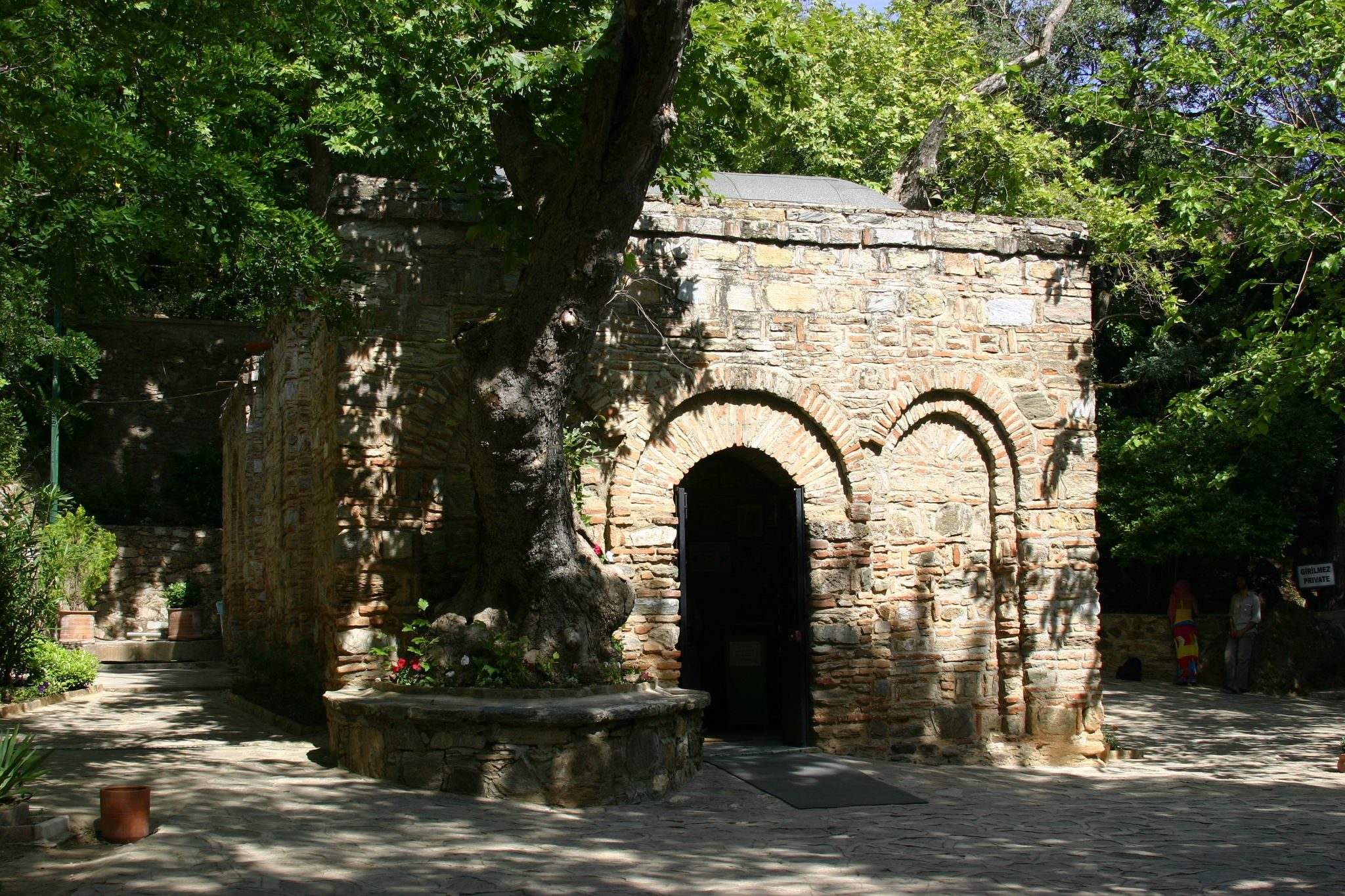
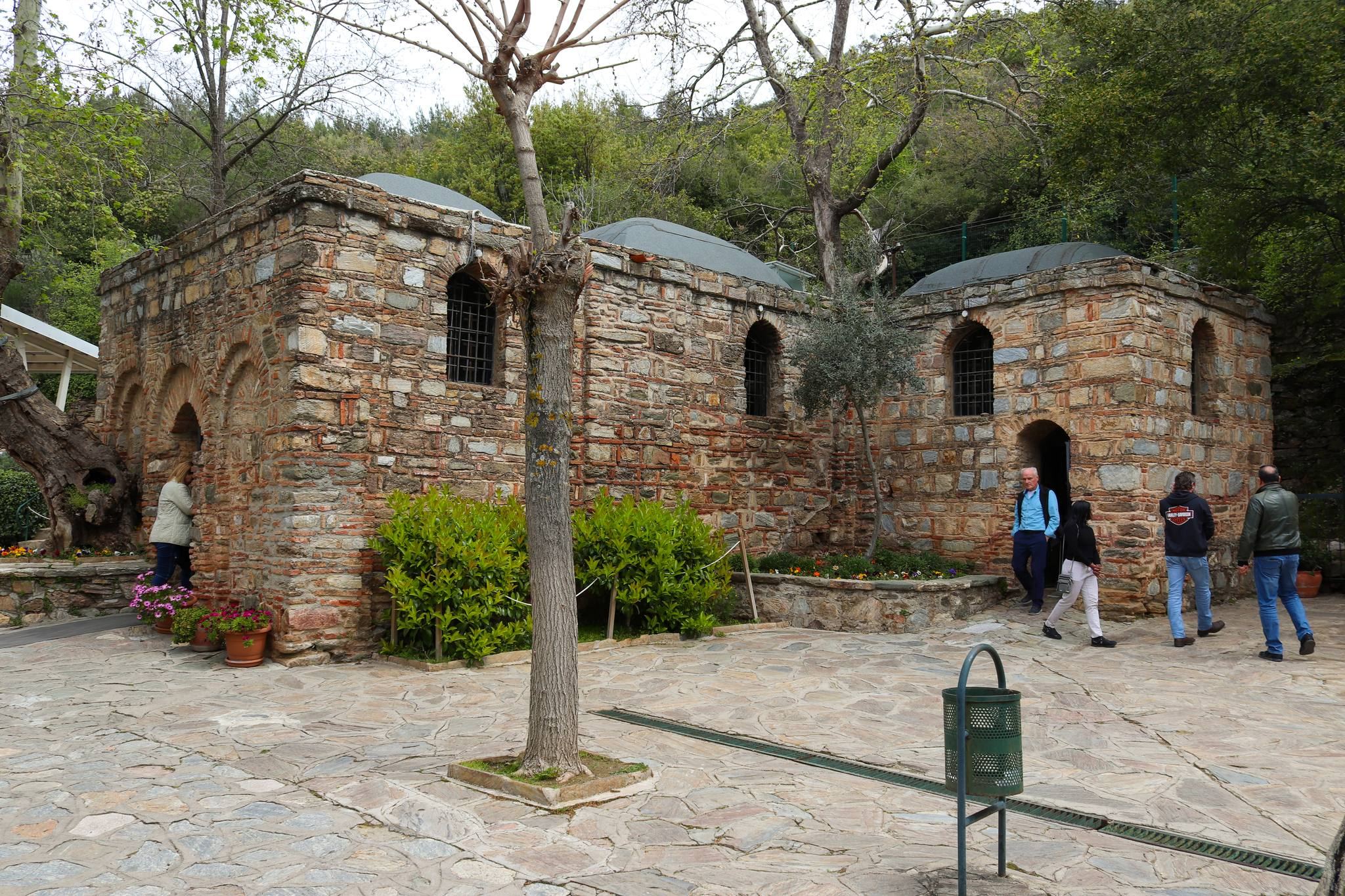
The present chapel is a largely reconstructed structure erected over exposed remains. Its surviving fabric has been dated variously from the fifth to seventh centuries, to the thirteenth century, or to an earlier phase. When the foundations were exposed in 1961, no pre-Byzantine foundation was demonstrated. The latest major alterations took place in 1951, when the pilgrimage complex received much of its present form. A painted red line distinguishes reconstructed portions from the original remains.
Late Byzantine chapel
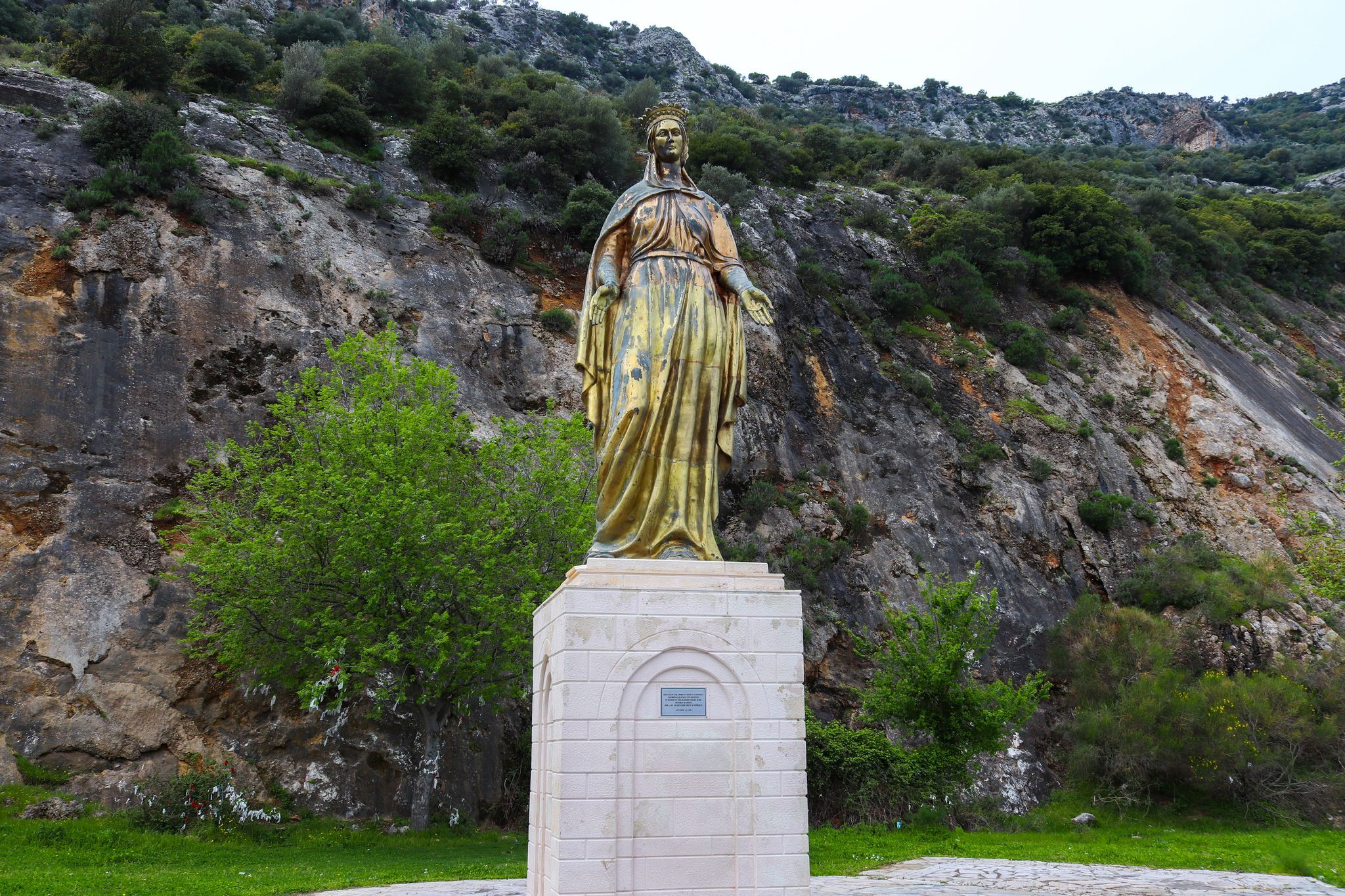
Prandi reconstructed the sacred building as a small late Byzantine chapel that originally had a dome. Uneven masonry suggests that its builders accommodated an earlier structure, especially in the southern side chapel traditionally associated with Mary’s sleeping chamber. The main interior is a single large room with an altar and a large statue of the Virgin Mary. A smaller room to the right is traditionally identified as Mary’s bedroom and is now known as the Koran Room.
Koran Room
The Koran Room has held particular importance for Muslim visitors since its walls were decorated with Quranic verses and Islamic symbols from the 1980s. Christian symbolism predominates elsewhere in the building. The room’s association with Mary’s sleeping chamber belongs to the shrine’s religious tradition, while its present form reflects the reconstruction and later devotional development of the complex.
Waterworks and archaeological remains
Spring and fountain
A spring and drinking fountain lie below the house. Marian tradition holds that water once passed through the room associated with Mary’s sleeping chamber like a channel before emerging outside the building. Some pilgrims regard the fountain or well as possessing healing or fertility-giving powers. These ideas belong to devotional belief rather than an archaeologically established property of the water.
Rectangular atrium
In the wooded area below the house is a rectangular, atrium-like space bounded by column arcades. A medieval water reservoir discovered there in 1964 has the form of an unusually large full-body baptismal pool. It has sometimes been interpreted as evidence that the location was used for early Christian baptism. An atrium is an open or partly enclosed court associated with a larger building complex.
Byzantine burials
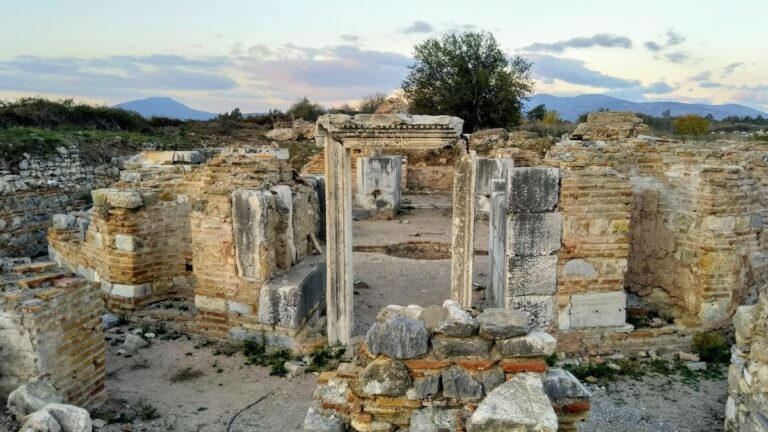
Several Byzantine burials were found near the rectangular forecourt west of the church. The graves were made with clay roof tiles, and the bodies were placed with their heads facing the church. Byzantine coins dating from the seventh and eighth centuries accompanied the burials, providing evidence for activity around the complex during that period.
Grounds and pilgrimage features
The grounds include landscaped gardens, flowers, fruit plantings, and the guest and sisters’ residence built in 1903. They also contain the Wishing Wall, a pilgrimage feature where visitors attach written intentions on paper or cloth. The combination of reconstructed chapel, archaeological remains, devotional additions, and cultivated grounds reflects the site’s development from a ruin identified in the nineteenth century into a Christian and Muslim pilgrimage complex.