Nottingham Castle: Royal Fortress and Ducal Mansion in England

Site at a Glance
- Rating
- 4.1
- Popularity
- Medium
- Country
- United Kingdom
- Primary era
- Early Modern
- External website
- Open
- Eras represented
- Medieval, Early Modern, Modern
- Civilizations
- British, English
- Site type
- Domestic
- Remains
- Elite Residence
On this page12 sections
History
Nottingham Castle is a medieval royal fortress and later ducal mansion in Nottingham, United Kingdom, built on Castle Rock by Norman rulers from 1068. Its position above the city, near a crossing of the River Trent and close to royal forests and hunting grounds, made it both a strategic stronghold and a place of royal residence and leisure.
Norman foundation and royal fortress
William the Conqueror, the Norman ruler who became king of England after the conquest of 1066, ordered the first castle at Nottingham in 1068. It was a wooden motte-and-bailey fortification, combining a raised mound with a defended enclosure. During the reign of Henry II, the wooden castle was replaced by a more substantial stone fortress with stronger defensive construction.
The castle became an important royal centre during the medieval period. It had its own deer park immediately west of Castle Rock, an area still known as The Park. Its high position and relationship to routes across the River Trent supported its military role, while its royal apartments and surrounding hunting landscape made it suitable for visits by the monarchy.
Richard I and Edward III
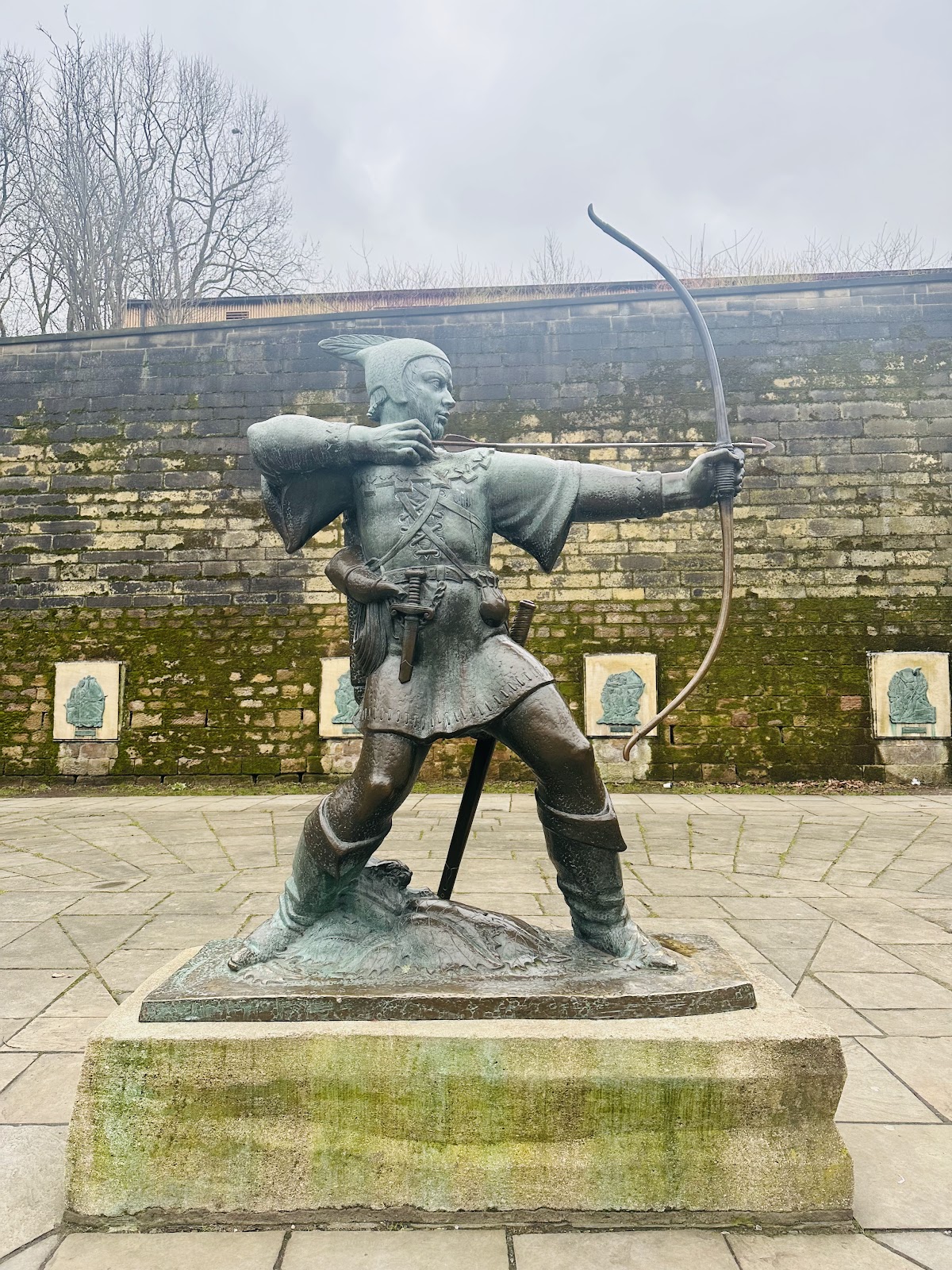
Nottingham Castle became involved in the struggle between Richard I and his brother, Prince John, during Richard’s absence on the Third Crusade, the campaign led by the English king and other European rulers to recover territory in the eastern Mediterranean. Supporters of John, including the Sheriff of Nottingham, occupied the castle. The stronghold also became part of the Robin Hood tradition, in which it is presented as the setting for the outlaw’s final confrontation with the sheriff.
In March 1194, Richard I besieged Nottingham during his campaign against John’s rebellion. Richard employed siege machines similar to those used during the Crusade, with support from Ranulph de Blondeville, 4th Earl of Chester, and David of Scotland, 8th Earl of Huntingdon. The garrison surrendered after a few days.
On 19 October 1330, shortly before his eighteenth birthday, Edward III used the castle to overthrow the regents Isabella of France and Roger Mortimer, 1st Earl of March. Sir William Montagu and his companions entered through a concealed passage known to William Eland, the castle’s castellan and overseer under Mortimer. They overpowered Mortimer, killed his guards, and arrested both him and Isabella. Mortimer was later executed at the Tower of London, while Isabella was compelled to retire to Castle Rising Castle. The seizure of power began Edward III’s personal rule.
Edward used Nottingham Castle as a residence and a place for Parliament. David II of Scotland was held there as a prisoner in 1346. In 1365, Edward added a tower on the west side of the Middle Bailey and created a prison beneath the High Tower. Peter de la Mare, Speaker of the House of Commons, was confined at the castle in 1376 after taking what was described as “unwarrantable liberties” with the name of Alice Perrers, the king’s mistress.
A state council met at Nottingham in 1387. In 1392, Richard II held the Lord Mayor of London, aldermen, and sheriffs at the castle while convening another council intended to humble the Londoners. Richard’s final recorded visit took place in 1397.
Queenship, the Wars of the Roses, and Tudor use
From 1403 to 1437, Nottingham Castle was the principal residence of Joan of Navarre, queen of Henry IV. Maintenance declined after her residence ended. During the Wars of the Roses, a series of dynastic conflicts chiefly involving the houses of Lancaster and York, the castle returned to military use. Edward IV proclaimed himself king at Nottingham and ordered a new tower and Royal Apartments in 1476.
The castle remained a royal fortress under Henry VII. Henry VIII ordered new tapestries before visiting Nottingham in August 1511. A survey made in 1525 described decay in the Great Hall, including part of its collapsed roof, and deterioration in timber, lead, and glass in the newer building. In 1536, the castle received a new drawbridge and a much larger garrison in response to the Pilgrimage of Grace, a major uprising against Henry VIII’s religious and governmental policies. In 1538, Thomas Manners, 1st Earl of Rutland and constable of the castle, reported that further maintenance was needed.
Civil War and destruction
By about 1600, Nottingham Castle had ceased to be a royal residence. The development of artillery had reduced the military value of medieval fortifications, and the castle was already partly ruined after skirmishes at the beginning of the English Civil War, the seventeenth-century conflict between supporters of Charles I and Parliament.
In August 1642, Charles I used Nottingham as a rallying point for his armies. After he left, Parliamentarian forces fortified Castle Rock under John Hutchinson and repulsed several Royalist attacks. The Royalist commander Marmaduke Langdale was captured and held at Nottingham Castle in 1648, although he escaped and reached Europe. The medieval castle was razed in 1651, two years after Charles I’s execution, to prevent it from being used again as a military stronghold.
The ducal mansion and municipal museum
After the Restoration of Charles II in 1660, William Cavendish, 1st Duke of Newcastle, began building a ducal mansion on the castle site during the 1670s. His son, the 2nd Duke of Newcastle, completed the work after his death. The mansion was later burned by residents of Nottingham’s industrial-era slums during riots in 1831. The protest reflected the 4th Duke of Newcastle’s opposition to the Reform Bill.
The ruined building was restored in 1875 and opened in 1878 as Nottingham Castle Museum by the Prince of Wales, later Edward VII. It became the first municipal art gallery in the United Kingdom outside London. Thomas Chambers Hine’s restoration changed the interior arrangement to accommodate a top-lit picture gallery modelled on the Grand Gallery of the Louvre.
The ducal mansion’s image appeared on millions of tobacco packets made by Nottingham firm John Player & Sons. Ian Fleming later referred to the familiar design in Thunderball, describing it as a non-fortress-like “dolls house.”
War, conservation, and recent administration
The British Army took possession of the castle and grounds in September 1939, and control passed to the Air Ministry in 1941. Large quantities of stores were kept there during the Second World War. The site returned to the city in 1946.
On Christmas Day 1996, a leaking water main caused a landslip that displaced 80 tonnes of earth and retaining wall from the Restoration terrace. The collapse exposed foundations of the original castle and the bedrock beneath them. Following debate over conservation methods, the terrace was reinstated with a traditional stone facade. The rebuilt structure incorporated a concrete foundation that allows access to medieval masonry.
The castle and grounds closed in 2018 for a large redevelopment costing £30 million. The project added a visitor centre, exhibition galleries, interactive displays, and a children’s adventure area in the former moat, alongside displays about local industries such as Nottingham lace. Nottingham City Council transferred responsibility for operating the site to the independent charitable Nottingham Castle Trust on 1 June 2021, and the castle reopened on 21 June that year. The trust entered liquidation and closed the grounds and exhibitions on 21 November 2022. Its failure was attributed to the COVID-19 pandemic, the subsequent financial crisis, and sharply increased energy costs. The trust owed the council £2.68 million in operating loans, and its employees were made redundant.
Nottingham City Council reopened the castle, grounds, and Brewhouse Yard on 26 June 2023, after which the site was to be operated through the city council’s museum service. Nottingham Castle is a scheduled monument, a historic site protected under United Kingdom law for its archaeological or historical importance, while Nottingham Castle Museum is a Grade I listed building, the highest level of statutory protection for a building of exceptional interest. The city council owns the site.
Remains
Nottingham Castle occupied the highest part of Castle Rock, a natural promontory whose cliffs rise about 130 feet, or 40 metres, on the south and west sides. Its medieval plan was arranged in three principal areas: an upper bailey at the summit, a Middle Bailey to the north with the main royal apartments, and a large outer bailey to the east. Surviving walls, gates, foundations, and fragments convey elements of this former arrangement, while the later mansion occupies much of the earlier castle site.
Medieval castle layout
The original Norman fortification was a wooden motte-and-bailey castle before being replaced by a stone fortress. Edward III’s changes included a tower on the western side of the Middle Bailey and a prison beneath the High Tower. Edward IV later ordered another tower and a group of Royal Apartments. A 1525 survey gives evidence of the deterioration affecting the Great Hall and the newer building, including a collapsed section of roof and damaged timber, lead, and glass.
Ducal mansion and surviving medieval fabric
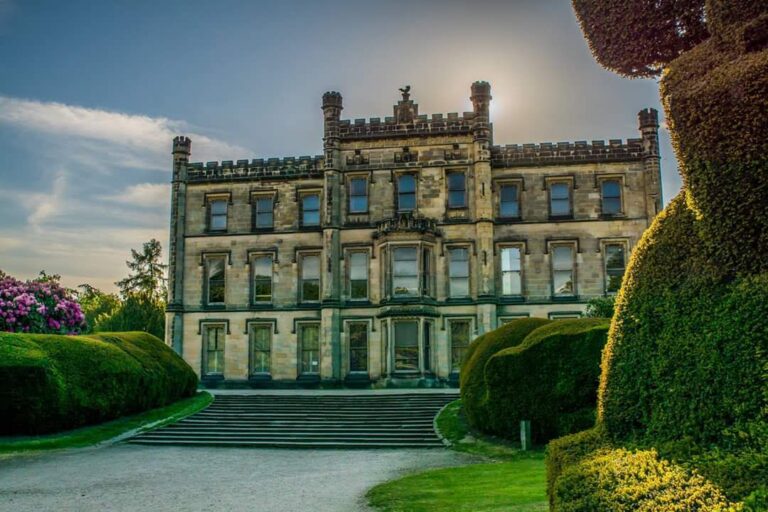
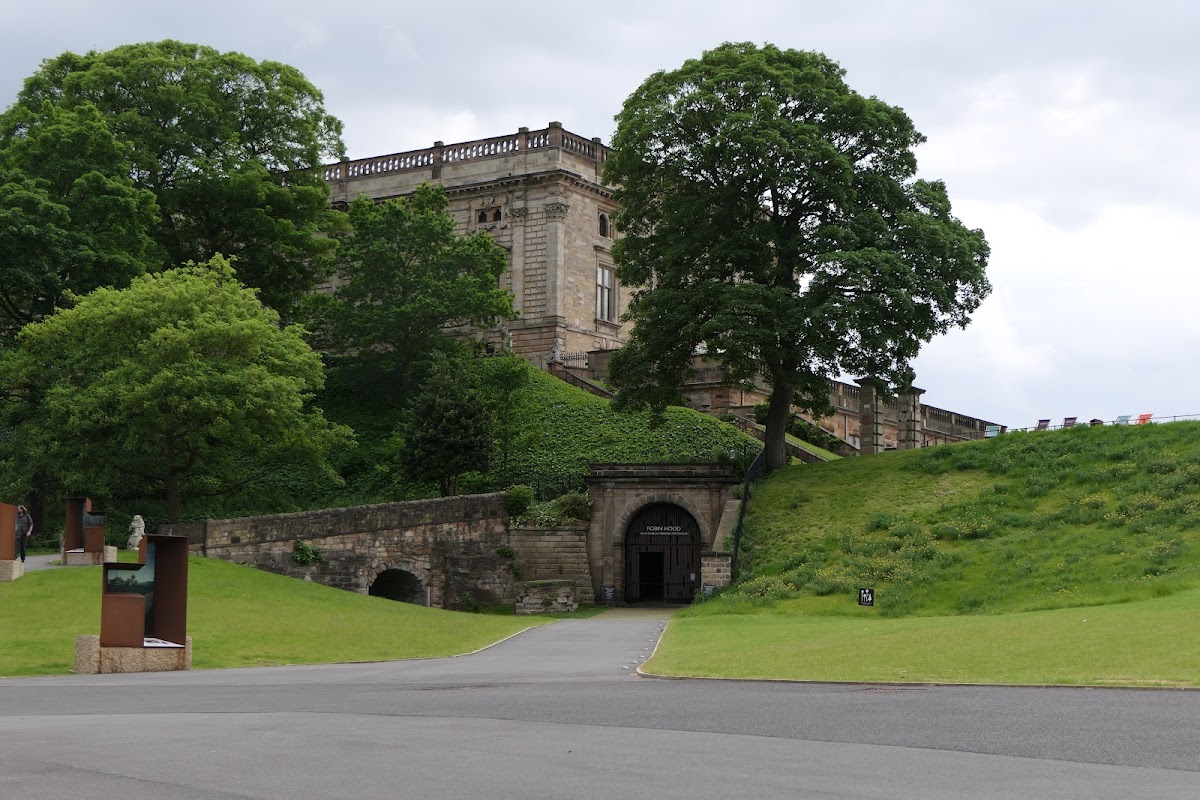
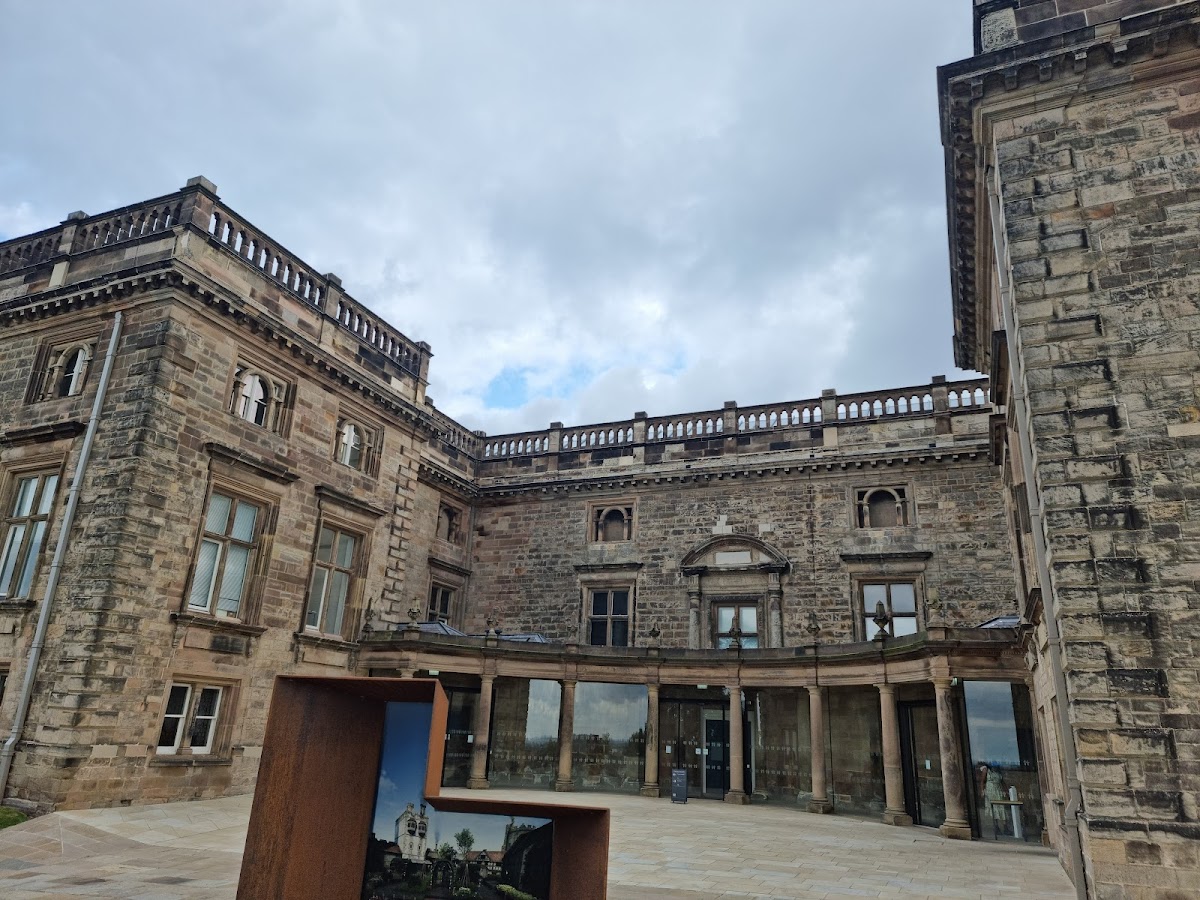
The present ducal mansion is an Italianate palace and a rare surviving English example of Artisan Mannerism, a late Renaissance style known for elaborate classical forms and highly crafted architectural detail. Samuel Marsh of Lincoln was its mason, and the design is generally considered strongly influenced by engravings by Peter Paul Rubens in Palazzi di Genova. The mansion was built over the earlier castle, but rock-cut cellars, medieval pointed arches, and a long passage descending to the bottom of Castle Rock remain beneath it.
The passage commonly called Mortimer’s Hole runs from the castle towards Brewhouse Yard. The medieval gatehouse and much of the outer-bailey walling were retained as the garden wall of the mansion. The Castle Gate House preserves medieval bridge and lower-tower architecture, while its upper towers and gatehouse include Victorian renovation.
Grounds and altered approaches
The northernmost part of the outer bailey was lost when an approach road was built in the 1830s for the development of The Park Estate on the former deer park. The area was later used for an extension of Nottingham General Hospital. The mansion’s original external stairs on its eastern facade were demolished to create a parade ground for the Robin Hood Rifles.
The 1996 landslip beneath the Restoration terrace revealed original castle foundations and bedrock. The terrace was rebuilt with a traditional stone facade and a concrete foundation that provides access to the medieval masonry. The redevelopment completed after the 2018 closure added exhibition galleries, interactive displays, a visitor centre, and a children’s adventure area in the old castle moat.
Museum collections and memorials
The museum houses much of Nottingham’s fine and decorative art, as well as galleries devoted to the history and archaeology of Nottingham and the surrounding area and the regimental museum of the Sherwood Foresters. Its collections include fifteenth-century Nottingham alabaster carvings, watercolours by Richard Parkes Bonington and Paul Sandby, the Joseph Collection of Wedgwood Jasperware, the Ballantyne Collection of contemporary ceramics, locally made salt-glazed stoneware including “bear jugs,” Nottingham lace and other costume, and Roman votive offerings associated with the Temple of Diana Nemorensis at Lake Nemi.
The Long Gallery contains British and continental European art by Thomas Barber, Richard Parkes Bonington, Henry Dawson, Paul Sandby, John Rawson Walker, Edward Burra, Tristram Hillier, Ivon Hitchens, Laura Knight, Harold Knight, L. S. Lowry, William Nicholson, Ben Nicholson, Winifred Nicholson, Stanley Spencer, Matthew Smith, and Edward Wadsworth. The Nottingham Castle Victoria Cross Memorial, installed on 7 May 2010, commemorates Albert Ball and 19 other Nottinghamshire recipients of the Victoria Cross, a British military decoration for exceptional bravery in the presence of the enemy.