Dale Abbey: A Medieval Premonstratensian Religious House in England
Site at a Glance
- Rating
- 4.6
- Popularity
- Very Low
- Country
- United Kingdom
- Primary era
- Medieval
- External website
- Open
- Eras represented
- Medieval
- Civilizations
- English
- Site type
- Religious
- Remains
- Monastery
On this page17 sections
History
Dale Abbey is the surviving ruin of a Premonstratensian religious house in the United Kingdom, near Ilkeston in Derbyshire. Dedicated to Mary, the mother of Jesus, it was founded in the medieval period, with 15 August 1204 accepted as the foundation date. The community belonged to the Premonstratensian order, whose canons combined communal worship with priestly ministry, study, pastoral work, and the administration of dependent churches. Its formal name was the Church of the Blessed Mary of Stanley Park, and Newsham Abbey in Lincolnshire served as its mother house.
Hermits and Earlier Foundations
The tradition of religious life at Deepdale begins with a hermitage probably established in the early twelfth century. A chronicle tells of a baker who experienced a vision of the Virgin Mary, settled in an isolated marshy place, cut a small dwelling into the hillside, and later built a hut and an oratory beside a spring. The same tradition links the hermit with Ralph Fitz Geremund, who granted him a tithe from his mill at Burgh, probably at Alvaston. It also tells of an outlaw who dreamed of Deepdale’s future glory, abandoned his companions, and may have become a hermit there. The story is strongly legendary, although settlement by hermits in the region during the unsettled reign of Stephen was considered plausible.
Several unsuccessful foundations preceded the permanent abbey. An Augustinian cell from Calke Priory, probably established between 1149 and 1158, consisted of six canons. It built a costly church, obtained burial rights, and attracted burials and gifts before declining discipline led to the canons’ removal. Six Premonstratensian canons from Tupholme Abbey later occupied Stanley Park, built a mill, and withdrew after about seven years because the arable land could not support them. A further group from Welbeck Abbey probably settled around 1194 to 1196 but also failed through poverty and misfortune.
Foundation of the Abbey
The permanent community emerged through the actions of William FitzRalph, his daughter Matilda de Salicosa Mara, her husband Geoffrey de Salicosa Mara, and William de Grendon. Matilda and Geoffrey first intended to create a Premonstratensian house at Stanley Park. William de Grendon then gave the projected community the Deepdale site and rents. A charter associated with 1 April 1196 granted the canons the liberties enjoyed by other English houses of their order, and nine canons from Newsham were sent to establish the community. Among its early members were Walter de Senteney, John de Ryford, Hugh de Grimsby, Roger de Alesby, and William le Sores.
The accepted foundation date is 15 August 1204, the Feast of the Assumption, which commemorates the belief that Mary was taken bodily into heaven. This date probably marked the foundation or consecration of the abbey church rather than the beginning of settlement. The surviving evidence does not establish the precise sequence, partly because important royal and papal documents are missing. Dale may initially have been a priory, governed by a prior, before gaining the larger complement required for an abbey, governed by an abbot.
Growth and Administration
Dale Abbey became an important English Premonstratensian house. It accumulated estates and agricultural granges across the East Midlands, where directly managed farms supplied food, livestock, rents, and other income. Its economy rested especially on pasture, animals, rents, mills, fisheries, and wool. The abbey held or controlled rights in churches at Egginton, Kirk Hallam, Stanton by Dale, Trowell, Greasley, Ilkeston, and Heanor. Some were granted early, while others came during the fourteenth and fifteenth centuries through royal licences, feoffees, or negotiated transfers.
The community also operated chantries, endowments that supported repeated masses and prayers for founders or benefactors. Its estates were assembled through numerous small grants, purchases, debt arrangements, and land transactions. Holdings included properties at Ockbrook, Boyah, Stanley, Sandiacre, Kirk Hallam, Alvaston, Borrowash, Stanton, Little Hallam, and elsewhere. The abbey’s mills were particularly important. A mill at Stanley remained in use after the Dissolution, while Abbot Simon built nine mills on the River Derwent at Borrowash.
The weirs connected with the Borrowash mills caused disputes with Sir Thomas Bardulph, the merchants of Derby, and the Order of Saint Lazarus. In 1283, Abbot Laurence led a force that assaulted the Lazarites during a property dispute. The abbey’s income was valued at £54 17s. 2d. in the 1291 ecclesiastical survey and £144 12s. in 1535. By the early sixteenth century, dependent churches supplied about one-fifth of its income, with Heanor alone producing £13 in 1540.
Premonstratensian Influence and Discipline
Although Dale remained subject to visitation and correction by Newsham, its abbots represented the house at provincial and general chapters of the order. Some served as visitors, reformers, or senior representatives of English Premonstratensian communities. Abbot William was elected head of the entire order in 1233, and William of Horsley later received authority to visit and reform Premonstratensian houses throughout England.
The number of canons varied. Dale had 24 in 1345, 15 in 1475, between 13 and 16 during the later fifteenth century, and 15 in addition to the abbot at the Dissolution. Their work included worship, estate administration, pastoral service in dependent churches, and chantry masses. Visitation records describe changing standards of discipline, including unauthorized ceremonies, disobedience, gambling, the keeping of hounds, sexual misconduct, and the transfer of canons to Dale for punishment. The house nevertheless received a favourable report in 1478, and the visitation of 1500 found no major fault apart from reduced numbers attributed to plague.
Dissolution and Later History
Dale was temporarily exempted from suppression in January 1537, despite having an income below the £200 threshold for the lesser monasteries. It paid £166 13s. 4d. for the exemption. The abbey and its estates were surrendered to William Cavendish for the Crown on 24 October 1538. The roofs were removed, making the buildings uninhabitable, while the former abbot and canons received payments and later pensions.
The inventory made at suppression listed church ornaments, two organs, six bells, lead roofing, glass, kitchen and brewing equipment, food stores, livestock, horses, and carts. An inspection in 1536 also mentioned relics venerated at the abbey, including part of Mary’s girdle, some of her milk, and a silver wheel associated with Catherine of Alexandria. After the Dissolution, the estates passed through several owners. Francis Pole acquired them first, John Porte bought the main Derbyshire portfolio in 1544, and the manor was reunited in 1778 under Philip Stanhope, 2nd Earl Stanhope.
Much of the abbey’s fabric was quarried for later buildings. Stone and architectural elements were reused at Morley church, Risley Hall, houses at Dale, and buildings in Stanton by Dale. Mason’s marks linked with reused material were also found on a lock of the Erewash Canal. The principal surviving ruin was listed as a Grade I building in 1967, while the nearby hermitage was designated a scheduled monument in 1972.
Remains
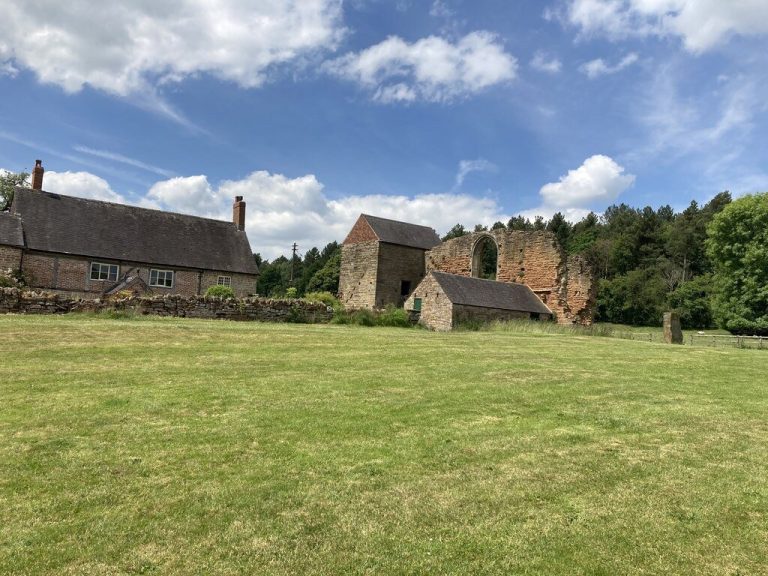
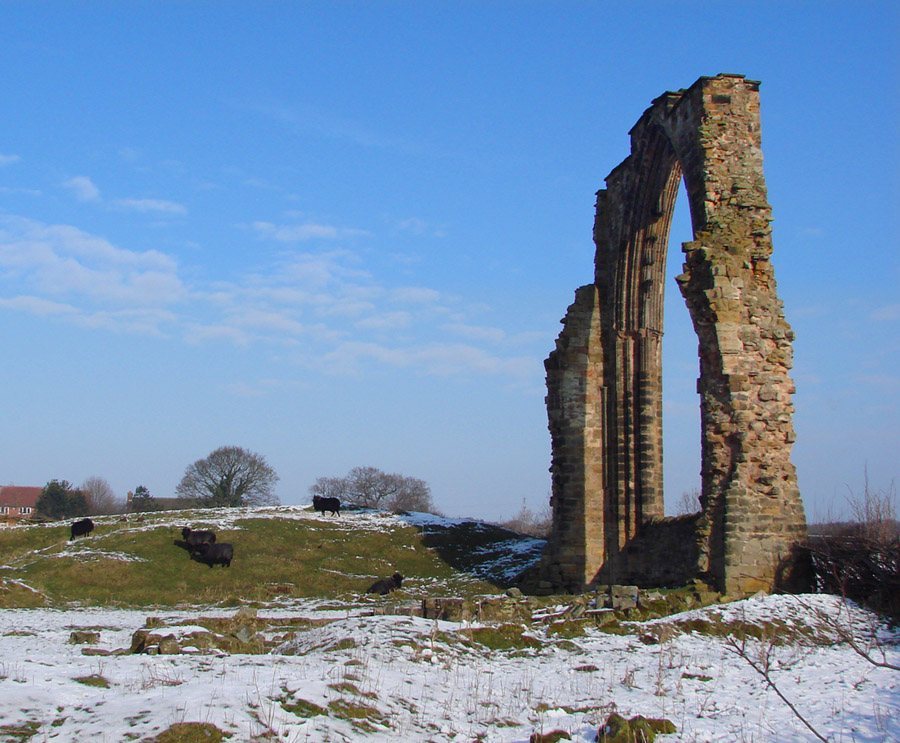
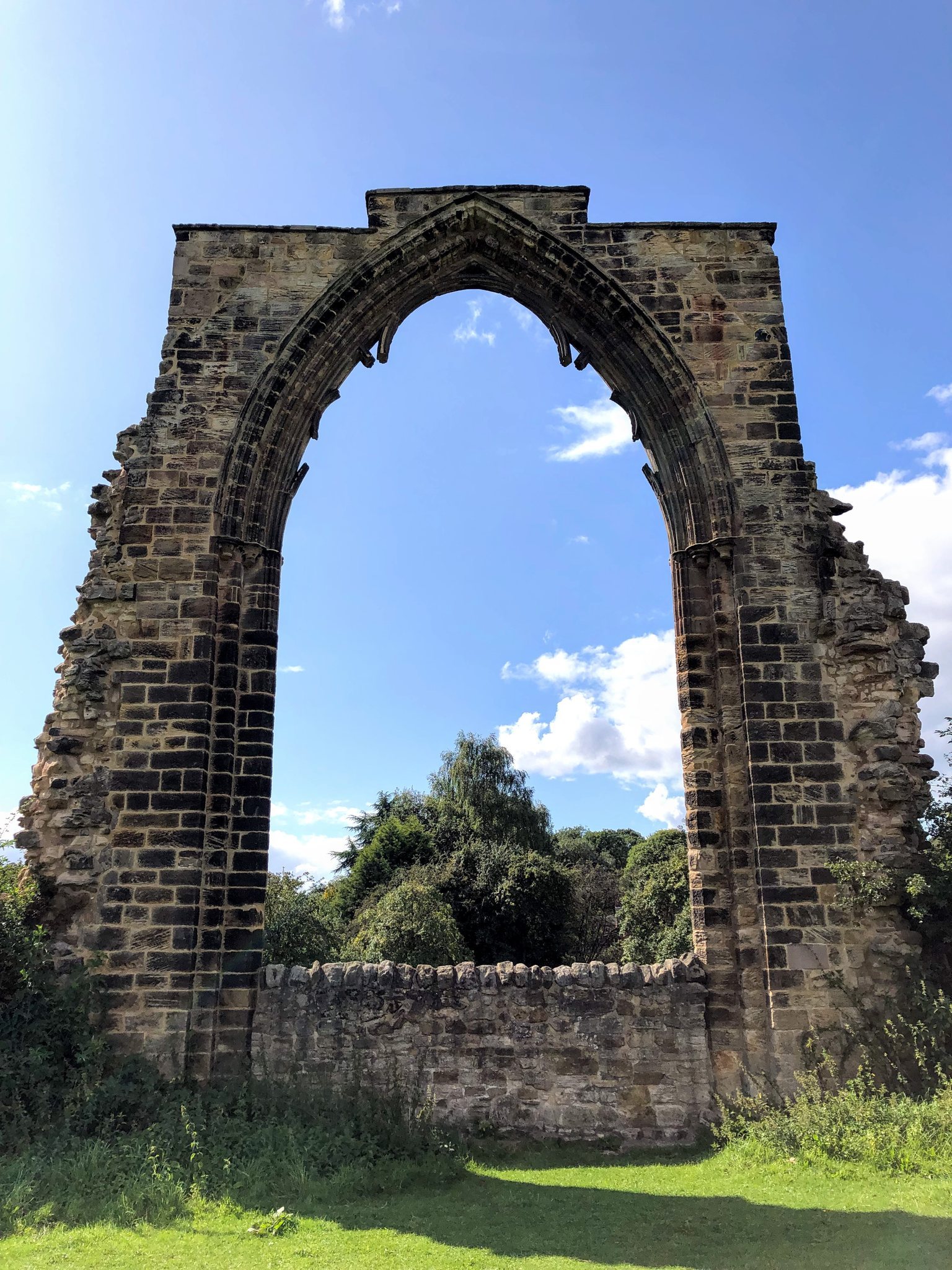
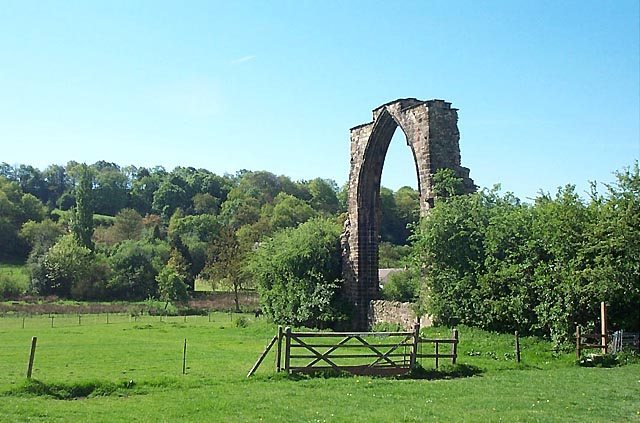
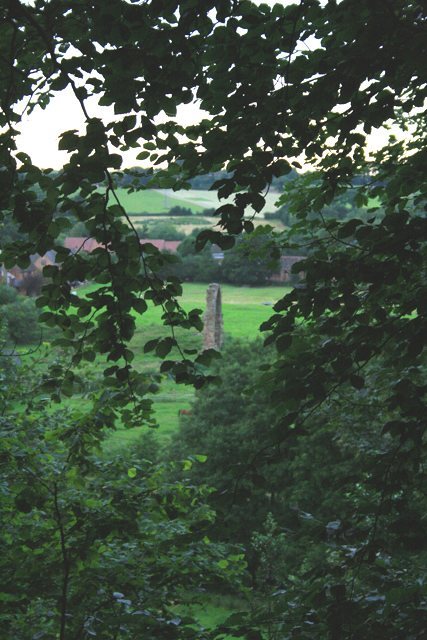
The former abbey church and claustral complex were extensive, but the surviving site is now dominated by the lofty arch of the church’s east window. Wall footings mark the extent of the church and associated buildings. The remains preserve the position of the chancel, the south chancel aisle, the south transept, and parts of the monastic buildings, allowing the former arrangement to be traced through standing masonry and foundations.
Abbey Church
East Window and Chancel
The east-window arch belonged to the chancel and retains substantial moulding and other decorative detail. Its height makes it the dominant surviving feature of the church. The outlines of the chancel and south chancel aisle remain visible in the wall footings, while the ruins preserve the scale of the former eastern end.
Crossing and South Transept
A column base survives at the southeast corner of the crossing. It formed one of the four principal supports for the central tower. The south transept retains footings and the base of another column. Excavation in 1878 showed that a large square chapel on the transept’s east side had once carried a vaulted roof. The vault had been brought down by removing its keystones.
Night-Worship Stairway
Within the ruins are the remains of the stairs used by the canons to enter the church for worship at night. This surviving feature relates the physical arrangement of the church to the community’s regular religious practice.
Claustral Buildings and Later Houses
Chapter House
Parts of the chapter-house roof vaulting survive. A museum now occupies approximately the site of the chapter house, while the remaining masonry preserves part of the building’s former structure.
Abbey House and Friar House
Abbey House incorporates a substantial section of abbey masonry, including a chimney and fireplaces thought to have come from the abbey kitchen. The northern end of Friar House has a dressed-stone ground floor beneath timber framing, preserving another use of material from the former complex.
The extent of the surviving buildings changed sharply after the Dissolution. In 1727, the entire south wall of the nave, substantial parts of the claustral buildings, and a gateway to a northern garden or close were still visible. In 1730, the kitchen, hall or refectory, abbot’s parlour, and gatehouse were reported in good condition, with oak-panelled ceilings surviving. By the 1780s and 1790s, the ruins had been reduced largely to the east-window arch and less conspicuous traces, including a kitchen chimney incorporated into Abbey House and foundations marking the former buildings.
Hermitage and Dependent Churches
Hermitage
The foundation tradition places an earlier hermitage at the southeast edge of the original marshy site, cut into the rock. A later hermitage associated with the same tradition stood beside a spring in the valley below and included an oratory dedicated to God and Mary. The surviving hermitage lies about 170 metres southeast of All Saints Church and is a scheduled monument.
Dependent Churches
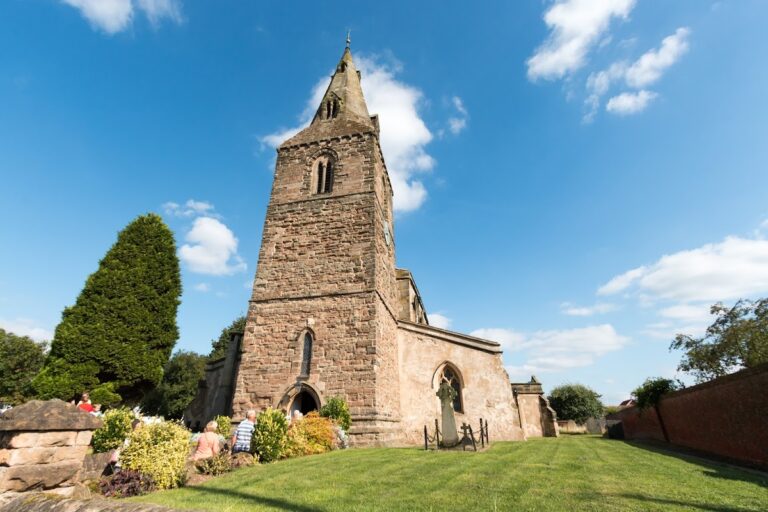
The abbey’s former dependent churches retain architectural evidence from several periods. St Wilfrid’s Church at Egginton dates mainly from about 1300, with later work. All Saints’ Church at Kirk Hallam is a fourteenth- to fifteenth-century building heavily restored during the Victorian period. St Michael and All Angels stands at Stanton by Dale, while St Helen’s Church at Trowell contains work from the thirteenth to fifteenth centuries and Victorian restoration. St Mary’s Church at Greasley is a much-restored fifteenth-century building, and St Mary’s Church at Ilkeston was also among the abbey’s dependent churches. St Lawrence’s Church at Heanor retains a Perpendicular fifteenth-century tower despite substantial rebuilding in the 1980s.