Monastery of Saint Nicholas, Horodok: An Orthodox Monastic Complex in Ukraine
Site at a Glance
- Rating
- 4.8
- Popularity
- Low
- Country
- Ukraine
- Primary era
- Early Modern
- Eras represented
- Early Modern, Modern
- Civilizations
- Polish–Lithuanian Commonwealth
- Site type
- Religious
- Remains
- Monastery
On this page12 sections
History
Monastery of Saint Nicholas, Horodok, is a historic Orthodox monastic complex in Ukraine, centered on the Baroque Saint Nicholas Church built in 1740. The monastery’s foundation is uncertain, with proposed dates ranging from the late fifteenth to the late sixteenth century. Its first written record dates to 1516, when Konstanty Ostrogski confirmed a testament transferring Horodok, nearby settlements, associated lands, revenues, and agricultural rights to the monastery.
Early Orthodox foundation
The monastery was initially a male community and was probably founded by monks associated with the Kyiv Monastery of the Caves, also known as the Kyiv-Pechersk Lavra. A lavra is a monastery or monastic complex given particularly high ecclesiastical status. Horodok was listed among that institution’s estates in 1593.
During the sixth week of Lent in 1628, a council of the Orthodox Church met at the Kyiv Monastery of the Caves’ estate in Horodok. Those present included Peter Mogila, an Orthodox metropolitan and church reformer who was then an archimandrite of the Kyiv Monastery of the Caves, as well as Job Boretsky, Meletius Smotrytsky, Isaac Boryskovich, and Paisius Ippolitovich. The council resolved to convene a local church council in Kyiv on 15 August 1628.
A smaller monastic settlement known as the Saint Elias skete was listed among the churches legally belonging to the Orthodox community in a document issued by King John II Casimir in 1650. A skete is a smaller monastic settlement or dependency linked to a larger monastery. In 1651, Janicki, a cavalry captain, raided and plundered the monastery.
Changes in ownership and religious affiliation
After the 1667 Treaty of Andrusovo, which settled a major conflict between the Polish-Lithuanian Commonwealth and Muscovite Russia, Horodok remained within the Commonwealth. The estate passed into the possession of Joseph Shumliansky, guardian of the Kyiv metropolitan see. He administered it until his death in 1708, after which it passed to his successors.
On 14 March 1715, by order of King Augustus II, Horodok passed to Helena Ledóchowska, who gave it to the Crown military official Lubomirski. In 1730, a tribunal placed Horodok under the jurisdiction of the Greek Catholic Bishop Athanasius Sheptytsky. Greek Catholic churches preserve Eastern Christian worship while recognizing the authority of the pope. That year, the Orthodox Saint Elias skete was definitively closed, and its principal church was converted into a Greek Catholic church dedicated to Saint Nicholas.
Sheptytsky commissioned a new masonry Saint Nicholas Church in 1740. Following the Third Partition of Poland, when Horodok became part of the Russian Empire, the church returned to Orthodox use.
Estate, sanatorium, and monastic revival
On 29 October 1801, Emperor Alexander I issued a grant transferring Horodok to Count Esterházy. After the count’s death, the estate passed to his son and then to relatives living in Austria. The von Stengel family later purchased Horodok, and Theodor von Stengel became its last owner.
In 1940, Soviet authorities deported the baron’s family to Germany, and a military hospital was established on the estate. From 1948 to 1990, the island site housed a regional tuberculosis sanatorium with 150 beds.
On 14 August 1991, the Rivne District Council executive committee transferred the Saint Nicholas complex and the sanatorium territory to the Rivne diocesan administration of the Ukrainian Orthodox Church. A regent’s theological school, which trains Orthodox church choir directors and conductors, began operating in the returned buildings on 1 September 1991.
The monastery was re-established in the former sanatorium and church buildings. In 1993, Bishop Irenaeus of Rivne opened the monastery and consecrated a house church dedicated to Saint Elias. Thirteen rassophore novices then formed the women’s monastic community. Sister Nina became its temporary superior, took permanent monastic vows under the name Michalina on 7 July 1993, and received the rank of abbess on 22 October that year.
The active women’s monastery belongs to the Rivne diocese of the Ukrainian Orthodox Church of the Moscow Patriarchate and is described as having lavra status. Its community comprises 120 residents: one abbess, two schema-nuns, 28 nuns, 84 novices, and five obedients. A schema-nun is a member of the stricter form of monastic vows in Eastern Christian monasticism. Abbess Michalina is the current superior. The monastery operates a regent’s theological school and a Sunday school, and administers associated establishments including the Holy Ascension metochion in Mlyniv, the Saint George metochion in Rivne, the Saint Righteous Anna skete in Onyshkivtsi, and the Alexander Nevsky stavropegic monastery in Horodno. A metochion is a dependent monastery, church, or monastic residence administered by a larger ecclesiastical institution.
Remains
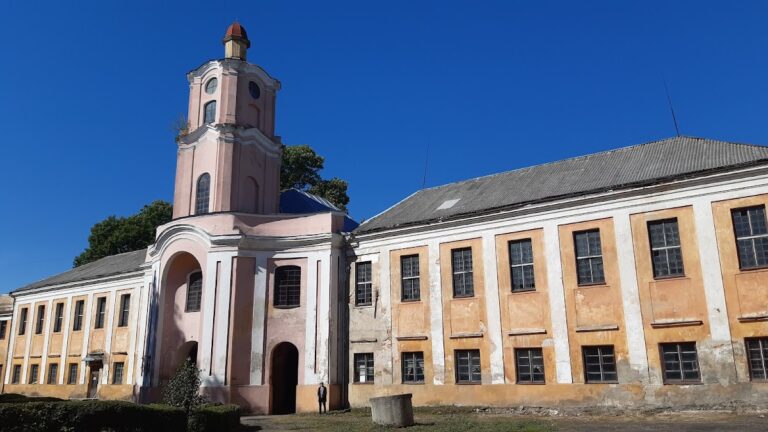
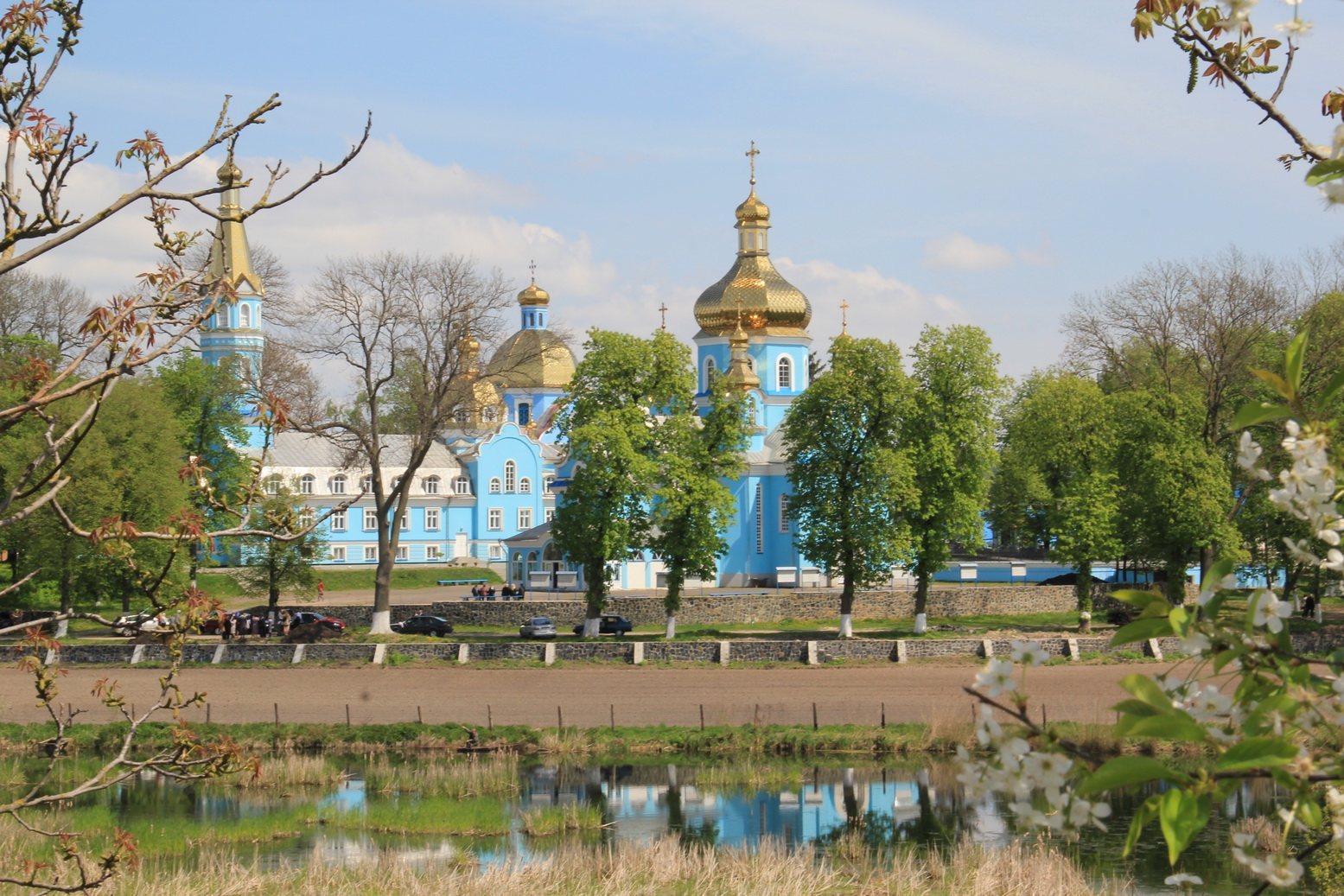
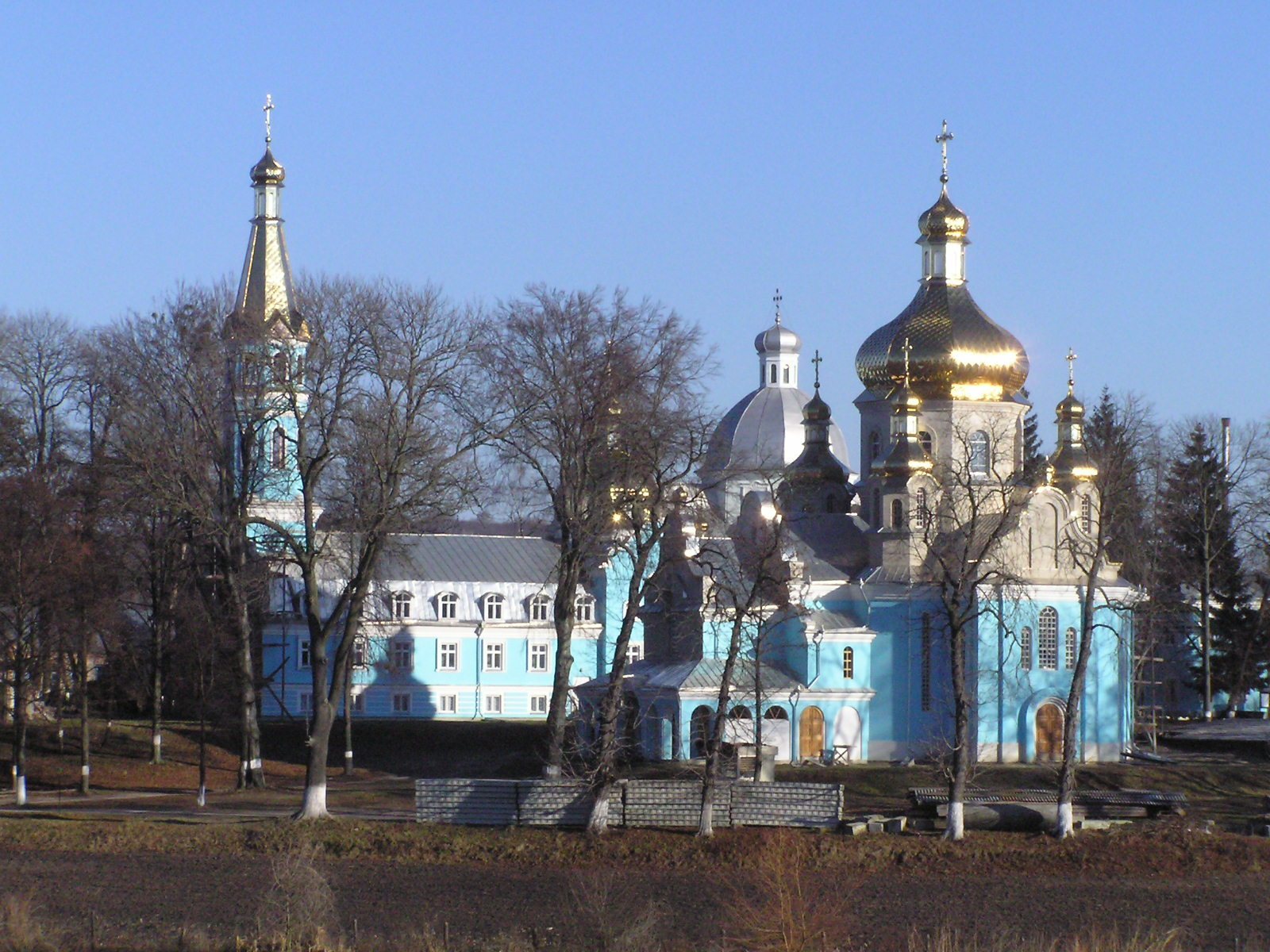
The complex occupies an island site and combines the eighteenth-century Saint Nicholas Church and wooden bell tower with later monastic buildings, churches, and restored former sanatorium structures. Its central monastic building was rebuilt, the refectory was restored and enlarged, additional churches were constructed, and the grounds were improved.
Historic church group
Saint Nicholas Church
The principal historic church is the masonry Saint Nicholas Church, built in 1740 in the Baroque style. Baroque architecture is an ornamental European style known for dramatic forms, rich decoration, and strong visual effects. The church was decorated with a highly artistic iconostasis, the screen of icons separating the sanctuary from the main worship space, together with Ukrainian-style wall paintings. Its furnishings included ecclesiastical objects, liturgical books, and bells made by Lviv metalworkers, whose work is described as outstanding in bell-foundry craftsmanship.
Wooden bell tower
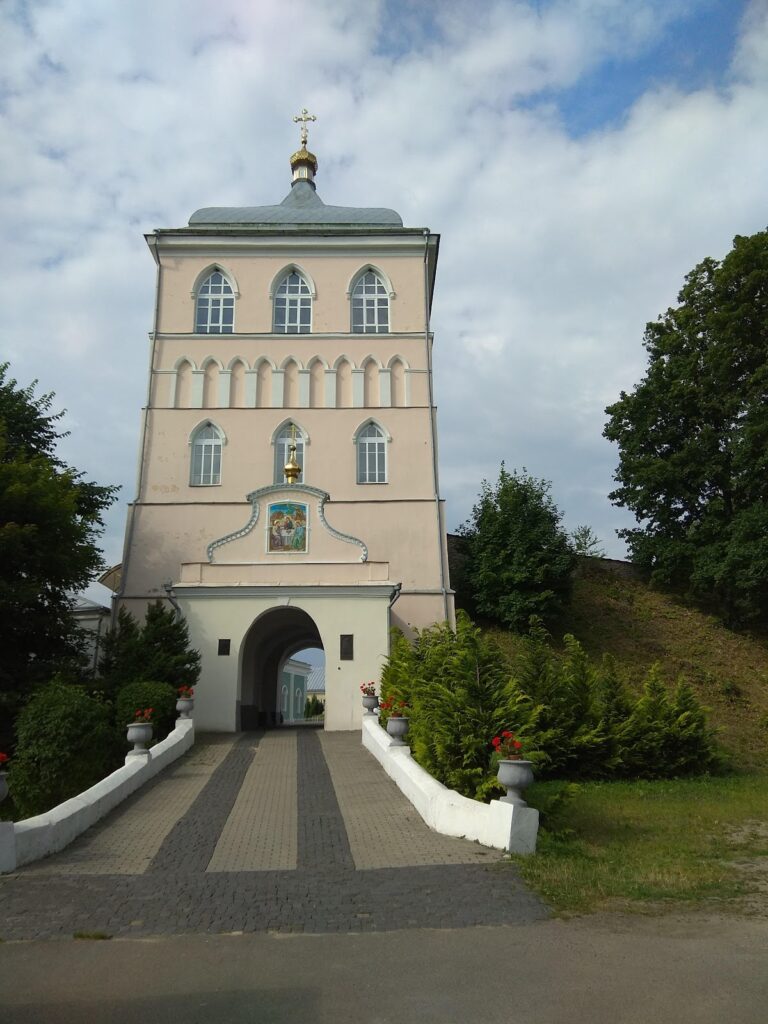
A two-tier wooden bell tower was built beside the church in 1772. Its lower tier also served as the gateway into the church estate. The tower was restored and completed in 1883, preserving its combined role as a bell structure and entrance.
Later churches
The re-established complex includes a house church dedicated to Saint Elias, consecrated in 1993. Other churches are dedicated to the Praise of the Mother of God, the Nativity of Christ, and the Holy Martyrs Faith, Hope, Love, and Sophia. Together, these buildings form the later church group within the restored monastic complex.
Monastic buildings and sacred object
Central buildings
The complex includes a central monastic building and an enlarged refectory. Both belong to the modern development of the monastery, which reused the former sanatorium and church buildings after the women’s community was established.
Kozelshchansky icon
The monastery’s principal sacred object is the wonder-working Kozelshchansky, or Merciful, icon of the Mother of God. A wonder-working icon is traditionally associated with miraculous healings or other supernatural aid. The Kyiv Monastery of the Caves donated the icon to the monastery, and it was transferred there on 11 January 2000.