Tōshō-ji Temple: Hōjō Family Mortuary Temple in Kamakura
Site at a Glance
- Rating
- 3.5
- Popularity
- Very Low
- Country
- Japan
- Primary era
- Medieval
- External website
- Open
- Eras represented
- Medieval
- Civilizations
- Kamakura shogunate
- Site type
- Religious
- Remains
- Monastery
On this page10 sections
History
Tōshō-ji Temple was a Rinzai Buddhist temple in Kamakura, Japan, founded in 1225 during the first half of the thirteenth century. Built under the patronage of Hōjō Yasutoki, it served as a Hōjō family mortuary temple, a place for memorial and funerary observances, and stood within the political world of the Kamakura shogunate.
Foundation and Hōjō patronage
Yasutoki established Tōshō-ji as a memorial foundation for his mother, whose tomb was located there. The founding monk was Taikō Gyōyū, a disciple of Eisai. The temple stood in Kasaigayatsu, southeast of Tsurugaoka Hachimangu and across the Nameri River. Its position also gave it defensive value. The temple occupied a narrow valley where the river gorge and steep hills restricted access, while its position overlooked the only road crossing the river.
A tradition preserved in the Taiheiki states that every regent of the Kamakura shogunate was buried at Tōshō-ji from its foundation until the shogunate ended. The Hōjō supplied the hereditary regents, or shikken, who exercised effective governing authority in the military government. Tōshō-ji therefore combined the religious duties of a family temple with close ties to the ruling house.
Religious institution and regional standing
Taikō Gyōyū is recorded as having died at Tōshō-ji in 1241. Other monks associated with the temple included Kuwata Dōkai, Yakō Tokken, Nanzan Shiun, Tōmyō E’nichi, So’an Ryōdō, Taisei Sōi, and Fusai Zenkyū. Nanzan Shiun was serving as abbot in 1307.
The scale of the institution is reflected in a memorial service held for Hōjō Sadatoki in 1323. Fifty-three monks from Tōshō-ji took part, forming the tenth-largest monastic contingent among the participating temples. The temple’s position among the Kantō Ten Temples, a ranked group of major Zen temples in the Kantō region, also changed over time. It ranked fifth in 1342, third in 1353, and third again in 1386.
Destruction in 1333 and later history
Tōshō-ji became the scene of a decisive episode in 1333, when the Kamakura shogunate was overthrown. Hōjō Takatoki, the final Hōjō regent, and members of the Hōjō clan barricaded themselves inside the temple during the attack led by Nitta Yoshisada. The Kamakura shogunate, the military government that had ruled from Kamakura, ended with this assault. The defenders set Tōshō-ji on fire and committed suicide. The recorded dead included 34 members of the Nagoe branch, 46 members of the Akahashi, Tokiwa, and Sase branches, and 283 members of affiliated households and followers. With accompanying soldiers included, the total exceeded 870 people.
The temple buildings were destroyed in the fire but appear to have been rebuilt soon afterward. Tōshō-ji still existed in 1512, when Ashikaga Masauji, the Koga kubō, appointed Myōtoku as its abbot. A record from 1573 states that its estate was granted to a monk of Kenchō-ji. The temple was abandoned between those dates, and it is also described as having been abandoned during the Sengoku period.
Several traditions preserve memories of the destroyed institution. In the early Edo period, a new Tōshō-ji was established in present-day Fujisawa to commemorate the destruction of the Hōjō family. A former abbot named Shinkai is also said to have fled with the temple’s image of Dainichi Nyorai to Ikego, in present-day Zushi, where he founded a temple under the same name that was later renamed. Another tradition says that Ashikaga Takauji, the first Ashikaga shogun, acted under Emperor Go-Daigo’s order to transfer the temple and the Hōjō remains to a new site, where the institution was renamed Hōkai-ji. A shrine called Tokusō Gongen was established there to pacify the supposed spirits of the Hōjō.
Archaeology and heritage protection
Archaeological investigations took place in 1975–1976 and 1996–1997, chiefly in the northern and central parts of the former temple valley. Layers of soil and deposits, pottery dates, charcoal, and traces altered by intense heat confirmed that the temple existed when the 1333 battle took place. The former site was designated a National Historic Site in 1998, recognizing its association with the Hōjō family’s principal temple and with the final destruction of the Kamakura shogunate.
Remains
Temple valley
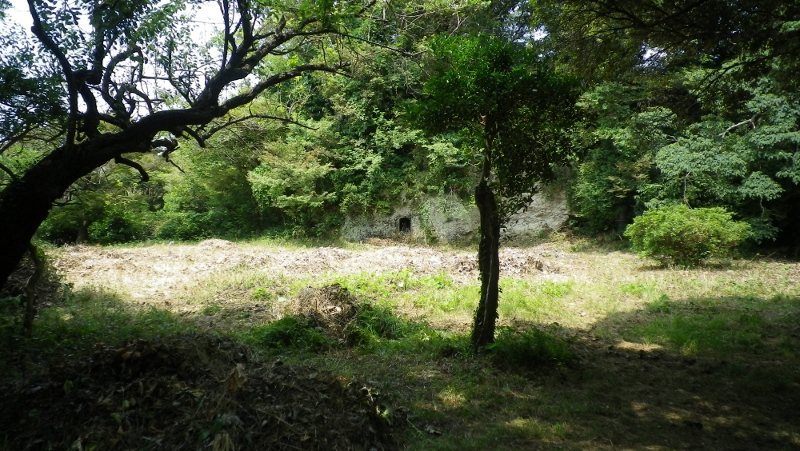
Tōshō-ji occupied, or very probably occupied, much of the Kasaigayatsu valley. The former temple stood at the head of a narrow valley, bounded at its base by the deep gorge of the Nameri River and on its other sides by steep hills. Excavations revealed a relatively well-preserved group of remains that helps define the construction and organization of the complex.
The surviving features include retaining walls built from locally quarried Kamakura stone ashlar, a slope paved with cut stone, and a drainage channel cut into bedrock. A row of foundation stones probably belonged to a gate. Excavators also identified one building with stone foundations and another constructed with posts. Chinese ceramics from the Song and Yuan periods include an animal-foot celadon incense burner, an animal-foot brown-glazed incense burner, and a Tenmoku tea bowl. A Ko-Seto jar made in Owari Province and decorated with a fallen-leaf design was also recovered.
Chinese pottery fragments and roof tiles bearing the Hōjō family crest were found among the remains. Stones and other surfaces were scorched by fire, while charcoal and heat-altered traces occur in the excavated deposits. Together, these physical traces correspond to the account of the temple’s burning during the 1333 attack.
Memorial caves and associated remains
Hōjō Takatoki Harakiri Yagura
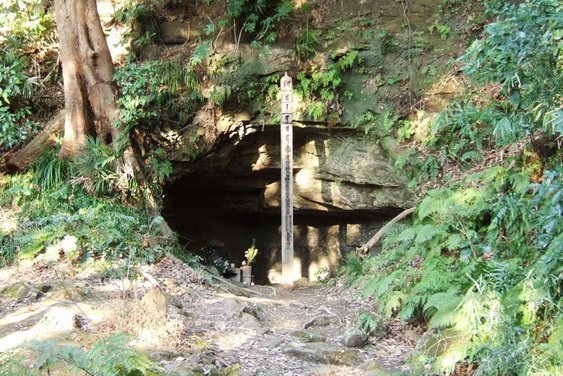
About 100 metres uphill from the temple site, in woodland, is the Hōjō Takatoki Harakiri Yagura. A yagura is a rock-cut cave or chamber often used in medieval Kamakura for burials or memorial purposes. This cave is traditionally identified as the place where Hōjō Takatoki disemboweled himself in 1333, although other locations in Kamakura make the same claim, leaving the identification traditional rather than certain. A monument erected there in 1918 marks the tradition. Access to the area is prohibited because falling rocks from the surrounding cliffs present a danger.
Shakadōgayatsu Yagura group
The Shakadōgayatsu Yagura group contains remains of some Hōjō family members traditionally said to have died at Tōshō-ji during the 1333 destruction. Their identification is associated with a gorintō, a five-part Buddhist memorial stone representing earth, water, fire, air, and space. The stone is dated to eight days after the invasion and forms part of the evidence connecting the cave group with the deaths that followed the fall of the Kamakura shogunate.