Loccum Abbey: A Cistercian Monastery and Lutheran Church Institution in Germany
Site at a Glance
- Rating
- 4.6
- Popularity
- Low
- Country
- Germany
- Primary era
- Medieval
- External website
- Open
- Eras represented
- Medieval, Early Modern, Modern
- Civilizations
- Holy Roman Empire
- Site type
- Religious
- Remains
- Monastery
On this page16 sections
History
Loccum Abbey is a former Cistercian monastery and continuing Lutheran church institution in Germany, in Rehburg-Loccum. Founded in 1163, it grew from a monastic settlement granted by Count Wilbrand I of Loccum-Hallermund into an Imperial abbey and later a centre of Protestant theological training.
Foundation and medieval expansion
Count Wilbrand founded the abbey by giving the monks the former Luccaburg and surrounding cleared land. Abbot Ekkehard and twelve monks came from Volkenroda Abbey in Thuringia, while Morimond served as the primary abbey in the Cistercian family. The new foundation took its name from the Luccaburg, an earlier fortification that had probably already been abandoned.
A monk’s account written around 1250 portrayed the foundation site as remote and dangerous, calling it a “place of horror.” That description remains debated, since the foundation charter refers to a manorial estate and three named villages connected with the endowment. Woodland and marsh clearance had already begun, and the monks expanded farming around the monastery and in the Grinder Forest. A fortified building may have protected the community. It could have been the castle of Monechusen, mentioned in 1183 and placed on the Haarberg between present-day Rehburg and Winzlar.
Loccum became an Imperial abbey, meaning that it stood directly under the pope and emperor rather than an intervening territorial lord. This position gave the monastery considerable political and administrative independence. In 1186 it founded the daughter monastery of Reinfeld while retaining its status as a free Imperial monastery.
The abbey also developed possessions beyond its immediate lands. By 1279 it owned property in Hanover, beginning with two stalls at the Hokenmarkt. In 1293 it acquired a farm in Osterstrasse, which was chiefly used to sell grain produced by the monastery. Further purchases formed the Loccum Hof, whose history as an abbey possession continued into the twentieth century.
Economic difficulties and fifteenth-century reform
From the thirteenth century, Loccum increasingly leased land to outside farmers because it no longer had enough lay brothers, or non-choir monks responsible for much agricultural and practical work, to operate its granges directly. The change brought an end to the earlier phase of economic growth. By the beginning of the fifteenth century, the abbey was borrowing to support about twenty monks and ten lay brothers. In 1424 it pawned Mass chalices and a manuscript to Scharnebeck Abbey and could not redeem them.
Property disputes with local lords also produced violence during the fourteenth century. In 1320, during a conflict with Konrad von Wendessen, three Loccum brothers abducted and killed his son. The abbey’s institutional crisis reached a turning point in 1454, when the abbot of Volkenroda arranged for Heinrich II of Marienrode to become abbot because Loccum had no suitable candidate of its own.
Heinrich began repairing the monastery’s finances. Arnold Holtvoigt, abbot from 1458 to 1483, admitted non-noble choir monks, and his successor Ernst, who served from 1483 to 1492, was himself of common birth. The noble monks subsequently left. A visitation report of 1504, prepared by Abbot Nicolaus of Volkenroda when Boldewin Clausing became abbot, found that the reforms had restored sound economic conditions. Loccum again had forty choir monks, and its substantial livestock holdings reflected the recovery.
Reformation and territorial change
In 1585 Loccum came under the sovereignty of the Guelph, or Welf, rulers while retaining its earlier rights. At the end of the sixteenth century, the abbey adopted the Augsburg Confession, the principal statement of Lutheran doctrine, and became Lutheran. Its original Catholic monastic pattern ended. The members became Lutheran clergy, no longer made lifelong vows of poverty, obedience, and chastity, and could marry if they then left the convent.
The Thirty Years’ War, the European conflict of 1618 to 1648 that involved religious and political struggles across much of central Europe, brought a temporary reversal. After the Restitution Edict transferred the monastery for a time to a Catholic Cistercian community, the Lutheran conventuals took refuge at the Loccum Hof in Hanover.
Between 1581 and 1661, fifty-four witchcraft trials took place in the Loccum ecclesiastical territory. About thirty-three people were executed, with the greatest number of trials occurring between 1628 and 1638. Pastor Heinrich Rimphoff, who served in Wiedensahl from 1622 to 1638, played a prominent role in the persecutions. In 2013, the council of Rehburg-Loccum adopted a resolution supporting the social and ethical rehabilitation of the victims. The Hanoverian Lutheran Church, its church senate, and the Loccum convent supported the initiative.
The community retained its monastic property until the agrarian reforms of the nineteenth century, after which it was recognized as a Calenberg territorial estate. The abbot also assumed the chairmanship of the Calenberg provincial assembly, a responsibility that remains part of the abbey’s institutional tradition.
Seminary and contemporary institution
Loccum has been the seat of the oldest preachers’ seminary of the Evangelical Lutheran Church of Hanover since 1820. Its institutional roots reach the turn of the eighteenth and nineteenth centuries, and regulated study began in 1795 on the initiative of Abbot Johann Christoph Salfeld. Since 2009, it has been the church’s sole seminary for practical theological training after university, while also preparing candidates from other regional churches in Lower Saxony and Bremen. An Evangelical Academy of the Hanoverian Lutheran Church has operated east of the abbey since 1952.
The Loccum Treaty was signed in the abbey’s refectory on 19 March 1955 by the state of Lower Saxony and the Protestant regional churches of Lower Saxony. It established arrangements for relations between the state and Protestant churches, which were recognized as public-law corporations, and influenced church and state relations in Germany.
Loccum remains a self-governing spiritual corporation within the Evangelical Lutheran Church of Hanover and officially retains its connection with the Cistercian Order. Its governing convent consists of the abbot and generally four to eight conventuals. The regional bishop of Hanover and the seminary’s director of studies are members by office, while the convent elects the abbot and prior. An amendment to the abbey’s constitution in 2020 allowed women to become full conventuals. Regional Bishop Adelheid Ruck-Schröder became the first woman conventual in 2021, followed by three more in 2022. Ralf Meister has served as abbot since 2020.
Between 2017 and 2021, the abbey buildings underwent comprehensive renovation. They now accommodate the seminary, a conference centre, and cultural uses. The monastery and the northern part of its forest form the 2.9-square-kilometre Loccum Monastic Landscape, classified in 2018 as a historic cultural landscape of statewide significance.
Remains
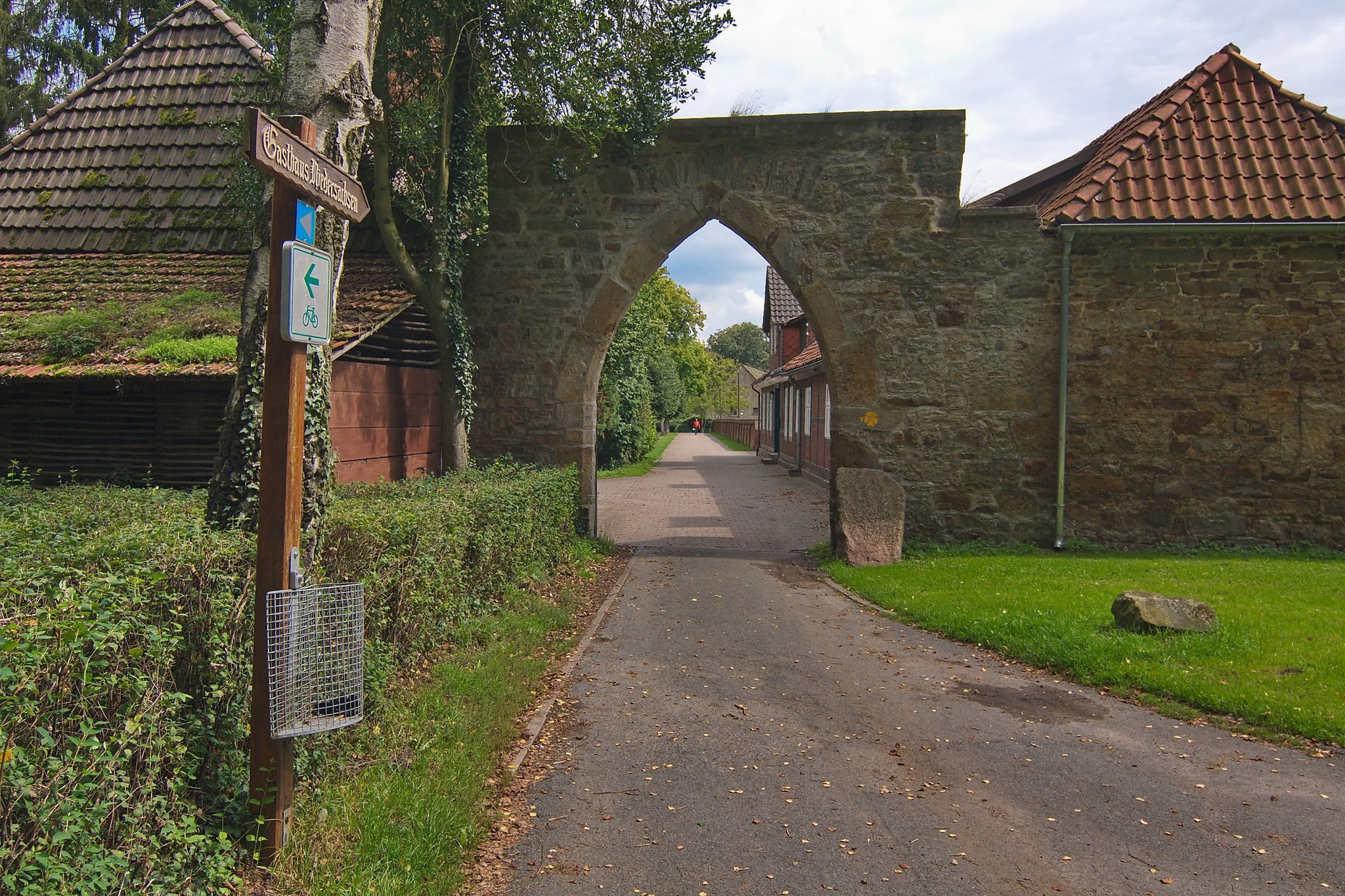
Loccum preserves a large Cistercian monastic ensemble with late Romanesque buildings, ponds, and woodland. The surviving complex includes the church, cloister, chapter house, sacristy, dormitory, refectory, library, lay-brothers’ wing, associated rooms, and service buildings. Together, these features preserve the physical organization of a monastery whose religious life was closely connected with farming and other forms of economic management.
Church and interior features
Monastery church
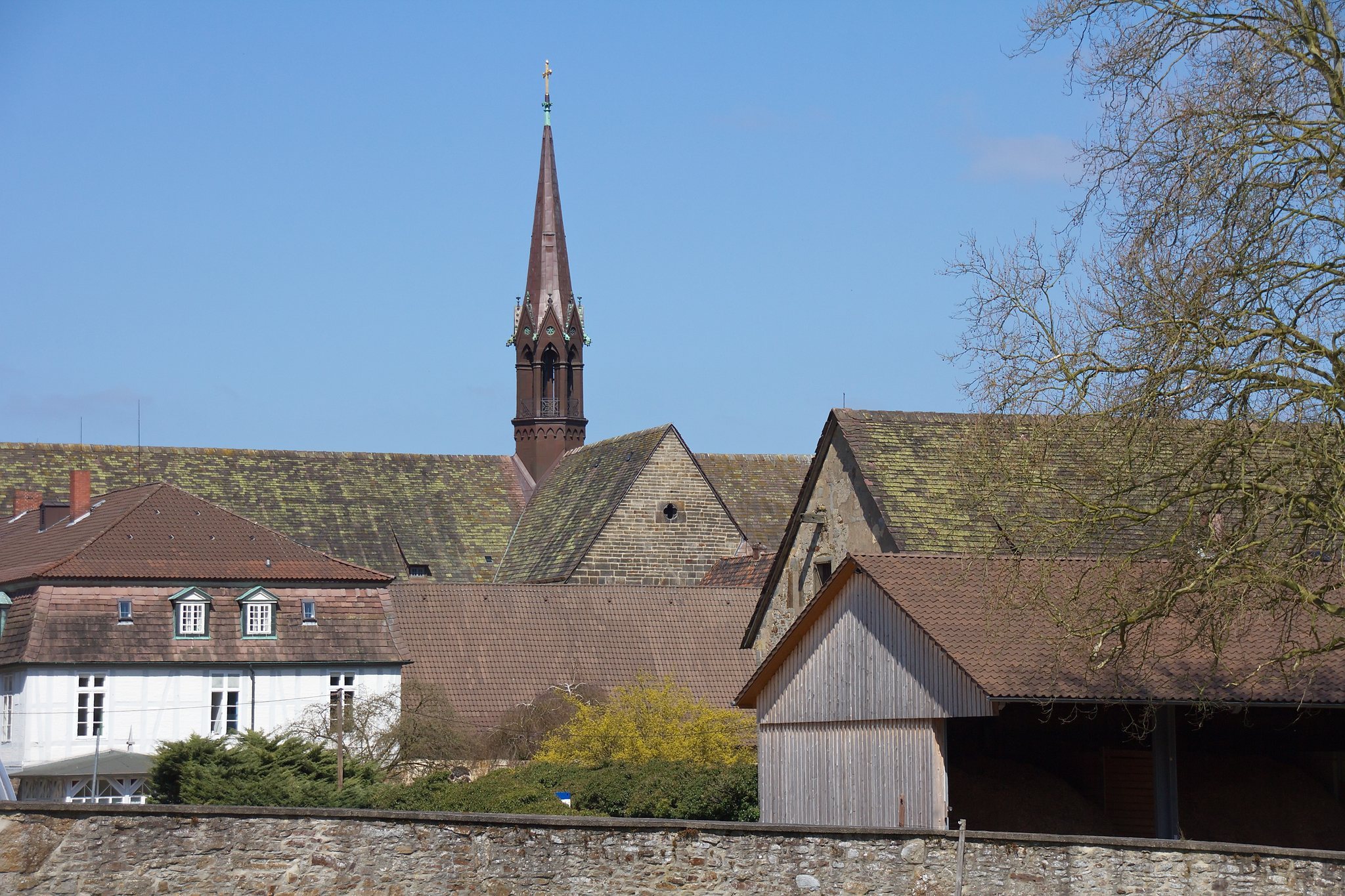
The church is dedicated to Saint Mary and Saint George and now serves as Saint George’s parish church. It is a late Romanesque building, probably begun around 1230 or 1240 and completed by 1280. Its present form remains substantially faithful to the simple Cistercian design. Romanesque architecture is characterized here by heavy masonry, rounded arches, and restrained decoration, preceding the wider adoption of Gothic forms.
Structural restoration took place between 2010 and 2012. The side chapels were enlarged and a new organ was installed. A bronze cast titled Amplexus by Werner Franzen depicts Jesus bending from the cross to embrace the kneeling Cistercian monk Bernard of Clairvaux and Martin Luther. Bernard was a major twelfth-century Cistercian abbot and reformer, while Luther’s sixteenth-century reform movement gave rise to Lutheran churches. A Renaissance baptismal font dated 1601 stands in the church and is traditionally associated with the period of Abbot Theodor Stracke, whose portrait hangs on the south wall of the cloister.
Organ and painted decoration
The church’s organ history reaches back to the fourteenth century. A larger instrument was probably constructed in 1417 with material from an earlier small organ. Andreas de Mare built another organ in 1599, which was enlarged during the eighteenth and nineteenth centuries and placed in a new case. It had thirty-two stops on three manuals and pedals before a church fire in 1947, which began in the organ motor and destroyed the instrument.
Paul Ott built a replacement in 1956, with its rear positive division completed in 1963. That organ had forty stops on three manuals and pedals. In 2011 it was replaced by an instrument from Orgelbau Romanus Seifert and Son, with thirty-seven stops and 2,414 pipes on three manuals and pedals. It has mechanical and electric playing actions, electric stop actions, and a seven-stop Spanish division using meantone tuning, playable from the first manual.
The former lay refectory contains wall paintings of biblical scenes created by Eduard von Gebhardt between 1884 and 1891. The refectory formed part of the wider monastic complex used by the lay brothers, whose agricultural and practical work supported the choir monks and the abbey’s economy.
Archaeological remains and former buildings
Luccaburg
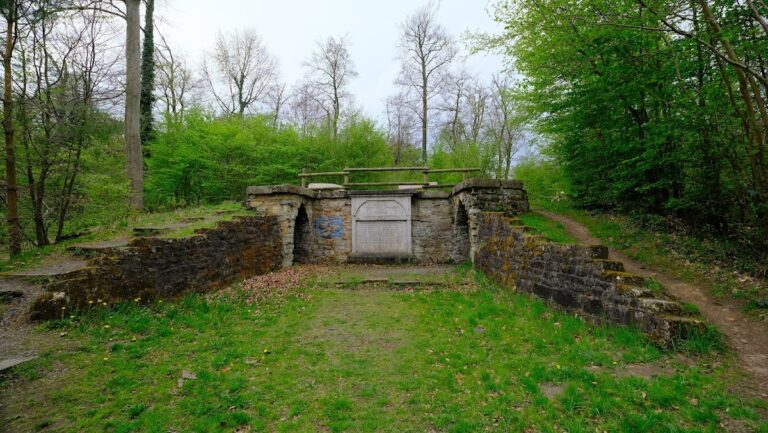
The former Luccaburg lay about one kilometre south of the monastery in the Fulde valley. It was probably a ninth- or tenth-century motte castle, a fortified site built around an elevated artificial mound. The circular mound measures about forty metres across. Investigations in 1820, 1893, and 1914 revealed a ring wall about two metres thick and nearly three metres deep, while only a small amount of its stonework remains above ground. A funerary monument erected in 1820 marks the mound of a Loccum prior and steward who died in 1818.
Medieval auditorium and water channel
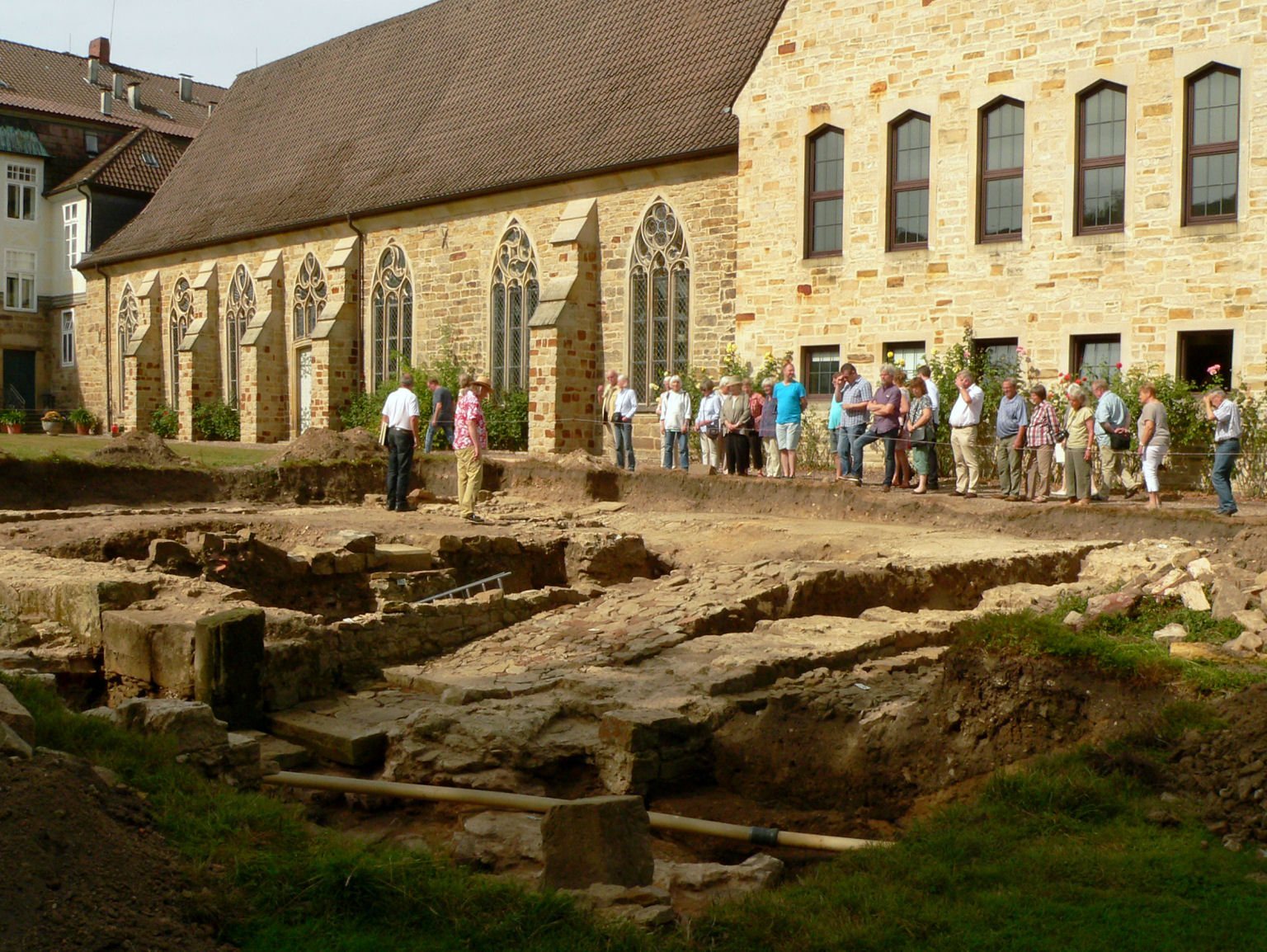
Excavations in the southeast part of the complex took place in 2014 and 2016 before a library was built in 2017. The building stands over the foundations of a medieval auditorium demolished in 1815, while the historic masonry was preserved below ground. The auditorium’s Romanesque foundations belong to a thirteenth-century building measuring approximately twenty by fourteen metres.
A barrel-vaulted masonry water channel runs beneath the auditorium from the brewing pond to the Fulde stream and remains in use. A latrine once occupied the cellar beside the channel. Around eighty centimetres of sediment beneath it yielded about 150 copper and silver coins, metal book clasps and edge protectors, buckles and appliques made from non-ferrous metal, fragments of painted and lead-glazed window glass, seventeenth-century drinking-glass sherds, tobacco pipes, and a thirteenth-century denarius bearing a bishop’s image.
Former convent house
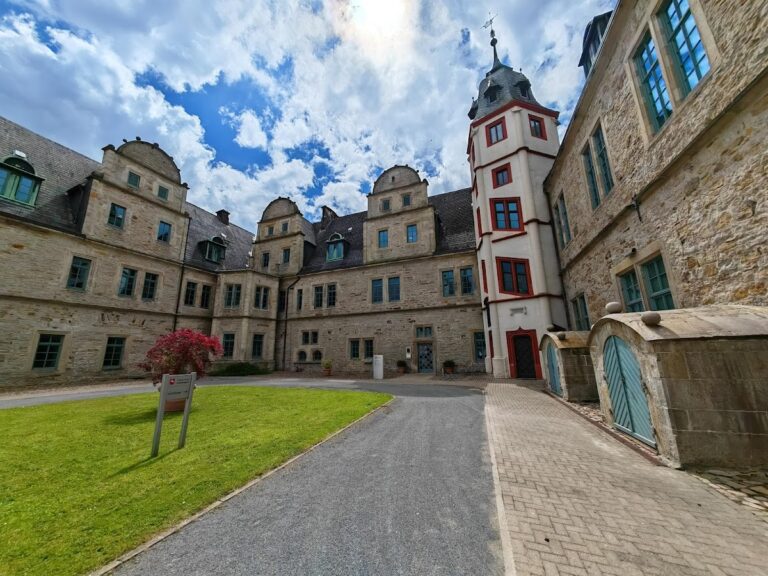
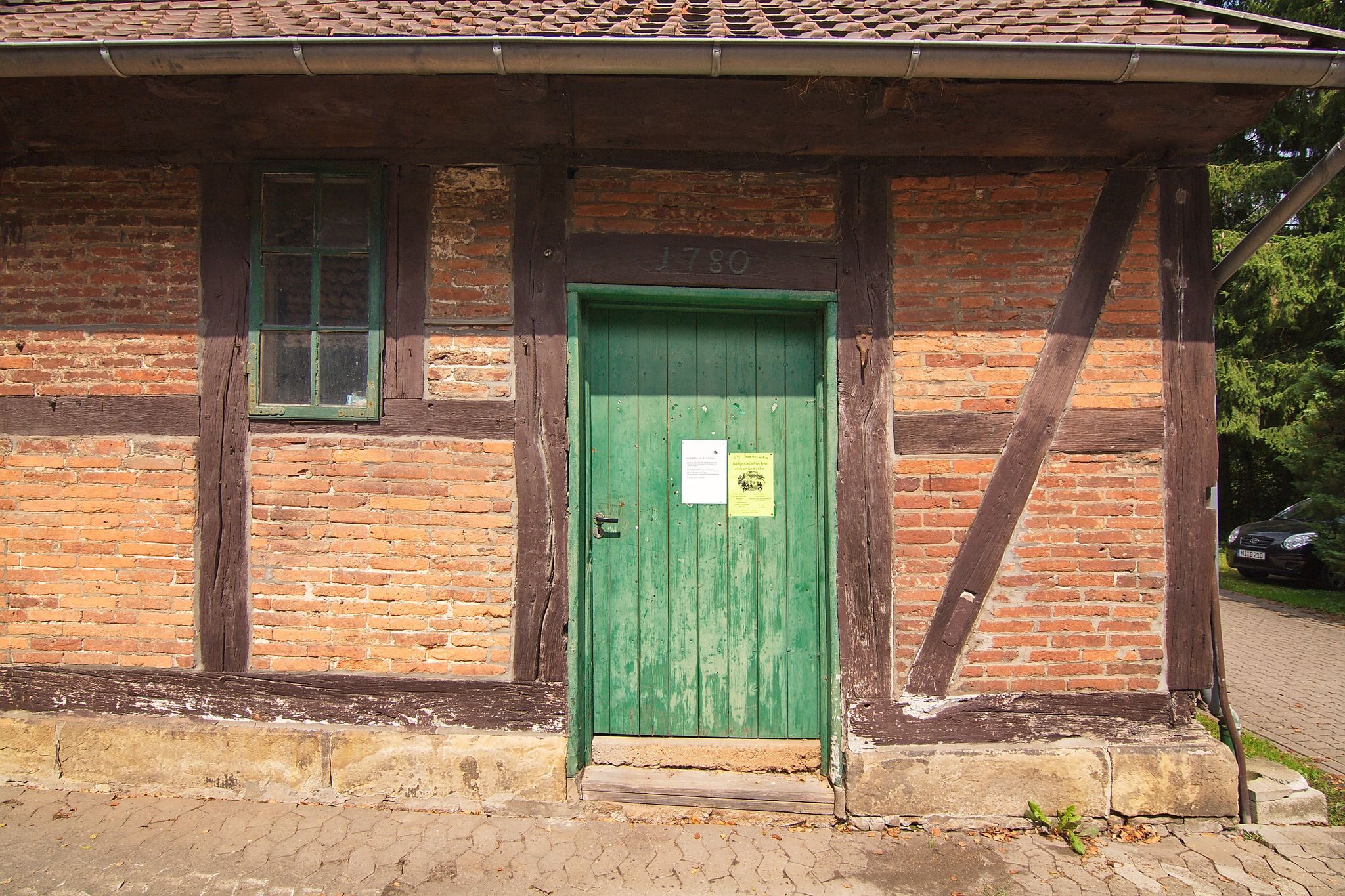
The former convent house was rebuilt between 1778 and 1780 as a substantial late Baroque half-timbered building. It forms part of the later architectural history of the complex, alongside the medieval monastic buildings and the continuing institutional spaces used by the seminary and convent.
Economic landscape and Hanover property
Monastic ponds and woodland
Ponds and woodland survive within the complex and preserve evidence of the monastery’s former agricultural and economic organization. These landscape elements belong to the material setting of the abbey’s farming system, which expanded around the monastery and into the Grinder Forest during the medieval period.
Loccum Hof
The Loccum Hof in Hanover was acquired and enlarged by the monastery for the sale of its grain. Its history as a monastic possession continued into the twentieth century, preserving a physical link between the abbey and the urban market through which part of its agricultural production was distributed.