Church of Saints Peter and Paul in Mimoň: A Baroque Parish Church in Czechia
Site at a Glance
- Rating
- 4.5
- Popularity
- Very Low
- Country
- Czechia
- Primary era
- Early Modern
- Eras represented
- Early Modern, Modern
- Civilizations
- Austrian Empire, Habsburg, Holy Roman Empire, Kingdom of Bohemia
- Site type
- Religious
- Remains
- Church
On this page15 sections
History
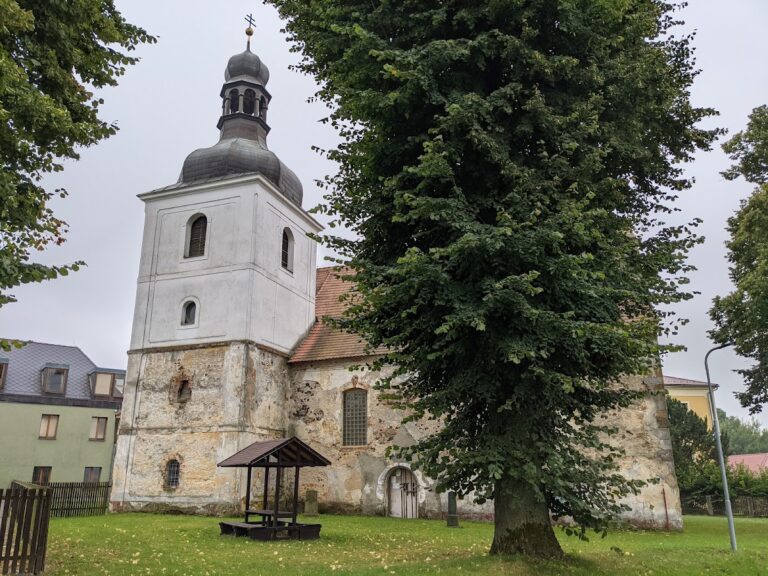
The Church of Saints Peter and Paul in Mimoň, Czechia, is a Roman Catholic parish church built in the seventeenth century in the Baroque style. It stands on a hill above the town, on the site of the former Mimoň castle, and its dedication refers to Peter and Paul, two principal apostles of Christianity. A church on the hill appears in the twelfth-century clergy catalogue of Litoměřice, while the names of its clergy are known from 1352 onward.
Medieval origins and religious change
The medieval church was accompanied by a rectory and occupied the elevated site associated with the former castle. During the second half of the sixteenth century, Protestant pastors administered the church. Roman Catholic administration returned at the beginning of the seventeenth century, restoring the building to the religious framework that shaped its later development.
The church acquired a further association with Saints Agapitus and George during the seventeenth century. Relics of the two saints were received in 1647 from the future Pope Alexander VII. Another tradition places their acquisition in 1650, when Jan Putz of Adlersthurn received them from Pope Innocent X, and says that his sons placed them in the new church in September 1663. The church consequently came to be associated with four patrons, Peter, Paul, Agapitus, and George.
The Baroque rebuilding
After 1661, the small wooden church was demolished and replaced with a stone Baroque building. Construction took place from 1661 to 1663 on the instructions of Jan Putz of Adlersthurn, the estate owner. The initial work was undertaken by the Italian builder Carlo Giuseppe Bossi. Giulio Broggio is identified as the builder of the new church, while Santini Bossi is associated with its construction leadership. Financing came from Jan Putz’s sons, Franz Edmund and Dominik Ignatz Putz.
A tower was erected soon after the church. It originally stood separately as a bell tower and was later linked to the church under Jan Ignaz Putz, Jan Putz’s son and successor. The completed complex was consecrated on 24 July 1689 by Ignatius Dlauhoweský of Longovilly, bishop of Prague. The five bells were consecrated on the previous day. The accompanying celebration lasted from 19 to 25 July and included the confirmation of 3,700 people from Mimoň and the surrounding area.
The church grounds were developed as a religious and funerary enclosure. A cemetery lay beside the west side of the church within a rectangular boundary wall. Four corner chapels dedicated to the archangels Gabriel, Michael, Raphael, and Uriel were added during the 1670s, while a fifth chapel dedicated to Saint Honory served as a mortuary chapel. A new rectory was completed in 1678.
Fire, rebuilding, and nineteenth-century changes
A town fire on 11 June 1806 badly affected the church and its surroundings. The church and the adjacent chapel burned, as did the rectory. The shingle roof and clock were destroyed, parts of the interior were damaged, and heat affected the relics. The bells melted and fell. Parish priest Josef Christoph Bothe, chaplains Anton Schneider and Franz Blasius Girschik, and the bell ringer Thum saved some ecclesiastical documents by concealing them beneath sand in the rectory cellar.
The relics were restored in Saxony and returned to the church. The building itself was reconstructed and structurally altered after the fire. It was heightened, the nave was joined to the tower, and a tiled roof replaced the earlier shingle covering. New organs and bells were obtained from Prague. A replacement clock was installed in 1831, and an additional bell was added in 1838 together with the recast large bell. Lightning destroyed all the church windows in 1838, after which a lightning conductor was fitted to the tower.
The church also received a statue of Our Lady of Loreto after the Church of the Assumption of the Virgin Mary at Svébořice was dissolved after 1948. Its bells experienced repeated replacement, repair, and requisition. During the First World War, bells were removed on 30 August 1916 and 24 July 1917 for military use and weapons production. During the Second World War, the four bells installed in 1923 were removed on 14 and 16 March 1942. Only a small bell remained for alarms and funerary signals.
Recent bell restoration and continuing use
After the First World War, a public collection raised approximately 70,000 Czechoslovak crowns for new bells. Richard Herold made a 35-kilogram funeral bell that was installed in 1921. Four bells cast by the Oktav Winter foundry in Broumov followed on 27 May 1923. Their weights were 1,396 kilograms, 614.5 kilograms, 304 kilograms, and 79 kilograms, and they first rang in memory of those killed in the world war.
Two surviving bells were rehung and mechanically modified on 23 June 2020 by Impuls-B of Ostrava-Staré Bělé. Their fixed suspension was changed to allow them to swing, and each was rotated by about 45 degrees so that the impact would be distributed across different parts of the rim. They rang after the work during a pilgrimage Mass on 28 June 2020. Two new bells cast in Italy arrived on 12 December 2022 and were consecrated on 14 May 2023 by Jan Baxant, bishop of Litoměřice. The initiative came from the parish priest, Father Richard Cenker SVD. The larger bell weighs 480 kilograms and bears Mimoň’s coat of arms; the town contributed one million Czech crowns toward their production.
The church remains a Roman Catholic parish church administered by the Mimoň parish and continues to serve for worship. On the first Saturday of September, a pilgrimage Mass commemorates the enshrinement of the patrons’ relics, whose reliquaries are uncovered during the service. The church, the Baroque rectory, and the statues beside the church are protected as cultural monuments under registration number 19644/5-3146. Together with the surviving associated structures, they form part of the Mimoň pilgrimage route established in 2007.
Remains
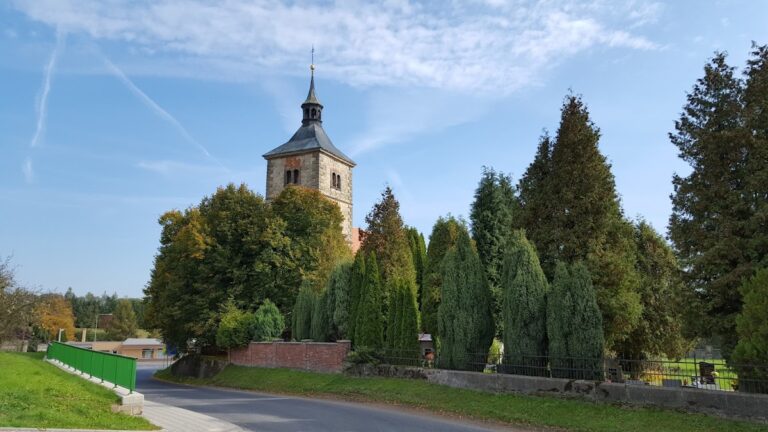
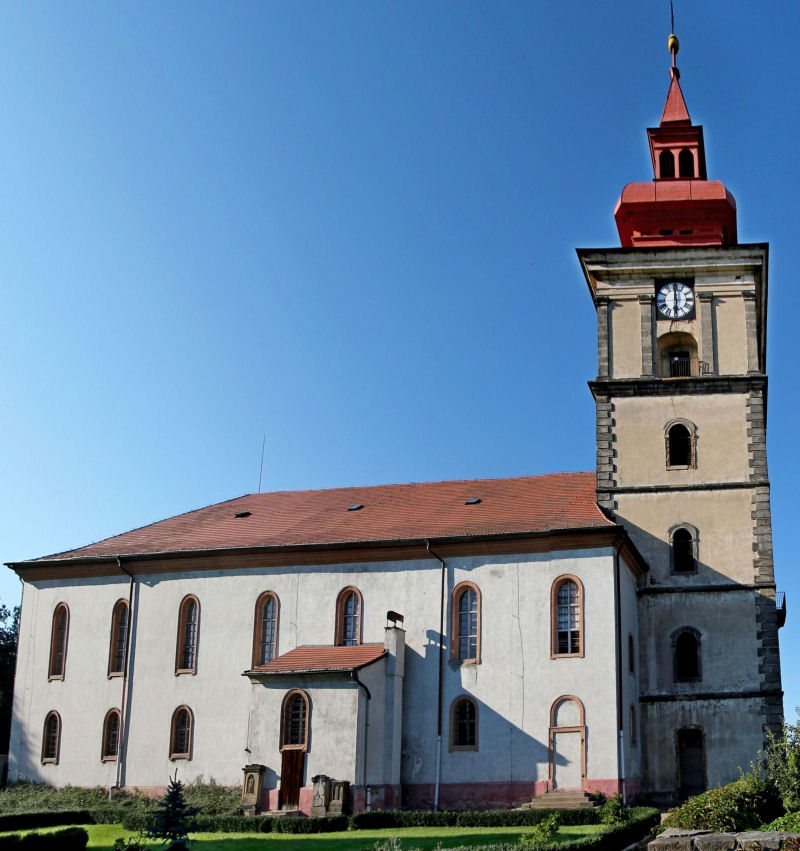
The surviving church is a Baroque stone-and-brick building on an elevated sandstone hill formerly known as Church Hill. Including the tower, it measures 48 metres in length and is 15 metres wide. The altar faces east. The church occupies the principal elevated position above Mimoň, while the tower, rectory, surviving chapel, and statues preserve elements of the wider religious complex formed around it.
Church and associated buildings
Church building
The present church belongs mainly to the seventeenth-century rebuilding of 1661 to 1663. Its stone-and-brick construction reflects Baroque architecture, a European style of the seventeenth and eighteenth centuries known for dynamic forms and elaborate decoration. The building was heightened after the 1806 fire, and the nave was connected to the tower during the same post-fire rebuilding. The church now has a tiled roof, replacing the original shingle roof destroyed in the blaze.
Tower and clock
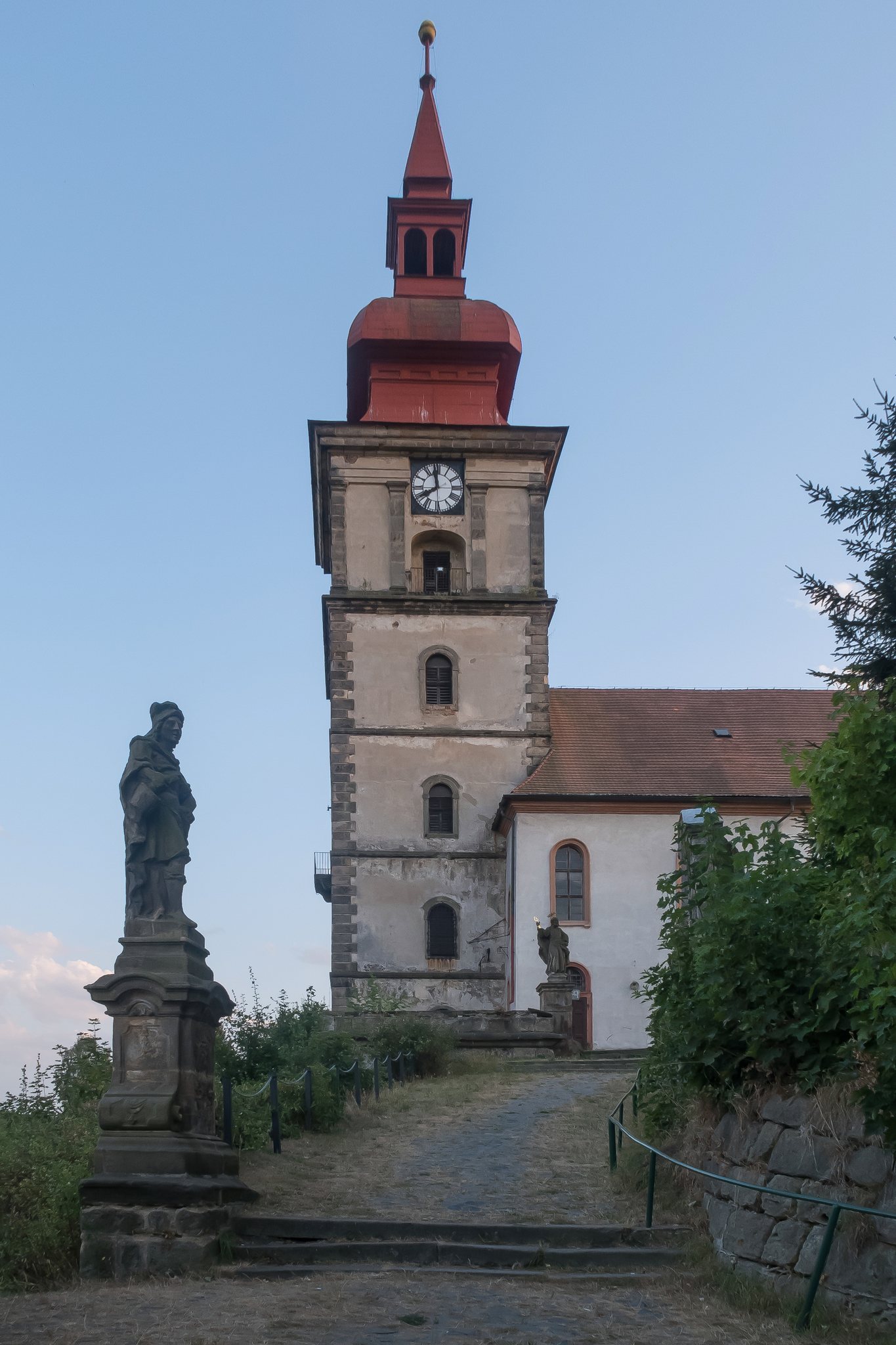
The tower began as a separately standing bell tower and was later joined to the church. A clock was installed there in 1787, but it was destroyed in the 1806 fire. The replacement clock dates from 1831. The tower also houses an electronic carillon, although it is not a true bell carillon. Its melodies are produced through loudspeakers rather than by a group of bells, and it first sounded on 27 November 2015.
Rectory and surviving chapel
The rectory beside the church dates from 1678 and forms part of the protected Baroque complex. The earlier enclosure included a west-side cemetery bounded by a rectangular wall, four corner chapels for the archangels Gabriel, Michael, Raphael, and Uriel, and a southern mortuary chapel dedicated to Saint Honory. The four corner chapels have been demolished, while the Saint Honory chapel remains. Statues beside the church and the surviving chapel are included in the associated protected complex and pilgrimage route.
Bells and bell history
Seventeenth-century bells
The bell history preserves several phases of the church’s development. Two bells were consecrated in 1655 during the tenure of parish priest David Ignatz Klehr. One, dedicated to Saints Peter and Paul, weighed approximately 219 kilograms. The other, dedicated to Saints George and Agapitus, weighed approximately 449 kilograms. Both used a combination of new metal and material from earlier bells.
A probably older bell, apparently cast in Mladá Boleslav in 1577 during the tenure of the Lutheran pastor Michael Tylenus, was installed in the new tower during the 1661 to 1663 rebuilding. It cracked at Easter 1686 and was recast in Mladá Boleslav by Jean Briquei, a bell founder of French origin. The replacement weighed approximately 1,311 kilograms and carried a Latin inscription to the Holy Trinity containing the year 1686 in a chronogram, an inscription in which selected Roman-numeral letters add up to a date.
Surviving small bell
The small bell cast in Prague by Johann Georg Kühner in 1770 bears a relief of the Crucified Christ and an inscription naming its maker and Prague as its place of casting. It probably hung from 1772 in the small roof bell turret, a structure on the roof that houses a bell, and survived the 1806 fire almost undamaged. After weighing in 2020, it was recorded at 40 kilograms with a diameter of 435 millimetres.
Post-fire bells
Five bells were listed in the completed complex in 1689, including a largest bell weighing approximately 998 kilograms. After the fire, new bells were cast in Prague by Anna Kühner, widow of Johann Georg Kühner, using new metal and material from bells that had melted. Anton Pietsch of Hvězdov donated a funeral bell in 1807. Its German inscription refers to death, human suffering, and eternity. A second bell, donated by the Mimoň-born Prague merchant Ignatz Ludwig, commemorated the town fire, while Countess Eleonora Hartig, born Coloredo and widow of Franz Hartig, donated a bell dedicated to Saint Florian, regarded as a protector against fire. She had helped fight the blaze.
The large post-fire bell developed a crack and lost its clear tone. Karl Bellmann recast it in Prague in 1837 or 1838, producing a bell of approximately 1,550 kilograms. A new Saint Joseph bell weighing approximately 296 kilograms was installed with it in 1838, and one tower window had to be enlarged to allow the bells to enter. The large bell underwent further repairs in 1871, 1878, and 1896 after failures involving its clapper, suspension strap, and bearing.
Twentieth-century bells
The 1916 requisition removed a 414-kilogram small bell and a 1,400-kilogram large bell, as well as a 48-kilogram bell from the cemetery chapel. Three more tower bells were removed in 1917. The four bells installed in 1923 comprised a 1,396-kilogram large bell, a 614.5-kilogram Marian bell, a 304-kilogram Saint Joseph bell, and a 79-kilogram small bell donated by the Catholic People’s Association. They were lifted into the tower by block and tackle on 27 May 1923.
The larger of the two bells remaining after the Second World War weighs 280 kilograms and measures 790 millimetres in diameter. It bears a relief of the Archangel Michael and identifies Anton Nowotny of Temesvar as its maker in 1913. A ring of small S-shaped openings gives it an unusual appearance described as nearly unique. Its provenance and the date when it reached Mimoň remain uncertain, and have been linked to an unconfirmed postwar oral tradition.