San Matteo al Cassaro: A Baroque Roman Catholic Church in Palermo
Site at a Glance
- Rating
- 4.6
- Popularity
- Low
- Country
- Italy
- Primary era
- Early Modern
- Eras represented
- Early Modern, Modern
- Civilizations
- Italian, Kingdom of Sicily, Spanish
- Site type
- Religious
- Remains
- Church
On this page23 sections
History
San Matteo al Cassaro is a Roman Catholic church in Palermo, Italy, standing on the historic Cassaro, now Corso Vittorio Emanuele. Dedicated to Saint Matthew the Apostle and Evangelist, it belongs to the Archdiocese of Palermo, the Catholic diocesan jurisdiction governing the church, and was built in the Baroque period between the seventeenth and eighteenth centuries. Its history reaches back to a Norman-era Basilian foundation and is closely connected with the Miseremini, a lay religious association devoted to prayer and charitable acts for souls believed to be undergoing purification in Purgatory.
Norman and Dominican foundations
A Basilian church and monastery stood on the site by 1088. The Basilian order, a family of Christian monastic communities following traditions based on the teachings of Basil of Caesarea, was transferred to the Monastery of the Most Holy Savior between 1148 and 1151. The buildings then entered another phase when Dominican friars arrived in Palermo in 1227. The Dominicans, a Catholic order associated with preaching and theological study, occupied the church and monastery after a short stay at the Holy Trinity of the Chancellor, known as the Magione.
The Dominicans remained at San Matteo until 1300. The Dominican nuns later moved to the newly established church and monastery of Santa Caterina of Alexandria. These changes established the site as a place of successive religious communities before the confraternity that shaped the present church took responsibility for it.
The Miseremini and the present church
The Opera dei Miseremini was founded at the earlier Norman church on 15 April 1559. The Miseremini confraternity itself was founded in 1603 to support the souls in Purgatory through masses of suffrage, recited from dawn to dusk. The Union of the Miseremini also collected alms for their worthy commemoration. Prayer for the dead remained the central religious purpose of the church and influenced its chapels, paintings, sculpture, burial spaces, and later ceremonial life.
Construction of the present church began in 1633 on the initiative of the Miseremini confraternity. The site had been occupied by a palace belonging to the jurist Mario Muta, who donated it for the religious foundation. The Franciscan friar Leonardo Galici guided the project, while Mariano Smiriglio, architect of the Senate of Palermo, probably prepared the design. Archbishop Giannettino Doria blessed the foundation stone on 2 June 1633.
Archbishop Fernando Andrade Castro consecrated the church on 12 March 1647, although building work continued until 1664, when Gaspare Guercio and Carlo D’Aprile completed it. The main facade was finished in 1662. During the eighteenth century, the confraternity’s donations and bequests enabled a progressive enrichment of the interior. Local artists carried out extensive decorative work over several decades, and the church was reconsecrated in 1775.
Burials, worship, and later events
Members of the Miseremini confraternity were buried in the crypt from 1714. Burial in Palermo’s churches ended under a law of 1787, later extended to rural churches in 1864, and the earlier burials were subsequently transferred to common ossuaries. The crypt had contained the remains of Giacomo Serpotta, Vito D’Anna, Olivio Sozzi, members of the confraternity, and members of its associated company. Those remains are no longer in their original individual locations.
San Matteo remains connected with Palermo’s religious calendar. On Holy Thursday, a representation of the Last Supper is displayed at the high altar. On Good Friday, the confraternity organizes a major procession through Palermo’s historic centre, while the church’s confraternities take part in the city’s wider Holy Week rites. A commemoration of the dead is also held on 2 November.
The church is associated with the Beati Paoli, figures from a long-standing Palermo legend traditionally portrayed as a secretive brotherhood linked with underground passages and clandestine justice. A concealed opening behind a kneeling desk in the sacristy is traditionally identified as an entrance to a passage used by them. The legend says that their discovery at San Matteo forced them toward the area of the Kemonia river. The historical existence and use of the passage remain matters of legend.
The Oratory of the Miseremini, established above the sacristy in the seventeenth century, was damaged by bombing during the Second World War. The bombing affected statues of Clemency and Faith made by Giacomo Serpotta in 1728, and their heads are now preserved in the Diocesan Museum of Palermo. Many artworks in the church have suffered general neglect and require restoration, while the crypt is described as being in very good condition.
Remains
Facade and overall plan
Baroque facade
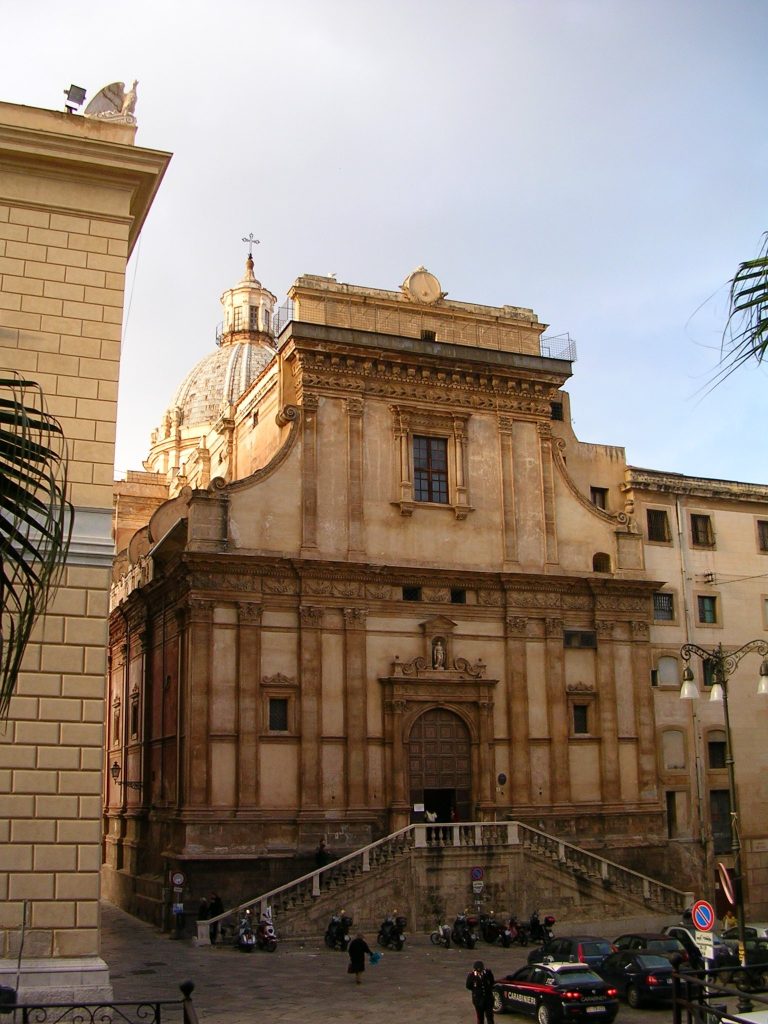
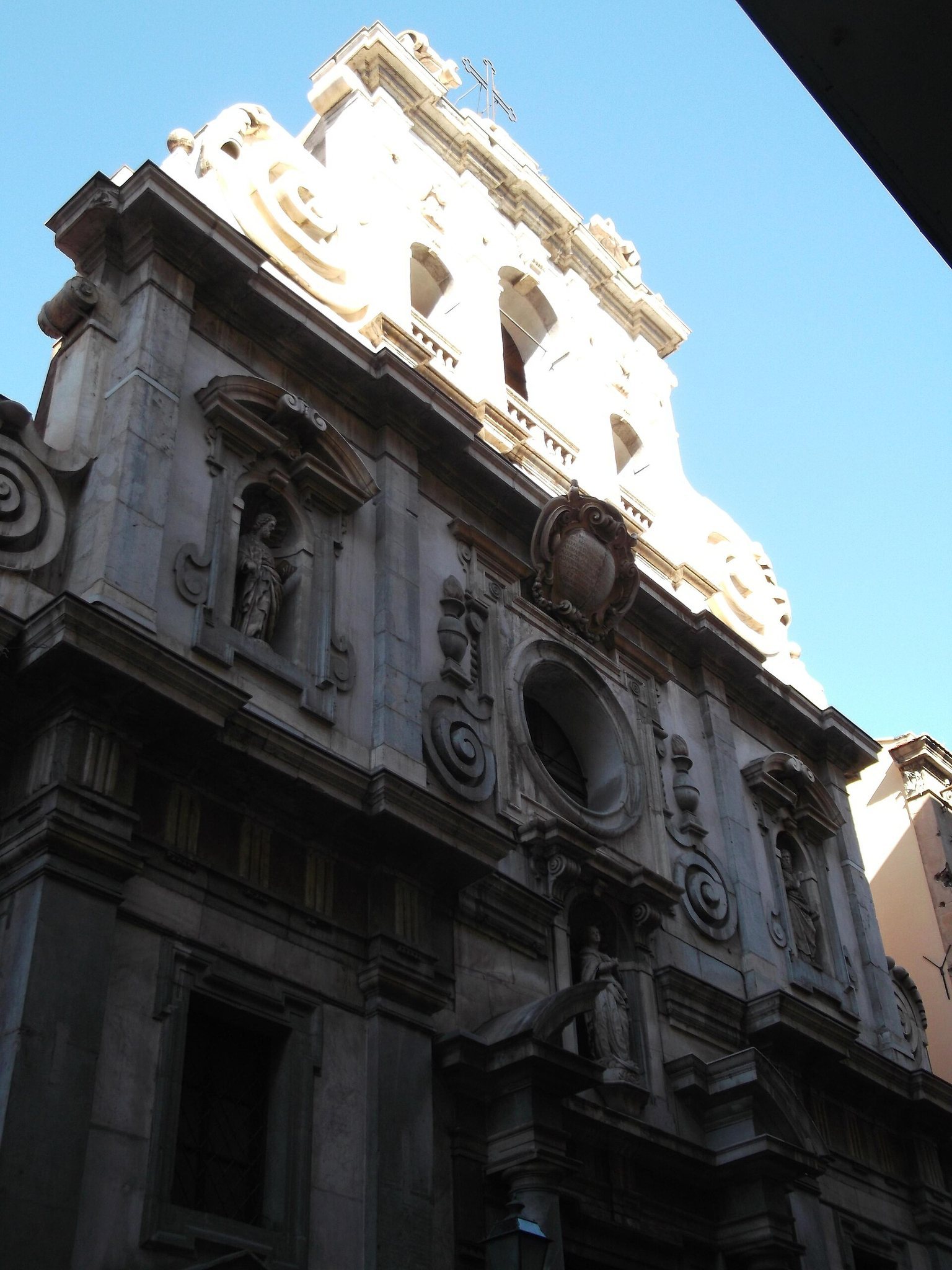
San Matteo faces the Cassaro with a three-level Baroque facade built from grey marble quarried at Monte Billiemi. Completed in 1662, it combines pilasters, niches, windows, volutes, brackets, and elaborate cornices in a carefully ordered composition. The three principal niches contain the Virgin Mary at the centre, Saint Matthew on the left, and Saint Matthias on the right. The architectural and sculptural work is attributed to Carlo D’Aprile and Gaspare Guercio.
The lowest level has six pilasters, with the four inner members projecting farther forward around the two side windows and the main entrance. The portal is framed by Doric columns and crowned by a broken double-arched pediment. Its intermediate niche contains a statue of the Virgin. Above the complex cornice, four pilasters frame two side niches with arched pediments and a large oculus, a circular window. An inscription, volutes, brackets, and vases complete this middle level. The upper order has three arched windows with balustrades, enclosed by two pilasters, while large spiral volutes connect the levels at either side.
Church plan
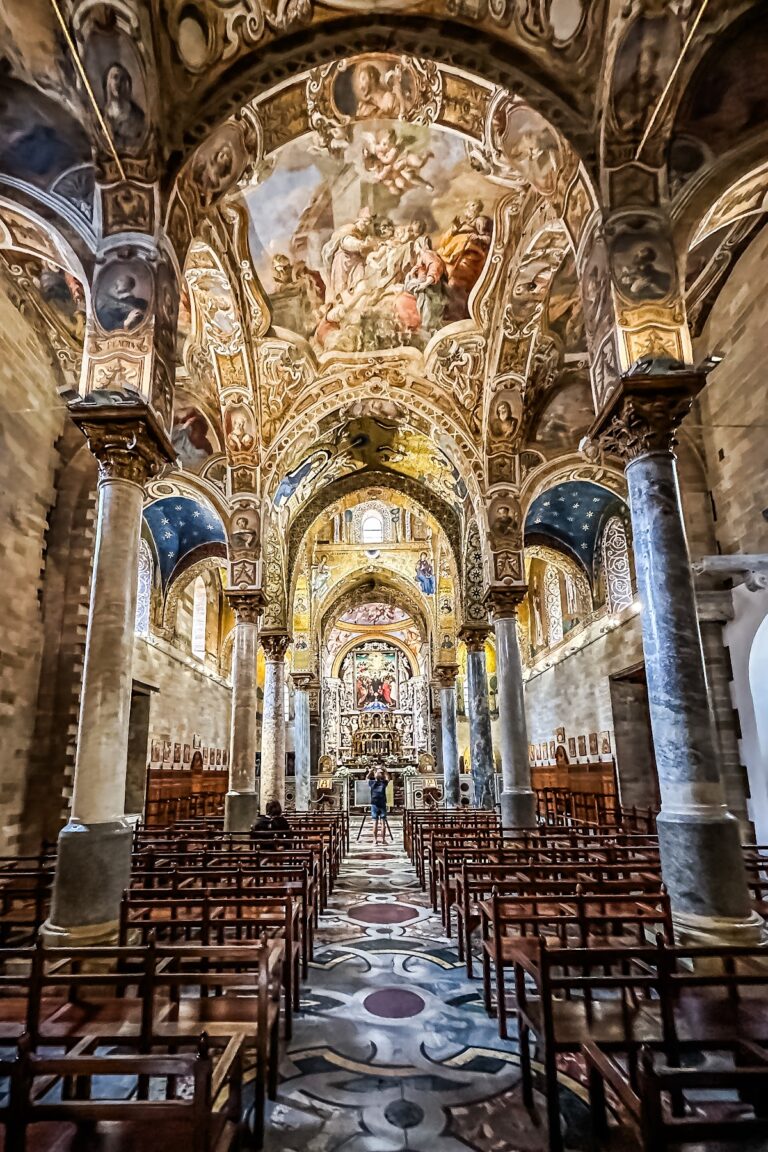
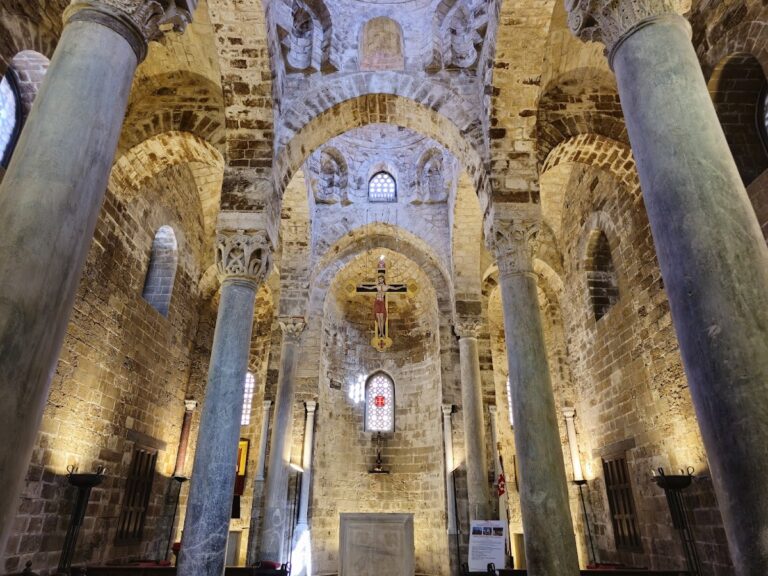
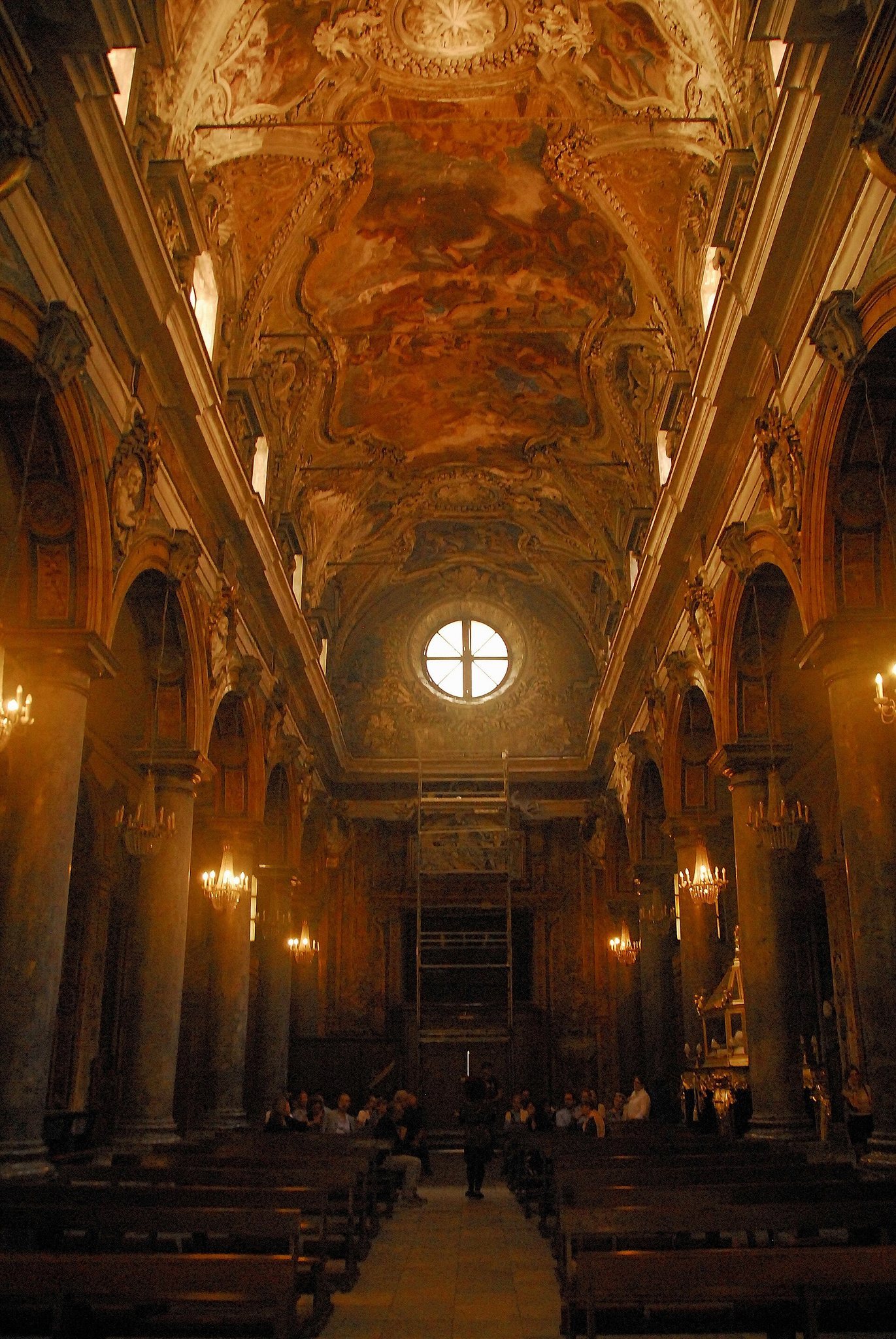
The church measures approximately 35 metres in length and 18 metres in width. Its plan is a Latin cross, with a long central axis crossed by a broad transept, and ends in a square-ended apse. Inside, two rows of seven grey Billiemi-stone Doric columns, installed in 1640, divide the building into three aisles. Semicircular arches rest on the columns, and the lateral aisles open onto ten chapels.
Nave, dome, and painted decoration
Nave and side chapels
The ten side chapels have vault frescoes from around 1760 by Gaspare Giottino and Crispino Reggio. Their walls are covered with polychrome marble revetment, an architectural technique that combines differently coloured marbles into patterned surfaces. Each chapel has a rear altar with an eighteenth-century marble frontal. The arches also carry polychrome marble, while gilded-stucco medallions in the pendentives show half-length figures of the twelve Apostles. These medallions are attributed to Bartolomeo Sanseverino, a pupil of Giacomo Serpotta.
At the entrance are two La Grassa holy-water stoups, installed in 1992 to replace eighteenth-century examples stolen in August 1990. Paintings throughout the church include works by Pietro Novelli, Leonardo Balzano, Filippo Randazzo, Antonio Manno, and Giuseppe Testa.
Dome and vaults
Four piers support the dome, which rises over an octagonal drum lit by eight large windows. Its curved inner surface carries Vito D’Anna’s signed fresco, The Triumph of the Name of Mary. The dome and vaults were frescoed in 1754 by D’Anna and members of his workshop. The central nave contains The Apotheosis of Saints Matthew and Matthias and The Liberation of the Souls in Purgatory. The left transept vault shows The Glory of Saint Gregory, while the right depicts The Expulsion of Adam and Eve from the Earthly Paradise and Christ the Restorer.
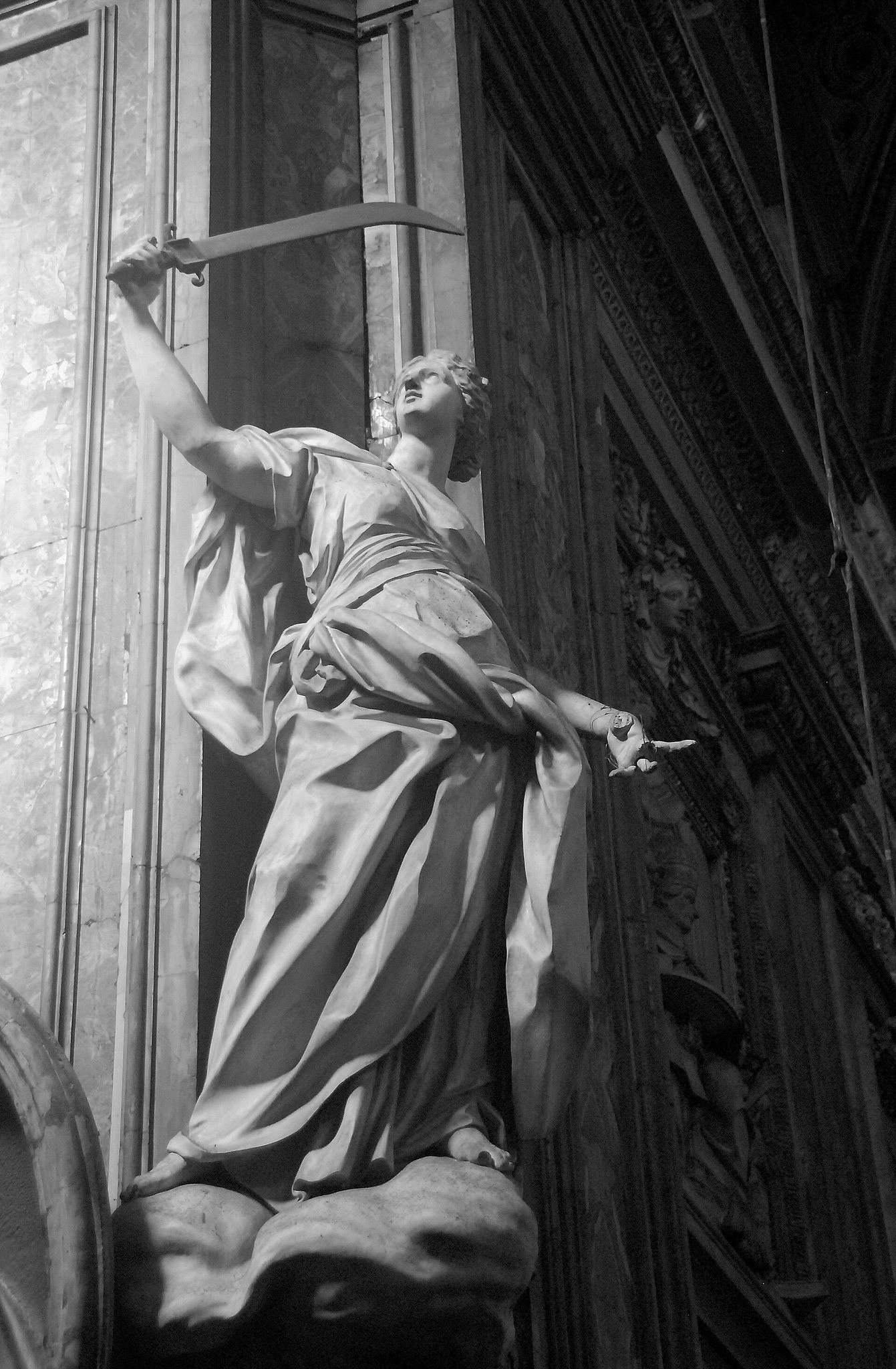
Allegorical figures beside the dome’s supporting piers represent the theological virtues. Giacomo Serpotta made Faith and Justice from designs by Francesco Ferrigno, while Bartolomeo Sanseverino made Hope and Charity. On the triumphal arch, three angels carry a large cartouche in a stucco group by Serpotta dated 1728. The high-altar pediment contains another group by Serpotta, with two female figures representing Faith and Prayer.
Entrance and counterfacade sculpture
In the lunette, two seraphim flank the Agnus Dei, or Lamb of God, lying on the sacred book bearing the seven seals of the Apocalypse. The counterfacade contains Serpotta’s 1729 relief Christ and the Souls in Purgatory. Female allegorical figures framed by stucco garlands are represented in frescoes by Francesco Sozzi.
Chapels of the nave
Right-hand chapels
The first chapel on the right is dedicated to the Immaculate Conception. Its altarpiece by Rosalia Novelli shows the Immaculate Conception with Saints Ignatius of Loyola and Francis Xavier, a Dominican nun, and a young figure identified as Saint Rosalia. The second chapel is dedicated to Saint Francis of Paola and contains an eighteenth-century Palermo painting of the saint by an unidentified artist, set in a marble frame beneath a cherub.
The third chapel, dedicated to the Annunciation, contains an Annunciation attributed to Pietro Novelli or his school. It is set within a marble cross and surmounted by a shell. The fourth chapel is dedicated to Saint Bonaventure and contains Novelli’s Presentation of Jesus in the Temple. In front of it stands a processional image of Our Lady of Sorrows, carried on Good Friday, while an Ecce Homo bust rests on the altar table.
The fifth right-hand chapel is dedicated to the Virgin of the Rosary. Restoration work revealed that its painting dates to 1676, replacing earlier attributions to Filippo Paladini and Filippo Randazzo.
Left-hand chapels
The first chapel on the left is dedicated to the Guardian Angel and contains an angel painted by an unidentified artist. It also holds the late-eighteenth-century-style monument of Canon Rosario Gregorio, the chaplain-major and an important Sicilian historian, together with a funerary monument to Giuseppe Vella bearing a Neoclassical allegorical medallion.
The second chapel, dedicated to the Holy Family, contains paintings of Jesus, Mary, and Joseph, including a 1796 Holy Family attributed to Giuseppe Testa, as well as a Saint Michael the Archangel. An inscription beneath the altar identifies the original tomb of Fra Leonardo Galici, although his remains were later moved. Beneath the altar table is an urn containing the dead Christ, belonging to the Confraternity of the Disabled and carried in the Good Friday procession.
The third chapel is dedicated to Maria Santissima of Trapani. Its marble altar statue of the Madonna and Child comes from the Gagini school. Reliefs of the Souls in Purgatory and Saint Michael the Archangel decorate the pedestal, accompanied by small devotional statues of Saint Rita and Saint Anthony of Padua. Wall plaques commemorate Bernardino Serio in 1640 and Marco Gezio in 1649.
The fourth chapel is dedicated to Saint Anne and contains Pietro Novelli’s Marriage of the Virgin and Saint Anne, dated 1647. Francesco Crispaldi commissioned the painting in 1642, as stated by the inscription beneath it. The fifth chapel is dedicated to Saints Matthew and Matthias. Its 1788 altarpiece by Antonio Manno, a pupil of Vito D’Anna, depicts the two titular saints. The chapel also contains a plaque of the Union of the Miseremini listing affiliates under Ferdinand III of Bourbon and Francis I of the Two Sicilies, together with Manno’s Jesus Christ and the Souls in Purgatory.
Transepts and presbytery
Right transept
The right transept contains the Chapel of the Crucifix. Its altar holds a large gilded wooden reliquary, a container for a relic or sacred object, enclosing a wooden Crucifix. A yellow-marble medallion bears the bust of Don Camillo Barbavara, a chaplain-major and notable seventeenth-century Palermo goldsmith. The chapel also contains statues of Our Lady of Sorrows and the scourged Christ, together with a painting of Saint Basil the Great by Zoppo di Gangi.
Left transept
The left transept contains the Chapel of Saint Gregory. Its altar painting, Saint Gregory Celebrating Mass, was made by Leonardo Balsano in 1615. Beneath the altar is a glass-closed urn containing the recently made statue of the Dormitio Beatae Mariae Virginis, popularly called the Assumption of the Virgin. The altar also holds the highly venerated statue of the Christ Child as Shepherd of Souls.
On the Epistle side, a yellow-marble medallion contains a white-marble bust of Mario Muta, who donated the house used for the church’s construction. The association between the donor and the building is thus preserved within the transept’s sculptural decoration.
Presbytery and high altar
The presbytery is enclosed by a marble balustrade with two finely worked gilded-copper doors. The doors originally carried images of Saints Matthew and Matthias by Battista Serpotta, dated 1643, but those images have been removed. A wooden altar facing the congregation has a carved base showing the Last Supper, and a nearby wooden ambo, a raised stand for readings, bears the symbols of the four Evangelists.
The high altar is faced with polychrome marble, Sicilian agates, and lapis lazuli. Gaspare Firriolo made its gilded wooden reliefs of biblical scenes, while Filippo Cinistri carved the gilded reliefs on the frontal from a 1798 design by Giovanni Cadorna. The altar contains Giuseppe Testa’s 1796 painting of the Trinity and the Souls in Purgatory.
The tabernacle takes the form of a small temple surrounded by columns. Its cupola, door, and plaque bearing the words Ecce Agnus Dei are made of lapis lazuli, while the capitals are gilded wood. Six small statues that decorated the tabernacle were stolen in 1970, together with four gilded wooden angels that supported the altar table. The side walls contain four marble-framed doors surmounted by reliefs of the Doctors of the Church, Gregory the Great, Augustine, Jerome, and Ambrose. These reliefs are attributed to Vincenzo Siracusa, a pupil of Ignazio Marabitti.
Sacristy and Miseremini Oratory
Sacristy
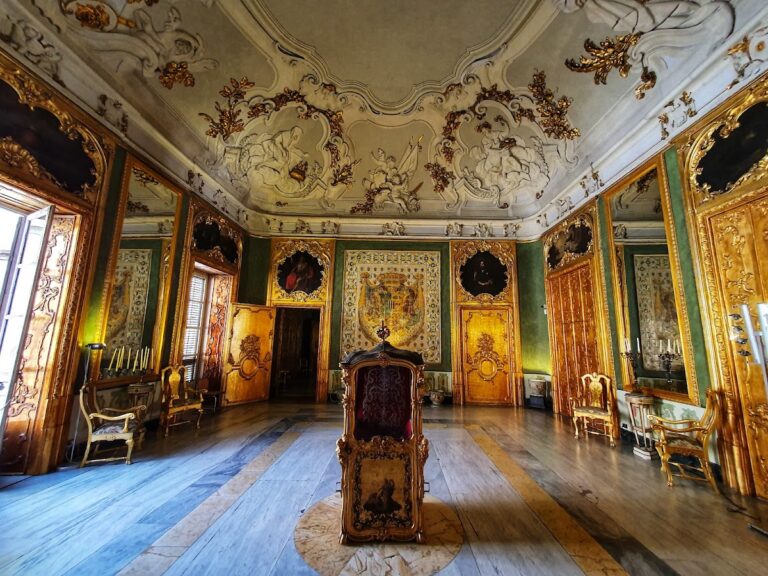
The sacristy and its two antechambers have wrought-iron choir galleries and a gilded wooden organ made by Giuseppe Lugaro in 1871. Large walnut cabinets carved by Pietro Marino in 1738 line the sacristy. Their doors originally carried small wooden statues of saints from the Old and New Testaments. Oval and round medallions with garlands and half-length figures of souls in Purgatory decorate the walls, while carved wooden busts of popes and bishops once stood above the cornices.
A theft around August 1990 removed the small wooden sculptures, three cabinets, and an eighteenth-century carved table. Some sculptural elements and paintings formerly in the sacristy are preserved in the Diocesan Museum of Palermo. The vault and walls retain frescoes, including a central composition attributed to Filippo Randazzo and dated 1742. It depicts Judas Maccabeus collecting 12,000 silver drachmas and sending them to Jerusalem as an offering for sacrifices for the sins of the dead.
Two nearby oval medallions show groups of angels holding cartouches that summarize the reasons for Judas Maccabeus’s action and Saint Paul’s words to the Corinthians concerning collections for fellow believers. Other sacristy paintings, dated 1741, are by the priest Giovanni Macula, who decorated the room without payment because of his attachment to the church. A large Crucifix, formerly placed on an altar, stands beneath an elaborate canopy between the cabinets.
The sacristy occupies the former garden of Mario Muta. On the opposite side of the altar, a classical-style area has two columns supporting an arch and a matching fountain. The marble angel that once poured water from the fountain was stolen in 1990. The concealed doorway behind a kneeling desk is traditionally linked with the Beati Paoli passage.
Miseremini Oratory
The Oratory of the Miseremini lies above the sacristy. Its facade retains an arch from a seventeenth-century loggia and a crowned coat of arms depicting a soul in Purgatory above the entrance lintel. On the counterfacade is a 1739 marble high relief of the Pieta by Lorenzo Marabitti.
Second World War bombing damaged the room and the statues of Clemency and Faith made by Giacomo Serpotta in 1728. Their heads are preserved in the Diocesan Museum of Palermo. The oratory’s surviving structure and decoration remain part of the physical record of the Miseremini’s devotional presence above the sacristy.
Crypt
The crypt lies beneath the central nave. Its marble burial niches have headrests arranged in superimposed rows. The space served as the burial place of confraternity members and other notable figures, including the people associated with the Miseremini’s religious community. Later, the individual remains were moved to common ossuaries, while the crypt itself remains in very good condition.